
Pin It

Join almost 1/2 million
monthly
readers!

Contact Me

Coaching and Consultation

Current mission

Reactivate my
forgotten Hungarian
for Budapest visit

Previous post:

Next post:

Learning Dutch after German (and English): What are the differences?

| 113 comments | Category: particular languages

Dutch is a fascinating and unique language, and you can find many good introductions to it online. (See the links at the end of this page for a nice collection of resources).

What can be most interesting about the language is how it is one of the closest in the world to English, while also being in the same language family as German. So if you speak both you will clearly have a huge advantage. Linguistically, it’s more or less half way between the two (while leaning more towards German).

Saying that it is just a mixture between the two is terribly inaccurate though; there are many unique aspects of the language that set it apart, and in today’s post I want to discuss the similarities and the differences.

But the similarities certainly give you a huge advantage! For example, I don’t think I could have pulled off 25 completely unique speed dates and a professional interview just over a month after starting to learn most languages. I hate it when people dwell on difficulties and become cry babies that they have to learn the “hardest” language in the world, but I am also quick to jump on any advantages I have when learning particular languages, and I certainly had them with Dutch!

I could progress very rapidly into speaking Dutch comfortably thanks to these advantages! I had aimed for fluency in two months and I didn’t reach it, but that is due to cultural issues leading to lack of consistent intensive speaking opportunities that I’ll be discussing in another post, not difficulties with the language.
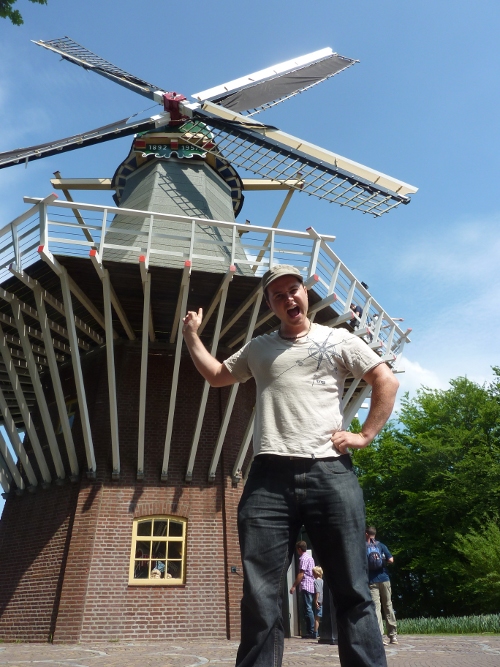
As “English” as a foreign language can get

What strikes me immediately as making Dutch stand out is how many similarities it has to English, especially if you think in terms of older Shakespearian English, and even Irish English. I’d also pronounce the as de and add in an extra syllable to the word film, and even random other things like conversationally (pejoratively) say “whore” as “hoor” (same pronunciation as in Dutch hoer).

Also, some dialects of Dutch have an exact replica of the English R! This combined with a strange antiquated version of English, almost makes it seem like they are speaking English sometimes as they pass you quickly in the street! (Although I never used this R as part of my strategy to make sure they wouldn’t speak English with me). This is only at the end of syllables, never at the beginning!

You will see “OPEN” in shop windows, as this is simply how it’s written in Dutch (it’s not copying English, it’s just the same word in both languages), although it’s pronounced differently.

People say Sorry (although this one could in fact be an English borrowing; it’s used both to indicate that you didn’t hear what was said and as an apology if you ram your bike into someone else’s in the middle of an intersection), and there are (as in other European languages) many loan words directly from English. However some native Dutch words sound and mean the same thing, like “do” (written “doe”) and “since” (written “sinds”). Many words are written the same, but pronounced differently (like week).

In fact, by taking any typical Dutch text and using your imagination a little like changing some vs to fs, removing double vowels and adding -e to the end occasionally (such as maak –> make), changing gs at the end to ys (vrijdag) and a few other tweaks, you could almost guess from the context what is being discussed, even without German to help! You’d need a lot of imagination though!

If it hadn’t been for the Norman conquest of England (Frenchifying English vocabulary quite a lot), Dutch and English would likely be mutually intelligible along the lines of Spanish and Portuguese.

Head-start with German

But at the end of the day, what really made Dutch make lots of sense for me right from the start was the fact that I speak German (at the C2 level).

I could communicate so much better than I usually do when I start a new language (since speaking from day one is always my priority) because I had a vast amount of vocabulary and a lot of the grammar structures (such as second verb to the end of the sentence, main verb always in second position, general order of the phrase is Time, Manner then Place etc.)

Listing all of the similarities would be somewhat pointless because there are so many of them. So many in fact that German and Dutch are mutually intelligible (to a point).

There are certain complications that are not there in Dutch, which could make it comparably easier, however I think the scale of “difficult languages” is too superficially presented by too many people. Yes, the grammar and vocabulary are easier in Dutch than in German, however I found it easier to learn German in Berlin.

In my opinion if I had started both from absolute scratch (no school background, and not having the other one already), I would have learned German quicker in Berlin than Dutch in Amsterdam because of the cultural differences, which people ignore far too quickly in cold humanless point by point comparisons. (This says nothing about learning German or Dutch in other cities or countries though).

But since I found it hard to actually find one of those point-by-point comparisons, I thought I’d create one myself to give you a little list of what struck me as the most obvious differences that stood out!

[Note that apart from somewhat regular conversations, I also learned my Dutch from the same books that I usually use for other languages, as described and linked to on this site's language learning resources.]

Differences between Dutch and German

  • G is always guttural. In German G is like in English go (never like in general) but in Dutch it’s usually the guttural sound like the ch in loch.
  • Also ch is guttural in exactly the same way (in the Netherlands, not in Belgium), but has various possibilities in German depending on the dialect.
  • Different vowel sounds. I was warned about this, but told that I could actually mimic the ui sound pretty accurately when I was focused. (It’s like “oy” but said in the front of your mouth)
  • Quite different spelling rules. In Dutch you must never end a (non-loan) word with two of the same letter. Even though ga (to go) has an “open” a sound you cannot write it as gaa. And wil (want, as in German) cannot be written as will. Also ‘c’ is used in Dutch at the start of words (corrigeren, certificaat etc.), and only ever done so in loan words in German.
  • Capital (uppercase) letters follow more or less the same rules as in English (with some exceptions like days of the week), unlike German which capitalises every noun.
  • Different phonetics. oe is the “oo” sound in Dutch (like in English boot), sj is the English “sh” sound (unlike in German sch), and somewhat confusingly for German speakers, sch is simply an s sound followed by a (guttural) ch sound (So Amsterdam’s well known airport Schiphol is S-[guttural]-ip-hol), w is almost like half way between a German and an English w (v & w) depending on the dialect. And n at the end of words/syllables is not pronounced in many dialects. So verbs like lopen, spreken, gesproken, ziekenhuis etc. are [lope, spreke, gesproke, ziekehuis].
  • Easier plurals. In German, the irregular and quite varied plurals can be quite difficult for learners, but in Dutch it is consistently -en or -s, and the rules for which to use are easy to learn.
  • Only two “genders”. German has masculine, feminine, neuter. Dutch has common and neuter, where common simply corresponds to both masculine and feminine. If you already speak German, this means that most of the time if you know the article in German you know it in Dutch (das Haus –> het huis). However, since common is twice as likely you can get by pretty well at first by guessing it will be common until you have learned which words are neuter. And indefinite (a/an) is always “een”. [Edit: one exception to masculine & feminine basically being the same for nouns that was pointed out in the comments is when referring back to nouns using the possessive, such as "De regering en haar leden" however most Dutch people do not apply this themselves. Belgians on the other hand may do it.]
  • No cases! This one is great news for learners, as it operates exactly like in English, with no cases ever applied to articles, adjectives or nouns. In German you have tables of der, die, das… den, die, das… dem, der, dem etc., but in Dutch it’s always just de & het (plural always de). No need for accusative, dative, genetive etc. In het huis, over de computer.
  • Lots of turns of phrase: today/tonight/this morning are all phrased as “van” (of) the word. Vanavond, vannacht, vandaag, [From avond, nacht, da(a)g] and of course many other expressions and a lot of vocabulary will be totally different.
  • Use of gaan for future. Like in English you can say “go to” to express the future in Dutch. This is not possible in German, where present tense (plus context) or future “werden” (will) is used.
  • Verbs ending in -eren require a ge- prefix in the past, unlike their corresponding -ieren verbs in German. So noteren –> genoteerd, activeren –> geactiveerd
  • Different end-verb orders. While the second verb does go to the end in a lot of situations in both languages, Dutch is a lot more like English in some cases of the order of these end-verbs, like Hij komt niet, omdat hij vandaag moet werken (He is not coming, because he has to work today). In German this would have to end with arbeiten muss, which is reversed. Also in Dutch, in some cases you can do both, while you must do only the second form in a similar German sentence: Zij zei dat ze het niet (heeft gevonden)/(gevonden heeft) (She said that she hasn’t found it).

Now of course, there are a huge number of differences between both languages, the vast majority of which I haven’t touched on here. Each language is very unique, with its own history and evolution from when they broke up from a common ancestor.

There is no way I can summarise all the differences, or even a considerable percentage of them in a small article like this. But I hope this superficial look over the major differences that stood out for me in my short time learning Dutch in Amsterdam will help others!

If there are other differences that stand out for you, or if you have any thoughts on the Dutch language itself, share them with us in the comments below!

***********************

Enter your email in the top right of the site to subscribe to the Language Hacking League e-mail list for way more tips sent directly to your inbox!

If you enjoyed this post, you will love my TEDx talk! You can get much better details of how I recommend learning a language if you watch it here.

This article was written by

Comments: If you liked this post or have anything to say, please leave a comment! I love reading them :)
Just keep in mind that I’ll delete any rude, trolling, spammy, irrelevant or way off-topic comments. If you have a general language learning question, please ask it in the forums. Otherwise please use the search tool on the right for any other question not related to this post.

———————————–

  • http://www.facebook.com/profile.php?id=1344572200 Lisa Mos

    Nice post. :) It’s Schiphol though, with an H.

    • http://www.fluentin3months.com/ Benny the Irish polyglot

      Corrected to add second h.

    • http://www.fluentin3months.com/ Benny the Irish polyglot

      Corrected to add second h.

  • Hester

    Nice post. :)
     
    Just a few minor comments:
    1. The “G”and “CH” are usually but not always gutteral. There are some loanwords such as ‘gene’, ‘champignon’ or ‘champagne’ where they are pronounced differently.
    2. Dutch does not have a ‘common’ and ‘neuter’ gender but has, like German ‘masculine’, ‘feminine’ and ‘neuter’. Unlike German however, it is only pronounced in indirect references such as: Het kabinet en haar leden.
    3. Bear in mind that vowels, the ‘g’ and ‘r’ are pronounced differently in each region. The ‘ui’ sound for example cannot be pronounced properly by over 10% of all Dutch speakers, and the correct pronunciation of ‘ou’, ‘uu’, ‘eu’ etctera varies greatly per region. It is a real pity you had most of your Dutch experiences in Amsterdam and not closer to the border with Germany or Belgium, where you could still find many traces of a previous dialectal continuum (and as a bonus, languages such as Fries, Twents and Limburghs)
    4. As I already told you personally: I still think you made remarkable progress in this 2 month period, a lot better than most expats (including those that have German/English as a mother tongue)  in Amsterdam would after 6-12 months. But Amsterdam is hardly an  ideal place for picking up Dutch. With 30% migrants, curiosity and willingness to speak Dutch with foreigners quickly ebbs away. Hope you had a good time nevertheless!

    Hester

  • Hester

    Nice post. :)
     
    Just a few minor comments:
    1. The “G”and “CH” are usually but not always gutteral. There are some loanwords such as ‘gene’, ‘champignon’ or ‘champagne’ where they are pronounced differently.
    2. Dutch does not have a ‘common’ and ‘neuter’ gender but has, like German ‘masculine’, ‘feminine’ and ‘neuter’. Unlike German however, it is only pronounced in indirect references such as: Het kabinet en haar leden.
    3. Bear in mind that vowels, the ‘g’ and ‘r’ are pronounced differently in each region. The ‘ui’ sound for example cannot be pronounced properly by over 10% of all Dutch speakers, and the correct pronunciation of ‘ou’, ‘uu’, ‘eu’ etctera varies greatly per region. It is a real pity you had most of your Dutch experiences in Amsterdam and not closer to the border with Germany or Belgium, where you could still find many traces of a previous dialectal continuum (and as a bonus, languages such as Fries, Twents and Limburghs)
    4. As I already told you personally: I still think you made remarkable progress in this 2 month period, a lot better than most expats (including those that have German/English as a mother tongue)  in Amsterdam would after 6-12 months. But Amsterdam is hardly an  ideal place for picking up Dutch. With 30% migrants, curiosity and willingness to speak Dutch with foreigners quickly ebbs away. Hope you had a good time nevertheless!

    Hester

    • http://www.fluentin3months.com/ Benny the Irish polyglot

      Thanks for the comment Hester, and glad you liked the post!
      But since you are nitpicking, let me reply in sort:
      1. This article is a general guide, and not about rare exceptions. In German ‘g’ also has other sounds, but in a brief summary mentioning this is pointless since the standard sound is the same in 99.9% (or more) cases. English also uses the French/Italian gn on occasion, but if I was to discuss English in less than 2,000 words I would not bring this up.
      2. Dutch does not have masculine and feminine genders on nouns. I think you’re quite confused here. “his” and “her” refer to the masculine or feminine possessor and these words do not care at all if the noun is even neuter vs common.
      3. I wasn’t here to research a variation of dialects in just 8 weeks, sorry. One is all I can manage.
      4. It didn’t ebb away with me. Since you are new to the blog or perhaps I didn’t explain this in person I should tell you that I don’t travel to learn languages. I didn’t come to the Netherlands to learn Dutch (and thus Amsterdam being a less than ideal location to do it). I came to AMSTERDAM (specifically chose this city) and learning Dutch was part of my attempt to get to know the culture better. I don’t travel for languages, so I don’t really care what an ideal place would be to pick up Dutch.
      I hope I showed people that even somewhere with 30% migrants, it’s still possible to have a better sense of immersion, even if challenges with agendas and cultural clashes made it harder. I did indeed have a good time, but am ready to move on.

      • Nico Huurman

        About point 2. I have to side with Hester. The grammatical gender does exist for all “common” nouns, although it can hardly ever be seen explicitly. It is mentioned at every noun in a dictionary. You will need it when referring back to a noun in a relative phrase. The example Hester gives is actually wrong though. As “kabinet” is a neuter noun, the possesive referring to it should be “zijn”.  In the sentence “De regering en haar leden”, you have to know that “regering” is a feminine noun. In practice only about 5% of Dutch people is aware of this and applies it correctly.

      • Nico Huurman

        About point 2. I have to side with Hester. The grammatical gender does exist for all “common” nouns, although it can hardly ever be seen explicitly. It is mentioned at every noun in a dictionary. You will need it when referring back to a noun in a relative phrase. The example Hester gives is actually wrong though. As “kabinet” is a neuter noun, the possesive referring to it should be “zijn”.  In the sentence “De regering en haar leden”, you have to know that “regering” is a feminine noun. In practice only about 5% of Dutch people is aware of this and applies it correctly.

        • http://www.fluentin3months.com/ Benny the Irish polyglot

          OK, the way you explain it makes more sense, now I see what Hester was trying to say! I did come across this in my studies.

          Her example was too confusing so I thought it might have been referring to a person in some way.

          Yes, so in this one case Dutch does have noun gender. But if 5% of people apply this correctly, then I’ll stick with the 95% ;)

          I’ve added an edit to that point, but since it’s so rarely applied it’s as good as grammatical gender not existing.

        • http://www.fluentin3months.com/ Benny the Irish polyglot

          OK, the way you explain it makes more sense, now I see what Hester was trying to say! I did come across this in my studies.

          Her example was too confusing so I thought it might have been referring to a person in some way.

          Yes, so in this one case Dutch does have noun gender. But if 5% of people apply this correctly, then I’ll stick with the 95% ;)

          I’ve added an edit to that point, but since it’s so rarely applied it’s as good as grammatical gender not existing.

          • Luc Roobrouck

            Nice article!

            In Belgian Dutch the gender system is a lot more preserved, we would consistently say ‘de regering en haar leden, de partij haar zetels, …’. You can hear it, too, because we still say ‘den’ instead of ‘de’ for masculine words (den auto, den boer) when it starts with either a vowel or b’s, d’s…, or things like ‘ne groten auto’, but never with feminine words (‘een grote kast’).

            So for the Flemish, de three-gender system is still alive and kicking, and actually also in the South of the Netherlands. I think it would be more correct to say that Dutch is in a state of transition between a three-gender system and a two-gender one.

            Sorry to make our language a bit more complicated, but given your article, it seems to me you can handle it :) .

          • http://www.fluentin3months.com/ Benny the Irish polyglot

            Thanks for the clarification! I’ve added that this would be different in Belgium to the article (since obviously I can only vouch for my experience in Amsterdam with Dutch).

          • http://www.fluentin3months.com/ Benny the Irish polyglot

            Thanks for the clarification! I’ve added that this would be different in Belgium to the article (since obviously I can only vouch for my experience in Amsterdam with Dutch).

          • http://www.fluentin3months.com/ Benny the Irish polyglot

            Thanks for the clarification! I’ve added that this would be different in Belgium to the article (since obviously I can only vouch for my experience in Amsterdam with Dutch).

          • http://www.fluentin3months.com/ Benny the Irish polyglot

            Thanks for the clarification! I’ve added that this would be different in Belgium to the article (since obviously I can only vouch for my experience in Amsterdam with Dutch).

          • Luc Roobrouck

            Nice article!

            In Belgian Dutch the gender system is a lot more preserved, we would consistently say ‘de regering en haar leden, de partij haar zetels, …’. You can hear it, too, because we still say ‘den’ instead of ‘de’ for masculine words (den auto, den boer) when it starts with either a vowel or b’s, d’s…, or things like ‘ne groten auto’, but never with feminine words (‘een grote kast’).

            So for the Flemish, de three-gender system is still alive and kicking, and actually also in the South of the Netherlands. I think it would be more correct to say that Dutch is in a state of transition between a three-gender system and a two-gender one.

            Sorry to make our language a bit more complicated, but given your article, it seems to me you can handle it :) .

    • http://www.fluentin3months.com/ Benny the Irish polyglot

      Thanks for the comment Hester, and glad you liked the post!
      But since you are nitpicking, let me reply in sort:
      1. This article is a general guide, and not about rare exceptions. In German ‘g’ also has other sounds, but in a brief summary mentioning this is pointless since the standard sound is the same in 99.9% (or more) cases. English also uses the French/Italian gn on occasion, but if I was to discuss English in less than 2,000 words I would not bring this up.
      2. Dutch does not have masculine and feminine genders on nouns. I think you’re quite confused here. “his” and “her” refer to the masculine or feminine possessor and these words do not care at all if the noun is even neuter vs common.
      3. I wasn’t here to research a variation of dialects in just 8 weeks, sorry. One is all I can manage.
      4. It didn’t ebb away with me. Since you are new to the blog or perhaps I didn’t explain this in person I should tell you that I don’t travel to learn languages. I didn’t come to the Netherlands to learn Dutch (and thus Amsterdam being a less than ideal location to do it). I came to AMSTERDAM (specifically chose this city) and learning Dutch was part of my attempt to get to know the culture better. I don’t travel for languages, so I don’t really care what an ideal place would be to pick up Dutch.
      I hope I showed people that even somewhere with 30% migrants, it’s still possible to have a better sense of immersion, even if challenges with agendas and cultural clashes made it harder. I did indeed have a good time, but am ready to move on.

  • Harry Haller

     ”In German you have tables of der, die, das… den, die, das… dem, der, dem etc., but in Dutch it’s always just de & het” In Dutch there is also “des” and “der”. 

  • Harry Haller

     ”In German you have tables of der, die, das… den, die, das… dem, der, dem etc., but in Dutch it’s always just de & het” In Dutch there is also “des” and “der”. 

  • Harry Haller

     ”In German you have tables of der, die, das… den, die, das… dem, der, dem etc., but in Dutch it’s always just de & het” In Dutch there is also “des” and “der”. 

  • http://www.facebook.com/stealthanugrah Fiel Mahatma Sahir

    Awesome post benny, I’ll use this in the future when I start taking Dutch seriously next time. But you know, that’s exactly how I thought of Dutch, Shakespearean English with a German twist. Awesome stuff Benny! 

    Great language post man! 

    • http://www.fluentin3months.com/ Benny the Irish polyglot

      Thanks! You can see from the initial stream of nitpicking why I only usually write one technical language post per mission :-P

      • http://www.facebook.com/stealthanugrah Fiel Mahatma Sahir

        yeah people seem to forget (like you always mention) that language is an art, a form of communication used to become more social rather than a nerd locked in a room knowing all the nooks and crannies of the language. 

        With your humbleness you always mention making mistakes, and people still forget to see the fact that you’re human and assert their “intelligence” towards you which is frikkin ridonculous. I love how they were mentioning archaic Dutch principles and how they knew it but the rest of the Dutch world had no idea knew it existed. Well good for them. There’s tons of points we could make in English that native speakers don’t know. especially me. 

        Did I ever mention that I learned more grammar in French class than in English. In English all we do is read books and “analyze” literature. I didn’t know what a verb/adverb was until I took French. I say blame the American Education system haha. At least I found out before I go and attend college this fall haha. 

      • http://www.facebook.com/stealthanugrah Fiel Mahatma Sahir

        yeah people seem to forget (like you always mention) that language is an art, a form of communication used to become more social rather than a nerd locked in a room knowing all the nooks and crannies of the language. 

        With your humbleness you always mention making mistakes, and people still forget to see the fact that you’re human and assert their “intelligence” towards you which is frikkin ridonculous. I love how they were mentioning archaic Dutch principles and how they knew it but the rest of the Dutch world had no idea knew it existed. Well good for them. There’s tons of points we could make in English that native speakers don’t know. especially me. 

        Did I ever mention that I learned more grammar in French class than in English. In English all we do is read books and “analyze” literature. I didn’t know what a verb/adverb was until I took French. I say blame the American Education system haha. At least I found out before I go and attend college this fall haha. 

      • http://www.facebook.com/stealthanugrah Fiel Mahatma Sahir

        yeah people seem to forget (like you always mention) that language is an art, a form of communication used to become more social rather than a nerd locked in a room knowing all the nooks and crannies of the language. 

        With your humbleness you always mention making mistakes, and people still forget to see the fact that you’re human and assert their “intelligence” towards you which is frikkin ridonculous. I love how they were mentioning archaic Dutch principles and how they knew it but the rest of the Dutch world had no idea knew it existed. Well good for them. There’s tons of points we could make in English that native speakers don’t know. especially me. 

        Did I ever mention that I learned more grammar in French class than in English. In English all we do is read books and “analyze” literature. I didn’t know what a verb/adverb was until I took French. I say blame the American Education system haha. At least I found out before I go and attend college this fall haha. 

  • http://www.facebook.com/stealthanugrah Fiel Mahatma Sahir

    Awesome post benny, I’ll use this in the future when I start taking Dutch seriously next time. But you know, that’s exactly how I thought of Dutch, Shakespearean English with a German twist. Awesome stuff Benny! 

    Great language post man! 

  • http://www.yearlyglot.com/ Randy the Yearlyglot

    Interesting post. I’ve noticed some of this stuff just from watching movies with Dutch subtitles, and even though I was never trying to learn Dutch, I actually picked up a lot of what you’re saying here just because it’s so similar to English and German.  Now, having read this post, I’m curious to get more exposure to it and see what else I can understand.

    • http://www.fluentin3months.com/ Benny the Irish polyglot

      Thanks Randy! Glad the post is inspiring you to check it out a bit more!

  • http://leakygrammar.com Gavin

    Hey Benny.  I really like the new site! Dutch has always kind of fascinated me because of its similarity with English and I imagined it might be what English would sound like to me if I didn’t speak it.  There’s a Dutch musician named Pete Philly that I somehow listened to a bit and through other youtube videos, got a bit more acquainted with the language.  

    The list of similarities and differences you wrote out really shows your mind at work unpacking a language.  Especially the metalinguistic awareness you can gain from learning more languages both closely related and completely unrelated. I think having that ability to make these kinds of comparisons is really a huge aspect of learning a language fast.  Great post, I’m interested to hear what some of the cultural difficulties you had were in your next post.

    • http://www.fluentin3months.com/ Benny the Irish polyglot

      Thanks! Glad you enjoyed my “metalinguistic” awareness :-P

    • http://www.fluentin3months.com/ Benny the Irish polyglot

      Thanks! Glad you enjoyed my “metalinguistic” awareness :-P

  • http://www.fluentin3months.com/ Benny the Irish polyglot

    I got the designer to create that section and quickly wrote something to fill it. I’ll rewrite it soon.
    (Not sure why this post is inspiring so much nitpicking all of a sudden… :P )

  • http://www.fluentin3months.com/ Benny the Irish polyglot

    I got the designer to create that section and quickly wrote something to fill it. I’ll rewrite it soon.
    (Not sure why this post is inspiring so much nitpicking all of a sudden… :P )

  • http://www.fluentin3months.com/ Benny the Irish polyglot

    This post may help: http://www.fluentin3months.com/not-mix-up/
    German didn’t really slip out; it’s more that I would use German simply when i didn’t know how to say it in Dutch. With time it got less and less German like, although it was certainly still quite German in the end.

  • http://www.fluentin3months.com/ Benny the Irish polyglot

    This post may help: http://www.fluentin3months.com/not-mix-up/
    German didn’t really slip out; it’s more that I would use German simply when i didn’t know how to say it in Dutch. With time it got less and less German like, although it was certainly still quite German in the end.

  • http://www.fluentin3months.com/ Benny the Irish polyglot

    Sorry Alex, but I only have 24 hours left in Amsterdam, and in true Dutch style my “agenda” is packed ;)
    Enjoy your time here! I hope you don’t ignore the language as it can open quite a lot of doors!

  • http://www.fluentin3months.com/ Benny the Irish polyglot

    Sorry Alex, but I only have 24 hours left in Amsterdam, and in true Dutch style my “agenda” is packed ;)
    Enjoy your time here! I hope you don’t ignore the language as it can open quite a lot of doors!

    • http://wiseninja.com Alex

      Fantastic Benny, on to your next linguistic challenge I hope! I just moved to Berlin, where I can now practice ignoring German ;)

      • http://www.fluentin3months.com/ Benny the Irish polyglot

        Best of luck with that! Yes, my new mission starts soon ;)

  • http://howlearnspanish.com/ Andrew

    Very interesting, but I’m even more interested in seeing the upcoming post explaining the cultural problems you had, those always fascinate me.

    Cheers,
    Andrew

  • http://howlearnspanish.com/ Andrew

    Very interesting, but I’m even more interested in seeing the upcoming post explaining the cultural problems you had, those always fascinate me.

    Cheers,
    Andrew

  • http://howlearnspanish.com/ Andrew

    Very interesting, but I’m even more interested in seeing the upcoming post explaining the cultural problems you had, those always fascinate me.

    Cheers,
    Andrew

  • http://www.fluentin3months.com/ Benny the Irish polyglot

    Aw, thanks for sharing that incredible story Pete!! :) That’s so great! I’m glad to see my advice getting through to people!!

    Keep up the excellent work!! :D

  • http://www.fluentin3months.com/ Benny the Irish polyglot

    OK, interesting how much the difference is with Flemish!
    Glad you liked my observations! That ow is actually a typo, so I’ll fix it now, thanks for pointing it out!
    Glad you enjoyed reading along and I hope you enjoy the following missions!

  • http://www.fluentin3months.com/ Benny the Irish polyglot

    OK, interesting how much the difference is with Flemish!
    Glad you liked my observations! That ow is actually a typo, so I’ll fix it now, thanks for pointing it out!
    Glad you enjoyed reading along and I hope you enjoy the following missions!

  • http://www.fluentin3months.com/ Benny the Irish polyglot

    From a Dutch perspective I can definitely see how French would feel similar. Since I’m coming from learning languages like Tagalog and Hungarian etc. Dutch just happens to be much more English in comparison :) Since I never learned English from a foreign perspective I can’t see its similarities to French as objectively as others could, although they are definitely there! I see that in French vocabulary all the time ;)

  • http://www.fluentin3months.com/ Benny the Irish polyglot

    From a Dutch perspective I can definitely see how French would feel similar. Since I’m coming from learning languages like Tagalog and Hungarian etc. Dutch just happens to be much more English in comparison :) Since I never learned English from a foreign perspective I can’t see its similarities to French as objectively as others could, although they are definitely there! I see that in French vocabulary all the time ;)

  • http://www.fluentin3months.com/ Benny the Irish polyglot

    From a Dutch perspective I can definitely see how French would feel similar. Since I’m coming from learning languages like Tagalog and Hungarian etc. Dutch just happens to be much more English in comparison :) Since I never learned English from a foreign perspective I can’t see its similarities to French as objectively as others could, although they are definitely there! I see that in French vocabulary all the time ;)

  • http://www.fluentin3months.com/ Benny the Irish polyglot

    From a Dutch perspective I can definitely see how French would feel similar. Since I’m coming from learning languages like Tagalog and Hungarian etc. Dutch just happens to be much more English in comparison :) Since I never learned English from a foreign perspective I can’t see its similarities to French as objectively as others could, although they are definitely there! I see that in French vocabulary all the time ;)

  • http://www.fluentin3months.com/ Benny the Irish polyglot

    Interesting! Hopefully I’ll get a chance to check out Flemish some other time! I may hint to a slight cultural difference in meeting a Belgian when I summarise my time in Amsterdam. I think I’d understand Belgians’ way of living slightly better and make friends much easier in a place like Antwerp than I did in Amsterdam.

  • http://www.fluentin3months.com/ Benny the Irish polyglot

    Interesting! Hopefully I’ll get a chance to check out Flemish some other time! I may hint to a slight cultural difference in meeting a Belgian when I summarise my time in Amsterdam. I think I’d understand Belgians’ way of living slightly better and make friends much easier in a place like Antwerp than I did in Amsterdam.

  • http://www.fluentin3months.com/ Benny the Irish polyglot

    Interesting! Hopefully I’ll get a chance to check out Flemish some other time! I may hint to a slight cultural difference in meeting a Belgian when I summarise my time in Amsterdam. I think I’d understand Belgians’ way of living slightly better and make friends much easier in a place like Antwerp than I did in Amsterdam.

  • http://www.fluentin3months.com/ Benny the Irish polyglot

    Interesting! Hopefully I’ll get a chance to check out Flemish some other time! I may hint to a slight cultural difference in meeting a Belgian when I summarise my time in Amsterdam. I think I’d understand Belgians’ way of living slightly better and make friends much easier in a place like Antwerp than I did in Amsterdam.

  • http://www.fluentin3months.com/ Benny the Irish polyglot

    Would anyone in normal conversation ever say des morgens or des avonds? If not, then what it was originally short for doesn’t matter any more. These are set phrases as far as I’m concerned, not an actual grammatical case being used that can be applied to many words. Des, the genitive form of saying “the” is dead.

    Did I say the name of this country is Holland? Of course not. Did I say you live in Holland? Nope. I said “19th century Holland” as a random example and could have just as easily picked another region or a city name. In all my blog posts I’ve always referred to the country as the Netherlands. Please read things carefully before nitpicking in future.

    • http://twitter.com/americancloggie Tiffany J. Jansen

      You’d be surprised at the number of Dutch language learners who write s’ avonds, s’ morgens, or s’ middags. Knowing that it was originally des, but that it became shortened by removing the de helps learners avoid this mistake. Many Dutch language teachers point this out for that very reason.

      While I disagree with some of your pronunciation, I find it very interesting to read your take on the language – especially as you have both English and German backgrounds.

      And, I feel you on the Holland thing… Though I constantly refer to the country as the Netherlands on my blog (and officially the ‘t’ in ‘the’ is not capitalized as Greetje has done in her comment), my blog is titled Clogs and Tulips: An American in Holland, and the very same poster that got on your case got on mine ;) I ended up doing a post about it – http://clogsandtulips.blogspot.com/2010/05/holland-or-netherlands.html, Seems some Dutch are really picky about it while others just don’t care. But, hey, ya can’t make everyone happy!

  • http://www.fluentin3months.com/ Benny the Irish polyglot

    Would anyone in normal conversation ever say des morgens or des avonds? If not, then what it was originally short for doesn’t matter any more. These are set phrases as far as I’m concerned, not an actual grammatical case being used that can be applied to many words. Des, the genitive form of saying “the” is dead.

    Did I say the name of this country is Holland? Of course not. Did I say you live in Holland? Nope. I said “19th century Holland” as a random example and could have just as easily picked another region or a city name. In all my blog posts I’ve always referred to the country as the Netherlands. Please read things carefully before nitpicking in future.

  • http://www.facebook.com/profile.php?id=100000008068385 Raphaël Serve

    Hi, My name is Raphaël and I read the advices of Benny, and I adapted them to the language I learn(Japanese). I would like to know if Benny’s advices worked on others persons(I’m a fan of image association!), and if someone reached fluency in his/her target language with the LHG or the advices on the blog. 
    PS: Je suis français donc si vous le parler ce serait sympa de m’écrire en français. ;-)

  • http://www.facebook.com/profile.php?id=100000008068385 Raphaël Serve

    PS2:I found my own method to learn grammar: sing! It works very well on me and I would like to know if it works on others persons. 

  • http://www.facebook.com/profile.php?id=100000008068385 Raphaël Serve

    PS2:I found my own method to learn grammar: sing! It works very well on me and I would like to know if it works on others persons. 

  • Eline Houtepen

    Interessant artikel. Het is leuk om te lezen hoe iemand met Engels als moedertaal tegen het Nederlands aankijkt. Ik ben Nederlands, heb Engels gestudeerd en spreek nog een paar andere talen, zoals Duits, Spaans en een beetje Frans. Ik heb me ook wel eens aan het Esperanto, Italiaans, Zweeds en Fins gewaagd, maar daar ben ik nooit ver in gekomen :) Ik vind het altijd wel heel interessant om te zien hoe een taal in elkaar zit.
    Groeten uit Nijmegen, Eline Houtepen

  • Anton Brikaer

    Love this post! Thank you for sharing!
    About masculine and feminine:

    I use this simple “rule”: words ending with -heid, -nis, -schap, -ing, -de, -te, -ij are feminine.
    That’s why “de regering en haar leden”. Most people confuse kabinet with regering though…

    You can find more on this at: http://www.onzetaal.nl/advies/woordgeslacht.php

    • http://www.fluentin3months.com/ Benny the Irish polyglot

      Thanks for that – thanks to German, I’d be able to guess what gender most words are anyway, but that’s a good general guide!

  • http://www.fluentin3months.com/ Benny the Irish polyglot

    Thanks for sharing the article Isabel! :)

    When I talk about similarities between Spanish and Portuguese I would mean more Latin American versions. Brazilians travelling to other countries and Spanish speakers travelling to Brazil can get by very well. However, I’ve heard it isn’t like that at all in Portugal and I can see why even natives may have trouble with some accents from Spain.

    Thanks again and glad you liked what I wrote!

    • Matías

      Hey Benny, just saw your reply to Isabel. Indeed, Brazilian Portuguese and Latin American Spanish have lots in common. You might get 70% of an article in a magazine, although you may not get a single word if a group of brazilian people is chatting among themselves at real life pace. Difficulties come from spoken language and accents; accents from the north are harder to get, and accents from the south (the island of Florianópolis for example) are softer and easier (and natives there are just used to dealing with tourists from Argentina, Uruguay and Paraguay that go to the southern beaches of Brasil anytime during the year). Portugiese grammar is similar to that of spanish, there are loooooots of cognates (and some fake cognates), but argentinians learning portuguese complain about the hard spelling and verb conjugations, saying that it is not as easy as it looks (it looks really easy for us)

      I also speak german, and, being not entirely objective as I am a native spanish speaker but not a native german speaker, I would say -totally sure about it- that spanish and portuguese are much closer than german and dutch.

      Cheers from Buenos Aires!

  • Lorenzo

    Hi Benny, I’ve only just watched your interview and as an Italian I can say that you don’t sound Italian to me at all while speaking Dutch. But you don’t sound Irish (or Anglophone) either! Well done!

    • http://www.fluentin3months.com/ Benny the Irish polyglot

      Thanks ;)

  • http://www.fluentin3months.com/ Benny the Irish polyglot

    Thanks Ritchie! Glad to see Google is ranking this post high as I couldn’t find such useful things myself when I searched for a similar phrase ;)

    Unfortunately I can’t speak about Flemish since I never made it there, but I didn’t have a problem following TV from Belgium and people from Belgium. Most sources say it’s similar to the difference between British and American English and I’d agree. Those who say they are very different seem to be motivated more by pride and politics.

  • http://www.fluentin3months.com/ Benny the Irish polyglot

    Haha, I sense some pride coming out of your comment! Probably best to tone it down since I imagine Dutch people would disagree ;)

    I do want to go to Belgium and dabble in Flemish though! I got along great with you guys when I did meet; I’d have more in common with Belgians than I would with Dutch I think.

    It’s not really “an ingenious trick” though – you just incorporate gender into indefinite articles, so it’s easy to apply that to other situations. It’s not a trick if you have to be native Flemish to start off with haha :-P

  • http://www.fluentin3months.com/ Benny the Irish polyglot

    Haha, I sense some pride coming out of your comment! Probably best to tone it down since I imagine Dutch people would disagree ;)

    I do want to go to Belgium and dabble in Flemish though! I got along great with you guys when I did meet; I’d have more in common with Belgians than I would with Dutch I think.

    It’s not really “an ingenious trick” though – you just incorporate gender into indefinite articles, so it’s easy to apply that to other situations. It’s not a trick if you have to be native Flemish to start off with haha :-P

  • http://www.studiobronts.com Maarten Bronts

    In the North of the Netherlands, where I live, the final part of a word is usually otherwise pronounced: not like ‘lope’ or ‘spreke’, but more like ‘loop’m’ or ‘spreek’n’ – it’s called schwa-elision and is very common to Drentish, Gronings and Frysian. Good luck!

  • Marjorie / Histoire à Vivre

    Bravo, Benny, article très utile !!! Je suis justement allée pour la première fois aux Pays-Bas il y a deux semaines, à Delft voir un ami connu depuis peu. Les Hollandais sont vraiment ouverts, tolérants envers les étrangers, très accueillants et des personnes simples. Tout semble calme, propre, lumineux, à l’image des fenêtres sans volets ni stores, c’est fascinant ! Je connais un peu d’allemand et pas mal l’anglais, et mon ami Hans était étonné que je puisse deviner certains mots de hollandais justement, grâce à l’anglais et à l’allemand. Nous avons beaucoup ri lorsqu’il m’a parlé de “brûler” un CD, car il ne connaissait pas le terme français (il parle très bien le français et parfaitement l’anglais). Je lui ai appris qu’on disait “graver” un CD, et j ‘ai aussi appris le terme anglais. Autres rires lorsqu’il a dit “poisson avec des ailes”, alors que c’était “poisson à l’ail” ! MDR !
    Amitié cher Benny, je kiffe ton blog. Je suis impatiente de découvrir tes nouvelles aventures en Turquie ;)

    • http://www.fluentin3months.com/ Benny the Irish polyglot

      Merci Marjorie ;)
      C’est vrai que c’est bizarre que l’on dit “brûler” en anglais :P

  • gcallah

    “What can be most interesting about the language is how it is one of the
    closest in the world to English, while also being in the same language
    family as German.”

    As is English!

  • gcallah

    “What can be most interesting about the language is how it is one of the
    closest in the world to English, while also being in the same language
    family as German.”

    As is English!

    • http://www.fluentin3months.com/ Benny the Irish polyglot

      Do you have issues understanding the word “also”?

    • http://www.fluentin3months.com/ Benny the Irish polyglot

      Do you have issues understanding the word “also”?

    • http://www.fluentin3months.com/ Benny the Irish polyglot

      Do you have issues understanding the word “also”?

    • http://www.fluentin3months.com/ Benny the Irish polyglot

      Do you have issues understanding the word “also”?

    • http://www.fluentin3months.com/ Benny the Irish polyglot

      Do you have issues understanding the word “also”?

    • http://www.fluentin3months.com/ Benny the Irish polyglot

      Do you have issues understanding the word “also”?

    • http://www.fluentin3months.com/ Benny the Irish polyglot

      Do you have issues understanding the word “also”?

    • http://www.fluentin3months.com/ Benny the Irish polyglot

      Do you have issues understanding the word “also”?

    • http://www.fluentin3months.com/ Benny the Irish polyglot

      Do you have issues understanding the word “also”?

    • http://www.fluentin3months.com/ Benny the Irish polyglot

      Do you have issues understanding the word “also”?

  • gcallah

    “What can be most interesting about the language is how it is one of the
    closest in the world to English, while also being in the same language
    family as German.”

    As is English!

  • gcallah

    “What can be most interesting about the language is how it is one of the
    closest in the world to English, while also being in the same language
    family as German.”

    As is English!

  • gcallah

    “This one is great news for learners, as it operates
    exactly like in English, with no cases ever applied to articles,
    adjectives or nouns.”

    English nouns have a genitive case (noun + “‘s”).

    • http://www.fluentin3months.com/ Benny the Irish polyglot

      That’s NOT a case being applied to a noun as I see it. It’s a universal possessive ending.
      Please spare me of your nitpicks. If you keep spamming this article I will block you.

    • http://www.fluentin3months.com/ Benny the Irish polyglot

      That’s NOT a case being applied to a noun as I see it. It’s a universal possessive ending.
      Please spare me of your nitpicks. If you keep spamming this article I will block you.

    • http://www.fluentin3months.com/ Benny the Irish polyglot

      That’s NOT a case being applied to a noun as I see it. It’s a universal possessive ending.
      Please spare me of your nitpicks. If you keep spamming this article I will block you.

    • http://www.fluentin3months.com/ Benny the Irish polyglot

      That’s NOT a case being applied to a noun as I see it. It’s a universal possessive ending.
      Please spare me of your nitpicks. If you keep spamming this article I will block you.

    • http://www.fluentin3months.com/ Benny the Irish polyglot

      That’s NOT a case being applied to a noun as I see it. It’s a universal possessive ending.
      Please spare me of your nitpicks. If you keep spamming this article I will block you.

    • http://www.fluentin3months.com/ Benny the Irish polyglot

      That’s NOT a case being applied to a noun as I see it. It’s a universal possessive ending.
      Please spare me of your nitpicks. If you keep spamming this article I will block you.

    • http://www.fluentin3months.com/ Benny the Irish polyglot

      That’s NOT a case being applied to a noun as I see it. It’s a universal possessive ending.
      Please spare me of your nitpicks. If you keep spamming this article I will block you.

    • http://www.fluentin3months.com/ Benny the Irish polyglot

      That’s NOT a case being applied to a noun as I see it. It’s a universal possessive ending.
      Please spare me of your nitpicks. If you keep spamming this article I will block you.

    • http://www.fluentin3months.com/ Benny the Irish polyglot

      That’s NOT a case being applied to a noun as I see it. It’s a universal possessive ending.
      Please spare me of your nitpicks. If you keep spamming this article I will block you.

    • http://www.fluentin3months.com/ Benny the Irish polyglot

      That’s NOT a case being applied to a noun as I see it. It’s a universal possessive ending.
      Please spare me of your nitpicks. If you keep spamming this article I will block you.

  • gcallah

    “This one is great news for learners, as it operates
    exactly like in English, with no cases ever applied to articles,
    adjectives or nouns.”

    English nouns have a genitive case (noun + “‘s”).

  • gcallah

    “This one is great news for learners, as it operates
    exactly like in English, with no cases ever applied to articles,
    adjectives or nouns.”

    English nouns have a genitive case (noun + “‘s”).

  • gcallah

    “This one is great news for learners, as it operates
    exactly like in English, with no cases ever applied to articles,
    adjectives or nouns.”

    English nouns have a genitive case (noun + “‘s”).

  • http://www.facebook.com/jerel.johnson1 lib1

    I’ve always wanted to learn Dutch, it seems easier than German.

    • Johnny Emanuel

      it isn’t!

      • http://www.facebook.com/jerel.johnson1 lib1

        German is easier?

  • Matías

    Hallo da, Isabel! Ich komme aus Argentinien, und als ich deinen Kommentar gelesen habe, war ich davon ein bisschen erstaunt, dass du Portugiesisch für unverständlich halst! Vielleicht ist das weil Portugiesisch von Portugal sehr hart und trocken klingt. Portugiesisch von Brasilien ist viel einfacher zu verstehen, und, obwohl nicht genau, man kann vermuten, wovon es gesprochen wird. Wenn langsam gesprochen, Argentinier und Brasilianer können sich sehr gut verstehen :)

  • Johnny Emanuel

    yeah right! for an english speaking person dutch sounds ecxactly as chinese! it makes noi diferrence weather they are both germanic languages or anything. Dutch is so strange as a language and unique, far, so far away from english…. it is tottaly a diferent world!!

  • travis.calley@yahoo.com

    Ich lerne jetzt Deutsch und ich finde es interessant aber Ich liebe neue Sprache lernen. So Ich war fuer ein andere einfach Sprache suchen. Ich denke Dutch ist es!

  • http://picknit.com/ Isaac Rabinovitch

    Not a language expert, but I’ve been told that the most English of non-English languages is Frisian.

  • Nicole

    Wow, it’s a bit weird to read an informative text about your own language (I’m Dutch); it sounds so difficult! You don’t really notice all these rules if it’s your native language, if that makes sense. One side note, though: Dutch and German are definitely not mutually intelligible. The only people who can understand German — as in.. are able to maybe follow the main story in a German movie –, and make themselves understood in German are people who have watched German tv ever since they were young and who’ve had years of German classes in High School. And even then, they understand less than you might think. It’s an actual different language, definitely not mutually intelligible. — and I have yet to meet the first German who can understand more than two words of Dutch.. it’s pretty much always the other way around.

  • http://www.redbubble.com/people/ddtk Denis Marsili

    Awesome article! Thank you for this…it’s a good head start!

  • Mouris

    Good stuff, makes me want to learn Dutch (the Flemish version which has less peculiarities and sounds slightly better).. I find Dutch as a whole sounds a lot better than German, which gives the harsh impression, especially as far as intonation is concerned.. Dutch is more “lively” in comparison, has a certain rhythm like English does, even though has some guttural sounds like g and ch (which sounds less peculiar in Flemish Dutch)!