Join over ¼ million
monthly
readers!

Contact Me

Current mission

Travel China using
the Mandarin I
learned in 3 months!

Previous post:

Next post:

Just 2 weeks learning Esperanto can get you months ahead in your target language

| 79 comments | Category: learning languages

Whenever I meet new people and try to help them with their language learning missions, when they hear that I have already learned to speak a few languages and ask me to list them, the one that always gets their attention the most is Esperanto.

Most people have never even heard of it, but occasionally they say that they thought it was dead and that maybe I learned it as an alternative to Klingon or Na’vi just for the hell of it, since “nobody actually speaks it”.

Well, today I am going to make a suggestion that I included as one of many other language hacks in the Language Hacking Guide, and it has nothing to do with saving the world, or peace and love between all races with a universal language. I don’t learn Esperanto to aim for a better world some day – to me it has very practical uses right now to me and to many learners.

Even if it had no speakers, it would still be very useful

In fact, let’s pretend that nobody actually speaks Esperanto.

In this hypothetical universe, there is just material online to learn it and one guy on Skype in Yemen who is willing to chat to you in it. Even in this situation, I still say that if you aren’t speaking your target language yet (Spanish, Japanese, Russian or whatever it may be), then devoting two weeks to Esperanto can get you months ahead in that language.

If you already speak several languages then this particular language hack will be lost on you, but for those of you still behind the “barrier” of actually conversing, this may be just what the doctor ordered!

One big criticism I have for many traditional learning systems is the obsession with studying (a.k.a. input if you like thinking of humans as the same as robots) because they see a language as nothing more than pure information and totally ignore the social aspect of it. You need to get over the barrier of feeling embarrassed, and simply not used to a foreign language. This is the strangest part of learning any language.

“Skip” the hardest first foreign language bit

Why should you learn Esperanto? Because it’s easy.

I don’t actually like using the word “hard” with languages – I think it’s counterproductive to randomly assign negativity, which will do absolutely nothing to actually help you learn a language. But anyway, if you are curious (I do get asked this a lit) the “hardest” language I ever learned and ever will learn was… Spanish. Yep – no matter what language you suggest in the world, Spanish will always have been the hardest one for me.

Not because of the subjunctive, or tables of conjugations or any of the other things that pessimists drool over when they get ready to compile a list of reasons to discourage people. It’s because it was the first foreign language that I ever tried to speak. It doesn’t matter about the grammar and vocabulary so much when you just are not used to any foreign language coming out of your mouth. This barrier is a tough nut to crack and extra work of needing to worry about conjugations, cases, word genders etc. are generally going to add to this pressure.

The reason I’m suggesting Esperanto for 2 weeks is because it is very easy (no word genders, no conjugation, perfectly phonetic, no random rule exceptions, easy consistent vocabulary). If you are truly devoted and have a lot less to randomly whine about, then in just a couple of weeks you can focus entirely on communication with way less study. You will recognise thousands of words already since most of the vocabulary is based on European languages like French, but there is some English in there too! For example, Yes is pronounced exactly the same (spelled as “jes”).

If you are fully devoted for two weeks, and in the second week do genuinely try to speak it in a chatroom or on Skype, you will be forced to use what you have learned, but you won’t have to think too hard to do it. If you are dedicated enough (and use some hacks to make sure you are speaking quicker) you could do this in a very short time. You will get over this speaking barrier and be communicating in a foreign language! You would need more than 2 weeks to speak fluently, but you can indeed speak it and get by in this time.

And then something amazing happens – that target language, the one you really want to speak (for moving to France, trying to rediscover your Chinese roots etc.) suddenly becomes your second foreign language! You already “speak” one, so you have gained this confidence that seemed so unobtainable before, and now you will have that extra edge where you actually want it.

The polyglot edge

It won’t surprise you to hear that the more languages you learn, the easier it is to learn the next one. If both me and a monoglot decide to take on language x at the same time, I’ll very likely learn it quicker than he will. This isn’t because I’m smarter, or because of mysterious reconfigurations within my brain. It’s because of techniques, familiarity and confidence. As far as I’m concerned these 3 aspects are the only things that separate me from people still speaking just one language as far as taking on a new language is concerned.

There are plenty of techniques, and familiarity plays a big part too, but the confidence to actually speak will hold you back if you don’t have it, even if you know a language inside out. If you can use Esperanto to hack your way towards this confidence quicker, then you will have it for your “second” foreign language; the priority language you definitely want to speak. You will know that you can communicate in a foreign language. You’ll have the polyglot edge.

This isn’t just my opinion. Several studies have shown that learning Esperanto first will give you that edge. For example, students learned Esperanto for six months and then French for a year and a half. Another control group studied just French for two years – so they had several months more studies in that language. And yet the first group that got “side-tracked” to learn Esperanto had significantly better command of French.

They needed to do it over the long term since this would have been done using the academic approach. As a language hacker, you would only need two weeks (maybe more if you can’t be very committed).

This post isn’t to convince the world that we all need a universal language. The point is that learning a language that is easy will get you miles ahead. Your actual target language will likely have some tricky things to learn that you will have to master if you are to speak it confidently. But simple confidence in itself won’t come to you unless you start speaking a language. It’s a vicious circle.

One way I get out of this circle myself is to speak as often as possible as early as possible. But it’s easy for me to say this because I have done it already before. Once you do it once, every time after that becomes so much easier.

So why not make the “first” time you do it all about communication with almost no technical grammar etc. to worry about so you can get over this barrier once and for all?

Oh yeah, the language itself is cool

Esperanto fits the bill because it was designed to be easy and material to learn it is very easy to come across. As well as this there are a lot of speakers who will be happy to help you, both online and in lots of places in person.

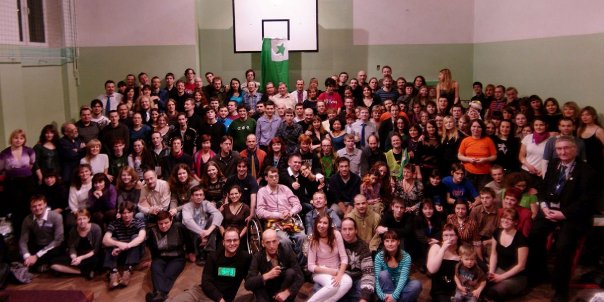
As I said at the start, even if there was just one guy to talk to and the material available to study, it would still work for the purposes described here. What is actually true is that there are millions of Esperanto speakers all over the world. I’ve met up with them many times and had lots of fun (click the last link to see me trying out my pathetic skills as an actor in the language).

I’m not looking for an ideal utopian society when I go to these week-long events where everything (karaokes, dinner menus, games, tours…) is in Esperanto. I go to find people I get along with really well, since there are a surprisingly large number of other polyglots, travellers, vegetarians, Linux users, non-drinkers and many open-minded people there.

There are lots of large events all around the world, or you can just find some speakers in your city to practise with, although you can already do a lot online. The Internet has plenty of Esperanto content; the Esperanto Wikipedia has more than 130,000 entries (more than Arabic). You can find an active forum and a fantastic free learning resource (with a great language learning course, a dictionary, a chat room etc.) on Lernu.net (the entire website is available in several languages).

The language sounds pleasant to listen to and has lots of easy to recognise words similar to English, French/Spanish/Italian and German. In fact, the content (not just the confidence) of Esperanto will help you in learning a lot of European languages! When I tried to learn German in school, the Accusative seemed very complicated. Even the name sounds like you are blaming someone. The accusative exists in Esperanto (it’s one of the very few bits of grammar, there only so you can have any word order you like), but its use is a lot clearer. Getting used to it there meant that it wasn’t so weird to add an -n in German either.

When I tried to learn Czech, the writing system of having “hats” on a letter like s and c didn’t seem strange at all, since Esperanto does this to make the language phonetic (s = s but ŝ = sh for example).

Even if you are learning a non-European language, the confidence you would gain in being able to communicate would bring you miles ahead. As I said, this lack of confidence in speaking a language is one of the main reasons people simply don’t.

If you can start communicating basically in one language for the investment of just a few weeks, then you wouldn’t have to wait the months you would have to otherwise with your target language. I think Esperanto is worth checking out beyond that, but even if all you are interested in is reaching spoken confidence in your actual target language – this small investment could make a big difference.

———————

So what do you think? If you have not been able to speak your target language yet, do you think that this injection of confidence of becoming multilingual in a short time will make a difference? Would you care to continue with Esperanto after that to make sure you were communicating much better? Think Esperanto sounds interesting enough to check out?

Let me know in the comments!

***********************

Want more language learning tips and cool links delivered to your inbox, as well as two free chapters of the Language Hacking Guide? Join the Language Hacking League by entering your e-mail on the top-right of the site!


This article was written by

Comments: If you liked this post or have anything to say, please leave a comment! I love reading them :) You don’t even have to write in English! I will reply to all comments in any language listed on the right with the flags.
Just keep in mind that I’ll delete any comments that:
1. Are unnecessarily nasty and mean to me or any other commenter or otherwise totally inappropriate.
2. Are irrelevant to the particular post they follow, or leave a link to a site that is totally irrelevant or are clearly spam. If you have a general language learning question, please ask it in the forums.
3. Use a commenter name of a business or brand instead of a human being or a spammy temporary disposable e-mail service, or a clearly fake address.
But that’s not you, so don’t worry! Can’t wait to see what you have to write… don’t be shy!! :)


———————————–

  • http://www.srcf.ucam.org/~te233/contact Tom

    Esperanto's great. I'd also recommend Ido, Novial and Interlingua, which are also great but have many fewer speakers than Esperanto.

  • http://www.fluentin3months.com/ Benny the Irish polyglot

    These languages may technically be slightly easier, but Esperanto is much more widely spoken so it fits the purposes of this post better since the learner will find it easier to practise speaking online and get over the spoken barrier.

    • http://twitter.com/zooplah Keith Bowes

      There’s no way that Interlingua is easier than Esperanto (three conjugations, three cases, letters whose sounds differ by their position in the word, etc.). I’d say that Ido isn’t either; it doesn’t have the accusative or noun/adjective agreement, but its vocabulary is *much* bigger. I don’t know much about Novial.

  • Fakename

    “Several studies have shown that learning Esperanto first will give you that edge. For example, students learned Esperanto for six months and then French for a year and a half. Another control group studied just French for two years – so they had several months more studies in that language. And yet the first group that got “side-tracked” to learn Esperanto had significantly better command of French.”

    I don't think the results of those studies really support your point in this article.

    In the particular study you mention, the benefit was only for the lower-graded set of students (because it helped to motivate them?). In the higher-grading set, the time spent studying Esperanto led to them knowing less French vocabulary than they otherwise would, and made them mix in Esperanto when speaking French.

    • http://www.facebook.com/people/Alex-Escomu/100001842925466 Alex Escomu

      I translate from an article in the Spanish Wikipedia:

      In accordance with the results,
      De acuerdo con/a los resultados,

      the preliminary study of Esperanto left a 25% improvement for learning Russian,
      el estudio preliminar del esperanto dejó un 25% de mejora para el aprendizaje del ruso,

      30% for German, 40% for English and 50% for French.
      30% para el alemán, 40% para el inglés y 50% para el francés.

      In other respects, the students who received preparatory teaching…
      En otros aspectos, los estudiantes que recibieron la enseñanza preparatoria…

      got significantly higher results…
      obtuvieron resultados notablemente superiores

      than the others, who did not receive similar introduction to the study of foreign languages.
      que los otros, que no recibieron la introducción análoga al estudio de lenguas extranjeras.

      This system of preparatory introduction was put into practice in Germany…
      Este sistema de introducción preparatoria fue puesto en práctica en Alemania…

      with a large number of students,
      con un gran número de estudiantes,

      but with the sole purpose of facilitating the learning of English.
      pero con el único propósito de facilitar el aprendizaje del inglés.

      The results showed that after two years of language orientation to the international language,
      Los resultados mostraron que tras dos años de orientación lingüística con la lengua internacional,

      the benefit was around 30%.
      la ventaja fue de alrededor de un 30%.

      SOURCE: es.wikipedia.org/wiki/Valor_propedéutico_del_esperanto

  • Kaja

    Saluton!

    I’m an occasional reader. Esperanto was my second language and I’m glad I made that choice. Thanks for the post. :)

  • http://www.fluentin3months.com/ Benny the Irish polyglot

    What's the use in having more French vocabulary if they have less of an actual command to use the language?

    I think those studies go perfectly with the point of the article regarding abilities in one language helping another. Being too focused on the content of the language will not help you to actually speak it if you don't put yourself out there and learn to feel the language. Doing this even in an unrelated language can help immensely.

    As well as that your argument doesn't work since Esperanto vocabulary is very similar to French, so it can indeed help you with the pure content aspect of French. The vast majority of Esperanto vocabulary comes from French (differing usually only by adding an -o for example). Although that isn't the basis of my argument, and it works just as well for Chinese/Japenese etc. where one thing they all have in common is being a language that the learner feels uncomfortable to speak due to lack of experience in doing it before for any foreign language.

    I don't know what you mean by higher-grading. Most academic systems are huge wastes of time for practical command over a language, low or high grade. If someone already speaks a foreign language then my arguments here don't apply, since they already have confidence to speak it.

  • http://www.fluenteveryyear.com/ Randy (@Yearlyglot)

    I presume that you thought I'd dislike this post due to my negative experience and impression of Esperanto, but that's actually not the case.

    > “If you already speak several languages then this particular language hack will be lost on you”

    There's the disclaimer, no? I already speak several languages. And I think that is probably the biggest reason for my own dissatisfaction in Esperanto. But I can see how this easy constructed language could give a neophite language learner the confidence or momentum to learn a “real” language.

    And since you've presented Esperanto in a mostly realistic light, focusing mostly on using it to help learn something else, I'd say that I mostly agree with you! :)

    I do think it would serve your readers well to point out the difference in the way Esperanto is perceived and used in Europe compared to the United States. It seems as if everyone who defends Esperanto and claims to have met tons of cool people live in Europe, while most of us who live in the US find it to be useless, frivolous, and even cause for derision.

  • http://www.fluentin3months.com/ Benny the Irish polyglot

    Thanks Randy, glad you mostly agree!

    I don't like your “real language” reference though, but people have already argued with you on your blog so lets try not to open that Pandora's box here (sadly, I imagine someone else will anyway!) The links to videos I provided show how it's real to me.

    I don't think it would serve my readers well in the slightest bit to discourage them if they don't live in Europe. How can arguing perceptions be useful at all for this post? As I said, they can practise over Skype and on Lernu. For the purposes of this 2 week challenge they don't need to meet up in person with someone.

    Arguing Esperanto's worldwide usefulness is not the intention of this article. It has genuinely helped me a lot with my German and Czech for example. I'm trying to be as pragmatic as possible, but the last paragraph shows that I do have other motivations for learning it besides those suggested by the core of the article.

  • http://www.fluenteveryyear.com/ Randy (@Yearlyglot)

    The “real language” thing was absolutely an attempt to stir the pot! Just like your tweet to me. :)

    But all fun aside, I do think the key is probably in whether or not Esperanto is one of the first languages you learn. I totally see how the experience would be different.

    As a slightly different suggestion, though, wouldn't most of the advice in this Language Hack be just as applicable if you applied it to a real, natural language… presuming it was also an easy one capable of giving you the same confidence boost?

    It seems to me that Tagalog was my Esperanto. Even though I was learning Spanish in school, I can imagine that it was actually speaking Tagalog with my Fillipino friend that gave me the confidence with languages. And Tagalog is super easy — no conjugations, no genders, no cases, no articles, not even a plural form for nouns! And as a bonus, there are a lot of Spanish influences on the language. But most important for me is the fact that I can recognize a Tagalog-speaking person on the street… or go to their country and be immersed… two things that can't happen in Esperanto. (At least not for more than one week per year!)

    • http://users.skynet.be/antoine.mechelynck/ Tony Mechelynck

       Chronologically, Esperanto was between the fifth and eigth language I learnt (depending on whether you count Russian, which I still cannot speak without a dictionary, and classical Latin and Greek, which I never could speak fluently despite learning them six hours a week each for respectively six and two years). But nowadays it is one of the only three languages that I speak with real ease (besides English and my native French, and getting fluent in English took me incredibly more work and dedication than in Esperanto), and if I had to do it again I’d do it, and earlier (because Esperanto speakers are fun people to be with). I rest my case.

  • http://www.fluentin3months.com/ Benny the Irish polyglot

    Yes these suggestions would work just as well for any equally easy language. I'd also recommend Tagalog or Swahili etc. for these purposes. The whole article works just as well. Although Esperanto would be easier for Europeans than those languages simply because it was designed to be.

    I can't go to a specific country for Esperanto, but I've immersed myself in the language several times. Your last point is not relevant to the purposes of the article! If you want to argue real languages for real countries etc. then that's fine (although perhaps an article that invites that would be better for stirring the pot, rather than one that simply brings up the dreaded E word… :P )

    You can immerse yourself in Esperanto events. They are actually easier to get to than the Philippines for many people, even Americans ;) I've randomly run into more Esperanto speakers than I have Filipinos in my lifetime, although I imagine if you are playing a numbers game then Filipinos are are better target when living in the states.

    • http://www.learnlangs.com Judith

      Swahili has a very complicated grammar, with just about every part of the sentence (including verbs) having to match nouns, and lots of different verb tenses / aspects. I can’t weigh in on Tagalog. Anyway, I learned Esperanto after I already knew English, Latin and a bit of French, and I still find that it helped me tackle Chinese and Modern Greek.

  • Brian_Barker

    As far as a practical international language is concerned I think we need Esperanto, rather than an untried project.

    Indeed Esperanto has now ceased to be a “hobby” language.

  • http://www.fluenteveryyear.com/ Randy (@Yearlyglot)

    Right… which goes back to my point about the importance of considering where you live when you make this choice. :)

  • juddski

    Don't believe the hype. I've tried learning Esperanto many times but it is really hard. People who have a passion and an aptitude for language learning find such things easy, but not everyone is like that. People who have a passion for sport and exercise find going to the gym easy and enjoyable, but many people won't go near a gym or any other form of exercise because they find it hard.

  • http://www.fluentin3months.com/ Benny the Irish polyglot

    When I was 20 years old I “didn't have a passion and an aptitude for language learning”, so I guess I should have just accepted that and never tried, right? :)

  • Juddski

    Thing is, I already speak the international language and we are conversing in it. I don't need to learn anything else.

  • http://www.fluentin3months.com/ Benny the Irish polyglot

    Wow, are you on the wrong blog if you think English is the answer to all of life's problems! haha You sound like who I was talking about in this post.

    • David

      I do find it ironic that you say that, but 95% internet output (detected by me, I haven’t scoured everything you’ve posted), is in English!!!! I would say that if you want to promote Esperanto (or German, French, Italian): Post in them!

  • Quokka

    Some time ago I browsed through lernu. Well, I found it bookmark-worthy. But right now I just don't feel like I'd like to devote myself to learning Esperanto.

    The only foreign language I feel to some extend good at is English. Way back when I began learning I already liked the fact that it'd enable me to talk with people all around the globe. However, my main motivation was that there is a lot of literature concerning my hobby written in English & I wanted to read & understand it all.

    The point I am trying to make is: I think that if you want to learn a language for whatever reason (often it's not just one single purpose) start out by learning the language while you are doing what interests you the most. It didn't take a long time and I felt confident enough to have conversations.
    Note: I am not promoting input-methods. If you just watch TV or trudge through course-books without genuine interest but the believe that this is a good method it won't work & is a waste of time.

    This doesn't mean that I find Benny's approach wrong. Not at all!
    If I start learning a new language I will use that one as my goals have shifted.
    Right now I am more interested in the social aspects.
    That's actually the reason Esperanto might be interesting.

    At least I already match the profile of an Esperanto-speaking person (to some extend) ;-)
    polyglot:2.5 languages, traveller: yep, vegetarian:well, let's say I am a vegetarian up to 70% of the time :-p ,Linux user & non-drinker: yup.

  • http://twitter.com/mithridates Dave MacLeod

    Right, but you did make the point above that Esperanto would be worth learning even if it didn't have a single speaker, did you not?

    Good post though, and I agree. I tailor my IAL recommendations based on what I think a person is looking for. If it's about meeting new people and traveling on a budget then definitely Esperanto. If it's a person fed up with Esperanto for some reason I may suggest Ido. Some people can't decide whether to learn French or Spanish or some other Romance language (and aren't planning on traveling anywhere soon) so to them I recommend Interlingua or Occidental. My goal above all is to make just the right recommendation that will keep a person interested in the language for the amount of time it takes to become proficient. I'm of the opinion that the real struggle for IALs isn't among each other, but against the idea that they are somehow deficient and incapable of playing the same role that 'natural' languages do, which is the real audience that counts since it numbers in the billions. The early 20th century had a lot of favorable coverage for IALs but once it began to look like English was going to fulfill the role of a world language (which it won't) it became much more cynical and sparse.

  • http://www.lernu.net Miĉjo

    Great article! I, too, recommend learning Esperanto first – it’s what I would have done, had I known back then. Learning French was very helpful in subsequently learning Arabic, which actually has surprising similarities with French; had I learned Esperanto before French, it would have made it considerably easier, too.

    If I may be so bold, I’d just like to add a couple of things:

    1. Esperanto is a useful tool for language learners even when one’s native language is *not* (European Indo-)European, for two reasons. One, Esperanto’s grammar is quite flexible, making it possible to pattern one’s Esperanto to a large degree and with little effort, first after one’s native language, then after other languages, all without losing any clarity. Two, Esperanto’s vocabulary tends toward maximum internationality, and if you’re targeting a European language, you’ll pick up a large number of roots common to many European languages before you get started on that language, making it an excellent springboard to European languages.

    2. Even if you already know several languages, I believe Esperanto to be a useful language-learning tool. I find that learning Esperanto after French, Arabic and some German and Hebrew has limbered up my mind even more, especially as I try to model my Esperanto after these other languages, and even in ways you wouldn’t imagine in any of them.

    3. Another interesting Esperanto learning resource is the free, downloadable multimedia introductory course at http://www.ikurso.net .

    Ankorau dankon pri la interesega, amuza kaj pensiga artikolo de spertega lerninto de pluraj lingvoj. Mi esperas, ke pluraj leg[iao]ntoj rimarkos vian rekomendon kaj sekvos vian ekzemplon, lernonte ne nur Esperanton, sed ankaŭ aliajn lingvojn.

  • http://mavericktraveler.com El Guapo

    So I see you mention that it’s good for beginners, but what if you already speak 2 languages fluently, 2 languages more or less fluently, and 1 beginner (3 of those languages are Latin derivatives). Still worth it?

  • http://mavericktraveler.com/blog ElGuapo

    You have no idea what you're missing…

  • http://mavericktraveler.com/blog ElGuapo

    Russian has also very complicated grammar. I'm a native speaker so I don't appreciate it as much as someone learning it. Nouns must match the subject, as the verbs, etc. But verbs change forms from simple tense conjugations as well by adding different prefixes and suffixes to describe an action more specifically.

    I would never be able to teach it because I have no idea why I say the things I do.

    I'd be impressed if someone can learn it and speak pretty fluently within a short time frame.

    Also, although I've met people who learned it (by living in Moscow or being married to a Russian), I have never met anyone who can speak it with no accent. I can easily tell within the first word or two.

    • http://users.skynet.be/antoine.mechelynck/ Tony Mechelynck

       Russian has complicated declensions, but less so than Latin. It has extremely simple conjugations (only one conjugated tense, plus one that varies like an adjective predicate, an imperative, and four participles). The fact that verbs go in pairs is a novelty for a Westerner, but not an insurmountable one. The alphabet is not Latin, but (if the stress location is known, which is not always obvious) the relation between spoken and written Russian is far more systematic than in English or even in French. About speaking with no accent, maybe I’m lucky in that I have a “musical ear” (and started learning my second language — Dutch — very young); but I can see how it could be a difficulty for people less lucky than I am.
      I wouldn’t say Russian is easy, and it is certainly several orders of magnitude harder to learn than Esperanto; but I’d like to learn it better, and I feel that, given the right environment, it would be possible.

  • http://www.fluentin3months.com/ Benny the Irish polyglot

    This blog is called “fluent in 3 months”, not “con fluidez en 3 meses” or “couramment en 3 mois” etc.

    It's pretty clear the premise is that it's in English. If I started writing in a random different language every week just because I could, only other polyglots would read the blog. I'm writing to people who only speak one language and want to learn more. Most of the readers are Americans, or at least understand English so writing posts like this in anything but English isn't going to be at all helpful.

    Besides, this may come as a shock to you, but there is life outside of the Internet :P 95% of Internet output does not = 95% of the actual output in my life.

  • http://www.fluentin3months.com/ Benny the Irish polyglot

    Nedankinde!! :)

  • http://www.fluentin3months.com/ Benny the Irish polyglot

    As I said in the post, the argument here was to use Esperanto as a bridge to get over the discomfort in speaking. This post focused on that one aspect of Esperanto.

    However, there are plenty of other reasons to learn it, as shown in the last part. I learned Esperanto as my 7th language, and I still found it very useful due to the social aspects of the meetings and the fun in getting an extra language “for free” for very little work. I'd still recommend you give it a try – if you have already learned Latin languages you will master it in no time.

    It's up to you if you think it's worth it! You can look at the videos I linked to and see why I was happy to learn it myself! :)

  • http://www.fluentin3months.com/ Benny the Irish polyglot

    Dankon Miĉjo!!! :) Ankaŭ mi esperas ;)

  • http://www.umitorhan.com/ Umit Orhan

    My story with Esperanto began when i was in high school. I was just trying to learn English(the hardest one since it was the first) and at first when i discovered about Esperanto I was amazed! It was such a brilliant idea!.. I put some efforts to learn it, try to speak it with other Esperantists, but since my efforts was very low, soon i gave up learning it.
    But still i do remember lots of things from Esperanto, and i can surprise the people who speaks it by simply speaking a couple of sentences.
    It is really easy, and i will finish that incomplete task of my life sometime in the future.
    Great post dear Irish Polygot! I love this blog so much… Thank you for blogging…
    All the Best.

  • http://www.adventurerob.com AdventureRob

    Seems to be a lot of people disagreeing here, but I can see the point, in fact I want to try Esperanto now :-) It's almost like an underground language.

  • http://www.fluentin3months.com/ Benny the Irish polyglot

    Glad to see you are rebelling against the status quo ;)

  • http://www.fluentin3months.com/ Benny the Irish polyglot

    Thanks so much for your comment!! That kind of positivity is the power that motivates me to continue writing :)
    Great to see your own Esperanto story!

  • David

    I'm sorry if you took it badly, I did not mean to imply that 95% of your output was in English. I've read your methods, and I like them a lot! (hence why I'm here). And I did do a similar “mission” that you did for the two foreign languages that I speak the best (French in Lyon, Spanish in the USA), and I'm working on my Italian and Russian and planning similar cheap trips in the near future. However, I hope to one day travel to Korea, China, Japan, India, Greece, Portugal, Russia, Austria, Italy… so many places and I intend on speaking 6 total languages (ish, its a rough goal). It's not only not practical, but I'd say it would be impossible for me to keep up my demanding studies/job in medicine , plus be able to keep all the languages to a fluent level.
    When I visited Germany for two weeks, I stayed with French friends. I learned basic German phrases to use, but most of my interaction was with the French: so I spoke French! I avoided speaking English when I was with Germans though, and tried German, and my French friends were so annoyed with this, they even started speaking English with German waiters and ticket salesmen to prove to me that “c'est juste mieux si tu parles anglais ici”. I think the fact that you don't speak the language shouldn't mean you shouldn't visit the beautiful country, and that you should try to interact with the people in English. I believe that while its less than the ideal, you can still have a fantastic trip and see the beautiful country (all countries are beautiful, nature always astounds me, as do peoples unending generosity. I love traveling).

    sorry for the long post, but I don't like it when people say that I should limit my explorations of the world based on my time/intellectual capacity to learn the languages. I'll always try to learn as much as I can in the foreign language, but when push comes to shove I can't have good conversation in Korean from visiting Seoul for two weeks.

    Good luck on your C3 test!!!

    • http://users.skynet.be/antoine.mechelynck/ Tony Mechelynck

       In all the countries you mention (even Korea) and in a lot of others, there are many people who speak Esperanto (I know some who learnt it in Uzbekistan). Finding them is easy, with the Yearbook of the Universal Esperanto Association or the Pasporta Servo (a service built on the same idea as CouchSurfing, but long before the latter even existed, and which used a paper yearbook before the Internet existed).

  • http://www.youtube.com/user/FluentCzech FluentCzech

    I agree with you that some parts of Esperanto are hard. I spent an hour a day for two months learning Esperanto, and the only easy part is learning the grammar (there are only a few rules to learn so it takes just a few days to learn them).

    What isn't easy is learning the vocabulary. It is just as hard as with any language since there are thousands of words to learn. Having said that, you can start to speak with Esperanto even when you have a very limited vocabulary, since even when you do not know a word you can often construct (i.e. invent) one.

    Rather than mock you for not knowing a word, many Esperanto speakers will congratulate you on your inventiveness when you work around this and create words of your own. This brings me to a real advantage of the Esperanto community: they are used to hearing newcomers struggle since there are very few native Esperanto speakers so almost everybody who speaks Esperanto has gone through the same process. As a result they tend to be far more forgiving of mistakes and much more encouraging and helpful than you often find with native speakers of other languages.

    Having said all that, I stopped learning Esperanto after two months because I felt I had learned what it was all about, and appreciated its grammar and the kindness of the community, but wanted to spend that hour a day on other things. Overall, it was 50 hours well spend, but that was enough for me.

  • Bill Chapman

    Sorry, Juddski. My experience of travelling is that English simply does not do the job. I've been lost in Bulgaria and in rural Italy and failed to find an English speaker to help me out. Of course, there are successful learners of English (notably in the Netherlands and Scandinavia) but many – even most – learners do not succeed.

    Of course you can't expect to bump into Esperanto speakers without a bit of planning, although I've had a few chance encounters.

  • russ

    Certainly Esperanto is not easy – learning any language takes work. If you like, say that it is not easier than other languages, but rather it is much less difficult than other languages. Depending on your motivation, learning techniques, and talent, it might still take a while to learn – but you'd learn it quicker than you'd learn German or Polish or whatever.

    Despite having studied various other languages and lived in a couple of foreign countries, Esperanto's the only language I became competent and fluent in as an adult.

    But I also see various ways that Esperanto has indeed given me concrete vocabulary and grammatical concepts that help me learn other languages. The experience of getting fluent in another language was very inspiring, after believing for years that I never could.

  • http://amikeco.ru Slawik

    Sometimes I feel like Russian cannot ever be learnt to a „near native“ level :)
    Most often there's no need for that, of course.

  • Shane

    Very interesting Benny, thanks!

  • http://lingomatch.com Andrew Playford

    Hi Benny. The first I had heard of Esperanto was when people starting emailing me and asking for it to be inserted as a language option in our drop down on http://lingomatch.com. It is now there so if anyone wants to meet up for real and practice talking, you are good to go at LingoMatch!

  • Steve K

    Love the blog, and find this post about Esperanto interesting. Some time back when I considered learning it, this site http://www.xibalba.demon.co.uk/jbr/ranto/ put me off it. I'd be interested in knowing your take on it. It strikes me that Esperanto speakers from the same language group would be able to understand each other quite well, but others maybe not so.

    Anyway, good blog.

  • russ

    Are you talking about literally understanding speech, in the sense of phonetically distinguishing the words someone is saying? My experience is that there can indeed occasionally be difficulty understanding the speech of people from other language groups if their Esperanto is too dominated by the accent of their first language – the same as happens with ANY language, whether English, Polish, whatever, not just Esperanto, of course! If someone hasn't learned a language well, speaks carelessly, mumbles, mispronounces the vowels and consonants according to the rules of their first language instead of the target language, etc, then no language can solve that problem.

    If you mean higher level semantic confusion, e.g. due to different grammatical constructs, different active vocabularies, confusing use of “false friends”, etc, I haven't found that to be a problem in Esperanto. I normally have no problem understanding what someone from another language group means, given that I literally understand the literal words they are saying (or am reading text written by someone from another language group). E.g. my first language is English, and I have spent a lot of time in conversation with Esperantists whose first language is Polish, German, French, etc, and a lot more time reading and emailing with them. Sure, there are national variations in expressions people use (e.g. a Russian recently told me that Russian Esperantists tend to say “Estu sana” after someone sneezes, whereas most of the time I'm used to hearing “Sanon”), but such regional/cultural/idiom differences obviously don't cause problems.

    As for the ranto page – in my opinion, it exaggerates a lot of problems, and presents a lot of subjective preferences or judgment calls about elegance etc. It also points out some justifiable complaints about Esperanto, or complaints I'd agree with (e.g. I dislike the -in suffix and lack of a sex-neutral 3rd person singular pronoun) – but so what? There's no such thing as a perfect language, and despite its flaws, Esperanto has fewer flaws, and it is WAY easier to learn than national languages (I can say with confidence, having tried learning quite a few others, and succeeding only with Esperanto), and it works fine as a real language. I use it every day, including with people from other language groups.

  • Steve K

    I agree about the ranto page exaggerating some problems with Esperanto.

    As for my own take on it, I was thinking about pronunciation more than anything else. Where pronunciation of certain constructs are not prescriptive, then people who come from different language groups will presumably use their own native pronunciation. Having said that, I say presumably because I don't know anybody who actually speaks Esperanto.

    What I do know is that the ranto pages put me right off something that I thought was a great idea, and now, thanks to this blog I'm thinking again :-)

    • http://users.skynet.be/antoine.mechelynck/ Tony Mechelynck

       IIUC, the pronunciation of Esperanto is prescriptive, with very few exceptions.
      a [a], b [b], c [ʦ], ĉ [ʧ], d [d], e [ɛ / e], f [f]
      g [ɡ], ĝ [ʤ], h [h], ĥ [x], i [i], j [j], ĵ [ʒ]
      k [k], l [l], m [m], n [n], ng [ŋɡ], o [o / ɔ], p [p], r [r]
      s [s], ŝ [ʃ], t [t], u [u], ŭ [w], v [v], z [z]
      The range of free variation for e, o, or even between Spanish and French [r], is never an obstacle to comprehension; even strong English, French, Russian or Japanese accents (which are among the most marked), if they may elicit some smiles, are not an obstacle after very little getting used to.

  • http://www.lernu.net Miĉjo

    Mr. Rye (author of the ranto) makes a few valid points, but for the most part, I find his comments exaggerated, inaccurate or irrelevant. It's a straw-man: Esperanto never claimed to be perfect, only to work as a (relatively) easy-to-learn language within reach of everyone without sacrificing expressiveness, which it does.

    An interesting read is this brief review of the ranto by the late Claude Piron, former U.N. translator and professor of psychology, well-known Esperantist (in Esperanto circles, anyway :-) ), and writer in and about Esperanto:

    http://claudepiron.free.fr/articlesenanglais/wh

  • Douglas

    Hey Benny! I love your blog, bro! :D

    So, I also learn Esperanto, but have you ever tried to learn Interlingua? I started to learn it few months ago…and it is very interesting.

    Then, that is it! Good luck there!
    Até mais! Abraço!

  • http://twitter.com/Mneiae Caroline L

    I've often thought this about Esperanto. I've studied French and Spanish and continue to do so in college. I grew up as a Vietnamese-American. Latin was the very first language that I studied.

    After trying to tackle Mandarin, though, I've realized that Romance languages get you nowhere when you want to learn something that is totally unrelated. Esperanto is a great choice if you want to learn Western Hemisphere languages, but it's not a good choice for everything.

    I admit freely that I'm biased, as Mandarin is the only language with which I've had serious problems or to which I've had to devote effort. It came in handy when I went to Beijing, but I'm glad that Google's new Goggles thing has gotten us one step closer to Douglas Adam's babble fish.

    • http://users.skynet.be/antoine.mechelynck/ Tony Mechelynck

       Claude Piron, who knows much more about Mandarin than I do since he used to be a translator of Chinese for the WHO, argues that the deep structure of Esperanto is akin to that of Mandarin: in both, word roots don’t change; and it is usually possible to translate word-for-word from Mandarin into Esperanto without sounding contrived. I’m not sure how much of a help Esperanto can be for learning Mandarin, but he makes it sound like Esperanto can be a great language help if the only language you know is Mandarin. The article is somewhere on http://claudepiron.free.fr/ but I don’t have the exact URL at the moment.

  • http://twitter.com/Zentaurus Héctor Palma Téllez

    Sólo por éste post ahora empecé a estudiar Esperanto, para ello dejé de lado el serbio y el croata que comencé hace no tanto rato. Llevo menos de una semana en el Esperanto y ya creo que me servirá. Mucho más he aprendido del Esperanto de lo que aprendí del croata y el serbio antes.
    Espero pronto dominar un par de idiomas más… por lo bajo. Como dices en otro de tus posts, no se comienza de cero y creo que en varios idiomas ya empiezo de uno (o dos en otros) a pesar de que sólo se me inculcó el inglés en el sistema educacional local.

    Confieso que es como la cuarta vez que me meto a leer acá comentarios y partes del post mismo y sólo ahora me animé a comentar yo :D

    Bueno, un saludo desde Chile y, en serio, ¡muchas gracias por escribir cosas como esto! :D

  • Brian_Barker

    I don't think it makes sense to have lots of international languages.

  • Valdas Banaitis

    Hey, Benny!
    Neither easiness nor spreadedness. Esperanto is just a European pidgin, naturally reinvented by a genius infant, and that is why it survived. It was a childish discovery of universal grammar based on the mirror neurons system. Read about Nicaraguan Sign Language anfd the conclusion of Judy Kegl-Shepard, and about origin of language in extreme situations, and this is the way to language.
    Valdas, the Lithuan polyglot

    • http://users.skynet.be/antoine.mechelynck/ Tony Mechelynck

       When Zamenhof published «The International Language» (in 5 languages), he wasn’t an «infant» anymore, but a Doctor of Medicine, and the language project had been developed over many years, with two «beta milestones» (known only much later to the public), starting when he was in high school.

      Esperanto is not «just» a European pidgin. According to Claude Piron, a former Chinese-French translator for the WHO, who later became a university teacher of psychology in Switzerland, the superficial layer (choice of word roots etc.) of Esperanto is Indo-European (maybe 70% Romance, 60% Germanic, 50% Slavic; the total is well over 100% because of the many words roots common to two or three of these), its medium layer (word formation etc.) is agglutinative (think Hungarian, Finnish, Turkish, Tatar, etc.) but the deep structure, which really defines what the language is, is akin to that of Chinese. (Claude PIRON, ‘Esperanto: European or Asiatic language?’, about 35 pp. depending on language, out of print in French and Esperanto, available in Dutch http://katalogo.uea.org/katalogo.php?inf=1230 )

      Maybe Esperanto mirrors the structure of the nervous system, I don’t know the latter well enough to tell; but if it does, that would make it wonderfully easy. One thing I do know, and it can be ascertained by just looking at all that’s been published (in both original and translation), is that Esperanto is no less expressive that any other human language.

      About spreadedness: Esperanto is spoken on all continents, and I would venture that its world coverage (the set of places near where someone speaking it can be found) is far better than that of English.

      See also Ivo Lapenna’s address to the Program Commission of UNESCO, 4-dec-1954:  original in French; published in Esperanto translation in “Esperanto”, feb. 1955 issue, then reprinted in Carlo MINNAJA (red.), ‘Eseoj memore al Ivo Lapenna’, Denmark, © http://www.kehlet.com, under the auspices of Internacia Instituto Ivo Lapenna, p.367.

      • http://www.facebook.com/people/Penelope-Vos/100002563606794 Penelope Vos

         As a native English speaker, your use of the phrase “easiness and spreadedness” (instead of “ease and spread”) marks you as a language learner.

        It’s not fair that it makes you look inferior, since you know more languages than most of us, but still- that’s how it is.

        Were you to be speaking Esperanto, intelligent extrapolation would result in correct speech and you would appear as masterful as you deserve.

        This is the problem of English as a lingua franca : massive investment and you still look second-rate.

        Esperanto is accessible – even for those who can make no massive investment – and with dignity.

        Sorry Benny, for the off-topic post. I know that this is supposed to be about Esperanto as a hack for other language learning, which has been so effective in my experience as a language teacher that I recommend it as the first foreign language for primary school kids everywhere.

  • Valdas Banaitis

    The best way to learn a language is to revisit the natural one all the children have passed

  • Andy Rosenbaum

    Hi Benny!

    You may or may not remember me, but we briefly met (almost exactly) a year ago at the IJK 2009 in the Czech Republic.

    Anyway, I've just discovered your blog, and I've really enjoyed it so far. I especially like this post.

    This “language hack” applies to me, and I would like to share my story here. I started drafting a comment, and it turned out to be a bit lengthy. So, I've decided to post the whole thing on my personal blog, and include a link here. Enjoy!

    http://seekthesooth.blogspot.com/2010/07/hack-o

    ~Andy

  • Zach

    That is so ignorant it’s laughable. You don’t see websites with foreign languages because you’re doing searches in ENGLISH. Try running a search with a word that isn’t English and your mind will probably be blown. My God, talk about people making up random statistics.

  • Mike

    This really has inspired me to take on the two week Esperanto challenge. I really feel I need to get over the embarrassment of speaking. My question is: Where may I find people to practise and Skype with?

    • http://www.fluentin3months.com/ Benny the language hacker

      Go to Lernu.net. It has a forum and a chat room. Otherwise search in Skype per language and set it to Esperanto. There are plenty of other ways ;)

    • http://www.fluentin3months.com/ Benny the language hacker

      Go to Lernu.net. It has a forum and a chat room. Otherwise search in Skype per language and set it to Esperanto. There are plenty of other ways ;)

  • Mike

    This really has inspired me to take on the two week Esperanto challenge. I really feel I need to get over the embarrassment of speaking. My question is: Where may I find people to practise and Skype with?