Pin It

Join almost 1/2 million
monthly
readers!

Contact Me

Coaching and Consultation

Current mission

Secret project in
Berlin! Subscribe to
email list to find out
about it first!

Previous post:

Next post:

Why ESL teachers are the best teachers and the best learners

| 54 comments | Category: learning languages, travel

I’ve had many jobs in the last eight years on the road but the one that I could always rely on was ESL (English as a Second Language) teacher. I worked in Spain, France, Italy, Germany, Brazil, and Ireland as an English teacher for non-natives and found it to be very satisfying work.

However, what I have also found is that the process of teaching English has also helped me to refine my language learning strategy and learn the local language better.

As well as this, I take great satisfaction in the fact that I was successful in helping even the weakest students to speak English and dramatically improve the level of many of those I taught. My success in teaching English is a huge part of why I am so confident in giving advice about learning languages in general on this blog (as well as my own experience in learning to speak them of course).

In meeting other ESL teachers, I can see this is true for many of them. There are plenty of exceptions, but I have found that ESL teachers make better teachers than traditional academic ones, as well as having an edge themselves for learning a language.

Non-traditional techniques in a classroom environment

ELS teachers are forced to step outside of their idea of a failed academic system that never helped them learn to speak a language when they were at school and to do things completely differently.

When I try to compare my own personal experience as a learner in school, with how I personally taught English (which I know is very similar to how many other ELS teachers do) there are several things that I did very differently to the traditional academic approach:

  • I always taught my classes entirely in English, even when I spoke the local language fluently, without exception (even with absolute beginners). This helped my students tremendously as they were forced to communicate in English with an actual human being, rather than see it as a list of rules. Many traditional academic courses teach through the mother tongue of the learner, which makes the target language more artificial and theoretical and less like a means of communication. To teach a language, you absolutely have to use the language way more than just occasionally.
  • I never discussed grammar in tabular form and would very rarely use technical terminology (words like past participle, conjugation, etc.) Grammar was always explained by use of examples in such a way that it didn’t feel like grammar. My own German classes in school would directly discuss cases, adjective agreement and many other things I simply didn’t care about. Unless you are a grammarian learning a language this way is boring. Grammar can and likely must be taught, but in a communicative context.
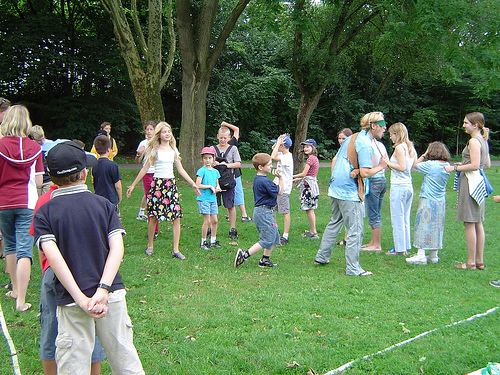
  • Many ESL teachers even abandon the whole classroom idea and make it a game, especially with children. When you take learning away from blackboards and copybooks, into dances, puzzles, board games, activities, competitions, interesting assignments rather than homework etc. the student is way more likely to participate simply because it’s more fun. These work just as well with adults (but perhaps using less stuffed animal toys). One of my most favourite jobs as an English teacher never involved entering a single classroom. One day I dressed up as a pirate (see photo) and went hunting for treasure with my students, but added in important vocabulary along the way and corrected mistakes they would make.
  • Positive rather than negative feedback. I would always encourage my students, and congratulate them on their efforts, no matter how small the achievement. Corrections would be added in subtly, in a way that they would remember, but without embarrassing them. All I remember about my German classes in school was constantly being wrong, feeling stupid and suffering through a marking system that emphasised my mistakes rather than focusing on progress. This feedback loop made me hate a language that I could have actually learned to love in a more encouraging environment.
  • Personal touch. The traditional classroom environment has the teacher constantly at the blackboard and perhaps occasionally peering over your shoulder to criticise your work. In more personal (and in my opinion, more efficient) classrooms the teacher joins in on games, sits down with particular groups, and gives students encouraging pats on the back. I got warned by my employer about my back-patting encouragement when I taught Mathematics in the states and found this unhealthy obsession with personal bubbles counterproductive. Teaching should be more human! In many countries teachers are way closer to their students and this helps a lot.

Result? ELS teachers learn languages quicker

The result of applying the above and other more efficient teaching techniques means that many ESL teachers figure out what they were doing wrong themselves as learners and actually get a good hold over learning their own language. They realise that (like in their own classroom) less study and more actual use of the target language makes all the difference.

Seeing others struggle with their own progress directly can also help as you give them words of encouragement and start to believe these words yourself. Even though I don’t teach English right now, encouraging others via this blog and the many e-mails people send me, reinforces my own enthusiasm in my language learning journey. Giving encouragement can encourage the person giving it too.

Teaching English was also part of my journey of becoming less shy, since this is necessary if you wish to be a good non-dull teacher. It’s ironic, but more experience can actually make many traditional teachers worse because they are bored with teaching the same repetitive course year in and year out and their disinterest comes across very clearly in the classroom. Since I never taught any particular courses, sticking to speaking and games much more, I did not lose my enthusiasm as easily.

The energy I got from pushing large groups of people to speaking a foreign language (English) would come with me and help me to convince small groups of people to listen to me as I make mistakes in their language.

The most important thing I learned in teaching English, is that learning a language can indeed be fun and not all about grammar, vocabulary, mistakes and feeling stupid.

——————-

If you are interested in becoming an ESL teacher yourself, check out Nomadic Matt’s site about teaching English overseas for some useful info.

Some readers of the Language Hacking Guide have been telling me that they have been using my suggestions in their own classrooms or with their own children with positive results! Do you teach a language in a more interesting way than traditional approaches?

Have you taught English (or another language) yourself and found that it helps your own language learning mission? Disagree with me and think that a dusty old blackboard and time-tested course material is the best way to learn a language? Share your thoughts with us in the comments below! And don’t forget to share this post with your friends on Facebook!

***********************

Enter your email in the top right of the site to subscribe to the Language Hacking League e-mail list for way more tips sent directly to your inbox!

If you enjoyed this post, you will love my TEDx talk! You can get much better details of how I recommend learning a language if you watch it here.

This article was written by

Comments: If you liked this post or have anything to say, please leave a comment! I love reading them :)
Just keep in mind that I’ll delete any rude, trolling, spammy, irrelevant or way off-topic comments. If you have a general language learning question, please ask it in the forums. Otherwise please use the search tool on the right for any other question not related to this post.

———————————–

  • Marcia

    I had a French teacher, back in 1967, believe it or not, in 7th grade – who was extremely strict and we were scared of her. A parent confronted her and found she had done her student teaching in a violent inner city school and was terrified of the students there. We were in a rural school, with many teens coming from farms. She soon changed her tactics, but she caused great harm in learning French. I learned because of the disciplined teaching, but learned no conversational skills from her. An older and wiser French teacher came along after her who was well traveled in France, she was wonderful.

  • Marcia

    I had a French teacher, back in 1967, believe it or not, in 7th grade – who was extremely strict and we were scared of her. A parent confronted her and found she had done her student teaching in a violent inner city school and was terrified of the students there. We were in a rural school, with many teens coming from farms. She soon changed her tactics, but she caused great harm in learning French. I learned because of the disciplined teaching, but learned no conversational skills from her. An older and wiser French teacher came along after her who was well traveled in France, she was wonderful.

  • http://www.fromwhoatogo.com Caron Margarete

    As an ESL teacher and a teacher trainer I can 100% totally agree with you. ESL is about being fun, playful and using positivity, and it is the enjoyment that keeps kids (& adults) learning and growing as confident English speakers.
    Great post Benny!

  • http://www.fromwhoatogo.com Caron Margarete

    As an ESL teacher and a teacher trainer I can 100% totally agree with you. ESL is about being fun, playful and using positivity, and it is the enjoyment that keeps kids (& adults) learning and growing as confident English speakers.
    Great post Benny!

  • Jen

    I agree with you! Though I am new to this field, only started about less than a year ago- the reasons you stated are the reasons I got into it. Also, I notice the tips I give people I assist I have begun to use on myself. I am an American English speaker who’s trying to learn Indian languages- Malayalam, Tamil and Hindi for a long time the traditional ways and very unsuccessful. But with some of the tips I gave in learning conversational English transferred to learning the Indian languages, I am making some progress. Thank you for sharing this.

  • Jen

    I agree with you! Though I am new to this field, only started about less than a year ago- the reasons you stated are the reasons I got into it. Also, I notice the tips I give people I assist I have begun to use on myself. I am an American English speaker who’s trying to learn Indian languages- Malayalam, Tamil and Hindi for a long time the traditional ways and very unsuccessful. But with some of the tips I gave in learning conversational English transferred to learning the Indian languages, I am making some progress. Thank you for sharing this.

    • http://www.fluentin3months.com/ Benny the language hacker

      Thanks Jen! Glad to see you following your own advice :D

    • http://www.fluentin3months.com/ Benny the language hacker

      Thanks Jen! Glad to see you following your own advice :D

  • http://www.fluentin3months.com/ Benny the language hacker

    Marcia, while I’m sorry for your disciplined teacher, I don’t think that’s particularly relevant to the post. I’m not talking about violence as a traditional teaching approach – that barely exists any more in modern western schools. My qualm with traditional approaches is just about how boring and useless it is.

  • http://tomfrompoland.com Tom from Poland

    Useful tips Benny, now I’m learning on English course at work and my teachers use techniques which you posted. My course concentrate at speaking (modify Callan method) but often we have a small talks about life too, it’s very helpful to my confidence and improving my English skill.

  • http://findalanguageteacher.com Tom

    The best language teacher I have ever had brought this approach into a regular school class room. At the age of 13, we became fluent in one year.

  • http://www.fluenteveryyear.com/ Randy (@Yearlyglot)

    My 7th grade Spanish teacher spoke to us only in Spanish the whole year. On the first day, we learned to understand him and his gestures… and he very patiently coached us through “el baño por favor”… His teaching style made a lasting impression on me, and I think there was merit to it, but none of us were even conversational at the end of that year. I think I learned more about understanding foreign-speak than I did about speaking a foreign language. In fact, the following year I had Spanish II with a different teacher and after two years of Spanish I still couldn’t have even a basic conversation.

    So I think the most important detail in your post is the part that got the least attention: it’s active participation that makes the difference. Getting people talking. Asking them questions and helping them learn how to answer. Learning to have a conversation. In spite of my lack of progress in two years of classroom, I learned more about conversations in my first 10 minutes on ICQ (remember when that was popular?) with a cute girl from Argentina… because I wanted to talk to her. :)

  • Joseph

    Since my experience is limited, I think that I’ll keep this brief and thoroughly skewed. In high school, I had three years of rigid grammatical study in Latin. My fourth year, we were thrown into the dactyllic deep end, reading long-form poetry (with some prose). Never once was I required to speak in Latin. That summer, however, attending the National Junior Classical League Convention, I met a man who walked around in Roman-style dress and spoke essentially nothing but Latin to students. Though halting in first conversing with him, I found myself reasonably fluent, though seldom had these words ever left my head or the page.

    That said, I once attended a short seminar on Brazilian Portuguese with a Professor who taught through Total Physical Recall through Storytelling. Using props, casting characters, and pointing at charts of particles and interrogative pronouns, he gave us a bare-bones story all in Portuguese. And I did remember some syntax, lots of vocabulary, and other things for many months.

    I find that both methods have merit. I find it difficult to discuss language intelligently without knowing one’s past participles, without knowing a dative case noun when one sees it, without understanding the difference between a passive periphrastic and an ablative absolute. But if a student doesn’t know any of the words, or how they sound together, he’ll never learn the language then, either.

  • http://faoiseamh.blogspot.com/ oranje68

    I agree with some of what you say but I think that you are not really comparing like with like. The approach to teaching languages varies from country to country. In Holland I know from experience that there is a big emphasis on grammar when teaching languages and yet Dutch people nearly all speak English well and most can manage in German plus others. I think that grammar is very useful if you already know the grammar of your own language. Too much of it is boring but ignoring it altogether is taking a very useful tool away from learners of a language.
    You are a big proponent of learning languages through the target language. I learned French and Irish without hearing a word of English in my school career. I came out of it well but I have to say that I did not understand Irish grammar until much later because they never explained the terms into English. I learned by instinct but explanations in English would have made things a lot easier. Sure teachers should use the target language as much as possible but it shouldn’t be a dogma.
    Another point that I think is very important is that school syllabuses normally concern literature and culture as well not just language. Reading poetry in French or German or Spanish is not always fun but it is necessary. In this case also explanation in the local language can help understanding literature.

  • http://www.fluentin3months.com/ Benny the language hacker

    That’s good to know Tom! Doing it in English is the key :)

  • http://www.fluentin3months.com/ Benny the language hacker

    I’m always pleased to hear that some teachers do this in “regular” classrooms :)

  • http://www.fluentin3months.com/ Benny the language hacker

    I’d argue that participation was a key factor of the points I brought up, but you’re right that it’s likely what was lacking in your own classes.
    Other motivations are always good though :D Ah ICQ…

  • http://www.fluentin3months.com/ Benny the language hacker

    It all depends on the person. Some people do like to analyse a language and understand the structure behind it. I’ll admit that I am partially in that field too. But to most people these explanations are boring and will not help them when they learn their first language. You’re right of course that knowing the words and how they sound is the key!

  • http://www.fluentin3months.com/ Benny the language hacker

    Of course, things change depending on the country. I presume most people reading the blog went through an English speaking education system which is a huge flop.
    I remember seeing a documentary about teaching in Holland and the teachers did exactly what I suggest here like being closer to their students etc. It would please me if that was what counted as “traditional” in some countries :) When you do it that way, then you can bring in grammar and it won’t bore your students.
    Grammar can be easier understood in your mother tongue. I’m not saying to go with a dogma of TOTAL abandonment in school, but a majority preference for target language instruction should be the goal. The fact that you can’t explain grammar doesn’t matter one iota in my opinion if you can speak the languages.
    I’d argue that reading poetry is totally unnecessary for most people unless you specifically want to study literature. It’s an interesting part of the culture, but too disconnected with what many want to use a language for. Literature can help a lot for practise, but poetry is something for advanced students in my opinion. Literature definitely works better when done entirely in the target language.

  • Annette

    Excellent post, Benny!

    >>All I remember about my German classes in school was constantly being wrong, feeling stupid and a suffering through a marking system that emphasised my mistakes rather than focusing on progress.<<

    I remember that from my high school German classes, too! Fortunately, my University German instructors were much better. Sadly, my first Italian instructor did a lot of the ‘looking over your shoulder’ to jump on your mistakes. I think he meant well but I really differed with his style of teaching.

    I’m an ESL teacher, too, or have been, and I love it! I too find it gives me energy and motivation to learn languages. I think learning languages also makes you a better ESL teacher because you know what the students are going through and will be better able to understand and help them.

    That pirate treasure hunt sounds like a great idea, too! I bet your students loved it and learned a lot without even trying that hard!

  • Frangipanni

    Hi there,
    Could you suggest any particular trainer for ESL? I live in Australia but am overwhelmed by the amount of course suppliers all with their spin on TESOL qualifications etc. I did look into a few times but always ended up too confused with who and which qualification is the useful and recognised one! By the way, love your posts! Keep them coming.
    Cheers,
    Michelle

  • Frangipanni

    Hi there,
    Could you suggest any particular trainer for ESL? I live in Australia but am overwhelmed by the amount of course suppliers all with their spin on TESOL qualifications etc. I did look into a few times but always ended up too confused with who and which qualification is the useful and recognised one! By the way, love your posts! Keep them coming.
    Cheers,
    Michelle

  • http://www.fluentin3months.com/ Benny the language hacker

    Yes, I’m sure they all mean well. My German teacher would have been very happy if I had made progress, but the academic approach only works for some people who others will simply categorise as language geniuses in school. To me they aren’t language geniuses, they are people who fit the academic approach.
    A more social approach works for many people and can turn even the worst academic into a “language genius” :)

  • Welmoed

    Hi Benny,

    I’m both an ESL teacher and a “traditional” English teacher and you make some excellent points. I am all for more communicative classrooms and I try to use my ESL experience to actually get people talking, regardless of what kind of class it is. However there are some hurdles that make this very challenging:

    * Class size – ESL classes in language schools are often 10-15 students. This is an ideal and manageable size. Everyone gets to talk, it’s easy to monitor, it’s the perfect size for playing games in two teams or groups of three. Secondary school classes in Holland (where I teach) are usually 25-30 students. To my embarrassment, I often find myself ‘losing’ students – reflecting on a class I just taught, I realize some students have not spoken or even participated at all. But hey, I guess I’m still lucky, in China a normal class is around sixty students! ;-)

    * Difference in motivation – In ESL classes, people are often there because they want to be there. There’s often different ages in a class, sometimes different backgrounds. There’s of course the odd student who is there because someone is making them but in my experience most of my classes consisted largely of people who wanted to learn English. The difference with a room full of reluctant Dutch teenagers is huge! A lot of my time and energy goes to classroom management, getting students to stop playing with their iPods, talking about their weekends (if they’d do that in English, I wouldn’t mind, but sadly they don’t) and sleeping. This is something I hardly ever had to pay attention to in ESL classrooms.

    * Time constraints – In ESL settings, you often have a class for a couple of hours a day. This gives you time for games, flexibility to let the students stay in their flow and to deviate from your lesson plan. In secondary school, most classes have English for one ninety minute class a week. This messes with the idea of immersion as well, you know it takes some time to ‘get into’ a language and often the time allotted simply isn’t enough to accomplish that.

    * Curriculum constraints – In ESL, usually the director tells you: here’s resources for your level, go create some nice classes! I love the freedom to play around with it, experimenting, finding new ways to get my kids to talk. In traditional teaching, there’s stuff to get through, files to complete, grammar to be explained (and yes, we have to do that, although lately there’s some talk of teaching grammar in chunks, rather than with rules, which I’m very pleased with!), stuff to be handed in, standardized tests to be prepared for…

    * Mindset – Languages have the reputation of being hard to learn (you know all about this!). To teach a secondary school class entirely in the target language therefore has the effect of alienating you from students, many of who don’t want to be there to begin with. I’ve found it very difficult to create rapport with a class if I only speak English, and therefore it’s tempting to fall back on Dutch every now and again. I think this one will be the easiest to fix though. I just need to be consistent…

    Don’t let this list of Yes, but… – points fool you: I completely agree with you! It is time for change when it comes to traditional teaching (because it’s just SO inefficient) and I do my best to be part of that change. So if you have any tips on how to get around these things I’d love to hear them! Sorry for rambling on for so long, keep up the good work and have fun with the Hungarian!

  • http://www.fluentin3months.com/ Benny the language hacker

    The one I did was the weekend course from i-to-i.com – since it was shorter it was better priced. There is also an Internet-only version of it. Their TEFL certificate was recognised in all schools I went to and I enjoyed the course itself.
    Best of luck teaching English :)

    • TEFL Survivor

      Their TEFL certificate may have been accepted when you started out, but there are far more TEFL teachers now, and it is *extremely* difficult to get a job with just an i-to-i weekend course or equivalent. You’re now getting your work based on your experience, not on that certificate.

      Frangipanni:
      Internationally, there are two major certificates: Trinity CertTESOL and Cambridge CELTA. Yes, there are lots of schools offering them. No-one on the internet is going to be able to tell you the best one for you, so try to find local schools offering TEFL classes to immigrants and ask the teachers there what the local teacher training courses are like.

    • TEFL Survivor

      Their TEFL certificate may have been accepted when you started out, but there are far more TEFL teachers now, and it is *extremely* difficult to get a job with just an i-to-i weekend course or equivalent. You’re now getting your work based on your experience, not on that certificate.

      Frangipanni:
      Internationally, there are two major certificates: Trinity CertTESOL and Cambridge CELTA. Yes, there are lots of schools offering them. No-one on the internet is going to be able to tell you the best one for you, so try to find local schools offering TEFL classes to immigrants and ask the teachers there what the local teacher training courses are like.

  • http://www.fluentin3months.com/ Benny the language hacker

    Some excellent arguments there Welmoed! These are the very challenges that make the academic system a very difficult way to efficiently teach a language. Most of these are problems with how the school organises the classes and can never be the teacher’s fault.

    Although I should add that most of my ESL children (obviously not adults) really did not want to be there and only went because their parents told them to.

    I did teach in a traditional school once as a substitute teacher and I found many problems, and I can see how a teacher may get demotivated in that environment. Even though I had a particular course to follow, I still talked about it passionately and attempted to interact with as many students as I could and I found this was very effective. However, keeping that up from 9-5 5 days a week is exhausting!

    As well as this, those at ESL courses tend to come from well-off families (since the courses are usually done in private schools and would be somewhat expensive). Public schools with people from many backgrounds creates a new challenge, and injecting enthusiasm into some students who really think there is nothing they can ever learn is very very hard.

    My advice to you: lots of Red Bull :P :P

  • TEFL Survivor

    Sorry, I’ve met a truckload of TEFL teachers who have *not* learned the local language, even after several years in the country. Some TEFL teachers have no idea whatsoever of what it feels like to learn a language.

    “I always taught my classes entirely in English, even when I spoke the local language fluently, without exception (even with absolute beginners). This helped my students tremendously as they were forced to communicate in English with an actual human being, rather than see it as a list of rules. Many traditional academic courses teach through the mother tongue of the learner, which makes the target language more artificial and theoretical and less like a means of communication.”

    It’s true that traditional courses do often fail to teach language as a means of communication, but I think that’s a fault of the teaching, not the language used to teach.

    When you teach absolute beginners in a monolingual classroom, you are forced to stick to very concrete concepts — “this is a car” – “this is a pen” – “is this a car?” – “is this a pen?”. You can boost that with the social-interaction phrasebook phrases — “Hello. My name is John. How are you?” — but I feel that this still isn’t communication, because when I’ve learned a language this way, I didn’t feel able to express myself. I was forced to say things that other people already knew and ask them for information I already knew.

    I feel communication is more about the abstract — pronouns, modals, that sort of thing.

    Modality is not demonstrable — it has to be explicitly taught, and if you wait until the student is proficient enough in the language to understand your explanation of modality, it robs them of the chance to express themselves from the beginning.

  • TEFL Survivor

    Sorry, I’ve met a truckload of TEFL teachers who have *not* learned the local language, even after several years in the country. Some TEFL teachers have no idea whatsoever of what it feels like to learn a language.

    “I always taught my classes entirely in English, even when I spoke the local language fluently, without exception (even with absolute beginners). This helped my students tremendously as they were forced to communicate in English with an actual human being, rather than see it as a list of rules. Many traditional academic courses teach through the mother tongue of the learner, which makes the target language more artificial and theoretical and less like a means of communication.”

    It’s true that traditional courses do often fail to teach language as a means of communication, but I think that’s a fault of the teaching, not the language used to teach.

    When you teach absolute beginners in a monolingual classroom, you are forced to stick to very concrete concepts — “this is a car” – “this is a pen” – “is this a car?” – “is this a pen?”. You can boost that with the social-interaction phrasebook phrases — “Hello. My name is John. How are you?” — but I feel that this still isn’t communication, because when I’ve learned a language this way, I didn’t feel able to express myself. I was forced to say things that other people already knew and ask them for information I already knew.

    I feel communication is more about the abstract — pronouns, modals, that sort of thing.

    Modality is not demonstrable — it has to be explicitly taught, and if you wait until the student is proficient enough in the language to understand your explanation of modality, it robs them of the chance to express themselves from the beginning.

  • http://howlearnspanish.com/ Andrew

    Absolutely, you’ve got to make it fun, interesting, and most importantly you’ve got to have as much motivation for learning the language as possible, a teacher can do NOTHING with a student who doesn’t want to learn–the only time a situation is truly ‘hopeless’ is if the student genuinely does not want to learn the subject in question, there’s nothing you can with that (unless you can change their mind, which would amount to finding a motivation for them).

    I’m really going back and forth on which method works better, yours or Iversen’s, because you’re both on the complete opposite end of the scale from each other. Have you read his ‘Guide to learning languages’?

    Cheers,
    Andrew

  • http://twitter.com/Junesun Junesun

    “The best teachers and the best learners”? Hardly. Because of the traditionally bad results of language teaching in English-speaking countries, a lot of ESL teachers never become fluent in any other language. This should disqualify them from being “the best learners”. But also, without having learned another language to fluency, how can you really guide your students to a place you yourself haven’t been able to reach?

    For me, the best teachers are those who are aware of a wide variety of methods. This should include traditional classroom methods (if I can say “German CH is hard after A, O and U and soft after all other vowels” then that makes things considerably easier for the student than if he gets lots of corrections and has to guess at a rule), but also non-traditional classroom methods (e. g. role-playing, TPR) and even self-study methods. For this reason, I’d say that those who have successfully learned a language outside of the classroom make up a large percentage of the best teachers. They may well have first learned a language in the classroom though – often success there is what enables people to consider learning a language on their own. The key is not to get trapped into thinking that you have a panacea, whether it be grammar or talking-asap or monolingualism, instead, give the student what he needs.

  • http://twitter.com/urimar_joa 우리말 진짜 좋아요^^

    Although I agree with you about the benefits of teaching English I think unfortunately there are some disadvantages as well when we want to learn a language. English teachers have to spend a significant part of their day in English, when it would be much better to spend the vast majority of the day in the language you are trying to learn. Also English teachers get in a habit of speaking with native speakers in English (because they do so in the classroom). . . and esl teachers also get used to helping other people with their English. People who you meet also expect you to help them with their English or teach them English because you are an “English teacher”. Depending on the country you live and whether you teach older (such as in a university) or younger students your students might want to hang out a lot with you in English too. . . ㅋㅋㅋ In general I think the best thing to do in learning a language is to pretend not to speak English which is rather hard to do when you’re an English teacher.

  • http://www.fluentin3months.com/ Benny the language hacker

    It was always extremely difficult to get a job. This is not something special to 2010… However, the amount of English natives may have changed for certain places. When I lived in Valencia in 2003 there were not so many TEFL teachers there then so it was easy. I’ve never tried to get a job as an English teacher in a capital city and I imagine the competition would be tough. Just 3 years ago I got my last English teaching job, but that was in a small town in Italy. I am pretty confident that it would be just as easy to get a job there now as it was then. But in Rome or Milan you’d have to have some pretty convincing qualifications or experience. But I got my job in Berlitz based more on my charming performance in the interview than experience. Personality is important for many schools and this can overtake the importance of certificates.
    I have lots of experience with many well known schools, so that made it easier later, but the TEFL was useful to get my foot in the door to work for smaller schools first.

  • http://www.fluentin3months.com/ Benny the language hacker

    As I said, not all TEFL teachers speak the language. The aspects I discussed here helped me to be a better language learner.
    You are ignoring many aspects of what I discussed in the article. I’ve said myself many times that your native language must be avoided when learning a language, but if you don’t speak it yet and you want to work in the country sometimes teaching English is the only option. I changed to target language as soon as I stepped outside of the school every time.
    Abstract is not communication. Knowing precisely what a pronoun is will not necessarily lead to you actually using them. If you have a native teaching you their language you need to take advantage of them and hear them speak it as naturally as possible. If you must learn what pronouns are then it’s just as practical hearing about it in theory classes. Have a linguistics class, but don’t call it a language class in my opinion.
    Please use your name in comments in future. I get a lot of spam comments and have to moderate what looks like it could be a company name advertising.

  • http://www.fluentin3months.com/ Benny the language hacker

    Yes, I read that thread. It’s interesting, but of course I disagree…

  • http://www.fluentin3months.com/ Benny the language hacker

    “But also, without having learned another language to fluency, how can you really guide your students to a place you yourself haven’t been able to reach?”
    An English teacher’s purpose is to teach English. I know some excellent teachers who never learned another language. They are way more useful than native local teachers who never truly learned to speak English.
    An expert in methods will get too distracted in my opinion and miss the point. The people I have learned the most from in the last 8 years have been natives with no teaching experience at all, just talking to me in the language. In my opinion an ESL teacher is good precisely because they don’t think much about methods and abstract grammar and talk and play in the language more. It’s organised structured time with a native using the target language.

  • http://howlearnspanish.com/ Andrew

    Oh I figured you would, but what’s really interesting is that BOTH of you get really outstanding results with methods that are polar opposites of each other. I suppose it comes down which style suits your personality, as opposed to ‘one is better than the other’ in an objective sense.

    I’m far more inclined towards focusing almost mostly on speaking like you are because my biggest motivation for learning languages is to be able to talk to the people who live in the countries where they are spoken because of my travel aspirations (I detail this in the ‘About’ section of my site). I feel like some of the other ‘language nerds’ out there (there appear to be a lot of this type on HTLAL) learn languages just because they love learning them (which is fine) and they like getting another notch in their belt so now they can say that they speak X number of languages even if they’ll never use most of them.

    Cheers,
    Andrew

    • Thib8500

      I’ve just read his method and I think this guy got the point to learn (on a paper) a language better than Benny. But Benny’s method does not mean to learn a language, but to know how to speak it ! In a lifetime, you must speak about 99.5% of the time and write about 0.5%. So, what’s the most interesting ?

  • http://www.fluentin3months.com/ Benny the language hacker

    Precisely – there is no point in me saying my “method” (i.e. speaking with humans) is the best way to learn a language because my goals are different to many people. For those who like literature and enjoy studying grammar, and especially for perfectionists, my method would not be an enjoyable or efficient way to reach your goals.
    My goal is definitely not quantity. Some people imagine me learning 4 languages per year at this 3 month rate, but that’s not what I’m after at all and will clarify it in a post at a later time.

  • Nigel Clarke

    No, I read the article, I think you’ve just misunderstood me.
    I’m not talking about knowing what a pronoun is, I’m talking about knowing how to use them. I’m talking about a language class, not a linguistics class. Teaching them explicitly doesn’t even require you to say the word “pronoun” even once.

    When I talk about “abstract”, what I mean is non-concrete vocabulary. In an native-language-only environment, it’s very hard to teach things like modals — should, could etc. It’s the modals that express attitude and feeling — real communication. But the native-language only learner is forced to talk in facts, commentating the world around him.

    Most of the abstracts in language can be tied to a close equivalent in other languages.

    Take adverbs of frequency.

    These are completely non-concrete, and when we introduce them, we tend to use a gradable cline of the form:
    always – often – sometimes – occasionally – rarely – never.
    Why do we use the gradable cline? Because there is nothing concrete to point to, so we rely on semantics to give us the meaning. But what’s wrong with “sempre = always”?

    This lets us use the word much sooner than would otherwise be possible. And if our goal is communication, surely it’s better to spend as little time on teaching the words and as much time as possible on using and practising them in communication?

  • http://www.fluentin3months.com/ Benny the language hacker

    Sempre = always is an isolated translation. These are easy to forget for many people.
    Using them in the right context reinforces them much better. Some people learn well via translations, but I’d argue they are the minority. In my experience, if I just tell a student “sempre = always” they’ve learned nothing. They won’t remember this the next day. If I ask them questions about how often they eat breakfast, go to the cinema etc. and coach them to give me answers in the right context, this helps immensely.
    Thinking in terms of translations will slow everyone down. This is very easy to argue. We need to understand the word, not associate it with its translation.
    I would teach students what a pronoun is in context, not by listing them as 1st, 2nd, 3rd, singular, plural. Those tables rarely help anyone, it’s understanding and tying the word to the concept that does it.

  • Nigel Clarke

    I went into TEFL in 2007 after a couple of years of thinking about it, and it was noticable looking at the job ads on the internet that the importance of the CELTA was increasing year on year.

    A particular problem is that more and more schools are signing up for British Council accreditation, and the British Council only accepts schools with properly qualified teachers.

    Of course, there are the “method” schools that don’t require any certificates at all, as you will be trained in their strict methods by the schools themselves. The main three I know of are Berlitz, InLingua and schools using the Callan method. Any of these will let you in on the strength of an interview, but the big chains like Berlitz and InLingua have a bit of a reputation for treating their employees like dirt — which they can get away with, because they know that you’ll have problems walking away and finding another job without any general qualifications.

    So while there are still jobs out there that don’t require the CELTA or Trinity, it’s dangerous for anyone to rely on finding one. Recognised qualifications give you far more opportunities.

  • Nigel Clarke

    “Sempre = always is an isolated translation. These are easy to forget for many people.
    Using them in the right context reinforces them much better. ”

    Again, you’ve not fully understood what I said. I specifically said: “This lets us use the word much sooner than would otherwise be possible.” — whether that use is active or passive, they are equipped to use the word “always” meaningfully. Jan Mondria did a study on this, and he found that word retention was not related to how the word was initially learned, but by how much use it got *after* the student knew what it meant, so why not give it to them quickly and then start asking them about breakfast?

    And I don’t use table to teach pronouns, I use words, and I use context. I agree that tables are not a useful teaching device. I agree that it’s tying the word to the concept that does it.

    However, it does not follow that teaching through the medium of translation is teaching the student to translate.
    Your goal in the teaching environment is to tie a foreign word to a concept. In order to do that, you have to evoke the concept. You point to a soft-top Focus and say a word I don’t know. Which concept are you pointing to? Focus, Ford, Cabriolet, Car, motor vehicle? The colour of the car? But if you say “car”, it evokes the full concept in my brain.

    You can’t point at the concept of “he”, but you can translate the concept or explain the concept. This is only a problem if you take the student’s explanation of the concept as proof of learning. (And sadly, many teachers do — in all subjects, not only languages.) But as you say, it’s only in using it that we learn it, so we just use the explanation as a quick boost to get the learner the chance to start using it.

  • Pingback: Why ESL teachers are the best teachers and the best learners « Vessyvk's Blog

  • Thib8500

    Actually, I don’t totally agree with you. As a french FLES (français langue étrangère et seconde) teacher, I know that all depends on the public you have in front of you. Some children need grammar, some don’t need. I try to speak and to make them speak most of the time, but sometimes, they ask me “pourquoi on dit comme ça ?” and they can’t manage to speak well untill they know why.
    Anyway, I don’t mean that your way of teaching is not good, but I just wanted to bring some nuances.

    Aussi, j’avais la flemme de lire tous les commentaires, donc je ne sais pas si ça a été dit, mais je pense que le fait d’avoir un prof natif qui parle naturellement permet d’apprendre la “vraie” langue, celle que les autochtones parlent réellement, et pas la langue “idéale” qui n’existe pas.

  • Jeff Winchell

    In the US, I had two experiences of studying a foreign language the bad way like Benny describes, and learned another foreign language in an ESL like school (learning German in Germany) that is more like what Benny describes as the good way.

    But the best learning experience I had was combining the two, at what is one of the best schools in the world – Middlebury College Summer Language program. They had the academic rigor that can be disheartening at typical schools, but made it real by requiring every student to speak ZERO English the entire time they were there – INCLUDING when going into the quaint New England village to shop, eat, socialize.

    Yes, I had to learn grammar rules and memorize lots of vocabulary and writing (this was Japanese), but the requirement to speak was key. Occasionally the teacher would use a little English, and you would see and hear English in the village, but it really was minimal compared to all the immersion you got in that quaint New England setting.

  • Jeff Winchell

    In the US, I had two experiences of studying a foreign language the bad way like Benny describes, and learned another foreign language in an ESL like school (learning German in Germany) that is more like what Benny describes as the good way.

    But the best learning experience I had was combining the two, at what is one of the best schools in the world – Middlebury College Summer Language program. They had the academic rigor that can be disheartening at typical schools, but made it real by requiring every student to speak ZERO English the entire time they were there – INCLUDING when going into the quaint New England village to shop, eat, socialize.

    Yes, I had to learn grammar rules and memorize lots of vocabulary and writing (this was Japanese), but the requirement to speak was key. Occasionally the teacher would use a little English, and you would see and hear English in the village, but it really was minimal compared to all the immersion you got in that quaint New England setting.

  • Jeff Winchell

    In the US, I had two experiences of studying a foreign language the bad way like Benny describes, and learned another foreign language in an ESL like school (learning German in Germany) that is more like what Benny describes as the good way.

    But the best learning experience I had was combining the two, at what is one of the best schools in the world – Middlebury College Summer Language program. They had the academic rigor that can be disheartening at typical schools, but made it real by requiring every student to speak ZERO English the entire time they were there – INCLUDING when going into the quaint New England village to shop, eat, socialize.

    Yes, I had to learn grammar rules and memorize lots of vocabulary and writing (this was Japanese), but the requirement to speak was key. Occasionally the teacher would use a little English, and you would see and hear English in the village, but it really was minimal compared to all the immersion you got in that quaint New England setting.

  • Jeff Winchell

    In the US, I had two experiences of studying a foreign language the bad way like Benny describes, and learned another foreign language in an ESL like school (learning German in Germany) that is more like what Benny describes as the good way.

    But the best learning experience I had was combining the two, at what is one of the best schools in the world – Middlebury College Summer Language program. They had the academic rigor that can be disheartening at typical schools, but made it real by requiring every student to speak ZERO English the entire time they were there – INCLUDING when going into the quaint New England village to shop, eat, socialize.

    Yes, I had to learn grammar rules and memorize lots of vocabulary and writing (this was Japanese), but the requirement to speak was key. Occasionally the teacher would use a little English, and you would see and hear English in the village, but it really was minimal compared to all the immersion you got in that quaint New England setting.

  • Anonymous

    Currently, the world’s Designer   Handbags or Cheap Designer Handbags brand lot of other people’s   favorite and most stylish brands: Longchamp   bags, coach bags,Marc by Marc Jacobs, Mulberry Handbags
     and   miu miu bags and so on. Because of   their style and   color are just a favorite.

  • http://www.facebook.com/christine.marie.9406 Christine Marie

    I have a story as a student rather than a teacher. This past summer I was studying French with a group of about 20 or so other American students in Toulouse. As per curriculum we would rotate classes and teachers throughout the weeks and the different teaching styles were very interesting to observe. (Sorry in advance if this starts to sound like a rant)

    ONE: The first professor spoke to the class almost entirely in English (which she spoke perfectly), unless we asked for a specific word or phrase. She did this because she wanted to make sure even the most beginner students could understand everything. She was a sweet lady and genuinely wanted to see us succeed in French, but her methods of speaking to us in English on top of tired worksheet activities led to most people dozing off or staring out the window wishing for class to be over. Most of the students agreed how little they learned in that class.

    TWO: Another professor was a feisty Frenchwoman, who also spoke perfect English, though she would only speak to the class in French, one up from the first class. This professor however was, how should I say, very abrasive. She would get in students faces (literally) and demand that they explain whatever they were asked or trying talk about to her immediately, not giving students time to think or really formulate a decent answer at all which in turn caused even the most outspoken and confident students to become very flustered and extremely hesitant about participating in class at all. The professor would also frequently LAUGH at mistakes that students would make when they did dare to speak up, incredibly discouraging. Perhaps she thought that embarrassment was a sufficient way for students to learn from their mistakes but all that really caused was the withdrawn students became more withdrawn and the outspoken students to speak much less and become slightly hostile towards the teacher.

    The obvious flaws aside, her methods of singing, crazy dancing and acting out songs were particularly exciting ways of keeping students involved and give a reprieve from her drill sergeant style interrogation.

    THREE: The third professor in the program refused to speak any English to his classes, and not even for the benefit of the students but because the man spoke NO English at all! Quite a shock, to me I would have expected a college professor who speaks a total of 6 languages would without a doubt speak English, wrong. Upon hearing this initially I admit I doubted how well this man could teach us, since he didn’t speak our language and as students we barely spoke his. This class turned out to be not only the most FUN, but also without a doubt the most educational of all the classes. Since we were forced to use the language, the French skills of all the students increased exponentially. Both students and professor used a lot of gestures, and google images (since the class was taught in a computer lab) to get our point across, and at the end of the semester that was the class everyone agreed they learned the most in and enjoyed the most.

    Yikes this is long! Sorry for the length of the post, just had a lot to say on the matter.

  • Rachel Fleming

    Is there any ESL course that you recommend the most in the ways of versatility (being able to country hop)?