


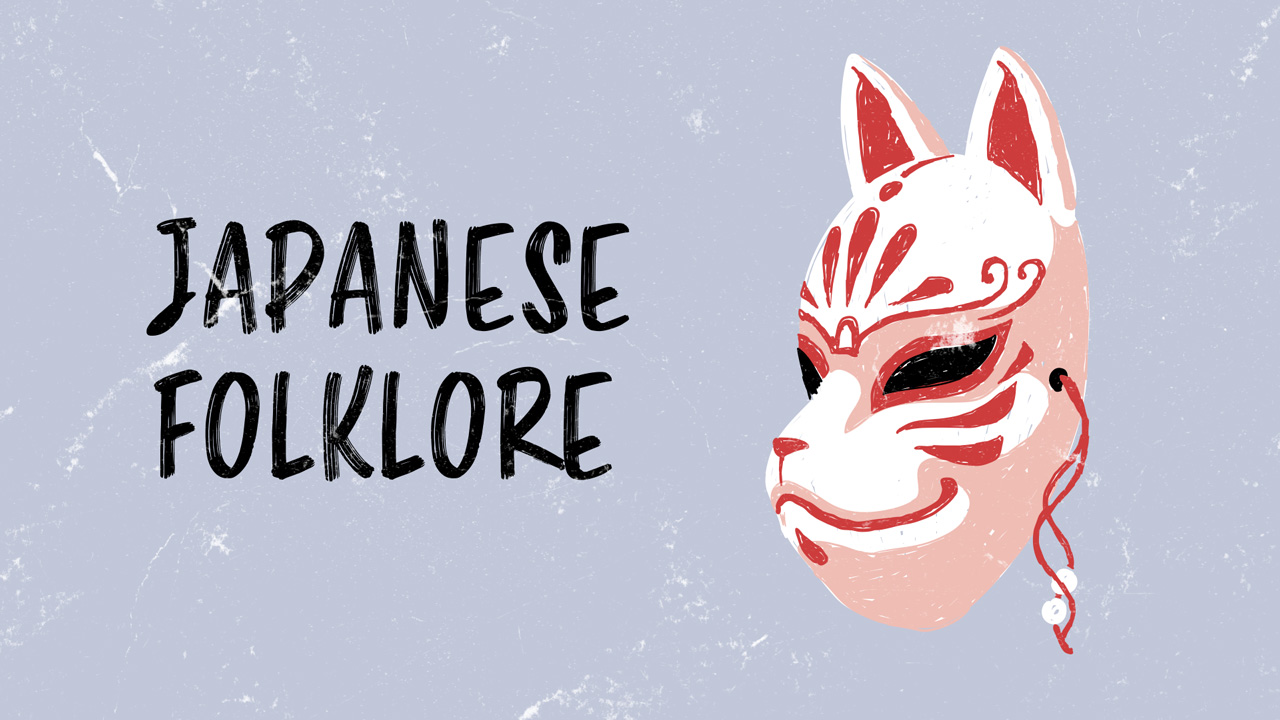
All About Japanese Folklore: Cool Creatures, Spirits, and Yokai from Folktales

Full disclosure: This post contains affiliate links. ?
If you’re a fan of Japanese pop culture, anime, manga, or movies, then you’ve probably experienced Japanese folklore.
Japanese folklore inspires plenty of anime, manga and games. Naruto draws on the nine-tailed fox, 九尾の狐 (kyūbi no kitsune), and many Pokémon borrow details from legendary creatures too.
Even Sailor Moon has loose inspirations from Kaguya-hime – a story you’ll learn about below!
Japanese folklore has deep cultural significance. Early works such as the Kojiki tell myths about the creation of the Japanese islands and connect the imperial line to the sun deity Amaterasu. Those are sacred and literary traditions, rather than straightforward historical accounts.
A useful Japanese term for folklore or folk tradition is 民間伝承 (minkan denshō).
You’ll also meet 神 (kami). The word can refer to deities, sacred beings, natural forces and other presences worthy of reverence. It isn’t a direct synonym for “god”, “ghost” or 妖怪 (yōkai).
Editor's note: Before we get started, if you’re looking for an online Japanese course, here’s the course we recommend: Japanese Uncovered – Learn Japanese Through the Power of Story, a course with a fascinating new method by Olly Richards. You can try it for free for 7 days!
Table of contents
Japanese Folklore Creatures
Japanese folklore includes kami, yōkai, auspicious animals, legendary heroes and much more. The categories overlap, but they aren’t interchangeable. The creatures below have all taken on new lives in Japanese pop culture.
Hōō: Japan’s Auspicious Phoenix
The 鳳凰 (hōō) is often translated as “phoenix”. It is related to the Chinese fenghuang, however, and it isn’t the fire-born, death-and-rebirth bird of Western legend. Pokémon fans may recognise the name from Ho-Oh.
Japanese artists show the hōō as a long-tailed mythological bird, often paired with paulownia. That pairing is an auspicious motif associated with virtuous rule.
Rather than measuring its “power”, it makes more sense to see the hōō as an auspicious symbol. It has been associated with virtue, peace and good government.
Kappa: The River Yōkai
河童 (kappa, also written かっぱ) are water-dwelling yōkai. Their appearance varies by region and retelling, though modern images often give them webbed limbs, a shell and a water-filled dish on top of the head.
Cucumbers and sumo wrestling are two of their best-known associations. Old-school Harvest Moon fans may already know about the cucumber offering.
In a common trick, a person bows to a kappa. When the polite creature bows back, the water spills from its head and it loses its strength. Regional traditions tell plenty of other versions.
Some kappa tales are much darker. They may drown people or animals, or try to steal a 尻子玉 (shirikodama).
The shirikodama is an imaginary ball said in some folklore to sit inside the body near the anus. It is a strange detail, but treating it as folklore rather than anatomy keeps the story in the right category.
Kitsune: Powerful Shapeshifters
You’ve probably seen 狐 (kitsune, “fox”) in Japanese pop culture. Think of Vulpix and Ninetales in Pokémon, Naruto’s nine-tailed fox, or the game Ōkami.
Foxes have an important place in Japanese culture and folklore, but anime versions often combine details from several traditions.
In many tales, foxes transform into people and trick, test or help the humans they meet. Foxes are also regarded as messengers of 稲荷大神 (Inari Ōkami). That’s why you’ll see fox statues at Inari shrines. Inari is not a fox.
Extra tails can signal a fox spirit’s age or power in some stories. The nine-tailed fox is the best-known example.
The nine-tailed fox motif has roots in China and developed different forms as it travelled through East Asia. Japanese storytellers made it part of their own fox-spirit traditions.
There is no single folklore rulebook that divides kitsune into 13 elemental types. Shrine traditions, local legends and later fiction use foxes in different ways, so check which tradition a claim comes from before treating it as universal.
Otters: Regional Shape-Shifters
The Japanese word for an otter is 獺 (kawauso). In some regional tales, supernatural otters disguise themselves as people or play tricks on travellers.
Some versions have them mimic voices; others give them a straw hat, a human form or a taste for sake. These are local story patterns, not fixed rules for every kawauso tale.
Like many shape-shifting animals in folklore, they can be comic, unsettling or both.
Tanuki: The Mischievous Raccoon Dog
狸 (tanuki) are Japanese raccoon dogs, real animals with a large supernatural reputation. If you’ve played Animal Crossing, you know one pop-culture version as Tom Nook.
Folklore often turns them into shape-shifting tricksters called 化け狸 (bake-danuki). Depending on the story, the trick can be funny, helpful or unsettling.
One motif is 狸囃子 (tanuki-bayashi): mysterious drumming heard at night. Art and later tales often show a tanuki beating its round belly like a drum.
Strange and Darker Japanese Folklore
妖怪 (yōkai) is a broad label for uncanny beings and phenomena. English translations include “monster”, “spirit” and “apparition”, but none covers the whole category. A yōkai may be dangerous, mischievous, helpful or simply strange.
Modern stories freely borrow from this visual and narrative vocabulary. That doesn’t make every anime spirit or monster a traditional yōkai, though; fictional creatures can be new creations or mixtures of several sources.
鬼 (oni) are often translated as “demons” or “ogres”. They are usually fearsome, horned figures, but their roles vary across religion, folktales, festivals and art. Fictional giants such as the Titans in Attack on Titan are not automatically oni.
お化け (obake) and 化け物 (bakemono) both come from the idea of changing or transforming. The terms overlap with yōkai rather than forming one tidy biological category. One famous example is the 女郎蜘蛛 (jorōgumo), a spider-like woman whose story changes from one telling to another.
テケテケ (Teke Teke) belongs to modern urban legend rather than old folktale tradition. In common versions, the ghost of a woman killed on railway tracks moves on her hands, making a “teke teke” sound. Some tellings describe her as an 怨霊 (onryō, “vengeful spirit”).
The details change in each retelling, including her identity, where she died and what happens to the people she catches.
雪女 (yuki-onna, “snow woman”) appears in legends from snowy regions. She is often a pale woman encountered during a storm, but her character varies: some versions make her lethal, while others make her mournful or even capable of living with humans.
網切 (amikiri, “net cutter”) is usually pictured with a bird-like beak, clawed limbs and a long segmented body. As its name suggests, stories and images associate it with cutting nets, though later retellings add their own details.
8 Famous Japanese Myths, Folktales, and Legends
These eight stories don’t all belong to the same category. Izanagi, Izanami and Amaterasu appear in creation myths. Momotarō and Hanasaka Jiisan are folktale heroes. Tanabata is a festival legend with Chinese roots, while Kaguya-hime comes from a literary tale that later entered popular folklore.
Izanagi and Izanami
The 古事記 (Kojiki, “Record of Ancient Matters”) was compiled in 712 and is Japan’s oldest extant literary work. It brings together myths, genealogies and accounts of early rulers, and it is one of the main sources for Japan’s creation myths.
In the Kojiki myth, the deities 伊邪那岐命 (Izanagi-no-Mikoto) and 伊邪那美命 (Izanami-no-Mikoto) create the Japanese islands and give birth to many more kami.
Izanami dies after giving birth to the fire deity Kagutsuchi. Izanagi follows her to 黄泉 (Yomi), the land of the dead, but fails to bring her back. During his purification after returning, Amaterasu, Tsukuyomi and Susanoo are born.
At the entrance to Yomi, Izanami vows that she will kill 1,000 people each day. Izanagi replies that 1,500 will be born. The exchange gives the myth an explanation for the cycle of death and birth.
Amaterasu Ōmikami: The Sun Goddess
In the Kojiki, the sun deity is 天照大御神 (Amaterasu Ōmikami), one of the central kami of Shinto tradition.
She appears during Izanagi’s purification, followed by the moon deity 月読命 (Tsukuyomi-no-Mikoto) and 須佐之男命 (Susanoo-no-Mikoto). The three are often called the “three noble children”.
Susanoo refuses the realm assigned to him and says he wants to go to the land of his mother. Before leaving, he visits Amaterasu in the heavenly realm of 高天原 (Takamagahara).
Amaterasu suspects a challenge. The pair hold a pledge contest, after which Susanoo runs wild. In the Kojiki, his violence causes the death of a weaving woman.
Amaterasu shuts herself inside the heavenly rock cave. Without the sun deity, heaven and earth fall into darkness.
The other kami devise a plan. Ame-no-Uzume dances, the assembled deities laugh and a mirror is placed outside the cave. Curious about the commotion, Amaterasu looks out and is drawn from hiding, bringing back the light.
Susanoo is banished from heaven and descends to Izumo. In the mythology recorded by the early chronicles, Japan’s imperial line is traced to descendants of Amaterasu. That is a mythic genealogy, not a claim that can be treated as ordinary history.
Momotarō and Oni Island
桃太郎 (Momotarō) is one of Japan’s best-known folktale heroes. In the common version, an old woman finds a giant peach floating down a river. She and her husband open it, and out comes a boy.
They name him Momotarō: 桃 (momo) means “peach”, and 太郎 (Tarō) is a traditional boy’s name. Other versions tell his arrival differently.
When he grows up, Momotarō sets out for 鬼ヶ島 (Onigashima, “Oni Island”). His parents give him 黍団子 (kibi dango), millet dumplings, for the journey.
Along the way, he meets a monkey, a pheasant, and a dog. He offers each of them one of his delicious dumplings if they join him, so they do.
Together, Momotarō and his animal companions defeat the oni. They return home with treasure, though the details and tone vary between retellings.
Hanasaka Jiisan
In 花咲か爺さん (Hanasaka Jiisan, “the old man who made flowers bloom”), a kind old couple care for a beloved dog. Nearby lives a greedy couple who copy everything they do.
The dog leads the kind man to buried treasure. The greedy neighbours borrow him, find only rubbish and kill him in anger.
The old couple bury their dog and grieve. His spirit then guides the old man through a series of dreams.
First, the dog tells him to make a mortar from a tree. Food made in it turns into treasure.
The greedy neighbours borrow the mortar, get a filthy result and burn it.
The old man keeps the ashes. When he scatters them over dead trees, they burst into blossom. A 大名 (daimyō, “feudal lord”) sees the wonder and rewards him.
The greedy neighbour tries the same trick, but the ashes blow into the daimyō’s eyes and he is punished. As with many folktales, editions differ on the final details.
Issun-bōshi
In 一寸法師 (Issun-bōshi), a couple wish for a child and receive a tiny son just one 寸 (sun) tall. That is about 3.03 cm.
His name means something like “one-sun boy”. Armed with a needle for a sword and a bowl for a boat, he sets off for the capital.
He enters the service of a noble household. When an oni attacks the young woman he is accompanying, Issun-bōshi fights it.
The oni swallows him, but Issun-bōshi stabs it from the inside with his needle. The creature spits him out and flees.
The oni leaves behind a wish-granting mallet called the 打ち出の小槌 (uchide no kozuchi). It restores Issun-bōshi to full size.
In the familiar ending, Issun-bōshi marries the young woman and prospers. Older versions contain extra twists, so children’s editions often simplify the story.
Omusubi Kororin: The Rolling Riceball
おむすびころりん (Omusubi Kororin) is a popular children’s tale. An old man stops for lunch on a hill, carrying rice balls called おむすび (omusubi) or おにぎり (onigiri).
He drops one, and it rolls into a hole. The title plays on ころころ (korokoro), a Japanese sound-symbolic word for something small and round rolling along.
When the man goes to get his rice ball, he hears voices from inside the hole singing, “The rice ball came rolling, rolling, rolling, rolling.”
The old man thinks this is strange and amusing, so he rolls another rice ball into the hole and hears the song again. This time, though, he leans in to listen and falls into the hole.
Inside are a bunch of mice, overjoyed by the food. So they offer to give him a reward of gold coins.
A greedy neighbour follows him and tries to frighten the mice by pretending to be a cat. His trick backfires, giving the tale its familiar warning against greed.
Tanabata
七夕 (Tanabata) is commonly celebrated on 7 July, though some regions hold it on 7 August or another date based on the older lunar calendar. Its best-known legend gives two star-crossed lovers one meeting each year.
The Japanese festival story grew from the Chinese Qixi legend and blended with local customs. 織姫 (Orihime) is associated with Vega, and 彦星 (Hikoboshi) with Altair. When they neglect their work, Orihime’s father, 天帝 (Tentei), separates them.
The Milky Way divides the pair, but they are allowed to meet on the seventh night of the seventh month. Rain is sometimes said to prevent the reunion.
Today, people often write wishes on colourful strips of paper called 短冊 (tanzaku) and hang them from bamboo. The festival date comes from the legend and calendar tradition, not from Vega and Altair reaching their closest point.
Kaguya-hime
かぐや姫 (Kaguya-hime) comes from 竹取物語 (Taketori Monogatari, “The Tale of the Bamboo Cutter”), a literary tale from around the tenth century. A bamboo cutter finds a tiny girl inside a glowing bamboo stalk and raises her.
The girl grows into a beautiful young woman, while the cutter finds wealth inside more bamboo. Kaguya-hime sets impossible tasks for her suitors, and none succeeds. She also exchanges poems with the Emperor.
Kaguya-hime eventually reveals that she belongs to the Moon. A celestial procession takes her home, despite the guards sent to stop it. She leaves the Emperor a letter and an elixir of immortality, which he refuses to drink.
Explore More Japanese Folklore
Which of these myths, folktales and legends surprised you most?
If Japanese folklore is your thing, I wrote a whole article on Japanese ghost stories to learn even more. There are also some really cool books about it, such as The Book of Yokai: Mysterious Creatures of Japanese Folklore.

Social