


French Subjunctive: When to Use It and How to Form It

Full disclosure: This post contains affiliate links. ?
Le subjonctif, or the French subjunctive, can feel tricky at first. It is a verb mood, and that mood has several tenses. This guide focuses on the present subjunctive and briefly covers the past subjunctive.
French uses the subjunctive in particular subordinate clauses after certain verbs, expressions and conjunctions. Many involve wishes, emotion, doubt, judgement, necessity or purpose, but the reliable approach is to learn the trigger together with an example.
I know that can sound vague. I thought so too when I first learnt about the subjunctive as a 17-year-old secondary-school student.
After more than ten years with French and a degree in the language, I find it most useful to understand the main patterns and memorise common triggers with complete phrases. The forms then become easier to notice and reuse.
Table of contents
Editor's note: Before we get started, if you’re looking for an online French course, here’s the course we recommend: French Uncovered – Learn French Through the Power of Story, a course with a fascinating new method by Olly Richards. You can try it for free for 7 days!
What Is the Subjunctive?
The subjunctive is a verb mood. In modern everyday French, you will mainly meet its present and past forms. Its use depends on the construction: meaning helps explain many triggers, but meaning alone does not predict every case.
English has traces of a similar mood in phrases such as “If I were” and “It is necessary that he be here”. Treat that only as a rough comparison. French has its own triggers, and a French si clause does not take the subjunctive simply because it is hypothetical.
Start with “It is necessary that you do your homework.” In French, “it is necessary that” is il faut que. This construction takes the subjunctive: Il faut que tu fasses tes devoirs. Here, fasses is the present subjunctive of faire (“to do”).
Another example is Je veux que tu sois heureuse, “I want you to be happy”, addressed here to a woman. Sois is the present subjunctive of être. The construction vouloir que expresses a wish about another subject and takes the subjunctive.
Both examples contain que because the subjunctive often appears in a subordinate clause introduced by que. But que itself is not a trigger. The verb, expression or conjunction before the clause determines which mood is required.
Many factual statements in essential French phrases use the indicative mood:
- Je fais mes devoirs. “I do my homework.”
- Il est fatigué. “He is tired.”
- Ça fait deux heures que j’attends. “I’ve been waiting for two hours.” (We don’t need the subjunctive here since we stated a fact.)
The subjunctive is common in everyday French, so you will encounter it in conversation, films, books and songs.
When to Use the Subjunctive
We already mentioned that the subjunctive in French is a verb mood, used in specific cases for specific feelings. But what are those feelings and cases? Let’s take a more detailed look:
After Expressions of Doubt, Emotion, Need, or Uncertainty
Many expressions of doubt, emotion, desire or judgement take the subjunctive before a subordinate clause. Learn the expression as a trigger rather than assuming every uncertain statement behaves the same way.
- Je doute qu’il vienne. “I doubt that he will come.”
- J’ai peur qu’il ne soit en retard. “I’m afraid that he will be late.” Here, ne is optional and expletive; it does not make the clause negative.
- Je suis triste que tu ne sois pas ici. “I’m sad that you’re not here.”
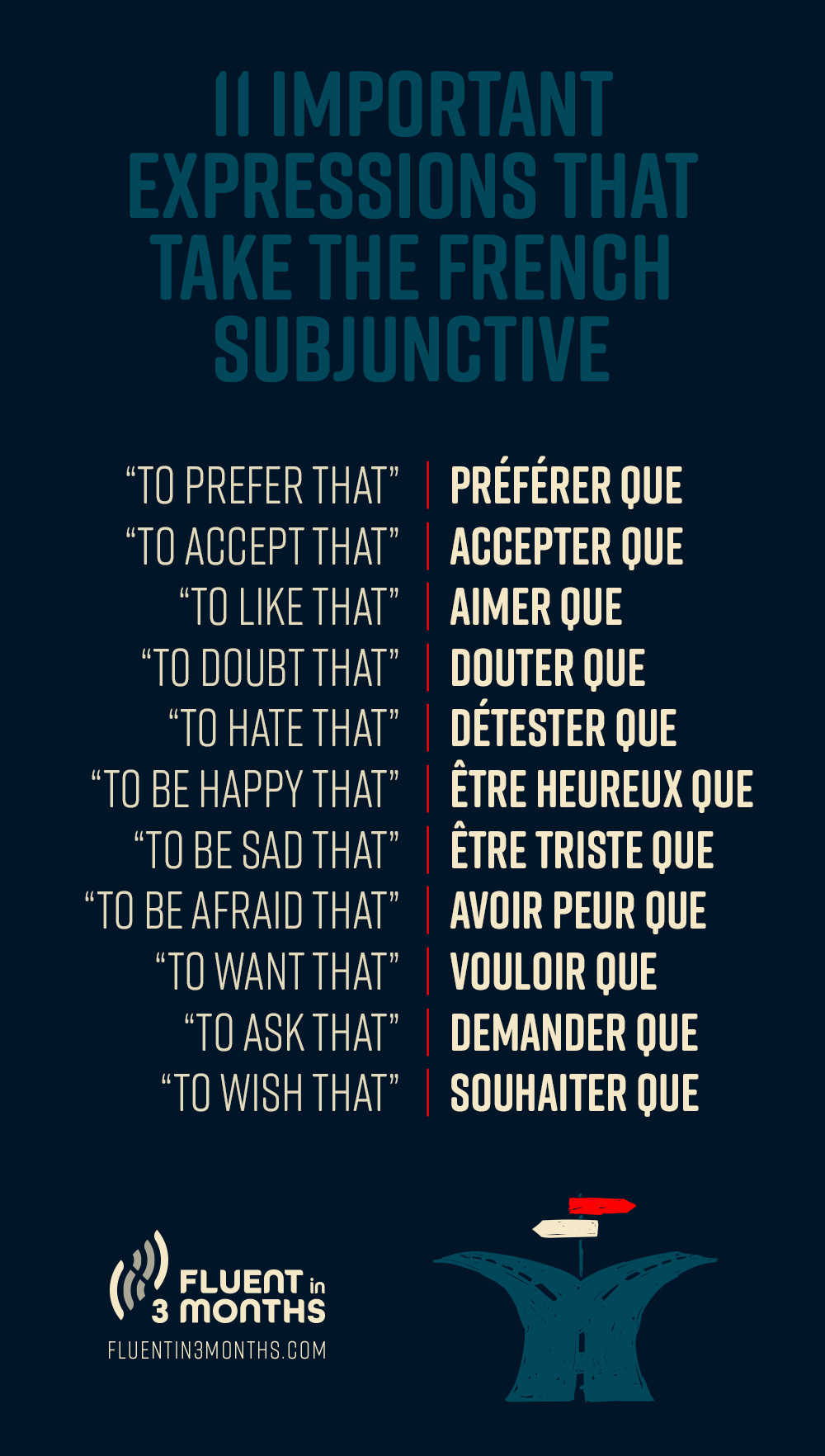
Start by checking out these expressions that require the subjunctive in French. You’ll hear them often, be it on the news, in discussions with friends, or in podcasts:
| English | French | Audio |
|---|---|---|
| “to prefer that” | préférer que | |
| “to accept that” | accepter que | |
| “to like that” | aimer que | |
| “to doubt that” | douter que | |
| “to hate that” | détester que | |
| “to be happy that” | être heureux que | |
| “to be sad that” | être triste que | |
| “to be afraid that” | avoir peur que | |
| “to want that” | vouloir que | |
| “to ask that” | demander que | |
| “to wish that” | souhaiter que |
After Certain Impersonal Expressions
Some impersonal expressions built with il express necessity, judgement, possibility or emotion and take the subjunctive. Others take the indicative, so learn the complete expression.
- Il faut que tu viennes me voir. “It is necessary that you come see me.”
- Il est dommage que tu ne puisses pas venir. “It’s a pity that you cannot come.”
- Il est important que vous soyez à l’heure. “It is important that you be on time.”
- Il vaut mieux qu’on parte maintenant. “It is better that we leave now.”
- Il est possible que je vienne demain. “It is possible that I will come tomorrow.”
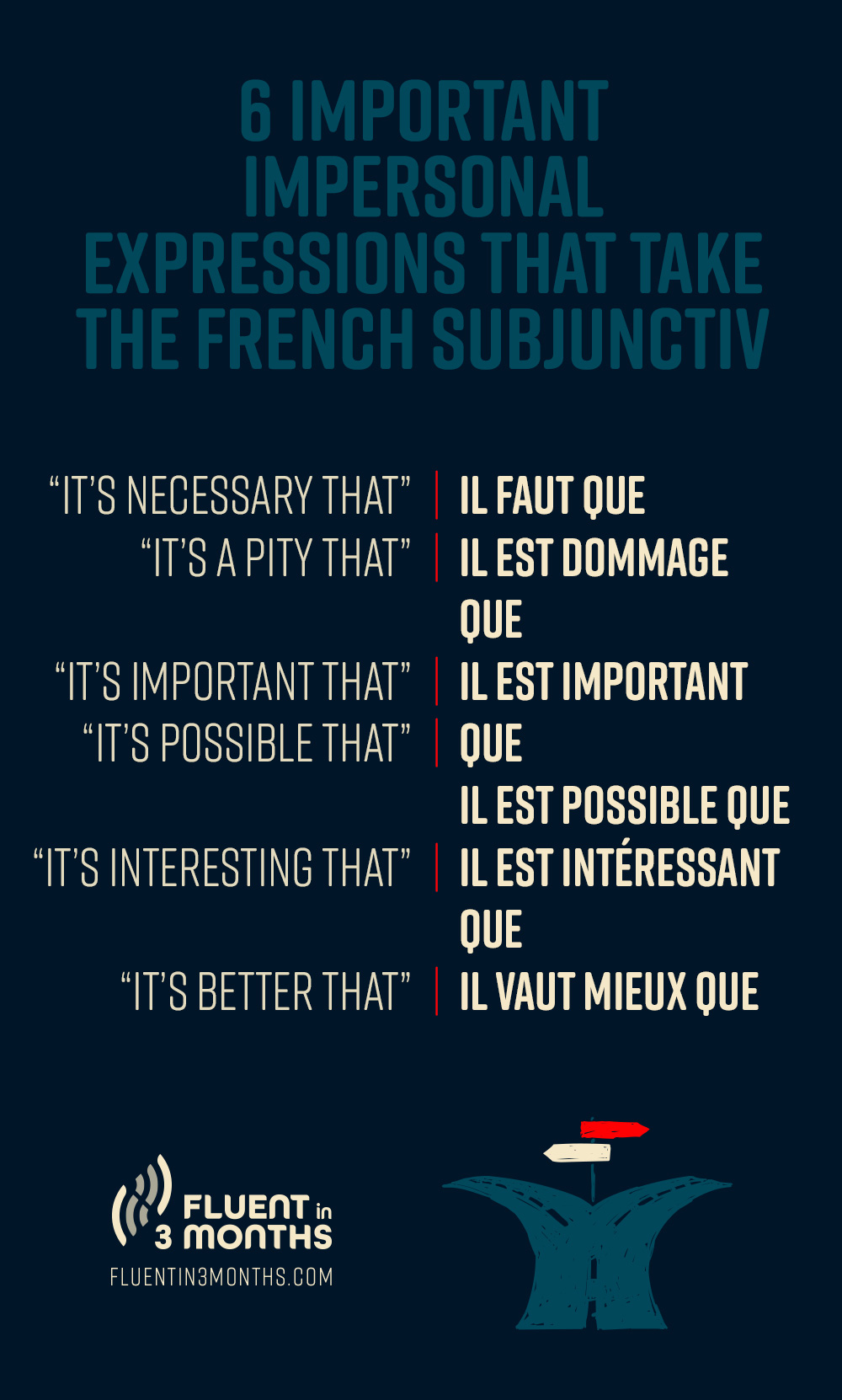
Not every impersonal expression takes the subjunctive. For example, affirmative il est clair que (“it is clear that”) normally takes the indicative. Here are common expressions that take the subjunctive:
| English | French | Audio |
|---|---|---|
| “It’s necessary that” | Il faut que | |
| “It’s a pity that” | Il est dommage que | |
| “It’s important that” | Il est important que | |
| “It’s possible that” | Il est possible que | |
| “It’s interesting that” | Il est intéressant que | |
| “It’s better that” | Il vaut mieux que |
After Certain Conjunctions
Certain conjunctions require the subjunctive. Standard French uses the subjunctive after avant que (“before”) and the indicative after après que (“after”), even though the subjunctive is often heard after après que in informal usage. Learn the mood with the conjunction rather than trying to derive every choice from uncertainty alone.
Here are some example sentences with conjunctions that require the subjunctive.
- Appelle-moi avant que tu partes. “Call me before you leave.”
- Je t’aide à étudier pour que tu puisses réussir à l’examen. “I help you study so that you can pass the exam.”
- Elle est perfectionniste. Elle va travailler sur le projet jusqu’à ce qu’il soit parfait. “She’s a perfectionist. She will work on the project until it’s perfect.”
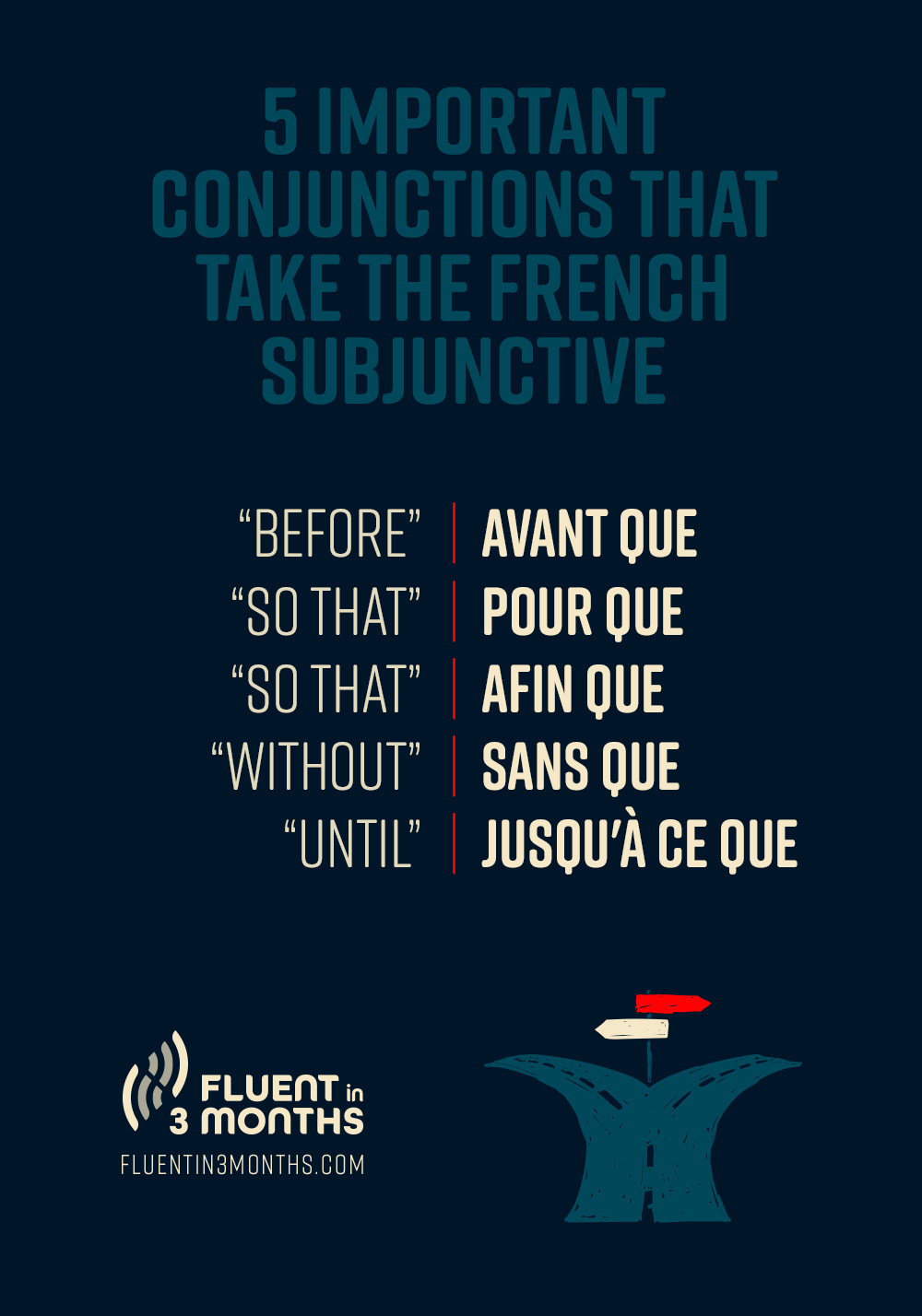
| English | French | Audio |
|---|---|---|
| “before” | avant que | |
| “so that” | pour que | |
| “so that” | afin que | |
| “without” | sans que | |
| “until” | jusqu'à ce que |
Forming the Subjunctive
Now that we’ve covered when to use the subjunctive mood, let’s look at how to put French verbs in the subjunctive form.
Regular Verb Conjugations
Regular verbs follow a consistent set of present-subjunctive endings.
For a regular -er verb such as parler, start from the third-person plural present indicative, ils/elles parlent, and remove -ent to get parl-. Add -e, -es, -e, -ions, -iez and -ent. The nous and vous forms match the present indicative here.
Parler (to speak)
que je parle
que tu parles
qu’il/elle/on parle
que nous parlions
que vous parliez
qu’ils/elles parlent
For a regular second-group -ir verb such as finir, ils/elles finissent gives the stem finiss-. Add the same endings: -e, -es, -e, -ions, -iez and -ent.
Finir (to finish)
que je finisse
que tu finisses
qu’il/elle/on finisse
que nous finissions
que vous finissiez
qu’ils/elles finissent
Irregular Verbs
Many of the most common French verbs change their stem in the subjunctive. Notice them first in material you read or hear, then practise retrieving them inside a complete trigger phrase.
Here are the subjunctive forms for some key irregular verbs:
| English Verb | French Verb | Subjunctive Conjugation |
|---|---|---|
| “To be” | Être | que je sois que tu sois qu'il/elle/on soit que nous soyons que vous soyez qu'ils/elles soient |
| “To have” | Avoir | que j'aie que tu aies qu'il/elle/on ait que nous ayons que vous ayez qu'ils/elles aient |
| “To go” | Aller | que j'aille que tu ailles qu'il/elle/on aille que nous allions que vous alliez qu'ils/elles aillent |
| “To do” | Faire | que je fasse que tu fasses qu'il/elle/on fasse que nous fassions que vous fassiez qu'ils/elles fassent |
| “To come” | Venir | que je vienne que tu viennes qu'il/elle/on vienne que nous venions que vous veniez qu'ils/elles viennent |
| “To know” | Savoir | que je sache que tu saches qu'il/elle/on sache que nous sachions que vous sachiez qu'ils/elles sachent |
| “To be able to” | Pouvoir | que je puisse que tu puisses qu'il/elle/on puisse que nous puissions que vous puissiez qu'ils/elles puissent |
| “To take” | Prendre | que je prenne que tu prennes qu'il/elle/on prenne que nous prenions que vous preniez qu'ils/elles prennent |
How to Use the Subjunctive in the Past Tense
To form the subjonctif passé, use the present-subjunctive form of avoir or être, followed by the past participle.
- Il est dommage qu’elle ne soit pas venue. “It’s a pity that she didn’t come.”
- Je doute qu’ils aient compris la leçon. “I doubt that they understood the lesson.”
Tips for Remembering the French Subjunctive
The subjunctive becomes easier to retrieve with repeated exposure and use. A wrong mood may be noticeable, but it does not have to stop the conversation. Here are some focused ways to practise.
Look for Patterns
This article gives more than 20 expressions and conjunctions that take the subjunctive. Start with a few that you expect to use, and study each one with a complete example rather than as an isolated label.
For example, a finite clause after il faut que takes the subjunctive. In Il faut que j’aille (“I need to go”), aille is the present subjunctive of aller (“to go”). Learn the whole chunk, then swap in another subject or verb.
Study Irregular Verb Forms
As we saw earlier, many common verbs are irregular in the subjunctive. Once you’ve learned some key phrases that take the subjunctive, move on to study irregular verbs:
- Il faut qu’il aille au supermarché. “He needs to go to the supermarket.” Use qu’il aille, not qu’il va.
- Je doute qu’ils aient de l’argent. “I doubt that they have money.” Use qu’ils aient, not qu’ils ont.
- Je suis heureuse que tu sois là. “I’m happy that you’re here.” Use que tu sois, not que tu es.
Practising with Authentic Examples
Look for the subjunctive in French films, conversations and songs.
Take Céline Dion’s Pour que tu m’aimes encore. The title means “so that you still love me”, and pour que requires the subjunctive. The song also includes Je veux que tu saches, “I want you to know”. Here, saches is the present subjunctive of the irregular verb savoir.
What to Do When You Can’t Remember the Subjunctive Form
Try the subjunctive when you can retrieve it. If a form disappears mid-sentence, you can sometimes rephrase with an infinitive or another construction. Preserve the meaning and check that the new structure is grammatical; simply deleting que is not a general rule.
Here are some examples:
Il faut que tu sois là means “You need to be here.” The finite clause after il faut que requires the subjunctive. A similar sentence is:
Tu dois être là. “You need to be here.” In this construction, the conjugated verb dois is followed by the infinitive être.
Keep Building the French Subjunctive
Start by recognising the subjunctive, learn a few high-value triggers, then use those phrases in short sentences. With the right study habits, the pattern becomes more familiar each time you meet it.

Social