


Best Podcast to Learn Greek? GreekPod101 In-Depth Review With Pros and Cons

Full disclosure: This post contains affiliate links. ?
What is GreekPod101?
GreekPod101 is part of the Innovative Language family of podcast-based courses, covering Greek from Absolute Beginner to Advanced. Audio and video lessons taught by native speakers are its main feature.
- what it’s for:
- Learning the Greek alphabet, building core vocabulary, everyday conversation, grammar and pronunciation practice, structured beginner-to-advanced study
- languages:
- Greek
- level:
- Absolute Beginner to Advanced
+ PROS
- Loads of lessons across 92 pathways and all levels
- Useful alphabet resources once you find them
- The 2,000 core-word list is a brilliant vocabulary shortcut
- Voice-recorder tool tackles Greek’s phonemic stress head-on
- Actively maintained with new lessons most weeks
- Every lesson includes a downloadable transcript and notes PDF
- CONS
- Too much English and transliteration in early lessons
- Pronunciation and audio tools are Premium, not Basic
- Advanced material is comparatively thin
- Feedback is limited to quiz scores below Premium PLUS
- The mobile app doesn’t have all the best features
Quick Fire Review
A well-organised, etymology-friendly way into a genuinely tricky language. 4.5/5.
Greek sits in a strange middle ground when it comes to difficulty. The US Foreign Service Institute puts it in Category III, alongside Russian, Turkish and Vietnamese, at roughly 1,100 hours of study for a diplomat to reach professional working proficiency. That's way past the 600-750 hours needed for French or Spanish, but nowhere near the 2,200 hours of Category IV languages like Arabic, Mandarin or Japanese. Greek is properly hard; it's just not the hardest.
My team at Fluent in 3 Months has used Innovative Language's Pod101 and Class101 courses for several of our language missions over the years, and I've always found them a solid, honest way to get a real foothold in a language fast. So when it came time to look at Greek, GreekPod101 was the obvious course to put under the microscope. The question I actually wanted answered was whether GreekPod101 handles the specific things that make Greek difficult, or treats it like any other language with a different vocab list bolted on.
What Makes Greek Different
Before judging any course, you need to know what it's up against. Greek puts a handful of real walls in front of learners, and a couple of surprising doors too.
A whole new alphabet. The first wall is the Greek alphabet itself: 24 letters, in continuous use since the 8th century BC, and holding a special place in linguistic history as the first alphabet to write vowels explicitly rather than leaving them to guesswork. That's not a Latin script with a few odd accents on it, and it's not an abjad like Arabic or Hebrew where you infer the vowels. It's its own system, and you have to learn it before you can read a single word of real Greek.
Four cases, three genders. Once you're past the alphabet, the grammar takes over. Modern Greek has four grammatical cases (nominative, genitive, accusative and vocative), which sounds brutal until you compare it to Russian's six, or even Ancient Greek's five. Every noun, pronoun and adjective declines by case, gender (masculine, feminine or neuter) and number all at once, so a single word can wear several different endings depending on its job in the sentence.
Verb conjugation and a voice English doesn't have. Greek verbs conjugate for person, number, tense, mood and voice. That last one is the tricky part: alongside active and passive, Greek has a mediopassive voice with no real English equivalent, roughly capturing actions the subject does to or for itself. On top of that, many verbs switch to a separate past-tense (aorist) stem, plus an added initial έ- called the augment, so γράφω (“I write”) becomes έγραψα (“I wrote”) and the past form doesn't always look like a variation on the form you already know. You often just have to learn it as a new word.
Stress that changes meaning. Modern Greek uses a single accent mark, the tonos, to show which syllable carries the stress (this replaced the old polytonic system of multiple accent marks, dropped by Greek law back in 1982). That sounds like a small thing, but stress is phonemic in Greek, meaning moving it can change what a word means entirely: πότε (pó-te) means “when”, while ποτέ (po-té) means “never”. Get lazy with where you put the emphasis and you can end up saying something completely different from what you intended.
Ancient Greek isn't Modern Greek, and that's the fun part. Ancient and Modern Greek aren't mutually intelligible without dedicated study, and the gap is bigger than the one between modern English and Chaucer. But there's a brilliant payoff hiding in that history for anyone who loves language: around 5% of English dictionary words come straight from Greek, and a far bigger share of scientific and technical vocabulary. Psychology comes from psyche and logos; geography, democracy and telephone follow the same pattern, along with hundreds of others. English speakers get way faster vocabulary recognition in Greek than in most other Category III languages, because you've already got the roots rattling around in your head from science class.
The good news: Greek spelling is honest. After all that, there's a counterbalance that makes the whole thing feel fairer. Once you actually know the alphabet, Greek spelling is highly phonetic. Words are said almost exactly as they're written, with very few of the silent-letter traps that make English or French spelling such a nightmare. Learn the letters properly and reading Greek out loud stops being scary remarkably quickly.
Getting Started with GreekPod101
Signing up costs nothing and takes about a minute: a free lifetime account with just an email address, no card required, then pick your starting level from Absolute Beginner up to Advanced. If you're not sure where you land, don't stress; you can change it later, and the site describes what you should already know at each level.
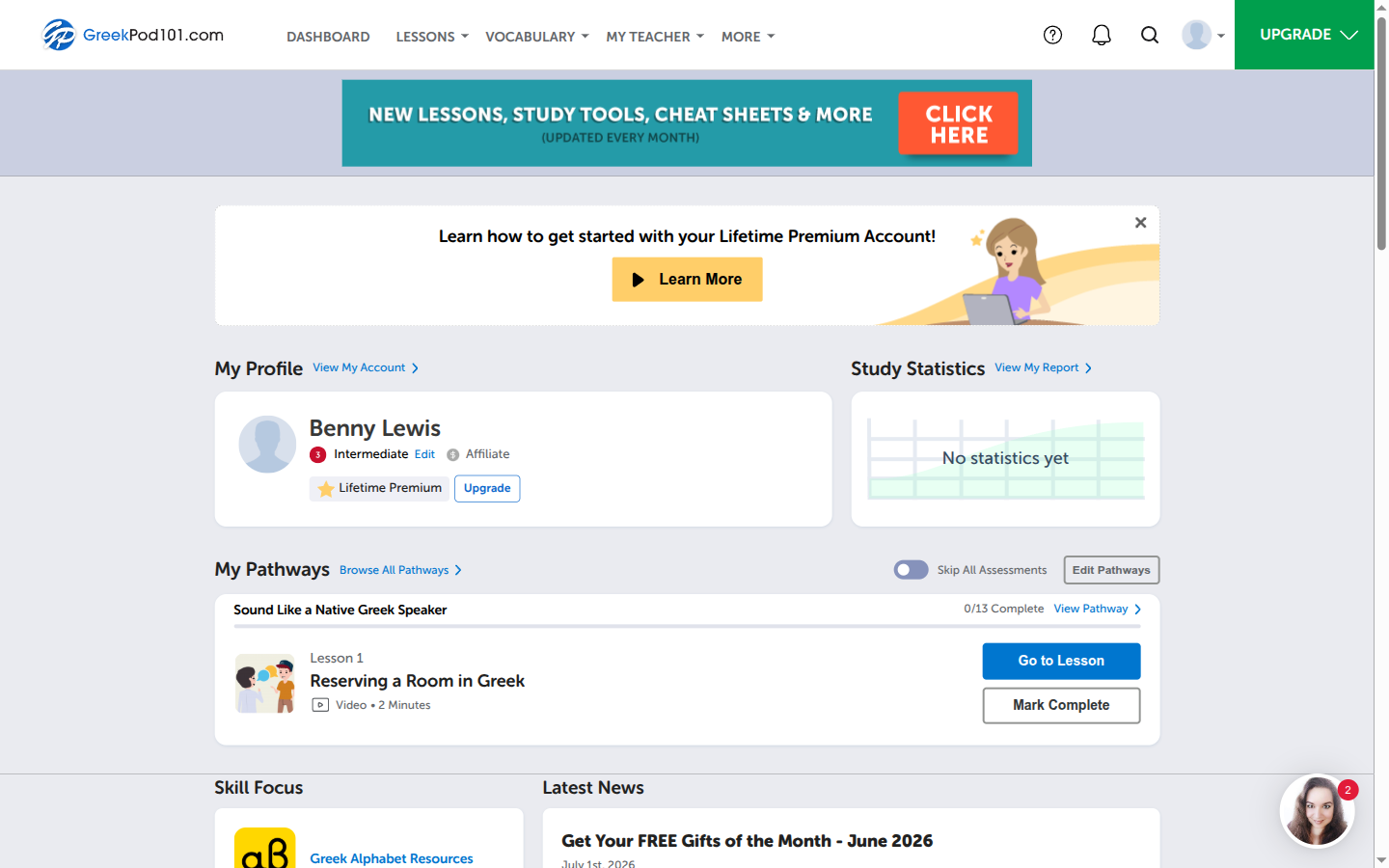
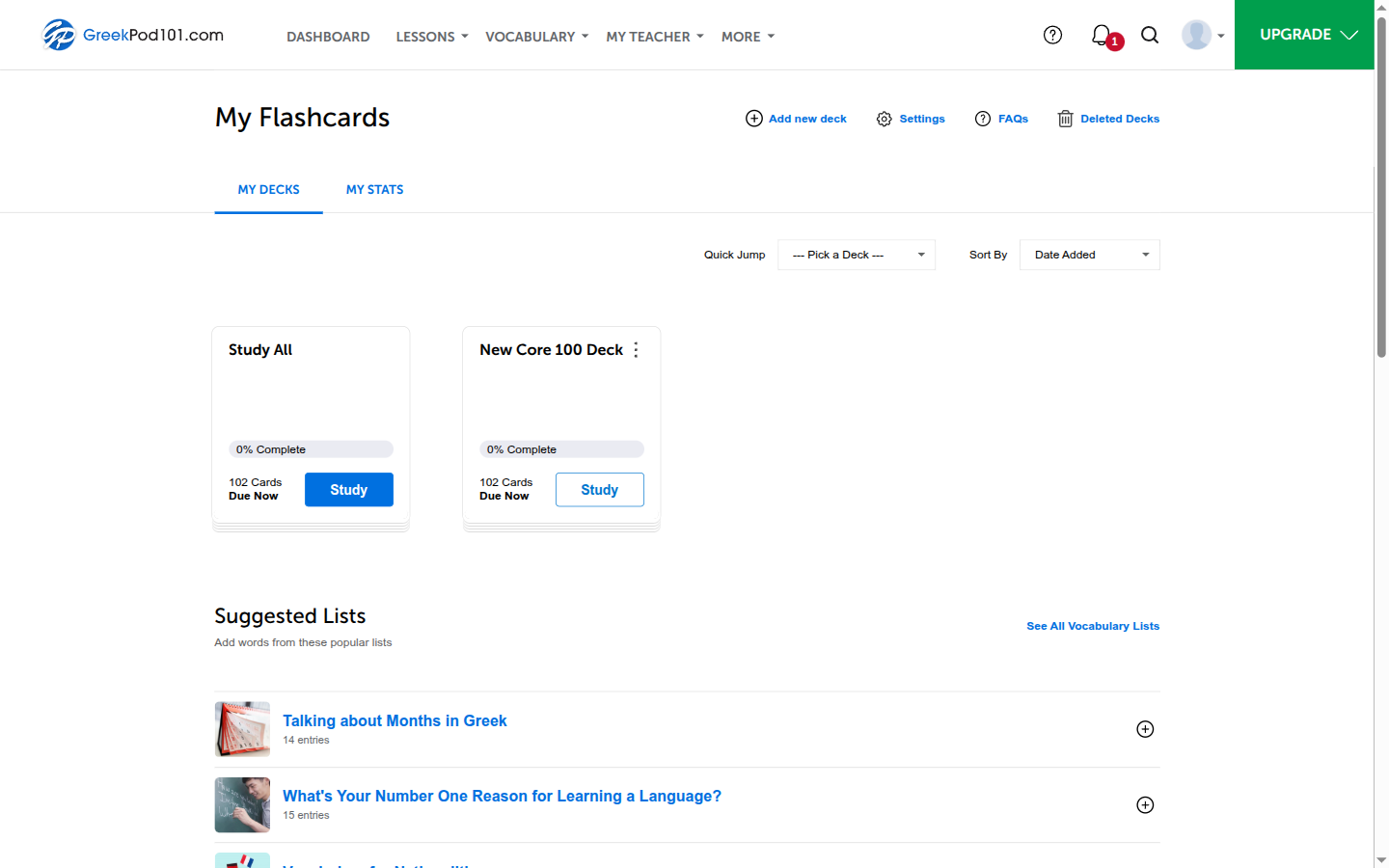
Once you're in, GreekPod101 builds you a guided learning path for your level, so you're not left wondering where to start. Your dashboard shows the newest lessons, vocab lists, and a running tally of lessons completed and hours studied, a nice little nudge to keep going.
The Alphabet and Pronunciation
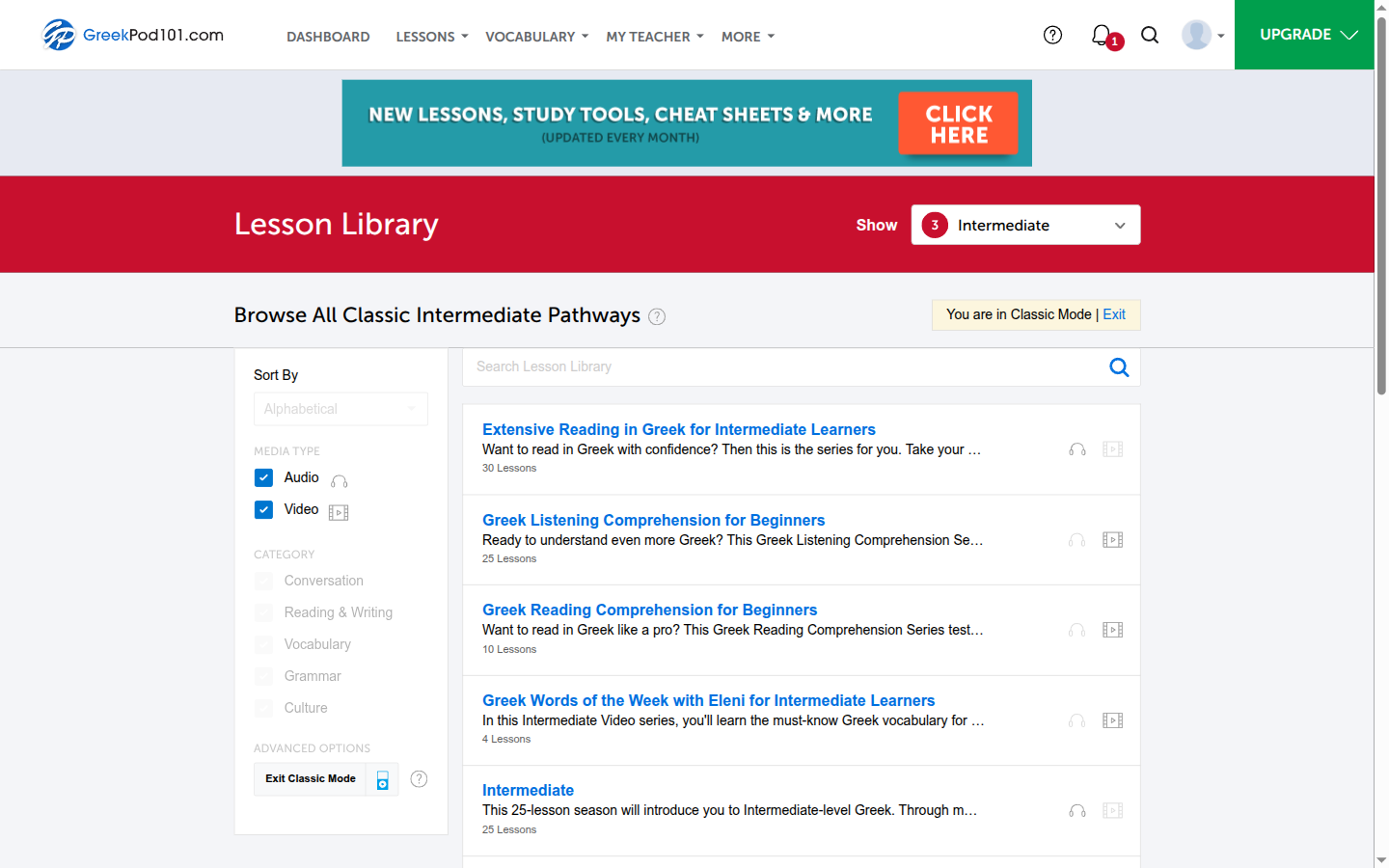
Given that the alphabet is the first wall for most learners, I wanted to see how seriously GreekPod101 treats it. The honest answer is that it treats it as important, but secondary. The site's own alphabet section is upfront that early vocabulary is taught “through transliterated words,” meaning English letters standing in for Greek sounds, aimed at learners who mainly want to speak rather than read from day one. Serious learners are told they'll “eventually need” the real script, but it's not forced on you from lesson one the way a Japanese course has to force kana early.
That said, the actual alphabet material is decent once you go looking for it. There's a free Greek Alphabet eBook with worksheets and stroke order, a numbered “Greek Alphabet Made Easy” series that starts right at the vowels, and a paid “Ultimate Greek Pronunciation Guide” series for anyone who wants to go deeper on sound rules. One catch if you're comparing plans: the line-by-line audio tool and the voice-recorder pronunciation tool, which let you record yourself and compare it against a native speaker at full or half speed, are Premium features, not Basic. If you're assuming the cheaper tier covers proper pronunciation practice, it doesn't.
Inside a GreekPod101 Lesson
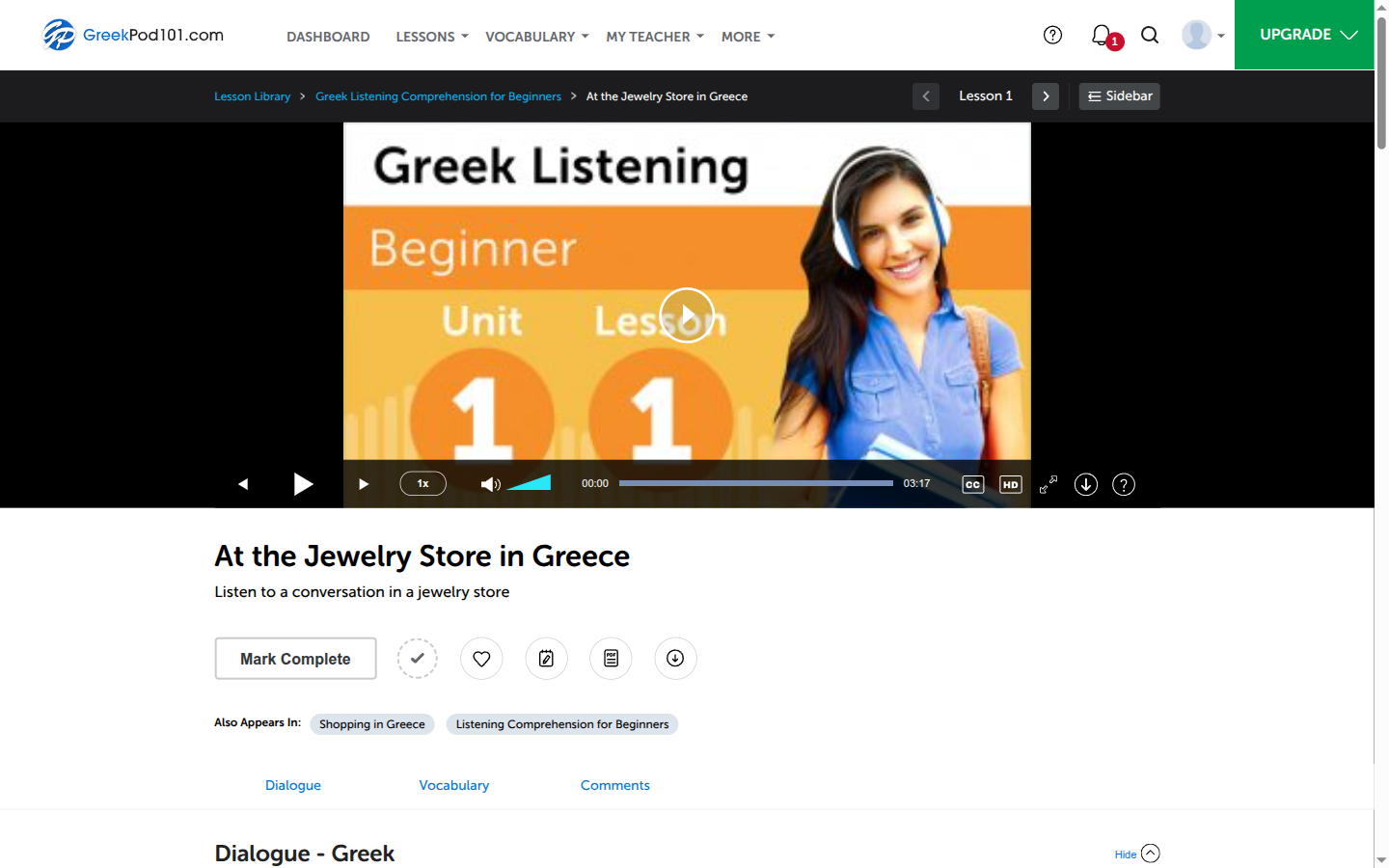
Most lessons run 3-15 minutes, and the format is consistent enough that you always know what you're getting: an audio dialogue between a native Greek speaker and a native English speaker, a phrase-by-phrase breakdown of that dialogue, a vocab list with audio for every word, a grammar point explained in plain English, and usually a cultural note thrown in too. Everything comes with a downloadable lesson-notes PDF, so you're not stuck relying on your memory of the audio alone.
The vocab and dialogue audio is where the alphabet-versus-transliteration question shows up again in practice: earlier lessons lean heavily on transliterated Greek and English explanation, and that thins out considerably as you move into the Upper Intermediate and Advanced levels, where the hosts chat more naturally and the training wheels come off. It's a reasonable trade-off for a course trying to serve absolute beginners and confident learners from the same catalogue, but it does mean the early stretch feels more English-heavy than some learners will expect.
Study Tools
Once you're on Premium, GreekPod101 opens up its full set of study tools: SRS flashcard decks built from the actual lesson vocab, a word bank you can build up as you go, a grammar bank collecting every grammar point you've covered, and assessments to check your progress. There's also a curated list of the 2,000 most common Greek words by frequency, a real shortcut given how much of Greek's early vocabulary load comes from unfamiliar roots rather than the cognate freebies of, say, Spanish or French.
The voice-recorder pronunciation tool sits in this Premium bracket too, letting you record yourself reading vocab or dialogue lines and play it back next to the native audio. For a language where stress changes meaning, it's one of the most useful tools on the whole platform, and a shame it's gated rather than sitting in Basic where more beginners would stumble onto it early.
The GreekPod101 App
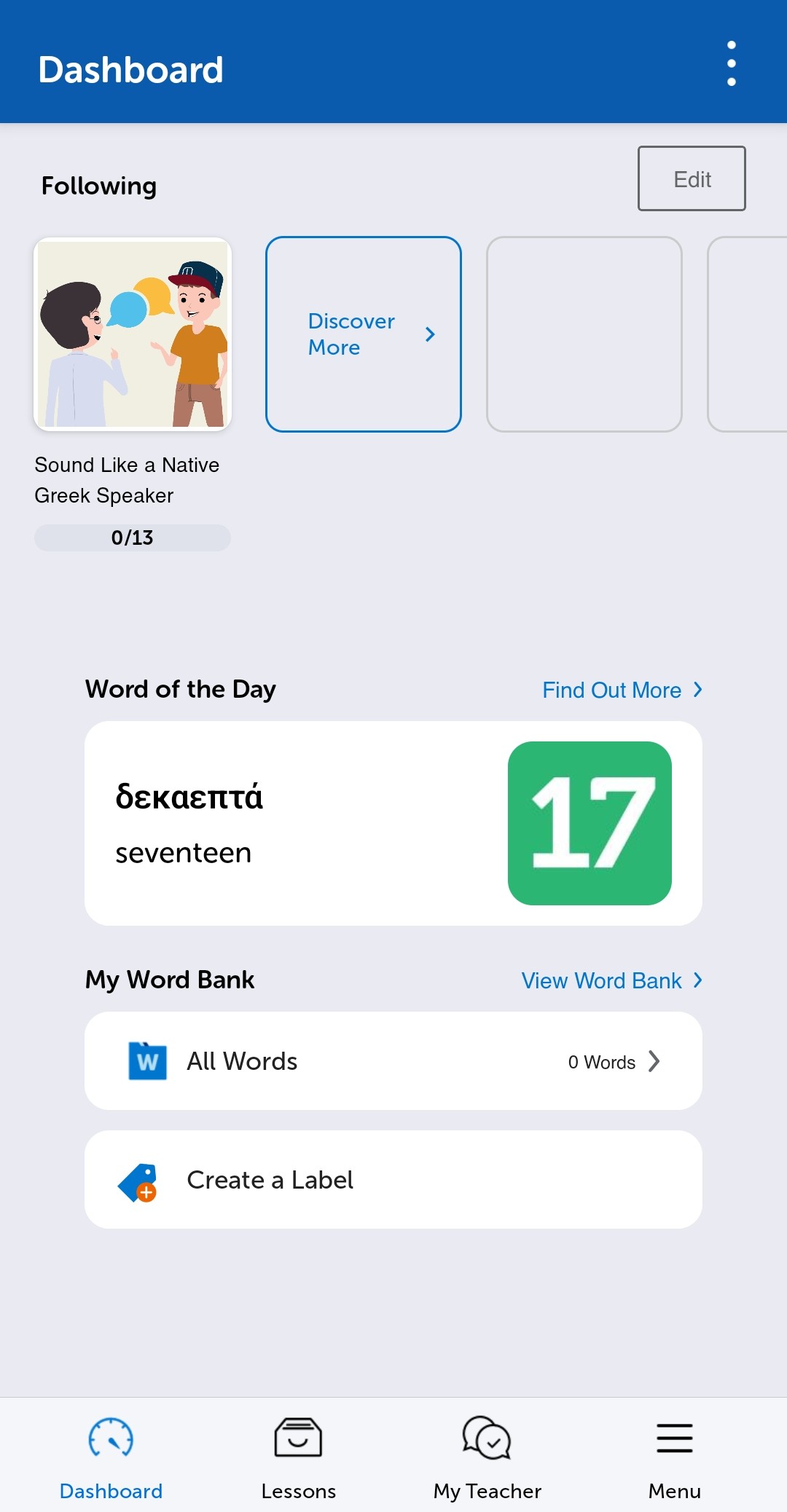
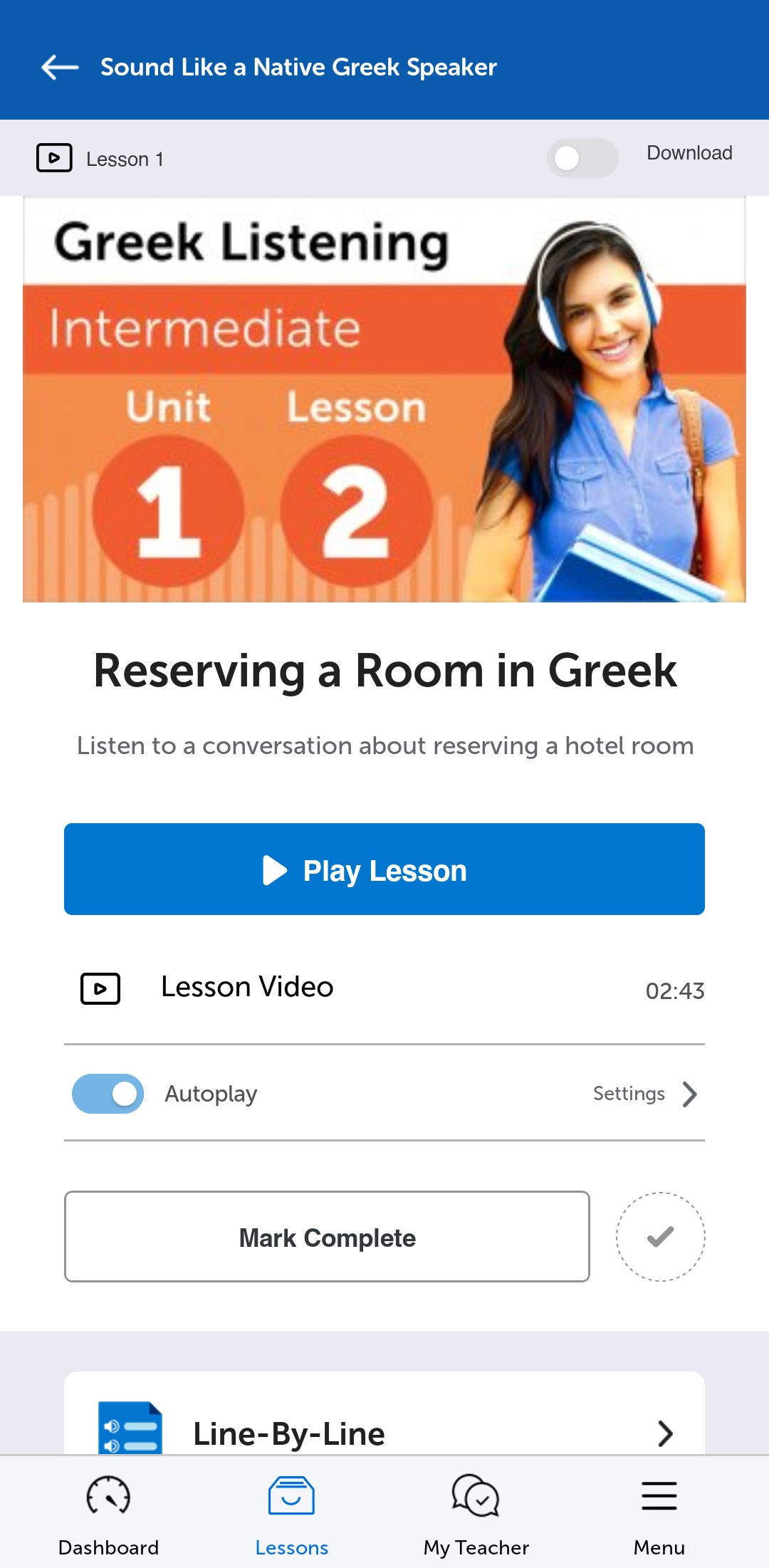
GreekPod101 runs inside the shared Innovative Language 101 app, the same one used across all their language courses, so there's no Greek-specific app store rating to point to (the closest signal is GreekPod101's long-running Apple Podcasts show, which is well rated and updated several times a week). Your progress syncs cleanly between desktop and mobile, and each lesson on the app still gives you the audio, dialogue, line-by-line playback and vocab list.
Where the app falls down, in line with the rest of the Innovative Language family, is the guided study path and quizzes. You can't follow your structured learning path or take practice assessments from the app; you have to pick a season and episode manually. The workaround, and the one our team has used on other Pod101 courses, is opening GreekPod101 in your phone's browser when you want the full study-path experience away from your desktop.
What Other Learners Say
Sentiment around GreekPod101, across blogs and Greek-learning communities like r/GREEK, lands pretty consistently. People praise the sheer volume on offer (a huge lesson catalogue organised into pathways for every level), how much you get for the price, and how much stronger it is than free options like Duolingo for building vocabulary and useful everyday phrases. The instructors come across as engaging, and the transcript-plus-flashcard combo on every lesson comes up as a favourite feature again and again.
The honest criticisms cluster around three things: too much English in the early lessons (it improves markedly by Upper Intermediate, but it's a real drag if you're hoping for immersion from day one); feedback below Premium PLUS limited to quiz scores rather than anything personal; and, most commonly cited, a comparatively thin advanced catalogue. It's strong for beginners through intermediate, but the material thins out past that stage, and more than one reviewer describes it as best used alongside a tutor or conversation partner rather than as a replacement for one.
Pricing and Plans
GreekPod101 runs the same tiered pricing as the rest of the Innovative Language family.
| Plan | Roughly | Unlocks |
|---|---|---|
| Free | Free forever | First 3 lessons of every pathway, Survival Phrases, Word of the Day, 100+ vocab lists, the app, a 7-day Premium trial |
| Basic | ~$4/mo | All lessons plus in-depth lesson notes |
| Premium | ~$10/mo | + flashcards, word bank, line-by-line audio, assessments, grammar bank, the pronunciation tool, 2,000 core words |
| Premium PLUS | ~$23/mo | + a 1-on-1 native Greek teacher, hand-graded work, personalised guidance |
Those headline figures are the 24-month rate, and GreekPod101 runs the near-permanent Innovative Language discount that varies over time, so check the checkout for the actual number rather than taking any figure here as gospel. There's also a 60-day money-back guarantee, which takes most of the risk out of giving Premium a proper go. For most readers, Premium is the sweet spot: it's the tier with the pronunciation and audio tools that matter most for a language where the alphabet and stress are the two biggest hurdles.
Pros and Cons
Pros:
- Loads of lessons covering everything from Absolute Beginner to Advanced
- Genuinely useful alphabet resources (free eBook, stroke-order worksheets, a dedicated lesson series) once you go looking
- The 2,000 core-word list is a brilliant shortcut for a language with unfamiliar roots
- The voice-recorder tool directly addresses Greek's phonemic stress problem
- Actively maintained, with new lessons added most weeks
- Every lesson comes with a downloadable transcript and lesson-notes PDF
Cons:
- Too much English and transliteration in early lessons, though this improves by the upper levels
- Pronunciation and line-by-line audio tools sit behind Premium, not Basic
- Advanced-level material is comparatively thin next to the beginner and intermediate catalogue
- Individual feedback is limited to quiz scores below Premium PLUS
- The mobile app doesn't have all the best features (no study path, no quizzes)
Who GreekPod101 Is (and Isn't) For
GreekPod101 is a strong fit if you're starting Greek from scratch and want a structured path through the alphabet, core vocabulary and everyday phrases, especially if the etymology angle appeals to you (there's real satisfaction in recognising Greek roots you already half-know from English). It's also a solid pick if you like having audio, transcript, vocab and grammar notes bundled into one lesson rather than hunting across separate resources.
It's a weaker fit if you're already advanced and need a deep, ongoing supply of challenging material, and it's not enough on its own if you need regular corrective feedback on your speaking; for that, you'd want Premium PLUS or a tutor alongside it.
Verdict: GreekPod101 Review, 4.5 Stars
Greek asks a fair bit of a learner: an entirely new alphabet, four cases, three genders, a mediopassive voice, and stress that can flip a word's meaning. GreekPod101 handles most of that well, even if the alphabet work sits a rung lower in priority than I'd like. The core lesson format is well organised, the vocabulary strategy plays cleverly to the Greek-root knowledge English speakers already carry, and the Premium tools target the exact parts of Greek that trip people up most.
Our affiliate link takes you to GreekPod101's plan page with their standing discount already applied, so you won't be paying the full list price shown elsewhere on the site. Combined with the 60-day guarantee, there's very little risk in giving Premium a proper trial.

Social