



SwahiliPod101 Review: Is It the Best Way to Learn East Africa’s Biggest Language?

Full disclosure: This post contains affiliate links. ?
What is SwahiliPod101?
SwahiliPod101 is part of the Innovative Language family of courses, teaching Kenyan Swahili from Absolute Beginner through Advanced. Audio and video lessons taught by native speakers are its main feature.
- what it’s for:
- Learning Kenyan Swahili from scratch, building strong grammar foundations (especially the noun-class system), preparing for travel or work in East Africa, supplementing textbook or classroom study
- languages:
- Swahili
- level:
- Absolute Beginner to Advanced
+ PROS
- Brilliant, clear grammar explanations for the noun-class system
- Deep, well-built Beginner-to-Intermediate content
- No new alphabet or tones to slow you down
- Native audio with a voice-recorder pronunciation tool
- Dedicated Grammar Bank
- Flexible, non-linear study pathways
- CONS
- Too much English in the dialogues for full immersion
- Teaches Kenyan Swahili, not Tanzanian
- Content thins at Upper Intermediate and Advanced
- Smaller practice community than bigger Pod101 languages
- The mobile app doesn’t have all the best features
Quick Fire Review
An excellent, clearly explained on-ramp to Swahili’s real challenge (noun classes), best through solid intermediate; thinner at Advanced. 4.3/5.
Swahili gets filed alongside the “exotic” languages that supposedly take years to crack, when the reality is the opposite. The US Foreign Service Institute, which ranks languages by how long they typically take an English speaker to reach working proficiency, puts Swahili in Category II, around 900 hours of study. That’s the same bracket as German, Indonesian and Malay, and a full tier easier than languages like Russian or Hindi. It’s honestly one of the more approachable languages you could pick, even though it doesn’t look that way from the outside.
I’ve used Innovative Language’s Pod101 and Class101 courses for loads of my language missions over the years, so when I sat down to properly review SwahiliPod101, the question I wanted answered wasn’t “is this a good course” in the abstract. It was more specific: Swahili’s real challenge isn’t what people assume it is, so does this course actually teach the part that matters? That’s what I dug into.
What Makes Swahili Different
It’s genuinely one of the easier languages out there
I’ll say this again because it’s the whole point of the review: Swahili sits in FSI Category II, roughly 900 hours to reach professional working proficiency. That’s only one tier above French and Spanish, and in the same effort bracket as German. If you’ve been putting off Swahili because you assumed it would be a slog, that assumption is wrong. The course needs to be judged on whether it makes the most of that head start, not on whether it can somehow make an easy language look impressive by overcomplicating it.
The alphabet and sounds won’t slow you down
Swahili uses the Latin alphabet, so there’s no new script to learn, which immediately removes one of the biggest early barriers you’d face with, say, Arabic or Russian. Spelling is close to one-to-one phonetic, meaning words are mostly pronounced the way they’re written. There are no tones to worry about, unlike Vietnamese or Mandarin, and stress almost always falls on the second-to-last syllable, so once you know that rule you can read most new words aloud with reasonable confidence straight away.
No gender, but the noun-class system takes its place
Swahili doesn’t have grammatical gender in the European sense, but don’t get too comfortable. It replaces gender with something arguably more intricate: a Bantu noun-class system with around fifteen or so active classes (the numbering scheme runs up to 18 with a couple of gaps). Every noun belongs to a class, and that class dictates a prefix that then has to agree across the adjectives, verbs, possessives and demonstratives attached to it. Say “the big dog runs” and the word for big, the verb for runs, and any possessive all have to carry a prefix that matches the noun class of “dog”. This is the real structural wall in Swahili, and it’s where a course lives or dies.
The verb builds like stacked blocks
Swahili verbs are agglutinative, meaning they’re built by stacking pieces onto a root: a subject prefix, then a tense or aspect marker, then sometimes an object prefix, then the verb stem itself. A single Swahili verb can carry the same information as an entire English sentence. It looks intimidating written out, but because the pieces are consistent and combine in predictable ways, it’s more a matter of learning the building blocks than memorising endless irregular forms.
Arabic loanwords tell a coastal trade story
Centuries of trade along the East African coast between Swahili and Arab merchants left a real mark on the vocabulary, particularly around religion, trade and units of time. You’ll notice it once you know to look for it, and it’s one of those details that makes learning the language feel connected to actual history rather than just a set of flashcards.
Getting Started with SwahiliPod101
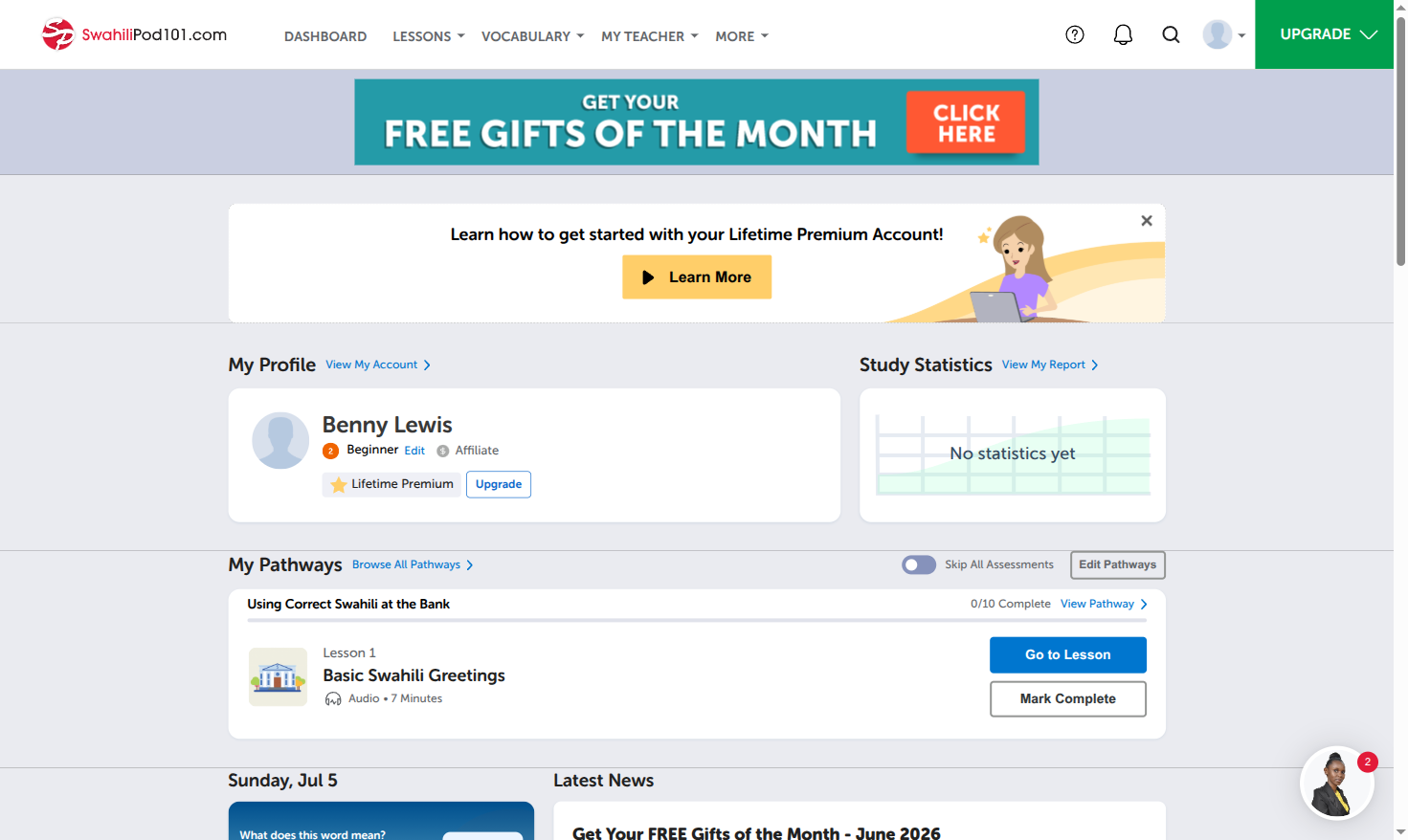
Signing up costs nothing and takes about a minute. You create a free lifetime account with just an email address, no card required, and pick a starting level from Absolute Beginner through to Advanced. If you’re not sure where you land, there’s a short description of what each level assumes, and you can change it later without losing anything. Once you confirm your account, SwahiliPod101 builds you a guided learning path based on that level, pulling from its library so you’re not left to work out where to start on your own. For a language where the real difficulty (the noun classes) only shows up once you’re past the basics, having a structured path that builds toward it properly matters more than usual.
Sound Rules and the Real “Spelling” Challenge
Because Swahili doesn’t need a new alphabet, the early lessons spend their time on pronunciation patterns and, more importantly, on how noun-class prefixes physically attach to words. This is effectively Swahili’s version of spelling rules; instead of memorising letter combinations, you’re learning which prefix goes where and why. The audio dictionary includes a native sample for every entry, and you can slow any clip down to half speed to catch the sounds properly. There’s also a voice-recording tool that lets you record yourself and compare it against a native speaker, which is a handy way to check whether your pronunciation is landing before you’ve been saying the same word wrong for a month.
Inside a SwahiliPod101 Lesson
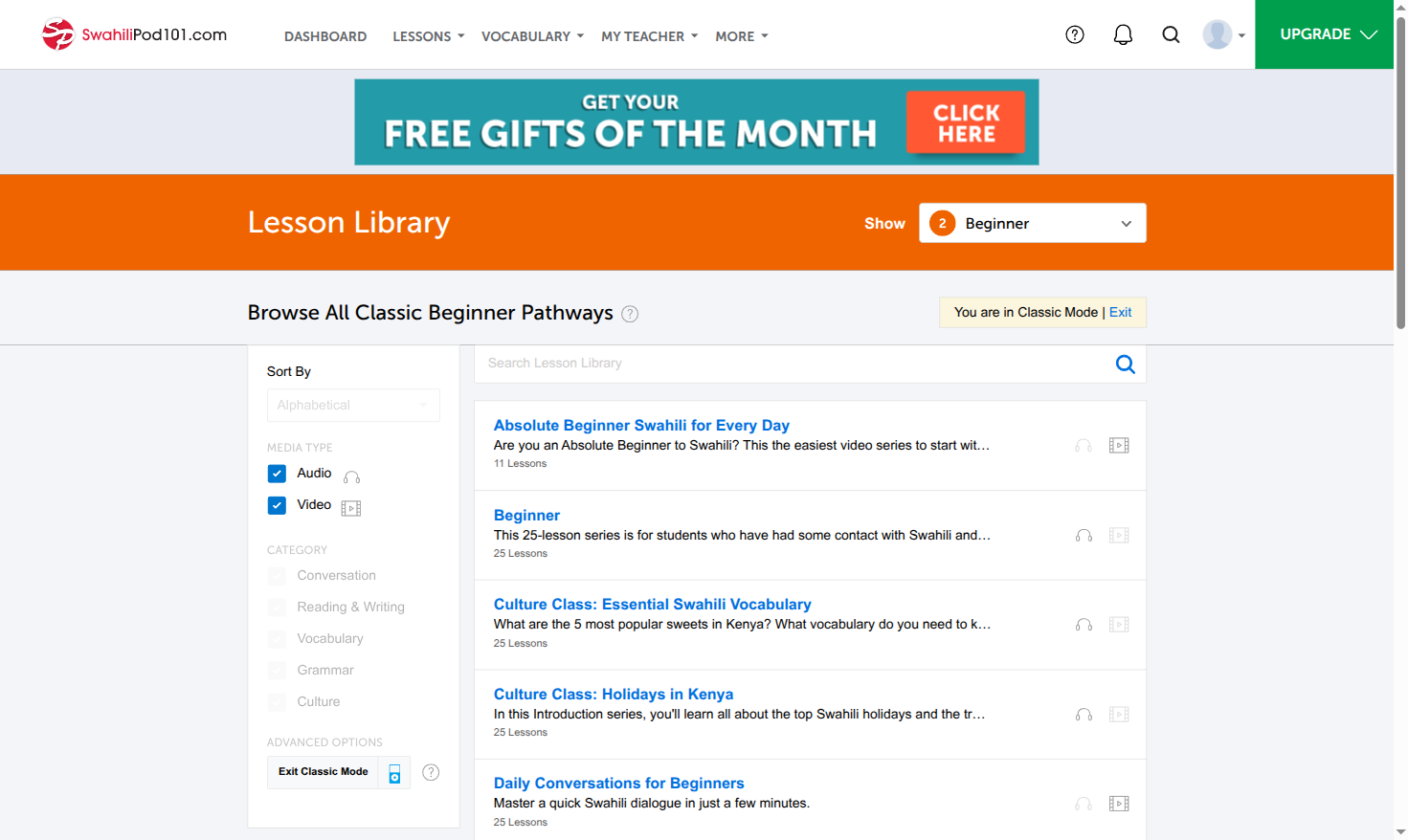
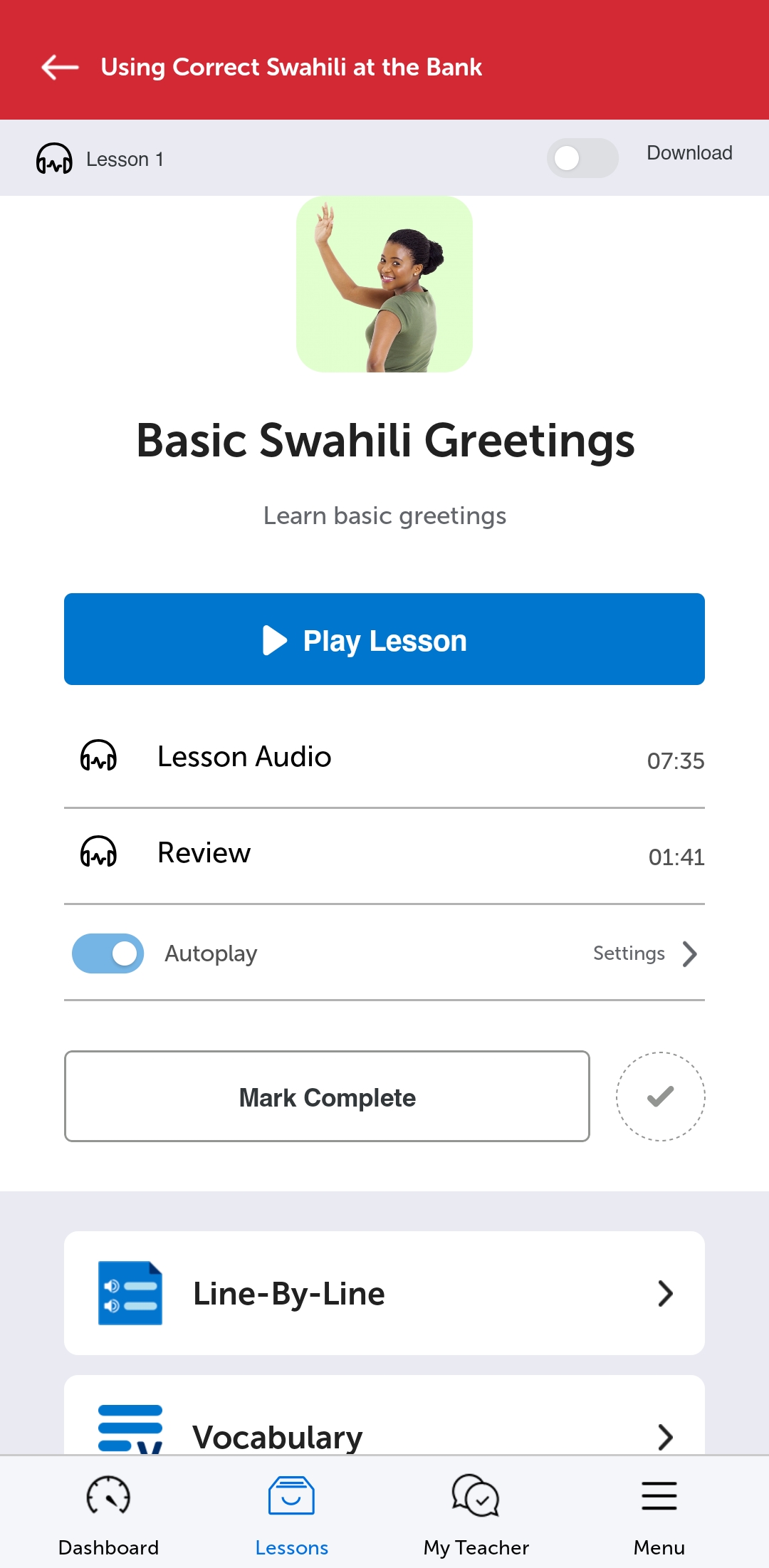
Most lessons run somewhere between three and fifteen minutes, so they slot into a commute or a coffee break easily. The format is consistent: a short dialogue in Swahili, a breakdown of that dialogue line by line, a vocabulary list pulled from it, an explanation of whatever grammar point the lesson is built around, and usually a cultural note tied to the topic. Everything comes with native audio, a full transcript, and downloadable lesson notes as a PDF, so you can review offline or print them if that’s how you study best. The lesson notes are where the course quietly earns its reputation. The grammar explanations in them are as clear as anything I’ve seen in a textbook, and that’s particularly true once you hit noun-class content, where a clear written explanation is worth way more than another dialogue.
Study Tools Worth Knowing About
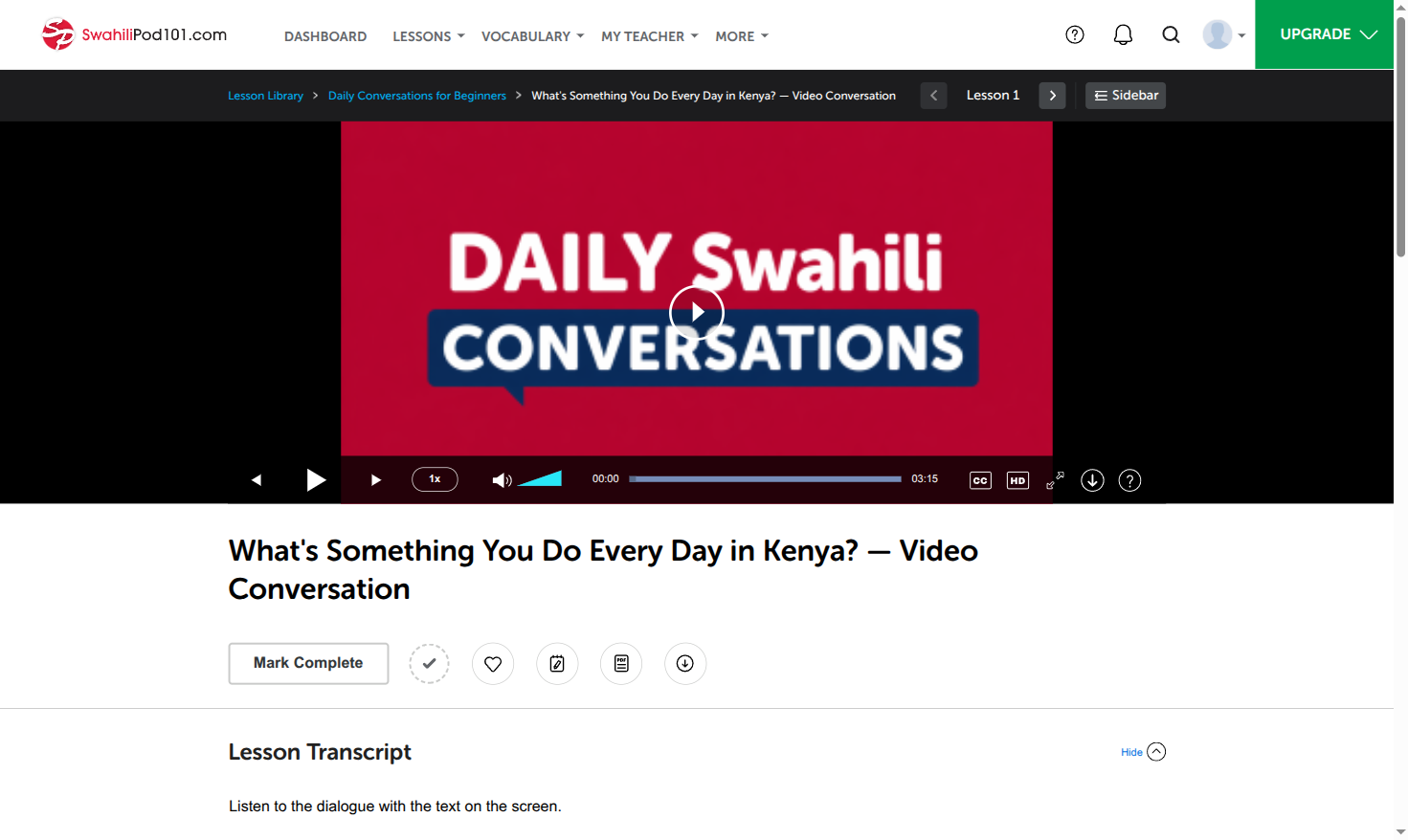
Beyond the lessons themselves, SwahiliPod101 gives you a spaced-repetition flashcard system, a word bank you can build up as you go, and a dedicated Grammar Bank, which is where the noun-class system gets tackled directly and systematically rather than in passing. There’s also a set of assessments to check your progress, the voice-recorder pronunciation tool mentioned earlier, and, on Premium, access to a curated list of the 2,000 most useful core words. None of this is padding. The flashcards and word bank actually populate with real content instead of sitting mostly empty, which isn’t always a given with courses that bolt extra tools onto a smaller language.
The SwahiliPod101 App
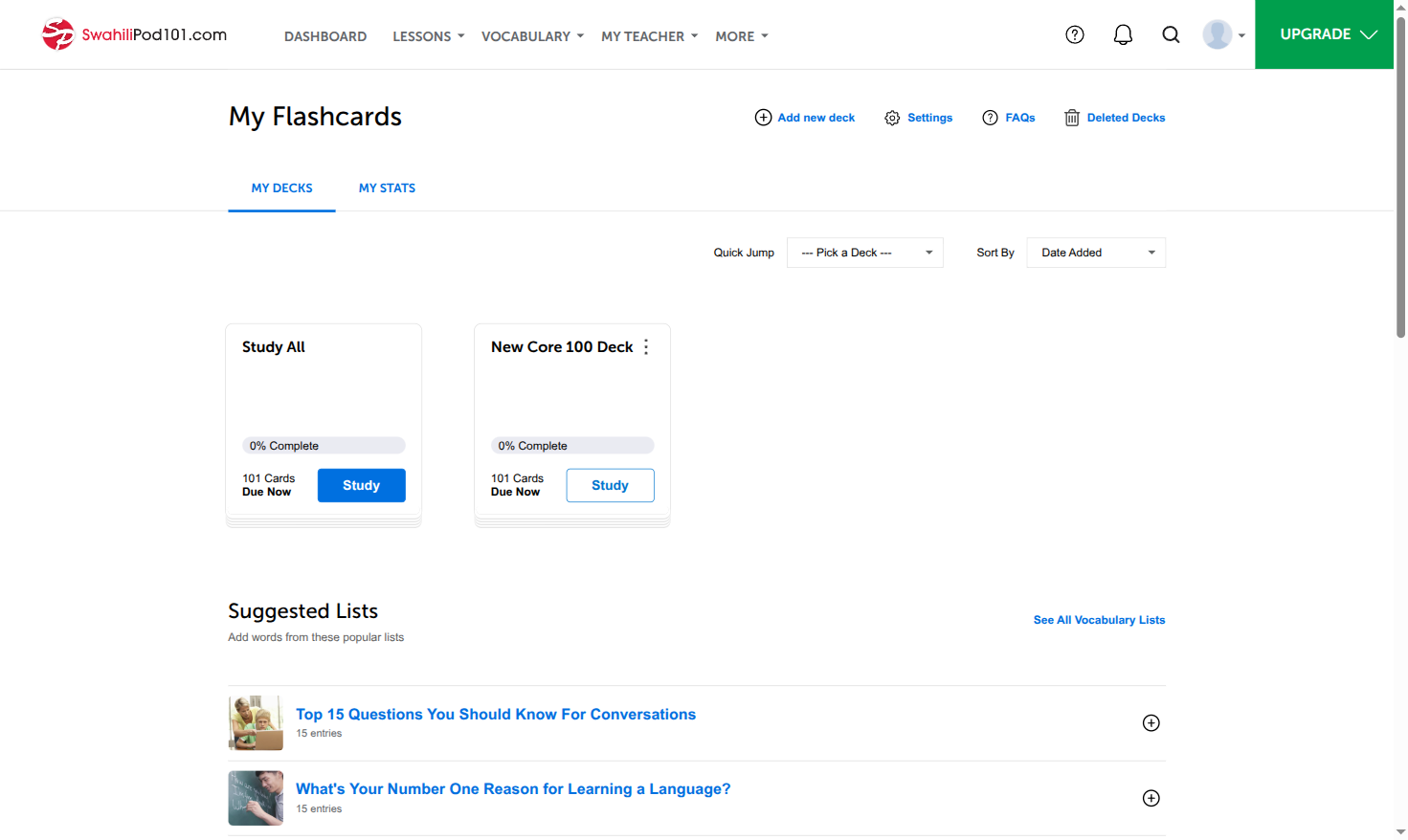
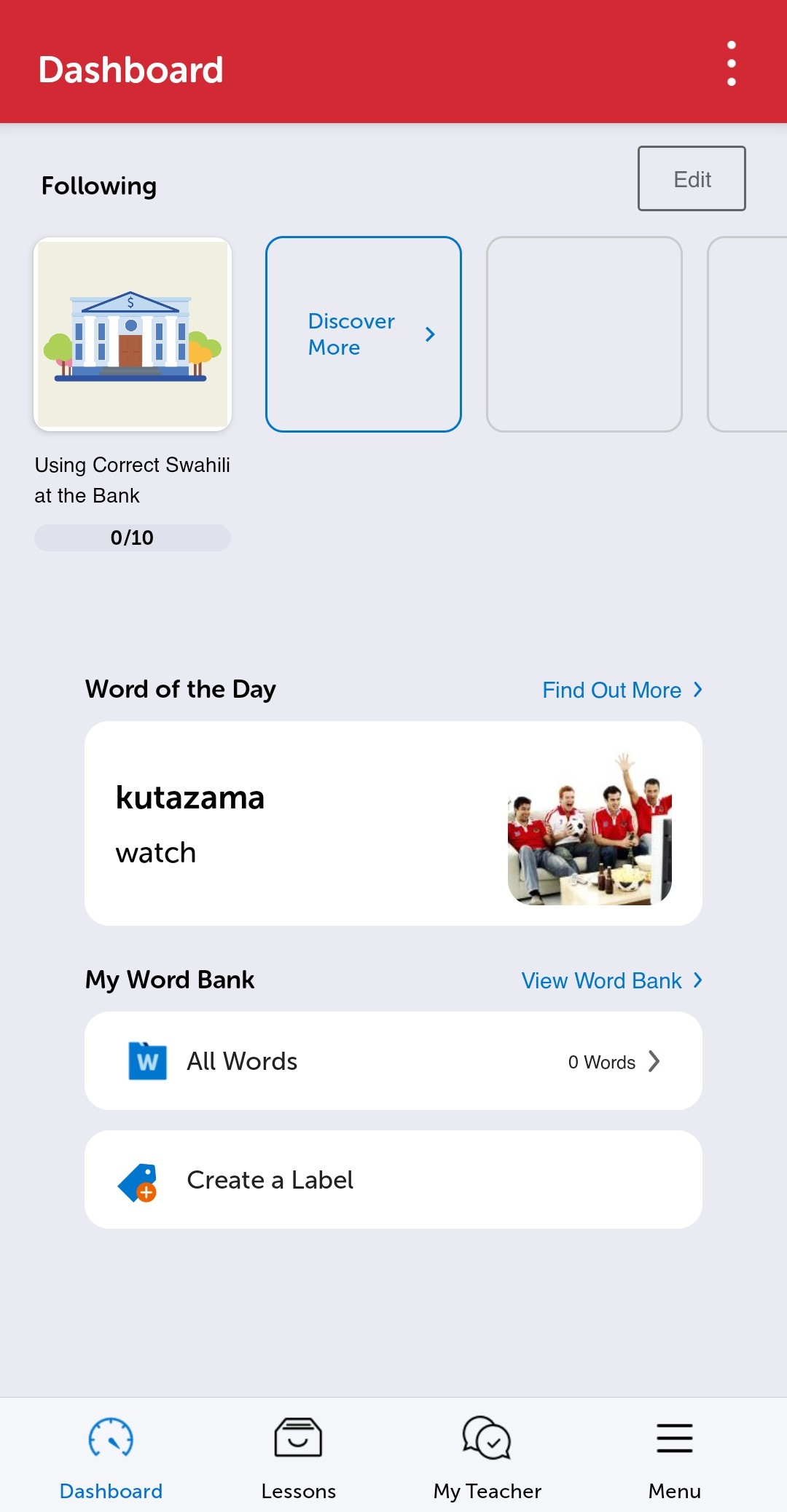
The Innovative Language app carries your account across devices, so anything you complete on the website shows up as done on your phone and vice versa. It’s a lighter experience than the desktop site, showing lessons, audio and vocab without some of the extras, and you can’t follow your structured study path or take assessments directly in the app. The workaround, which I’d recommend, is to open SwahiliPod101 in your phone’s mobile browser when you want the full study-path experience, and switch to the dedicated app for quick lesson reviews or vocab practice on the move.
What Other Learners Say
The praise for SwahiliPod101 lines up with what I found. The production is professional, with native speakers throughout, the grammar notes are brilliant, the non-linear study pathways let you jump around by topic rather than forcing a rigid order, and lessons download for offline use, which matters if you’re studying somewhere with patchy internet. The shared Innovative Language app is solidly rated on Google Play, which is a good signal for the ecosystem as a whole.
The honest criticism is worth taking seriously too, and it comes up across independent reviewers, not as a one-off gripe. The most common complaint is too much English relative to Swahili in the dialogues, which slows down the immersion you’d ideally want. And to be clear: this course teaches Kenyan Swahili specifically, not Tanzanian Swahili. The two are close enough that a Kenyan-trained learner will get by fine in Tanzania and vice versa, but if you have a specific reason to want one over the other, know that before you sign up.
The bigger issue, and the one that shapes how I’d recommend this course, is depth at the top end. The Absolute Beginner and Beginner levels are seriously deep, with loads of pathways between them. Intermediate is still solid. But Upper Intermediate visibly thins out, and Advanced leans heavily on culture and reading content rather than new grammar, meaning it sits closer to upper-intermediate or B2 than to a true advanced level. Two independent reviewers I checked both said the same thing: past B2, you’ll want to look elsewhere. There’s also a smaller practice community than you’d find with the bigger Pod101 languages, and meaningful, personalised feedback only comes with the Premium PLUS tier, not the lower plans.
Pricing and Plans
| Plan | Roughly | Unlocks |
|---|---|---|
| Free | Free forever | First 3 lessons of every series, Survival Phrases, Word of the Day, 100+ vocab lists, the app, a 7-day Premium trial |
| Basic | ~$4/month | All lessons plus in-depth lesson notes |
| Premium | ~$10/month | Adds flashcards, word bank, line-by-line audio, assessments, the Grammar Bank, the pronunciation tool, and the 2,000 core words list |
| Premium PLUS | ~$23/month | Adds a 1-on-1 teacher, hand-graded assignments and personalised guidance |
Those figures are the standard 24-month rate, and our link applies whatever discount Innovative Language currently has running at checkout. How big that is varies with the plan and the offer that’s live when you sign up, so check the checkout page for the current price. There’s a 60-day money-back guarantee too, which takes most of the risk out of trying Premium properly, and for the noun-class-heavy grammar this language needs, Premium is the sweet spot for most learners. And if you want a real teacher checking your work, the Premium PLUS option is there.
Pros and Cons
Pros:
- Brilliant, clear grammar explanations, particularly for the noun-class system that trips up most Swahili learners
- A dedicated Grammar Bank that tackles noun-class agreement head-on, not just in passing
- No new alphabet and no tones to slow down early progress
- Deep, well-built content from Absolute Beginner through solid Intermediate
- Native audio throughout, with a voice-recorder tool for pronunciation practice
- Flexible, non-linear study pathways that let you study by topic instead of a fixed order
Cons:
- Too much English in the dialogues for learners wanting fuller immersion
- Teaches Kenyan Swahili specifically, not Tanzanian, though the two are mutually intelligible
- Content thins noticeably at Upper Intermediate and Advanced, leaning on culture content over new grammar
- Smaller practice community than the bigger Pod101 languages
- The mobile app doesn’t have all the best features
- Real personalised feedback is gated behind the pricier Premium PLUS tier
Who SwahiliPod101 Is (and Isn’t) For
If you’re starting Swahili from scratch, or you’re sitting somewhere between beginner and intermediate and want a structured path with excellent grammar notes for the noun-class system, this is a strong choice, arguably one of the better options out there for exactly that stage. It’s also a good fit if you specifically want Kenyan Swahili, or if you’re happy treating the language as the easier undertaking it actually is and want a course that won’t waste your time.
It’s a weaker fit if you’re already past a solid intermediate level and need new grammar to keep progressing; at that point you’re better off treating it as one supplementary resource among several rather than your main course. It’s also not the right pick if full immersion with minimal English is a hard requirement for you, or if Tanzanian Swahili specifically is what you need.
My Verdict: 4.3 Stars
SwahiliPod101 does exactly the job I set out to check: it takes Swahili’s real difficulty, the noun-class system, seriously, and teaches it with clearer explanations than I’d expect to find in most textbooks. Add in that Swahili is one of the more approachable languages an English speaker can pick up, and this course gets you moving fast and keeps you moving well through intermediate. The one place I’ll be straight with you is the top end: the Advanced content here is closer to a strong upper-intermediate than a true advanced course, and I’d rather tell you that upfront than have you discover it after paying for Premium PLUS expecting something it isn’t built to be.
For beginner through intermediate learners, though, this is a brilliant way to learn Swahili, and the affiliate link below takes you straight to the plan-selection page with whatever discount Innovative Language currently has running already applied, so you won’t be paying full list price.

Social