



IndonesianPod101 Review for Beginners Who Want to Go Further

Full disclosure: This post contains affiliate links. ?
What is IndonesianPod101?
IndonesianPod101 is an online course library with guided pathways, lesson notes and review tools. Audio and video lessons taught by native speakers are its main feature.
- what it’s for:
- Beginner Indonesian, affixation, pronunciation, listening, vocabulary and formal usage
- languages:
- Indonesian
- level:
- Absolute Beginner to Advanced
+ PROS
- Practical dialogues support fast beginner progress
- The library directly covers affixation and reduplication
- Pronunciation lessons address hidden sound traps
- Transcripts and line-by-line audio support close listening
- Premium tools make review convenient
- Free sampling and a listed money-back guarantee
- CONS
- English can dominate early lesson time
- The library requires a deliberate route
- Course dialogues cannot reproduce fast colloquial speech
- Advanced learners need harder native material
- The mobile app does not include every website tool
Quick Fire Review
A useful beginner-to-intermediate base that goes beyond easy phrases into Indonesian affixation and formal usage. Add colloquial listening and live conversation. 4.2/5.
Indonesian gives English speakers an unusually friendly first week. It uses the Latin script, has no grammatical gender or noun cases, and verbs do not change to agree with each person. Tense is usually expressed with separate words instead of a table of endings. You can build useful sentences quickly.
Early progress does not remove the later work. Prefixes and suffixes change what a root does, reduplication carries several meanings, and the formal Indonesian taught in courses can sound far from everyday conversation. A learner who raced through tourist phrases can suddenly feel stuck.
IndonesianPod101 needs to support the fast beginning without pretending the whole language is easy, then lead learners into affixation and real varieties of speech. Its broad lesson library contains material on those problems. Learners still have to find and use it before the beginner glow wears off.
In practice, IndonesianPod101 is a good beginner-to-intermediate base for independent learners. It combines practical audio with searchable explanations and targeted grammar routes. Its main limits are English-heavy teaching, a library that needs self-direction, and the distance that remains between course dialogues and fast colloquial Indonesian.
What Makes Indonesian Different
The opening stage is fast. Standard Indonesian uses a familiar script and does not require noun gender, case endings or person-based verb conjugation. The same verb can work with “I”, “you” or “they”. Time words and particles usually show when an event happens. This lets a beginner say quite a lot with a small set of patterns.
Roots grow into families. Take a root such as tulis, connected with writing. Affixes help create forms related to writing, a piece of writing, a writer or an action with a different grammatical focus. Learning the root is only the beginning. You need to notice which pieces were added and what they did to the sentence.
Voice and affixation work together. Indonesian often chooses verb forms according to which participant or event is in focus. The verb doesn’t follow a European-style conjugation table, though its form still changes to carry grammar. Saying “Indonesian has no conjugation” without this qualification gives beginners the wrong expectation.
Reduplication is productive. Repeating a word can mark plurality or create another related meaning, depending on the word and context. It is systematic enough to study, but not safe to translate with one rule every time.
Formal and colloquial Indonesian can feel far apart. Course material often begins with the standard form used in education, news and formal situations. Everyday speech shortens words, changes affixes and adds regional or slang vocabulary. Research on colloquial Jakartan Indonesian treats competence in both registers as important. A polished formal sentence may be correct and still not prepare your ear for a group of friends.
Pronunciation has quiet traps. Indonesian has no lexical tone system, but English habits can still interfere. Stops may be less aspirated, r is commonly trilled, and glottal stops and regional variation affect what you hear.
The current US State Department table names Indonesian in Category II, with a normal 36-week course to professional working proficiency. That’s one band beyond its easiest group. The figure doesn’t predict how long a basic conversation will take. It does correct the claim that Indonesian is simply one of the easiest languages all the way through.
Getting Started with IndonesianPod101
IndonesianPod101 belongs to the Innovative Language course family. A free account requires no card and lets you sample the teaching style before choosing a plan. The library includes recommended level pathways and specialist collections for pronunciation, culture, grammar and vocabulary.
Begin with the recommended route for your level. Indonesian’s quick early progress makes random browsing particularly tempting. You can collect greetings and food phrases while avoiding the affixes that turn memorised chunks into flexible speech. The main pathway gives your study an order; specialist collections should solve specific problems as they appear.
The official library continues past the survival stage. Later material covers prefixes, suffixes, circumfixes, causatives, reduplication, tense, classifiers and formal Indonesian. The material for the second climb is there. Reaching it still takes a deliberate plan, so add one affix-focused session each week once the basics feel comfortable.

How It Teaches Pronunciation and Affixation
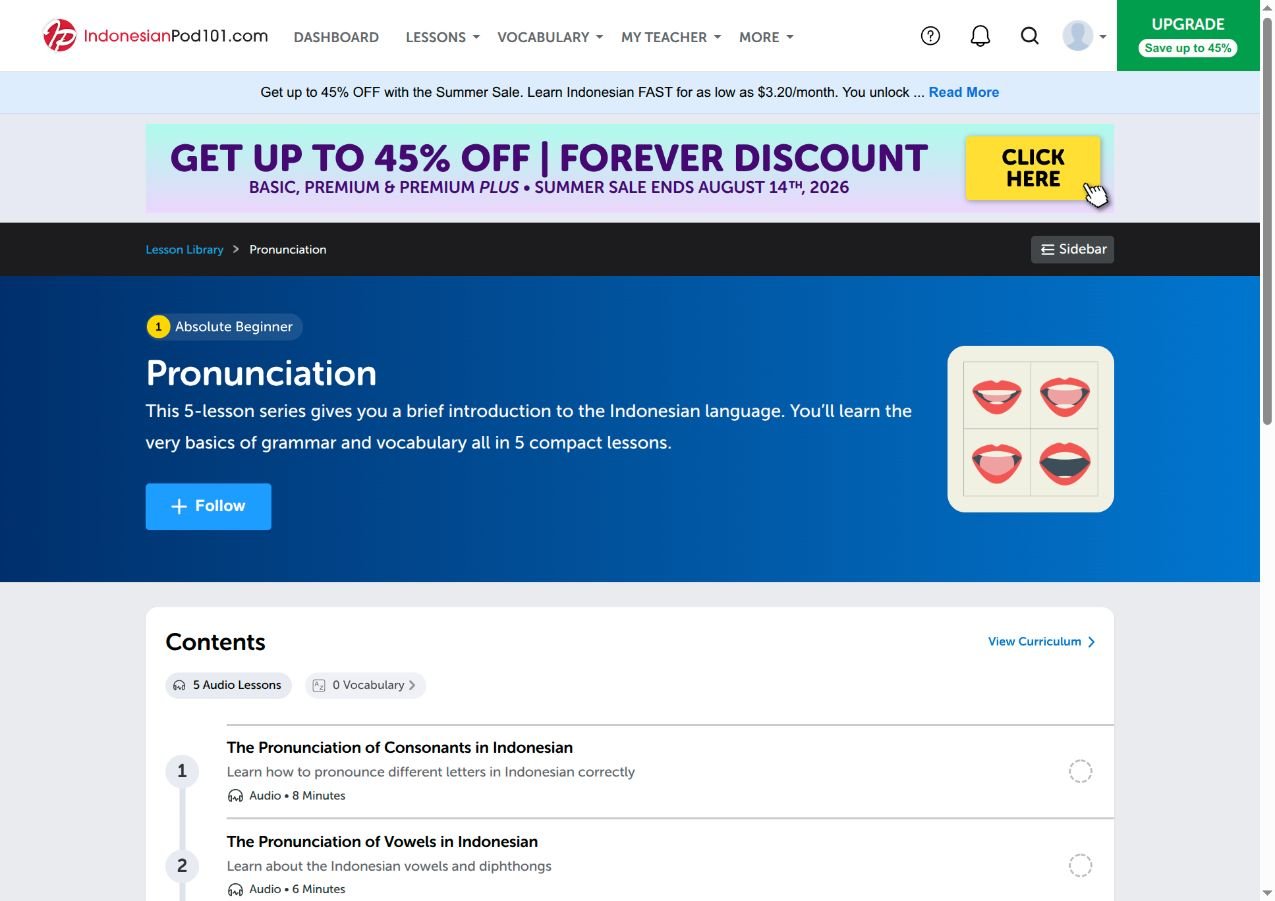
The dedicated pronunciation route covers consonants, vowels, loan sounds, dialects and common mistakes. The curriculum calls attention to the trilled r, unaspirated consonants and glottal stops. These details keep “Latin script” from turning into “pronounce everything as English”.
Native recordings and line-by-line playback are the real strength. Hear a complete sentence first, then isolate the word or phrase that does not match what your eyes predicted. Repeat it while keeping the rhythm of the whole line. Indonesian spelling is relatively regular, so this work pays off quickly once English sound assumptions are out of the way.
Affixation needs another kind of repetition. When a lesson introduces a derived form, write the root in the centre of a small word family. Add the form, its role and a short sentence. This turns vocabulary study into pattern study. A flashcard that asks only for one English translation misses why the word changed.
IndonesianPod101’s topic-specific routes can answer questions about noun-forming affixes, causatives and reduplication. Use them after you have met the form in context. Studying a long affix chart before you recognise the roots is harder than comparing two sentences that differ in one useful way.
Inside an IndonesianPod101 Lesson
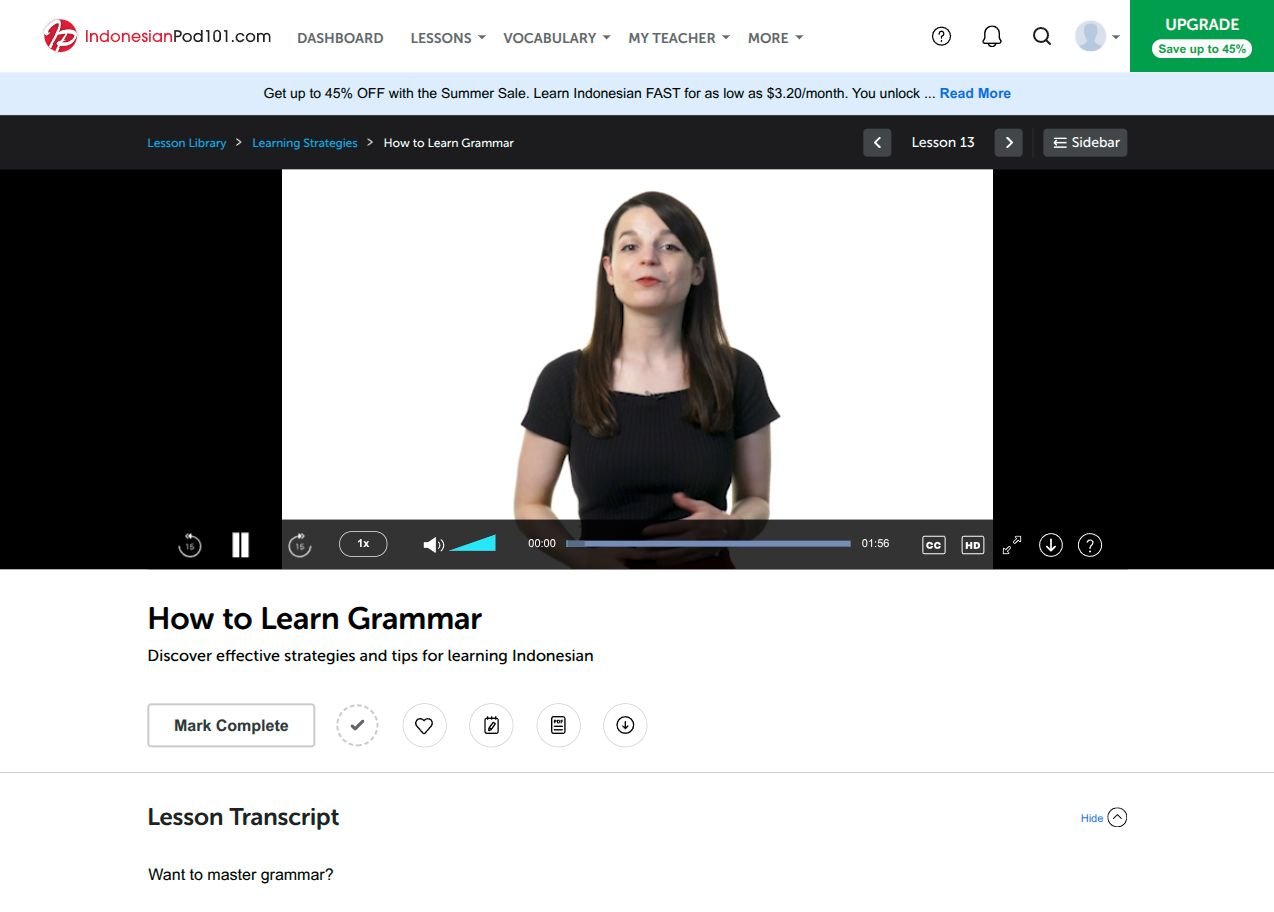
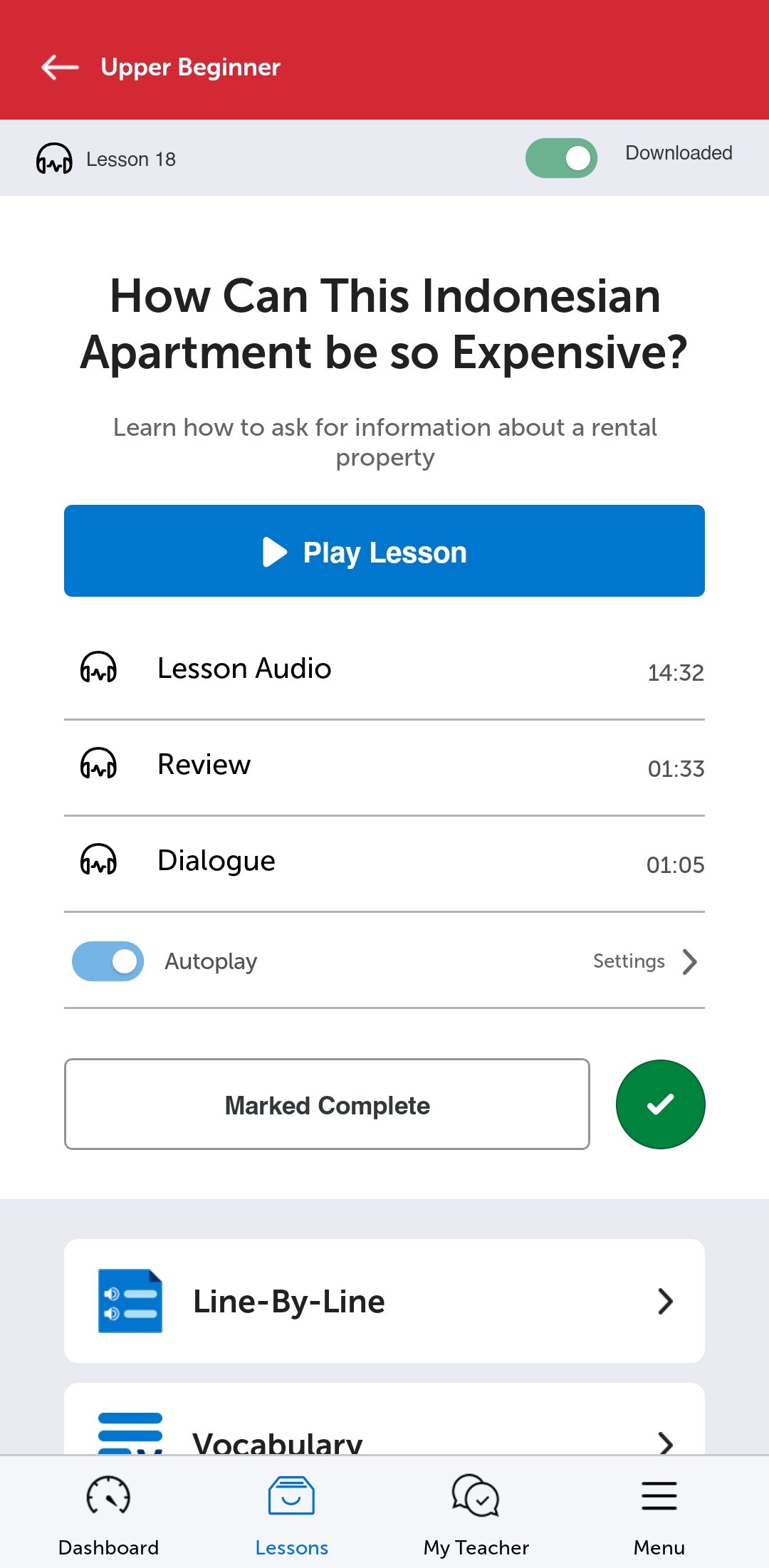
Lessons are built around short dialogues recorded by native speakers. The page brings together the transcript, vocabulary, sample sentences, grammar explanation and cultural notes. Audio can be replayed at the dialogue or line level, depending on your plan.
This format fits Indonesian’s beginner stage well. You can learn a compact exchange, change one item and use it quickly. Cultural notes explain when a phrase is formal, polite or situation-specific, which matters in a language with a visible register gap.
The same format can hide that gap if every dialogue is clean and careful. One learner reported finding IndonesianPod101’s intermediate situational lessons useful, including informal Jakarta scenarios, while still struggling much more with real speech and slang. That is a realistic result. Graded dialogue prepares the ear; it does not reproduce a fast conversation between friends.
English explanation takes up a noticeable share of many early lessons. Listen once for the teaching, then return to the Indonesian-only parts. Shadow the dialogue, transcribe a few lines, and change a root or time marker. A short lesson becomes serious practice when you do something with it.
The Study Tools
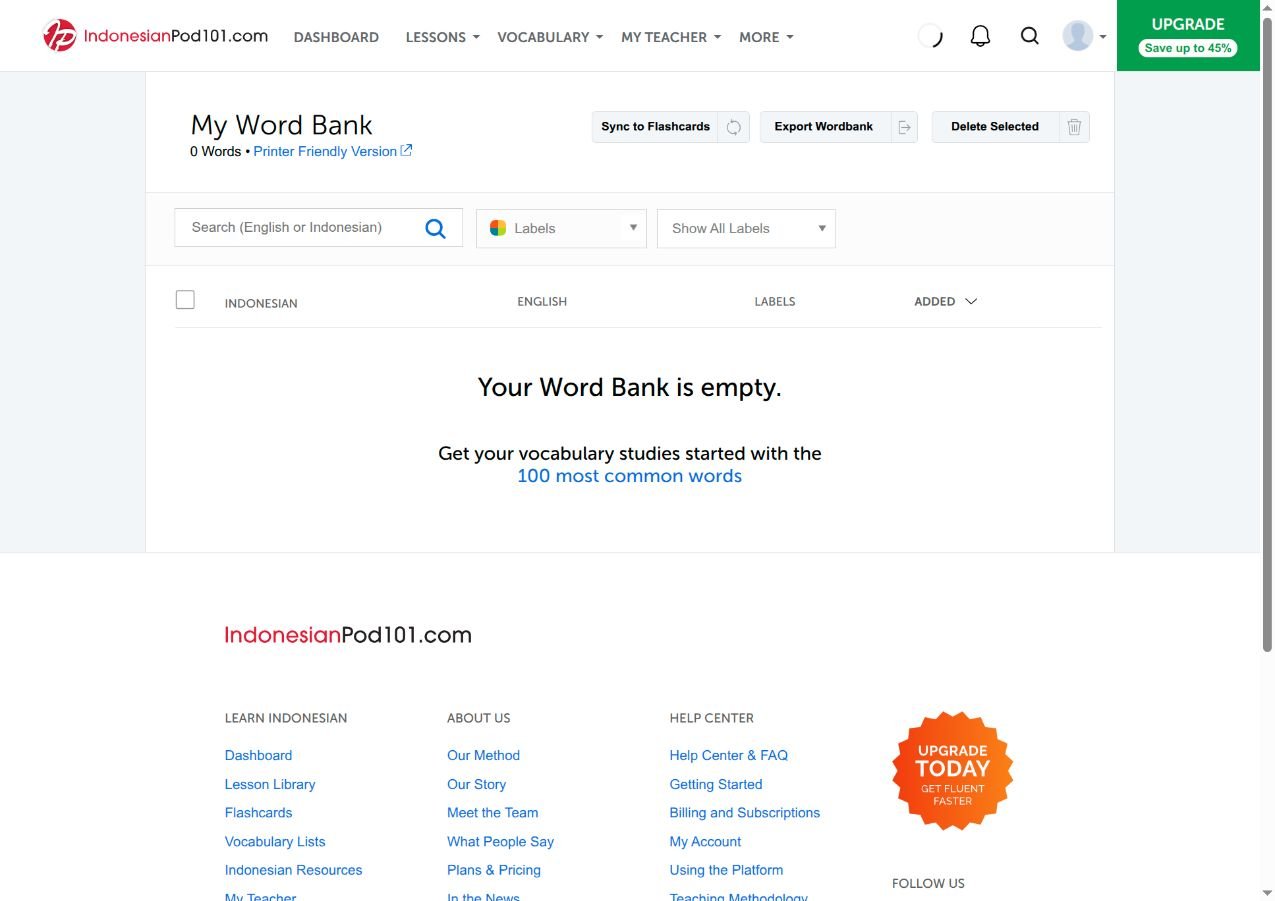
Premium adds line-by-line audio, flashcards, a personal word bank, assessments and pronunciation practice. The tools are convenient because a word can move directly from a lesson into review.
Convenience can also produce weak cards. Save Indonesian words in families and phrases. Put the root on one side and ask what a specific affix changes. Include whether a phrase sounds formal, neutral or colloquial when the lesson gives that information. Review should prepare you to understand another sentence, not only reproduce an isolated translation.
The voice recorder lets you compare your attempt with native audio. It is useful for rhythm, r and consonant aspiration, but it cannot explain what your tongue did. Assessments check recognition and lesson retention; they do not prove spontaneous speaking.
Premium PLUS adds a teacher, a personal programme and hand-graded writing or pronunciation work. It can be valuable if you submit work consistently and want the whole routine under one login. For more flexible live conversation, compare it with a separate teacher through our italki review.
The Mobile App
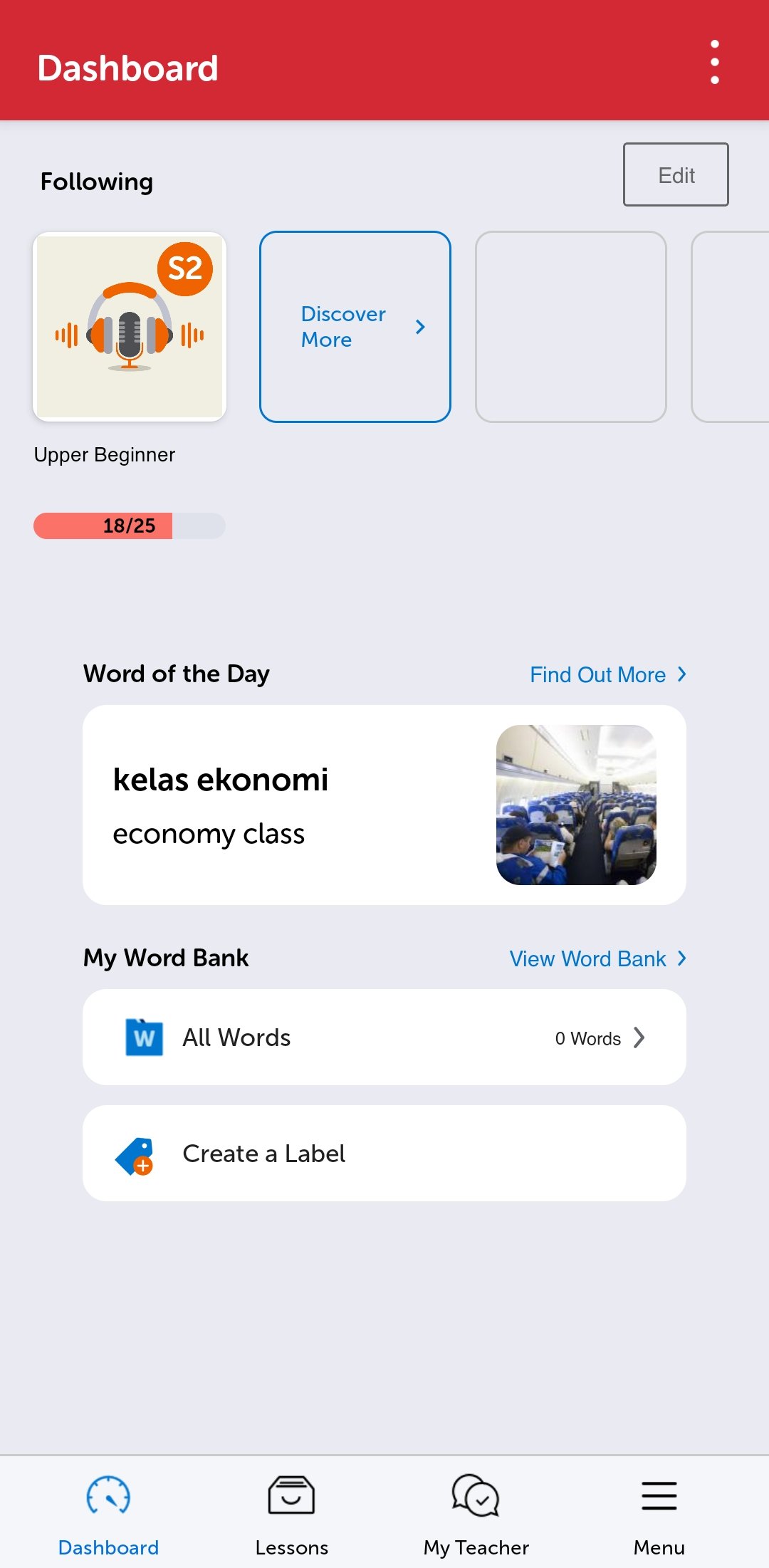
IndonesianPod101 uses the shared Innovative Language Learning app. It syncs progress with the website and allows offline lesson downloads. Lesson audio, video, transcripts and notes appear according to your subscription tier.
The app suits Indonesian’s fast beginner phase. A ten-minute lesson can feed directly into a short speaking drill during a commute. It also makes repeated listening easy, which is important once colloquial pronunciation starts compressing familiar words.
Use the browser or a notebook for affix families and register notes. A small phone screen encourages you to keep moving, while intermediate Indonesian often requires stopping to compare forms. Divide the work: listen and review on the phone, analyse and write on a larger surface.
The app covers the whole Innovative Language catalogue, so choose Indonesian and pin your current pathway instead of treating the home screen as a menu of possible detours.
What Learners Say
Recent learner comments tend to call IndonesianPod101 a solid beginner resource. Some also find it useful around A2 or for formal Indonesian. Independent reviewers praise the practical dialogues, native audio, orderly lesson pages and built-in review tools.
The criticism is equally consistent. Lessons can contain too much English, and advanced material may not challenge a strong learner. The formal style of course Indonesian does not automatically transfer to everyday speech. One app user reported lessons failing to start, though that is an isolated historical report and not evidence of a current system-wide problem.
Learners keep returning to the same point: IndonesianPod101 gives them a good start, while real Indonesian remains harder. A graded course should prepare you to keep expanding beyond it. Trouble begins when marketing or an “easy language” label convinces you that completing short lessons should make street speech effortless.
Fi3M’s account of an intensive Indonesian project offers a sensible broader mix: coursebook study, spaced repetition and frequent lessons alongside structured independent work. IndonesianPod101 can occupy the listening-and-explanation part of a similar plan.
IndonesianPod101 and Pimsleur
Pimsleur Indonesian uses a fixed audio sequence built around spoken recall. It prompts you to answer aloud and retrieve phrases, so it is easier to build a hands-free daily routine. The official programme is compact and tightly ordered.
IndonesianPod101 offers a broader library, written transcripts, vocabulary tools and direct routes into affixation, reduplication and formal Indonesian. Its long plans also have a lower monthly equivalent. The flexibility is useful when you know what you need and distracting when you do not.
Choose Pimsleur when your main goal is a prescribed speaking habit with minimal screen time. Choose IndonesianPod101 when you want to inspect how words are built, search for a grammar problem and keep several levels of listening material available. Add real conversation to either choice.
Pricing and Plans
IndonesianPod101 currently offers four tiers:
| Plan | Approximate monthly equivalent | Best for |
|---|---|---|
| Free | Free | Sampling the format and beginner material |
| Basic | About $4 | Full lessons and detailed notes |
| Premium | About $6–10 | Line-by-line audio, review tools, assessments and pronunciation practice |
| Premium PLUS | About $13–23 | Teacher guidance, a personal programme and hand-graded work |
The lowest monthly equivalents usually require a long term paid as one instalment. The site currently lists a 60-day money-back guarantee. Confirm the term, total charge and guarantee at checkout.
The discount is applied at checkout through our IndonesianPod101 link. The amount varies, so check the current price. Premium is the strongest value for learners who will use line-by-line audio and active review. Basic works if you already have separate flashcards and pronunciation practice. PLUS is worth considering only if regular teacher feedback will change your behaviour.
Pros and Cons
Pros
- Practical native-speaker dialogues make the fast beginner stage productive.
- The library directly covers affixation, reduplication and formal Indonesian.
- Pronunciation material addresses traps hidden by the familiar script.
- Transcripts, notes and line-by-line audio support close listening.
- Premium tools make vocabulary collection and review easy.
- The free account and listed guarantee make the format easy to test.
Cons
- English explanation can reduce Indonesian listening time.
- Learners can avoid the harder grammar by wandering through beginner topics.
- Clean course dialogues do not reproduce fast colloquial speech.
- Vocabulary tools need adapting for roots, affixes and register.
- Strong advanced learners will need more challenging native material.
- Corrective teacher feedback is reserved for the top tier.
Who IndonesianPod101 Suits
IndonesianPod101 suits beginners who want fast practical progress with enough explanation to understand what they are saying. It also suits lower-intermediate learners who know many roots but need help with affixes, listening and formal usage. Independent learners who enjoy choosing targeted resources will get more from the library than people who want one daily command.
It is less suitable for advanced learners looking for sustained colloquial immersion, anyone who wants an entirely Indonesian teaching environment from day one, or people expecting the familiar script to make the whole language effortless.
The Verdict
IndonesianPod101 handles the first climb well and contains the material needed for the second. The practical dialogues let a beginner start quickly. Its specialist lessons then address affixation, reduplication and formal Indonesian, which are exactly the subjects an “easy language” introduction tends to skip.
You have to make that transition deliberately. Follow the level pathway, add affix-focused review, replay the Indonesian instead of the English, and bring in colloquial listening and live conversation. Used that way, the library stays useful after the survival phrases have done their job.
My rating is 4.2 out of 5.
You can try IndonesianPod101 here. The discount is applied at checkout through our link; the amount varies, so check the current price. Use the free account to test the hosts, pathway and pronunciation material before choosing a plan.

Social