



NorwegianClass101 Review for Norwegian Learners

Full disclosure: This post contains affiliate links. ?
What is NorwegianClass101?
NorwegianClass101 is part of the Innovative Language family, with Norwegian audio and video lessons, transcripts, study tools, mobile access and optional teacher feedback.
- what it’s for:
- Building Norwegian listening, vocabulary, pronunciation and practical communication through short lessons and guided review.
- languages:
- Norwegian
- level:
- Absolute Beginner to Advanced
+ PROS
- Native-speaker audio and line-by-line playback
- Helpful Bokmål and dialect explanations
- Flexible short lessons
- Strong vocabulary review tools
- Web and mobile access
- Optional teacher feedback
- CONS
- Library can feel sprawling
- Limited representation of dialect diversity
- Speaking practice requires initiative
- App trails the website in places
- Advanced learners need outside material
Quick Fire Review
NorwegianClass101 is a flexible, audio-led Norwegian course with particularly useful support for Bokmål, pronunciation and dialect awareness. It suits self-directed beginners who will repeat the dialogues aloud and add real conversation.
Norwegian has an encouraging habit of letting an English speaker understand bits of a sentence before they have properly studied it. Familiar Germanic words turn up, verbs stay fairly manageable, and you can start building useful phrases quickly.
Then a Norwegian answers in a dialect you have never heard, and the comfortable feeling disappears.
That contrast shapes this NorwegianClass101 review. The platform is good at giving you lots of Norwegian to hear, short explanations to return to, and written support when the audio gets slippery. It is particularly useful for connecting Bokmål, the written form most learners meet first, with speech that does not always sound like the page.
In a practical routine, the platform gives a beginner plenty to work with. Dialect variation still requires broader listening, and speaking still requires practice aloud.
What Makes Norwegian Different?
Norwegian is often described as easy for English speakers. The current US State Department schedule places it explicitly in Category I, with a normal intensive course of 24 weeks for its professional objective. That is a useful comparison, but it does not mean Norwegian is effortless.
The grammar does remove some common obstacles. Verbs do not change for each person, and many sentence patterns and words feel familiar. You still have to learn noun gender and verb-second word order, while listening brings a separate challenge.
Norway has no official standard spoken language. Bokmål and Nynorsk are written norms, and people use local dialects naturally in education, media and daily life. Standard East Norwegian is influential, especially around Oslo, but it does not erase the rest.
Many Norwegian varieties also use two pitch accents. A change in the melody of a word can distinguish meanings, although the system varies and some regions do not use it. This is one reason isolated vocabulary lists only take you so far. You need to hear whole words and sentences repeatedly.
NorwegianClass101 fits that need better than a text-only course because audio sits at the centre of the product. The sensible aim is not to imitate every dialect. It is to build a clear base, understand the most common patterns, and become comfortable when real speech varies.
Getting Started with NorwegianClass101
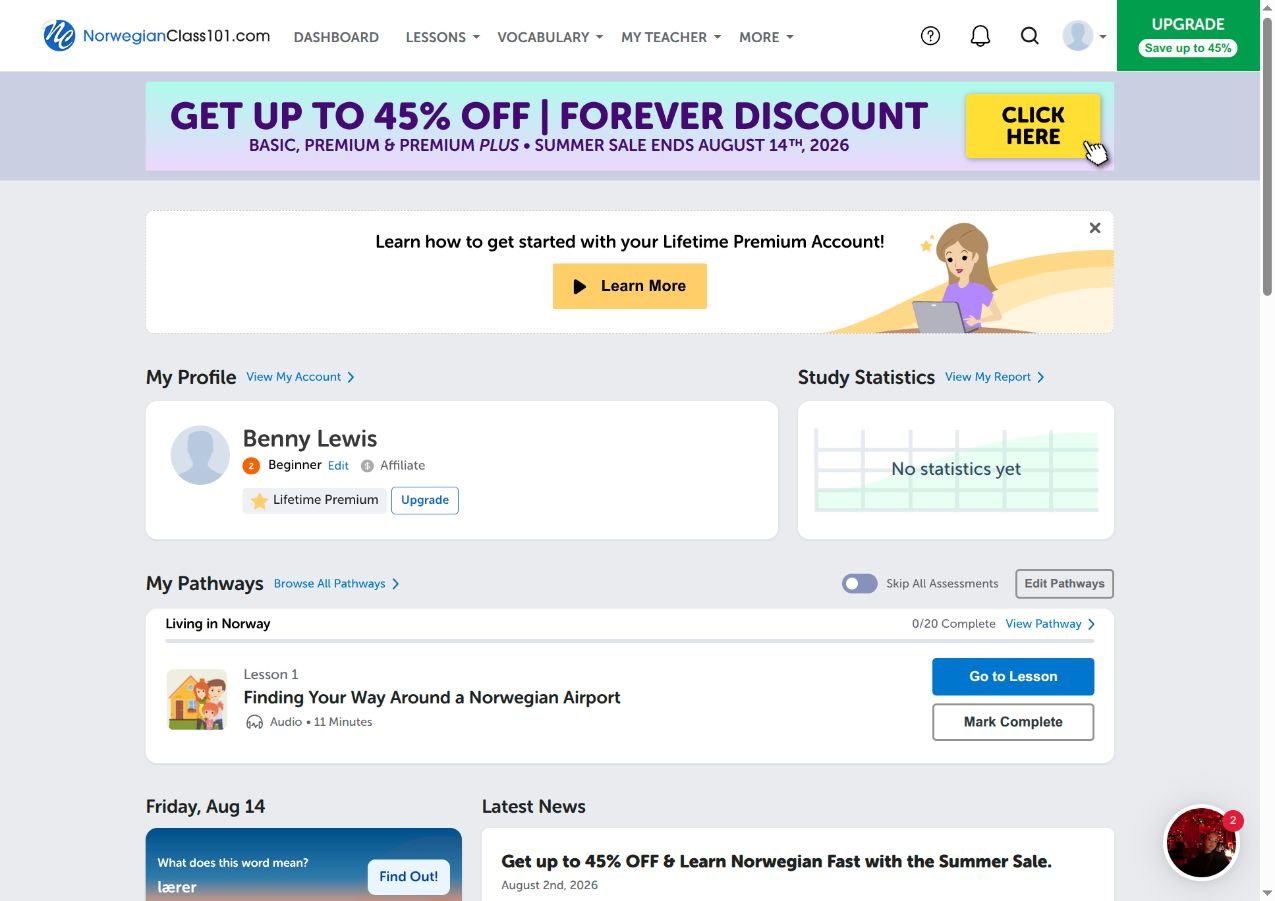
When you join, you choose a level and can follow a suggested pathway through the library. Absolute beginners can start with basic exchanges and survival language. Learners with some Norwegian can browse by level, skill or topic.
That choice helps when you already know what you need. It can also make the first screen look busier than a conventional course with one large Continue button. Pick one main pathway and keep everything else as optional review. You can change later without losing anything important.
The free account is useful for testing the teaching style. It currently includes a limited lesson selection, vocabulary resources and a trial of Premium tools. Listen to a complete lesson, inspect the lesson notes, and try the line-by-line audio before deciding whether the format works for you.
Learning Bokmål Without Mistaking It for Speech
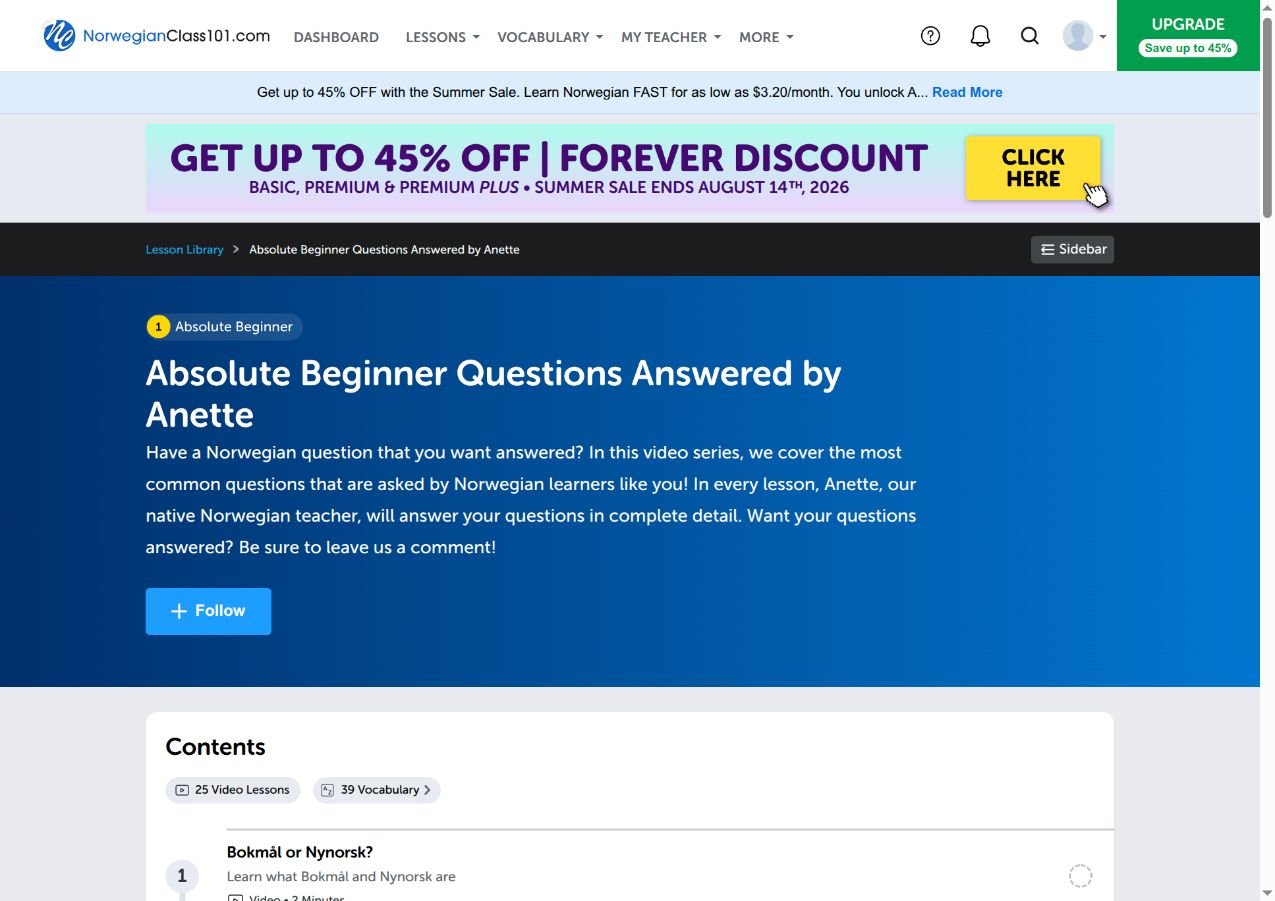
Most international learners begin with Bokmål because it is the dominant written form and has abundant learning material. NorwegianClass101 uses it as the practical written base. That is a reasonable choice, as long as you remember what it represents.
Bokmål gives you spelling, sentence structure and a stable form for notes. It does not prescribe one way that every Norwegian speaks. A dialogue recorded in an Oslo-influenced variety may track the spelling fairly closely. Someone from Bergen, Trondheim or Northern Norway may use different sounds, endings, pronouns and melody.
The platform has lessons that address Bokmål, Nynorsk and communication across dialects. This is more useful than pretending the variation does not exist. Its recordings still cannot give equal space to every region, so treat them as a base for listening, not a map of all Norwegian speech.
Once you can follow the main dialogue, add clips from Norwegian media and real conversations. My Oslo language challenge shows what happens when classroom Norwegian meets people in the city.
Pronunciation, Pitch Accent and Dialects
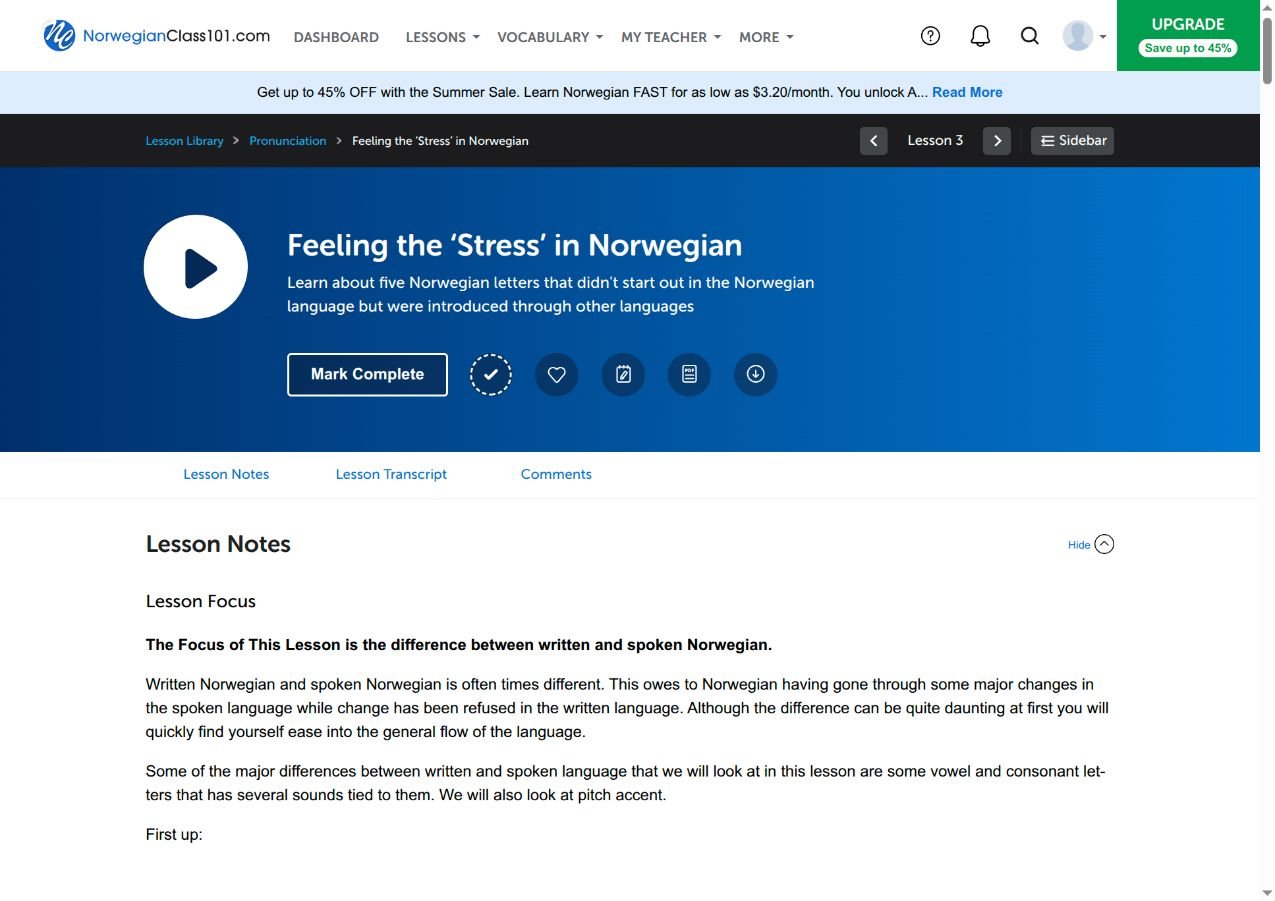
NorwegianClass101’s pronunciation material separates sounds, rhythm and pitch into manageable pieces. You can replay the dialogue, slow individual lines and record your own version. This works well for vowels and consonant combinations that are difficult to capture from spelling alone.
Pitch accent needs a light touch at the beginning. Norwegian has contrasting word melodies in many regions, but there is no universal spelling rule that tells you which melody to use. Learn the sound with the word. Repeating a short recorded phrase is more productive than trying to memorise an abstract symbol beside every noun.
The line-by-line tool is particularly good here. Listen once without text, reveal the Norwegian, and replay the smallest line that caused trouble. Then record yourself and compare the overall rhythm. The recorder is a comparison tool, not an automatic pronunciation judge, so focus on one detail at a time.
Dialect awareness should start with recognition. You do not need a collection of accents in your own speech. Build one pronunciation that people understand and train your ear to accept several.
Inside a NorwegianClass101 Lesson
A typical lesson begins with a Norwegian dialogue and then works through its meaning, vocabulary, grammar and cultural context. The presenters use English to explain what is happening. This makes the material accessible early, though experienced learners may want to skip some explanation and spend more time with the Norwegian audio.
Here is the study sequence I would use:
- Play the dialogue once without reading.
- Listen again with the transcript.
- Use line-by-line audio on the parts you missed.
- Read the notes and choose one grammar point.
- Say the dialogue aloud, then change a few details to make it yours.
The final step matters most. If the model says where someone lives, answer with your own town. If it asks what you like, give a real answer. This is how a lesson becomes speaking practice instead of another dialogue you recognise on screen.
The cultural notes are useful in Norwegian because register and dialect choice carry social information. Still, do not assume one dialogue represents the whole country. The platform works best as a source of clear examples that you then test against broader listening.
The Study Tools That Earn Their Place
Premium adds the tools that make the library easier to turn into a routine. Line-by-line audio is the most valuable for Norwegian because it lets you isolate short stretches of speech without constantly dragging a full recording backwards.
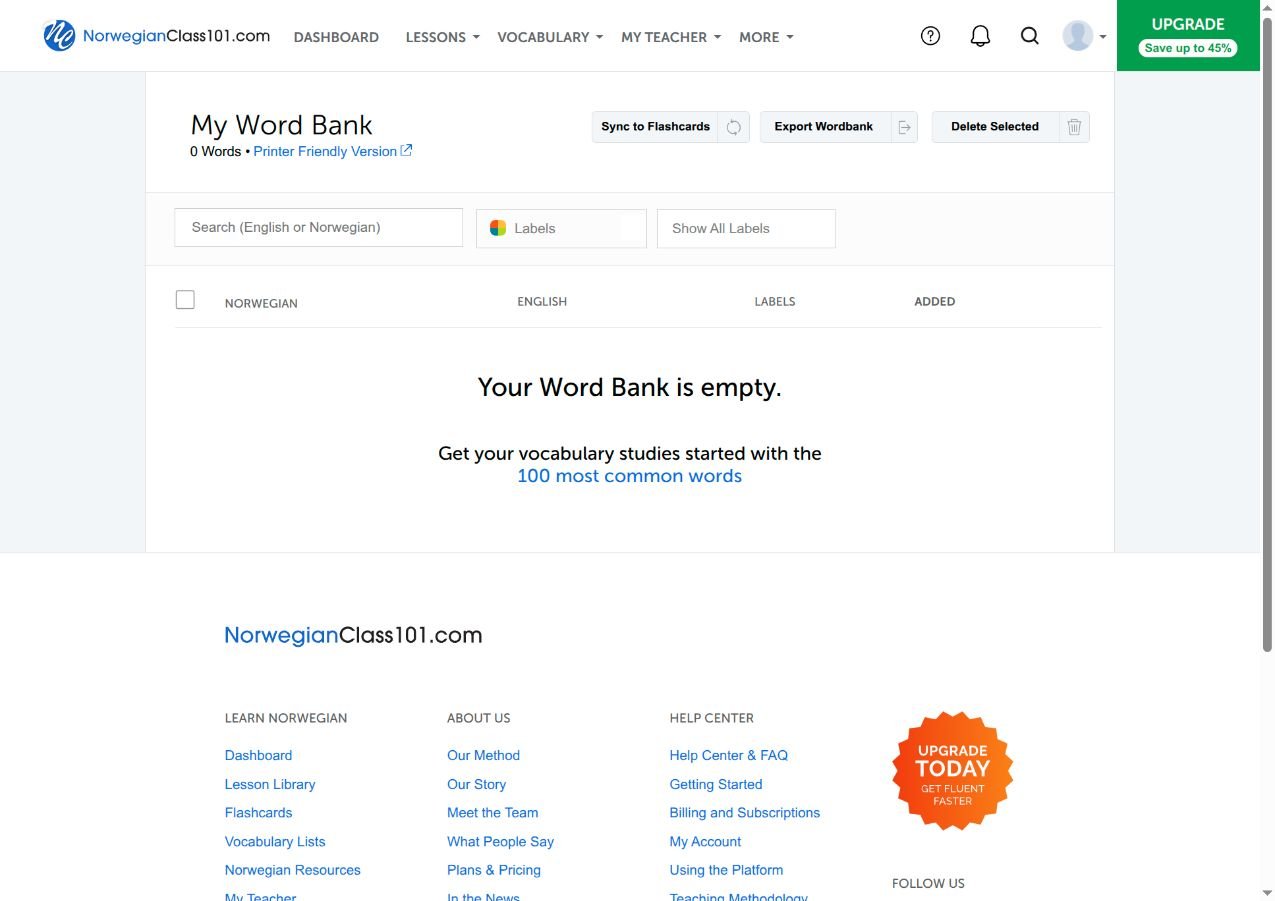
The word bank and spaced-repetition flashcards help with high-frequency vocabulary. Save words that have appeared in a useful sentence, including the audio. A bare English-to-Norwegian card can hide gender, pronunciation and context. A phrase gives you more information for almost the same review time.
The core vocabulary lists and assessments can reveal gaps, but they should support your pathway instead of becoming a second full curriculum. Ten minutes reviewing yesterday’s words is useful. An hour organising every list usually is not.
The recorder can make pitch and rhythm differences more obvious. It cannot explain why your version sounds off. For detailed correction, Premium PLUS offers teacher feedback, or you can book sessions through a service such as italki.
Using the App
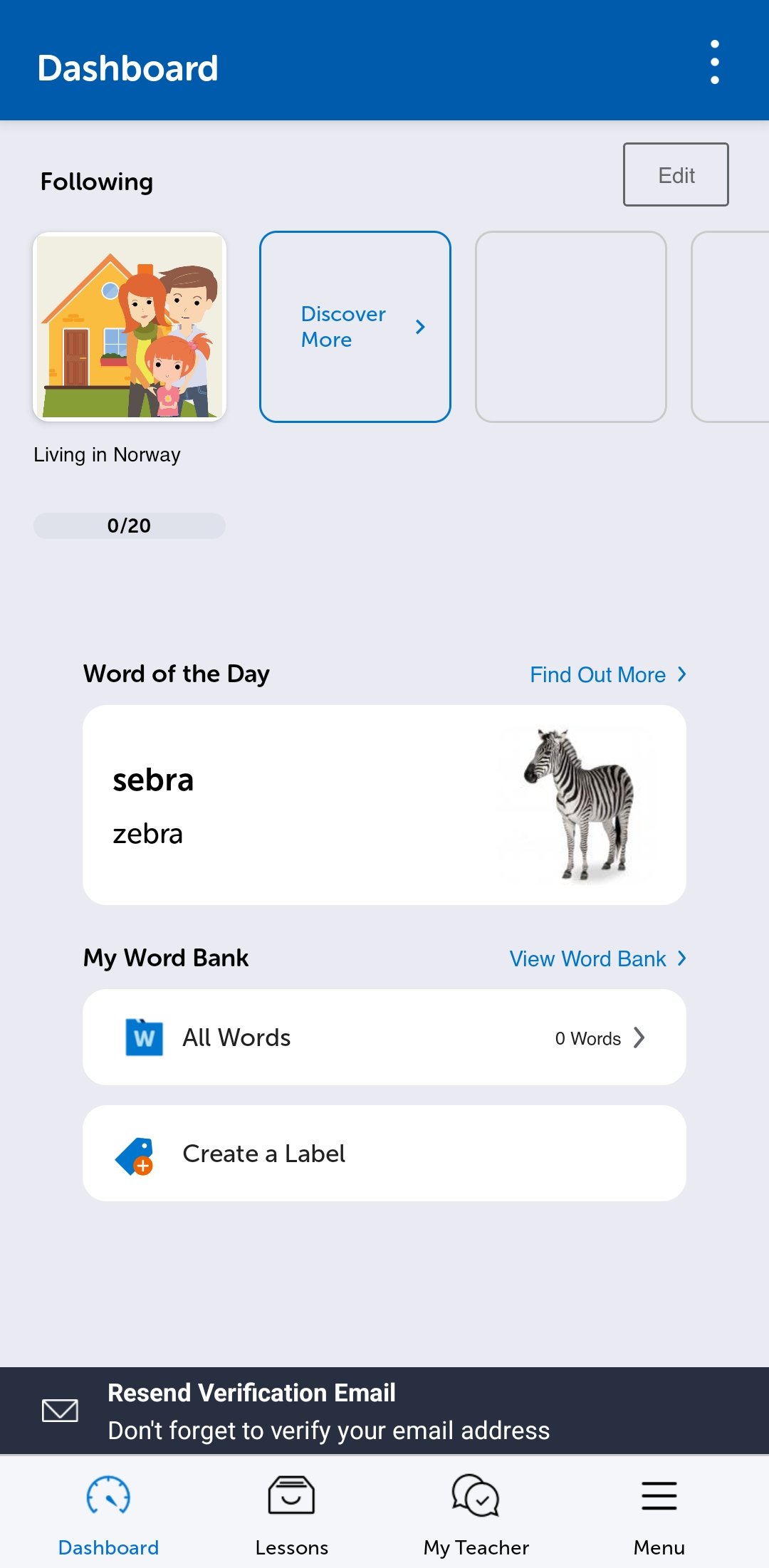
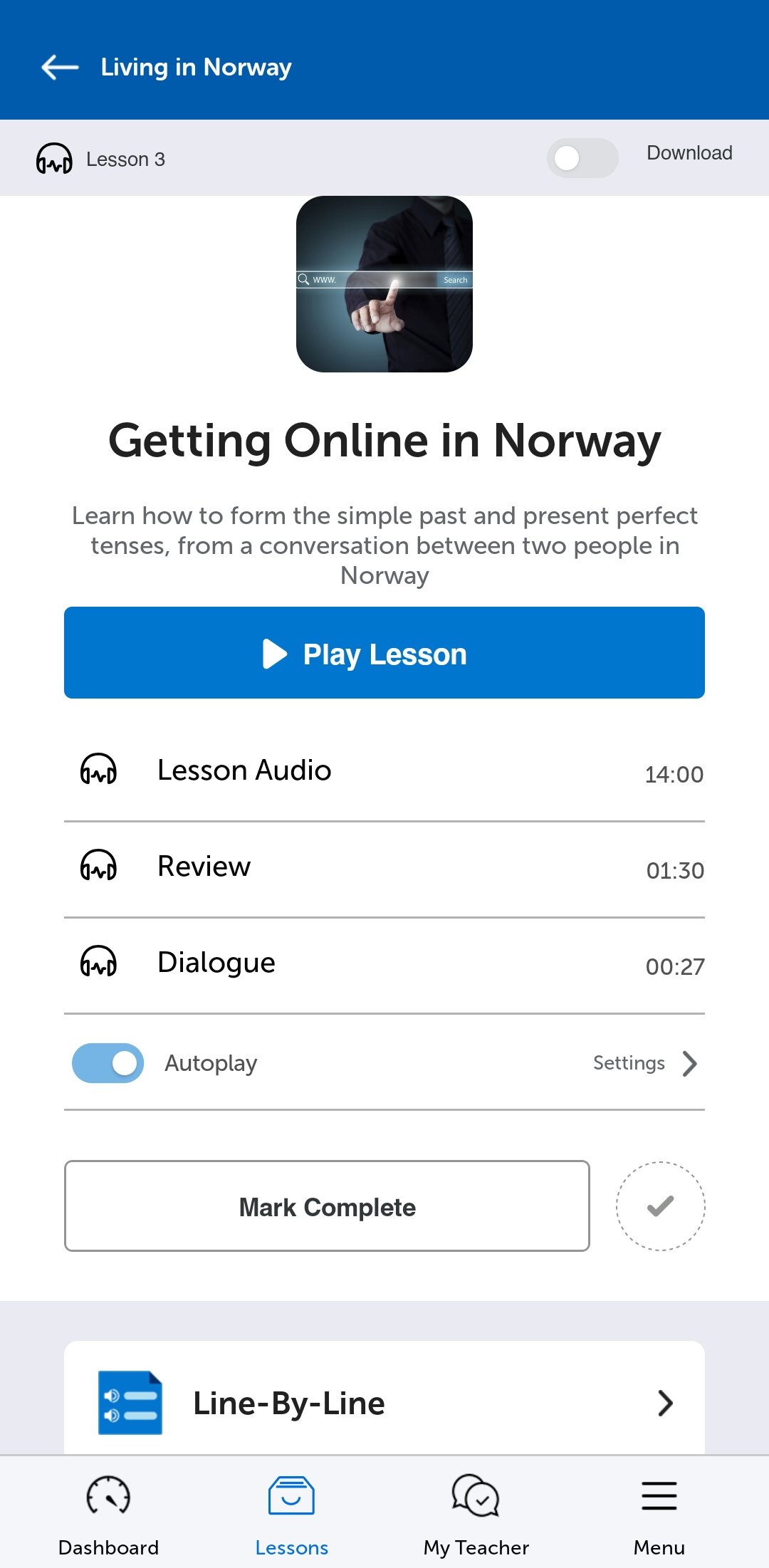
The Innovative Language app brings your pathway, downloads and review tools onto a phone. Lessons can be downloaded for travel, progress syncs across devices, and short audio sessions fit easily into a walk or commute.
The app is well rated overall, but public reviews repeatedly note that the website offers a fuller experience. Some users also report occasional loading or performance problems. That matches the most sensible division of labour: organise your week and read detailed notes in a browser, then use the app for listening and review.
Do not let portable audio become background noise. Before a walk, choose one short lesson. Pause after the dialogue, repeat two or three lines, and give your own answer to one prompt. Active use of ten minutes beats an hour that you barely notice.
What Learners Say
Independent learner comments are mixed in a useful way. Some Norwegian learners find NorwegianClass101 more practical than gamified apps because the dialogues and notes explain how people communicate. Others see it mainly as a supplement and feel the progression becomes less clear after the beginner material.
Both reactions make sense. The platform suits someone who likes choosing a topic, replaying audio and building a personal review list. It frustrates someone who wants a single route that decides every task and proves that each grammar point has been mastered.
There is also a difference between content depth and speaking progress. You can learn a great deal about Norwegian inside the platform. You only learn to manage a live conversation by having live conversations. The library prepares you for that experience; it cannot simulate all its speed, dialect variety and unpredictability.
NorwegianClass101 and Pimsleur
Pimsleur Norwegian is the clearest mainstream alternative if your priority is a linear speaking habit. Its audio sessions prompt you to recall phrases aloud and stay close to an Oslo-centred pronunciation. You press play, follow the sequence and speak.
NorwegianClass101 offers more control. You can inspect transcripts, grammar and vocabulary, choose short topics, and explore the relationship between written Norwegian and dialects. It also gives you more opportunities to replay tiny pieces of audio.
Choose Pimsleur if too much choice stops you studying and you want your daily speaking drill decided in advance. Choose NorwegianClass101 if you value written explanation, a wider library and the ability to investigate what you hear. Some learners could use Pimsleur for a daily speaking session and the free NorwegianClass101 account for extra reference material, though paying for both is rarely necessary at the start.
How Much Does NorwegianClass101 Cost?
Prices depend on billing length and current promotions. The lowest monthly anchors come with the longest billing period, so check both the term and total before paying.
| Plan | Rough monthly anchor | What it includes |
|---|---|---|
| Free | Free | A limited lesson selection, vocabulary resources, the app and a Premium trial |
| Basic | About US$4 | The lesson library and detailed lesson notes |
| Premium | About US$10 | Basic plus line-by-line audio, assessments, flashcards, word bank and pronunciation tools |
| Premium PLUS | About US$23 | Premium plus a teacher, marked work and personalised guidance |
Paid plans currently include a 60-day money-back guarantee.
Premium is the useful middle option for most independent learners. The line-by-line audio and review tools solve real Norwegian learning problems. Basic makes sense if you mainly want the recordings and notes. PLUS is worth considering when you will submit work and use the teacher consistently.
Check the current NorwegianClass101 price through our link. The discount is applied at checkout via our link. The amount varies, so check the current price before paying.
NorwegianClass101 Pros and Cons
Pros
- Clear native-speaker audio with transcripts and controllable line-by-line playback
- Useful explanations of Bokmål, spoken Norwegian, pronunciation and dialect variation
- Short lessons that fit around work and travel
- Strong vocabulary review and audio-based flashcards
- Flexible web and mobile access with offline listening
- Teacher feedback available for learners who choose Premium PLUS
Cons
- The large library can feel less coherent than one linear course
- Recorded lessons cannot represent Norway’s full dialect range
- Speaking is easy to skip unless you build it into every session
- The mobile app is not always as capable as the website
- Advanced learners may need more native material and targeted correction
Who Will Get the Most from It?
NorwegianClass101 is a good fit if you are a beginner or lower-intermediate learner who likes audio, wants written explanations and is willing to manage one main pathway. It is also helpful if you learned from an app and now need longer dialogues and clearer grammar notes.
It is a weaker fit if you want a fixed daily sequence, extensive live classes or one complete advanced syllabus. A learner preparing for a specific exam should check the exam requirements and add targeted practice. Someone moving to a particular Norwegian region should also seek local media and conversation partners.
A practical weekly routine would use three main lessons, brief vocabulary review on the other days, and at least one live or self-recorded conversation task. That is enough structure to create momentum without trying to consume the entire library.
Is NorwegianClass101 Worth It?
Yes, if you use its audio actively. NorwegianClass101 handles the meeting point between written Bokmål and spoken Norwegian better than a simple phrase app. The line-by-line player, useful notes and pronunciation material make difficult audio easier to examine.
Its weakness is also its appeal: you have many directions available. Choose one pathway, repeat the dialogues aloud, and take Norwegian beyond the platform every week. With that routine, the product is a strong base for early and intermediate study.
I rate NorwegianClass101 4.2 out of 5. Start with the free material, test a complete lesson on both web and mobile, and only pay when you know which tools you will use.
Try NorwegianClass101 and check today’s price.

Social