


PersianPod101 Review for Persian Learners

Full disclosure: This post contains affiliate links. ?
What is PersianPod101?
PersianPod101 is part of the Innovative Language family, with Persian audio and video lessons, transcripts, study tools, mobile access and optional teacher feedback.
- what it’s for:
- Building Persian listening, script recognition, vocabulary, pronunciation and practical communication through short lessons and review.
- languages:
- Persian
- level:
- Absolute Beginner to Advanced
+ PROS
- Script, romanisation, translation and audio together
- Excellent line-by-line playback
- Formal and colloquial Persian support
- Strong vocabulary review
- Mobile and offline access
- Optional teacher feedback
- CONS
- Busy lesson library
- Romanisation can become a crutch
- Tehrani focus has regional limits
- Speaking needs initiative
- App trails the website in places
Quick Fire Review
PersianPod101 is a flexible audio-led course whose script display and line-by-line playback suit Persian particularly well. It helps beginners connect written, formal and colloquial language, provided they add active speaking.
Persian gives beginners an unusual combination. The grammar is often kinder than expected, with no grammatical gender and no case endings. Reading asks for more patience because ordinary Persian text leaves most short vowels unwritten.
Spoken Persian adds another layer. The careful form you see on a page does not always match the colloquial Iranian forms used in everyday conversation, including the Tehrani usage represented in some course material. A resource has to help you connect script, sound and register without making one regional model stand for every kind of Persian.
PersianPod101 places native audio beside Persian script, romanisation and translation, then lets you slow down and isolate individual lines. Its format suits Persian remarkably well. You will need to organise the library and add active speaking practice.
What Makes Persian Different?
Persian is written from right to left in an Arabic-based script with additional letters and its own conventions. Long vowels normally appear in the writing. Three short vowels are usually left out in ordinary unvocalised text, so a written sequence can have more than one possible reading until you know the word or understand the context.
The uncertainty decreases with exposure. Common words become shapes you recognise, and audio helps you attach a reliable pronunciation to each one. Romanisation is useful at the beginning, though relying on it for too long delays the pattern recognition that makes real reading possible.
Grammar offers some relief. Persian has no grammatical gender and no noun case system. Verbs still require work, and the usual subject-object-verb order takes adjustment for English speakers.
There is also a gap between formal written Persian and colloquial speech. PersianPod101’s examples focus on Iranian Persian and include Tehrani colloquial usage, which is one regional model. It is not a universal spoken standard for every Persian-speaking community. Dari, Tajik and regional Iranian varieties have their own conventions and features.
The current US State Department schedule gives Category III languages a normal intensive course of 44 weeks for its professional objective. Farsi falls under that catch-all definition, although it is not named beside the 44-week line. For a beginner, the useful message is simply that script and listening need regular attention.
Getting Started with PersianPod101
PersianPod101 asks you to choose a level and offers pathways through its lesson library. Start with one Absolute Beginner route, even if several topics look interesting. The site is easy to browse and just as easy to scatter your attention across.
The free account lets you test a limited lesson selection and vocabulary resources. It also currently includes a short Premium trial without requiring a card. Use that trial to inspect the full lesson page, line-by-line audio and flashcards, since those features determine whether a paid plan is worth it.
A useful placement test starts with things you can do. Can you read the alphabet slowly? Can you understand a basic greeting without looking at the translation? Can you recognise colloquial forms such as the spoken version of “I want”? Choose the first pathway that makes one of those tasks slightly difficult.

Learning the Persian Script
PersianPod101 includes dedicated alphabet and writing-system lessons, but the most useful script practice happens inside ordinary dialogues. You see how letters join in real words and hear the word immediately.
Begin by hiding romanisation for words you already know. Read the Persian, predict the sound, then play the audio. When you are wrong, work out what happened. You may have missed a letter form, an unwritten short vowel or a colloquial pronunciation. Each problem needs a different fix.
Do not wait until you can read comfortably before speaking. Learn a phrase through audio, say it, and then study its written form. Script and conversation can develop together.
The Fi3M guide to Persian gives you a broader plan for reading and first conversations. It is a useful companion when a library lesson explains one feature but you want to see the whole writing system in one place.
Short Vowels and Line-by-Line Audio
The missing short vowels are the strongest reason to use PersianPod101’s line-by-line player. A beginner looking at a new word may not know which vowels belong between the consonants. The recording supplies the answer, and the transcript lets you connect that answer to the written shape.
Work with small pieces. Listen to one line without reading. Reveal the Persian script and listen again. Check romanisation only if you still cannot identify the vowels. Then record yourself saying the line and compare it with the model.
This process is slower than letting a full lesson play, but it trains reading and listening together. Over time, familiar vocabulary stops feeling under-specified because you already know how the word sounds.
The recorder does not score your pronunciation. Use it to compare timing, vowel length and stress. If you cannot hear the difference, teacher feedback or a conversation partner is more useful than recording the same mistake ten times.

Formal Persian and Everyday Tehrani Speech
PersianPod101 explicitly shows formal and spoken variants in some lesson material. This is important because colloquial Iranian Persian often contracts verbs, changes common words and uses endings that differ from formal writing.
Learn both forms as a pair when they serve different situations. The formal version helps with books, news and careful speech. The colloquial version helps you understand conversation and sound natural with Iranian speakers. Label the pair in your notes so you do not accidentally use a highly formal construction in a casual exchange.
Keep the geographical limitation in view. Tehrani speech is influential, but Persian is larger than Tehran and Iran. If your goal is family conversation in Afghanistan, work in Tajikistan or a particular Iranian region, seek speakers and media from that community early.
The platform provides a useful foundation because it refuses to make the spoken and written forms look identical. You supply the regional focus.
Inside a PersianPod101 Lesson
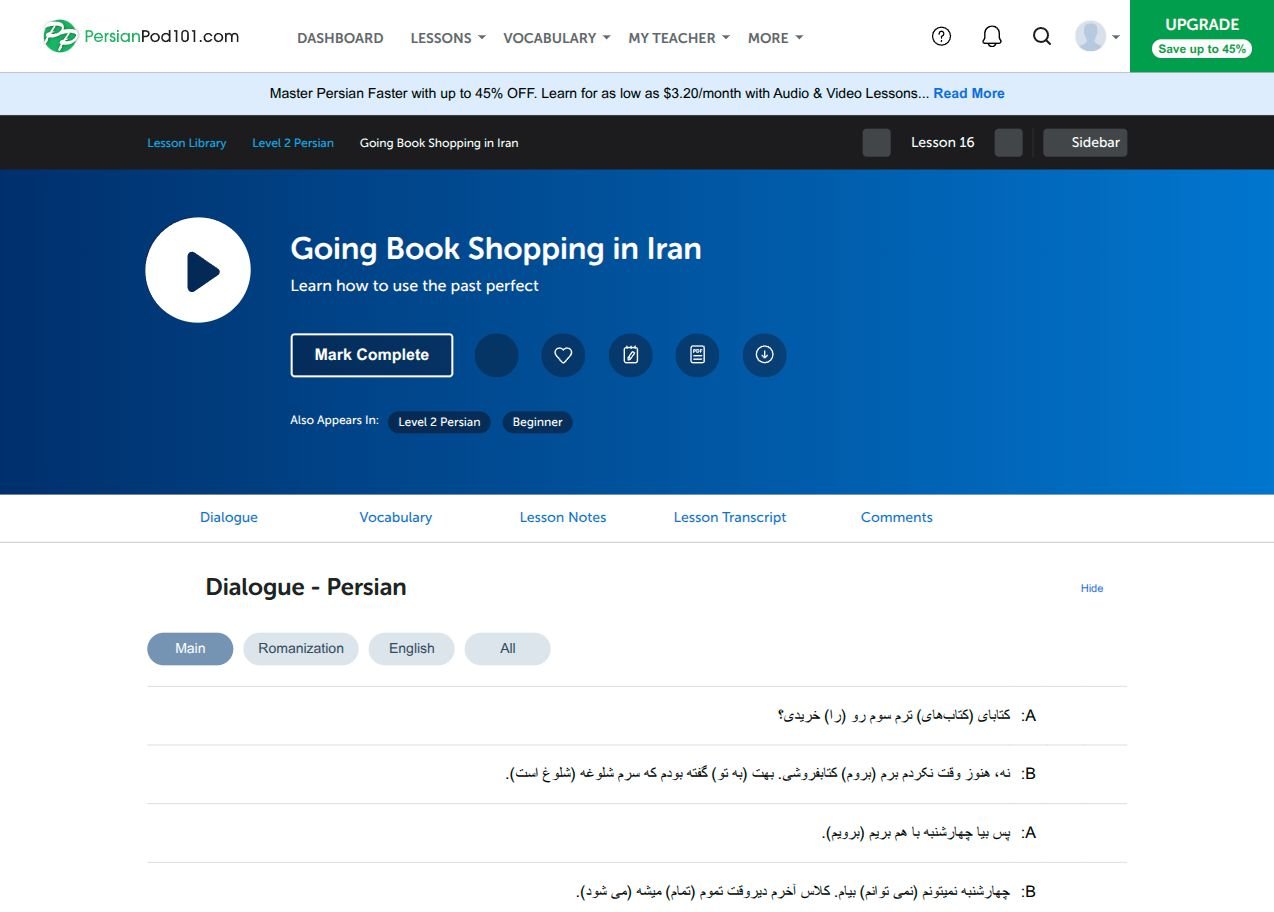
A typical lesson centres on a dialogue, followed by vocabulary, sentence explanations, grammar and cultural notes. English explanation makes the early material accessible. At higher levels, it can feel like time taken away from Persian, so skip ahead when you already understand the setup.
Use each lesson in two passes. On the first day, listen for meaning and study the notes. On the next day, return to the dialogue without the translation and reconstruct as much as you can. Delayed recall tells you more than immediate recognition.
Then adapt one exchange. Change the name, destination, time or opinion and say the new version aloud. Persian word order and colloquial verb forms become usable when you move them into a sentence that matters to you.
Cultural explanations are valuable, particularly for politeness and taarof. Treat them as introductions to patterns, not rules that predict every person or situation.
Vocabulary and Review Tools
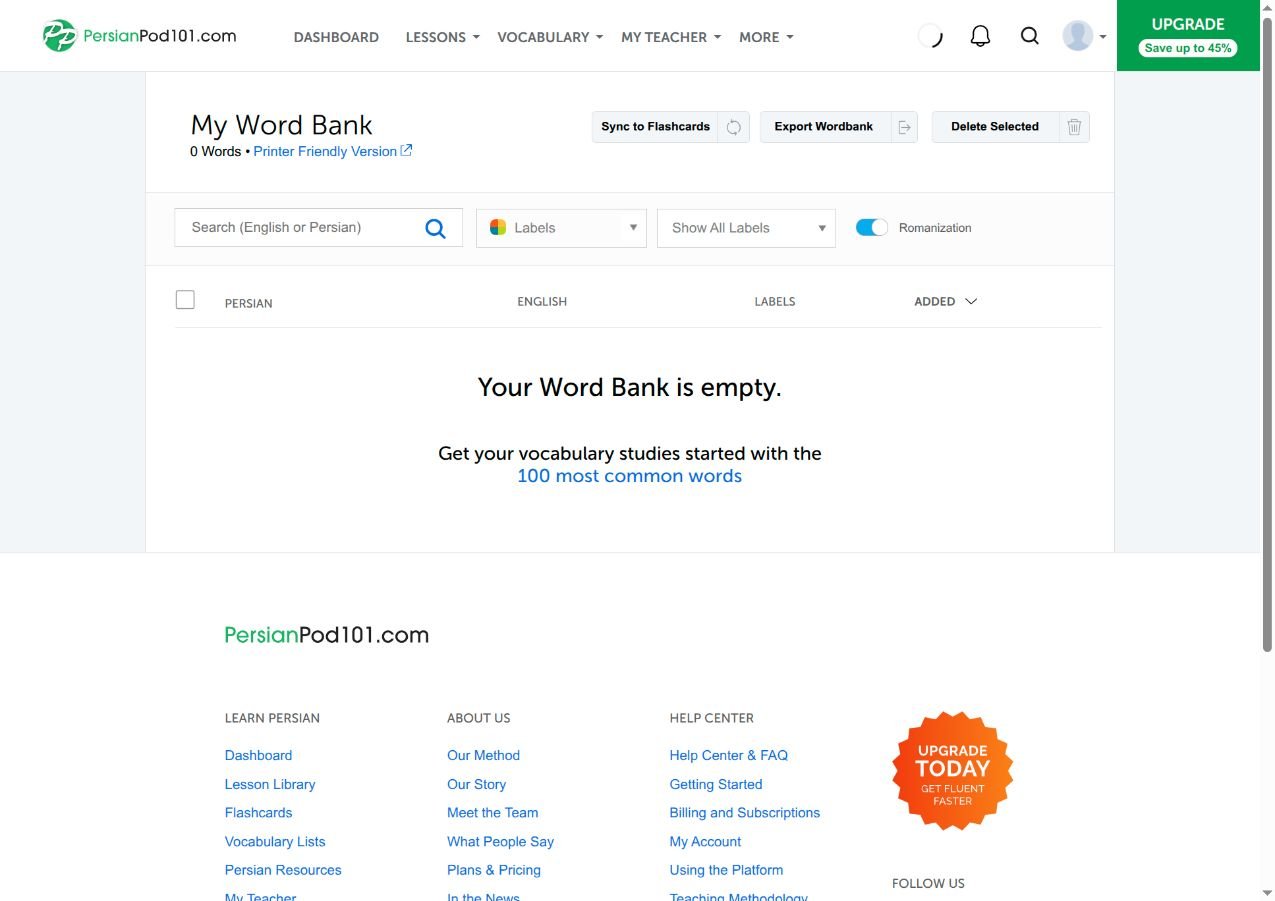
Premium’s word bank and spaced-repetition flashcards are useful if you save complete entries. Keep the Persian spelling, audio and a short phrase together. A romanised English-to-Persian card may produce quick quiz success while doing little for reading.
Line-by-line audio is still the most useful feature. It saves you from hunting through a recording whenever one colloquial contraction or missing vowel causes trouble. Assessments and core vocabulary lists can expose gaps, but they work best after real lessons. There is little value in turning them into a separate race to collect words.
The pronunciation recorder helps you notice broad differences. Premium PLUS adds a teacher who can mark work and provide personalised guidance. If you prefer live sessions, a tutor through a service such as italki can focus on your target variety and conversational needs.
Using the App
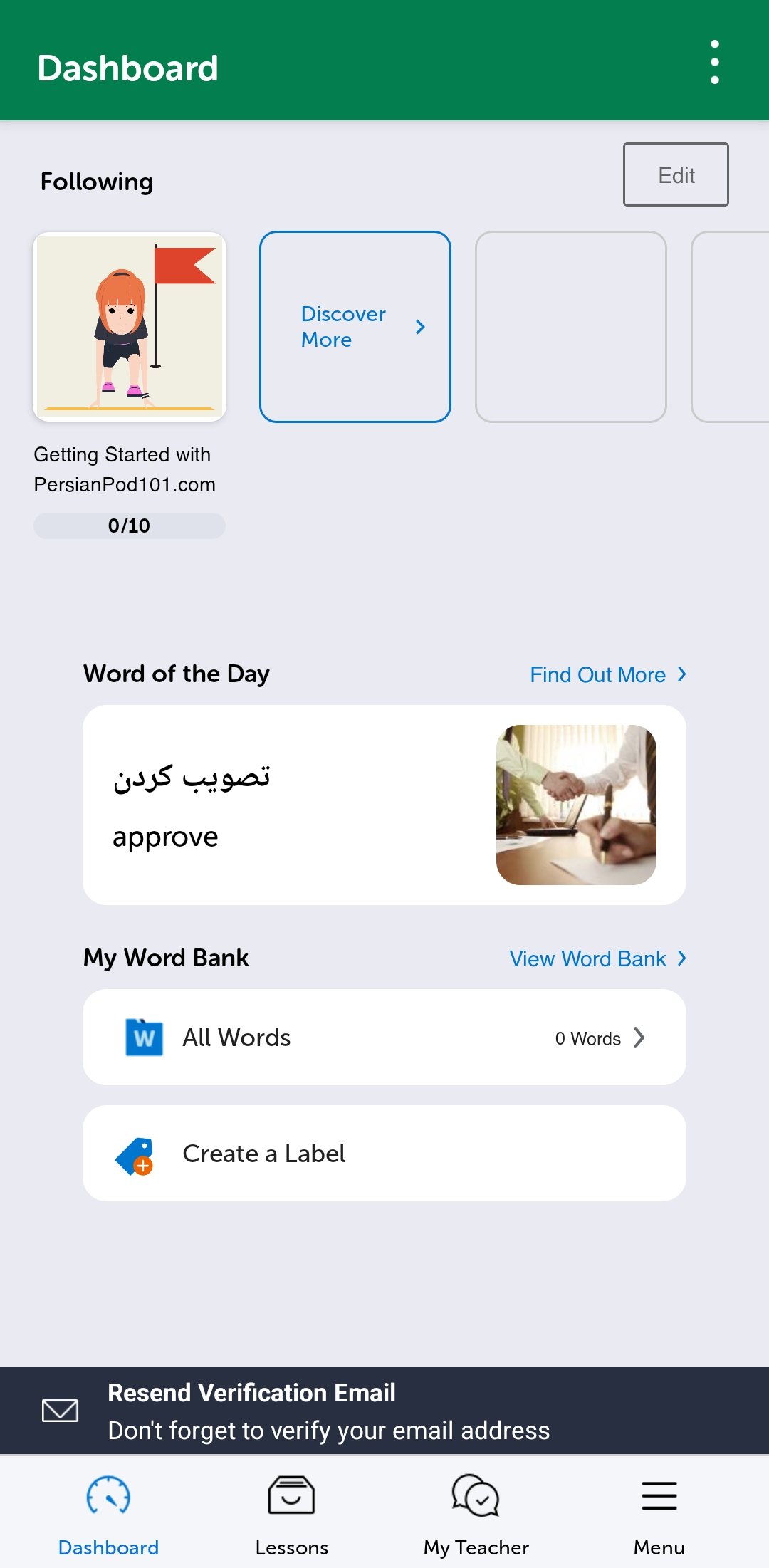
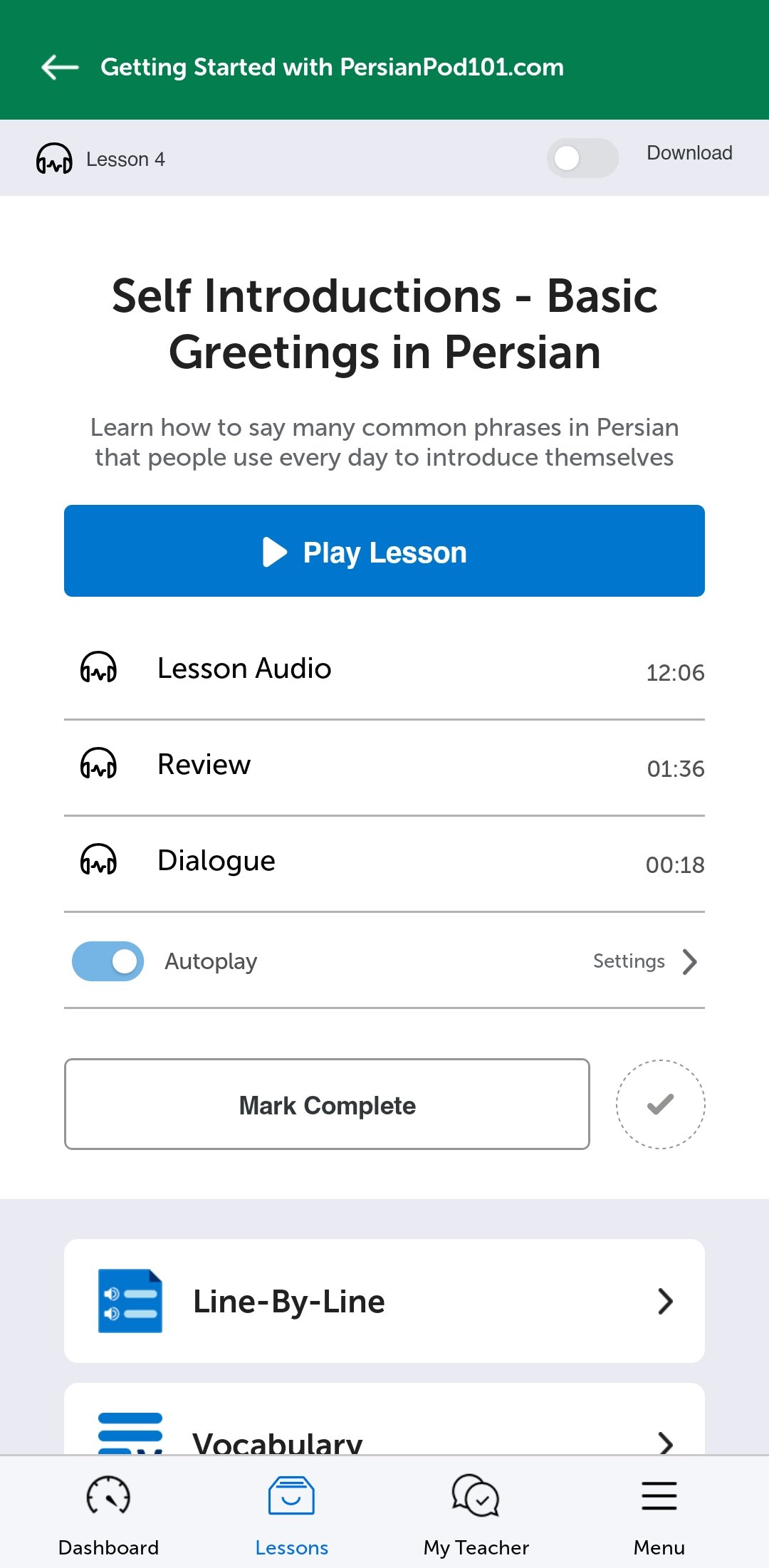
PersianPod101 runs through the shared Innovative Language app. It supports downloaded lessons, synced progress, notes, line-by-line playback and vocabulary review. That makes it easy to keep Persian in your day when you are away from a computer.
The public app-store response is positive overall, with recurring complaints that some website features are less accessible on mobile and that loading can occasionally be unreliable. For Persian, the smaller screen also makes detailed script study less comfortable.
Use the website for a first pass through a lesson, particularly when you are learning new letters or comparing formal and colloquial forms. Use the app to replay familiar audio, shadow a dialogue and review vocabulary. Download a lesson before travelling instead of depending on a connection.
What Learners Say
Independent learners often praise PersianPod101’s accurate content, native audio and the ability to see script, romanisation and translation together. Some find the interface dated or awkward, and several treat the service as a supplement instead of a complete course.
Authentic colloquial speed divides opinion. One learner hears useful real Persian; another hears a dialogue that moves too quickly to teach from. The line-by-line player is what turns the same recording from frustration into training. Slow down small sections, then return to full speed.
Comments about the broader 101 family also warn about long English introductions and uneven organisation. Those complaints matter, although they do not describe every Persian lesson. Skip material that does not help, stay with one pathway and measure progress by what you can understand and say.
PersianPod101 and Pimsleur
Pimsleur Persian provides a more linear spoken routine. Its core sessions prompt you to answer aloud and retrieve phrases under time pressure. You do less screen-based study and make fewer choices.
PersianPod101 gives you much richer access to the script, visible formal and colloquial forms, detailed notes and individual dialogue lines. It is a better reference and listening library, but it does less to force an answer out of you.
Choose Pimsleur when your main obstacle is establishing a daily speaking habit. Choose PersianPod101 when script, close listening and flexible review matter most. A beginner focused on conversation can reproduce Pimsleur’s best feature inside PersianPod101 by pausing before each response and answering first, though that requires discipline.
How Much Does PersianPod101 Cost?
The monthly equivalent changes with the billing term. The lowest monthly anchors come with the longest billing period, so check both the term and total before paying.
| Plan | Rough monthly anchor | What it includes |
|---|---|---|
| Free | Free | A limited lesson selection, vocabulary resources, the app and a Premium trial |
| Basic | About US$4 | The lesson library and detailed lesson notes |
| Premium | About US$10 | Basic plus line-by-line audio, assessments, flashcards, word bank and pronunciation tools |
| Premium PLUS | About US$23 | Premium plus a teacher, marked work and personalised guidance |
Paid plans currently include a 60-day money-back guarantee.
Premium is the strongest value for most self-directed Persian learners because the line-by-line tool directly supports script and missing-vowel work. Basic suits someone who mainly wants dialogues and notes. PLUS only earns its extra cost when you plan to submit assignments and use the feedback.
Check the current PersianPod101 price through our link. The discount is applied at checkout via our link. The amount varies, so check the current price before paying.
PersianPod101 Pros and Cons
Pros
- Persian script, romanisation, translation and audio can be studied together
- Line-by-line playback helps with unwritten vowels and colloquial contractions
- Lessons acknowledge formal and everyday spoken Persian
- Strong vocabulary and review tools
- Offline mobile listening and cross-device progress
- Personal feedback is available through Premium PLUS
Cons
- The library can feel busy and unevenly sequenced
- Romanisation is easy to depend on for too long
- Tehrani-focused material cannot cover every Persian variety
- Speaking practice requires deliberate effort below the teacher tier
- The app does not always match the full website experience
Who Will Get the Most from It?
PersianPod101 suits beginners and lower-intermediate learners who want native audio, visible script and the freedom to repeat difficult lines. It is especially helpful if you can understand a little Persian from family or media but have never learned to read it systematically.
It is less suitable for someone who needs live classes, a rigid daily syllabus or a course designed around Dari or Tajik. Advanced learners will need longer native texts, unscripted audio and regular conversation outside the platform.
A balanced week might include three new lessons, short daily script and flashcard review, and one conversation task. Record a message, write a few sentences for correction or speak with a tutor. That final part turns recognition into access.
Is PersianPod101 Worth It?
PersianPod101 earns its place by helping you see and hear the same language at the same time. Its line-by-line display makes unwritten short vowels less mysterious. Its treatment of formal and colloquial forms prepares you for the gap between a textbook sentence and everyday Iranian speech.
The platform needs a little management. Choose one pathway, reduce romanisation as soon as you can, and make yourself answer aloud before the recording does. Add regional input if your Persian goals extend beyond Tehrani Iranian speech.
I rate PersianPod101 4.3 out of 5. Test the free material with one full script-heavy lesson. If the line-by-line view helps you decode Persian you could not handle alone, Premium is likely to be useful.
Try PersianPod101 and check today’s price.

Social