



UrduPod101 Review for Learning Urdu

Full disclosure: This post contains affiliate links. ?
What is UrduPod101?
UrduPod101 is part of the Innovative Language family, built to get you understanding, reading and speaking Urdu from the first lesson. Audio and video lessons taught by native speakers are its main feature.
- what it’s for:
- First contact with Urdu, Nastaliq literacy, listening, pronunciation, grammatical gender, practical vocabulary, and phrases and conversation material
- languages:
- Urdu
- level:
- Absolute Beginner to Advanced
+ PROS
- Nastaliq practice inside the guided beginner pathway
- Native audio beside the script for omitted short vowels
- Line-by-line playback for close listening and pronunciation
- Dialogues with transcripts, vocabulary and lesson notes
- Reading collections and useful vocabulary tools
- Free access, a seven-day trial and a 60-day guarantee
- CONS
- The wider library can feel loose outside the recommended pathway
- Some grammar needs a more systematic companion
- Beginner lessons can contain too much English
- Some material may sound formal in casual conversation
- The mobile app lacks website features, including flashcards
Quick Fire Review
A strong Urdu audio and literacy base with integrated Nastaliq practice and line-by-line playback, best paired with systematic grammar and regular conversation. 4.2/5.
Urdu asks you to connect a language you hear with a writing system that tells you less than a beginner expects. It is usually written right to left in an extended Perso-Arabic alphabet, most visibly in the flowing Nastaliq style. The letters change shape as they join, and ordinary text usually leaves most short-vowel marks out.
The spoken language can feel more familiar if you know Hindi. Urdu and Hindi share their core grammar and much everyday vocabulary, but they are not just one language with two alphabets. Their standard scripts, literary histories and formal vocabulary have developed differently, and that gap becomes more obvious as the language gets more formal.
UrduPod101 follows the Innovative Language format: short native-speaker dialogues, transcripts, guided pathways, vocabulary tools and a shared mobile app. The question I’m answering here is how well that format handles Urdu’s script, missing vowels, pronunciation and grammar, and where a learner still needs another resource.
What Makes Urdu Different
A useful Urdu course has to prepare you for several connected challenges.
Nastaliq is a reading skill of its own. Urdu uses an extended Perso-Arabic alphabet, normally written in the Nastaliq calligraphic style. Nastaliq is not a separate alphabet, but its sloping shapes and joining behaviour can make a clean letter chart feel far removed from a real sentence. Letters take different forms depending on their position, while some join on both sides and others break the connection.
Short vowels often disappear from ordinary writing. Urdu has marks for short vowels, commonly taught as zabar, zer and pesh, but they are normally omitted once text is written for fluent readers. Long vowels are represented more consistently. This means a beginner may recognise every consonant in a word and still be unsure how to say it. Vocabulary and context supply the missing information, which is why audio beside the script matters so much.
The sound system contains contrasts English does not use in the same way. Dental and retroflex consonants differ by tongue position, and aspirated consonants differ from their unaspirated partners by a puff of air. Urdu’s Persian and Arabic vocabulary also introduces sounds and spellings that need careful listening, although pronunciation varies between speakers and registers. Romanisation can point you in the right direction, but it rarely represents the whole grid neatly.
Grammar reaches across the sentence. Urdu has masculine and feminine grammatical gender, and adjectives or verb forms may agree accordingly. It usually places the verb at the end and uses postpositions where English uses prepositions. Pronouns and verb forms also carry social distance. Memorising an isolated phrase can get you through an exchange, but building your own sentence asks you to understand what each part is doing.
Hindi gives you a head start, not a complete transfer. Hindi and Urdu developed from the same Delhi-region Khari Boli base. They share grammar and most basic everyday vocabulary, so ordinary speech can be highly mutually intelligible. Standard Hindi uses Devanagari and tends towards Sanskrit in higher vocabulary. Standard Urdu uses the Perso-Arabic alphabet and draws more heavily on Persian and Arabic. A Hindi speaker may understand a conversation immediately and still face a substantial Urdu literacy project.
The current US State Department framework places most languages outside its easier Romance and Germanic groups, apart from four separately named super-hard languages, in Category III. Urdu is not individually named beside the Category III description, so applying it is an inference from that catch-all definition. The normal intensive course is 44 weeks for the Department’s professional objective. The useful point for a self-directed learner is that spoken familiarity does not make the script and grammar disappear.
Getting Started with UrduPod101
You can create a free lifetime account with an email address and no payment card. The free level gives you a limited selection from the lesson library and starts a seven-day Premium trial. After you choose a level, the dashboard assigns a recommended pathway.
Follow the pathway before exploring the wider library. UrduPod101 contains pronunciation material, reading collections, vocabulary lists, culture lessons and specialist series. That breadth becomes useful when you can name a gap. At the start, it can scatter your attention across greetings, script and random vocabulary without enough repetition.
The current Level 1 pathway gives Nastaliq a regular place beside practical beginner lessons. It includes script checks throughout the sequence rather than treating the writing system as one introductory detour. Hand-graded writing and speaking challenges also appear for learners on Premium PLUS.

How It Handles Nastaliq and Pronunciation
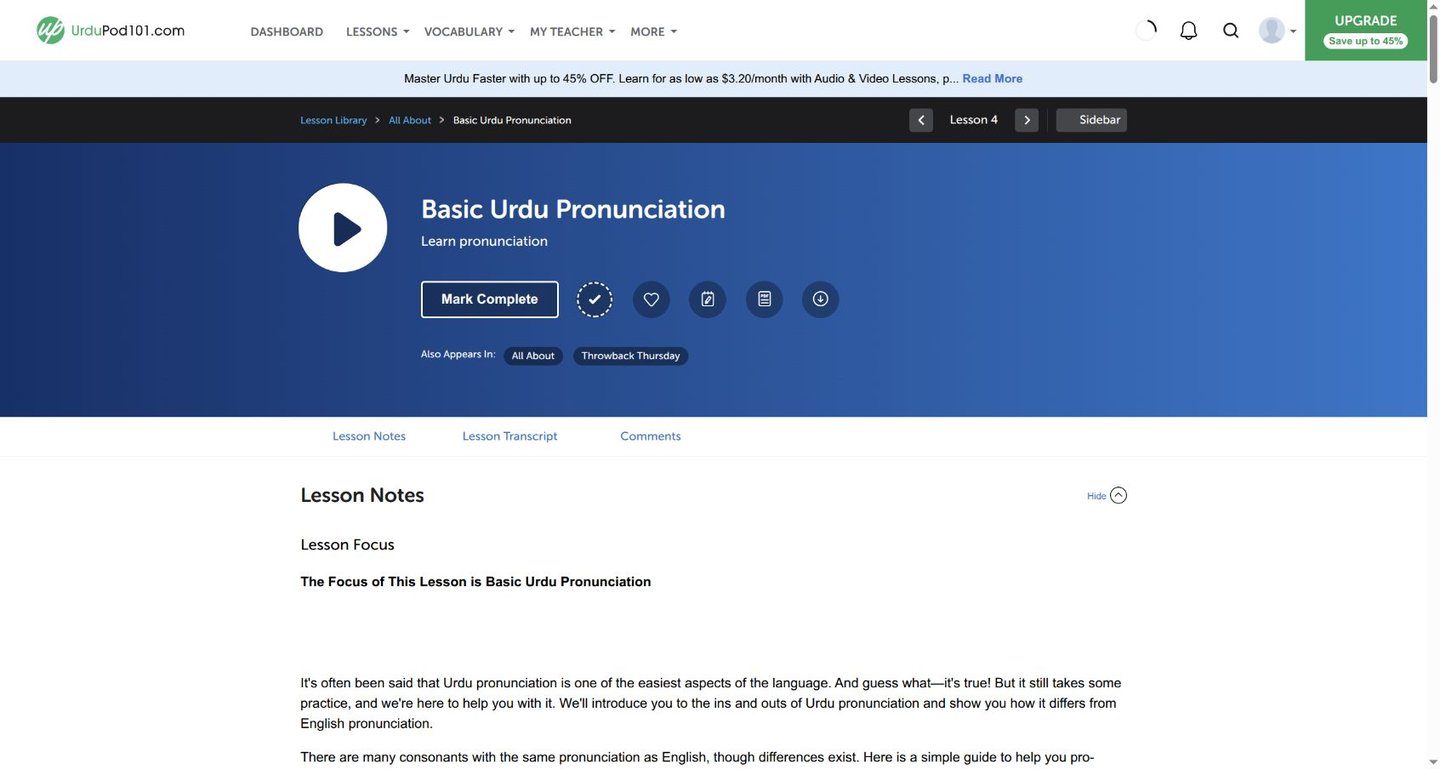
UrduPod101 has dedicated writing-system and pronunciation material, along with an alphabet guide and printable practice sheets. The better script practice appears inside the main beginner pathway, where you meet letters in words and sentences, then hear those words spoken.
That combination is far more useful than the platform’s broad marketing claim that Urdu writing is highly phonetic. Letter-to-sound relationships do help, but most short vowels are absent from ordinary text. A new word can remain ambiguous until you already know it or hear it. The line-by-line player supplies the sound that the unvocalised spelling leaves out.
Use romanisation for the first few days, then start hiding it. Listen to a line, read the Urdu script and predict the missing vowels before revealing the romanisation. Record yourself beside the native line as well. This turns Nastaliq into a route to sound instead of a decorative version of a phrase you still read in English letters.
The same comparison helps with dental and retroflex stops, aspiration and rhythm. The recorder does not tell you which contrast you missed; it simply places your recording next to the model. If you cannot hear the difference, a teacher or tutor through italki can give direct correction.

Inside an UrduPod101 Lesson
A typical lesson centres on a short native dialogue. You hear the exchange, work through the individual lines and vocabulary, then use the transcript and lesson notes for grammar and cultural explanation. Lessons are usually short enough to repeat, which matters more than ticking off a large number once.
The format suits Urdu’s missing-vowel problem. You can connect the written shape with a complete spoken word, then return to it in a sentence. It also helps with gender and politeness because the form appears in a social exchange rather than as an isolated chart.
The harder part is building those explanations into a system. One note can explain why a verb or agreement pattern appears in that dialogue, but Urdu grammar needs a map that builds across lessons. Some learners report that grammar topics are glossed over or that examples become more complex than the beginner explanation around them. Keep a small reference beside the course, recording nouns with their gender and phrases with the agreement that follows.
Beginner episodes also use plenty of English. That can make an unfamiliar writing system less intimidating, but it reduces the amount of Urdu you hear. Once you understand the teaching point, replay the clean dialogue and individual Urdu lines. The explanation should help you return to the language, not become the main listening practice.
The Study Tools
Premium adds the tools that turn the library into a more practical study system:
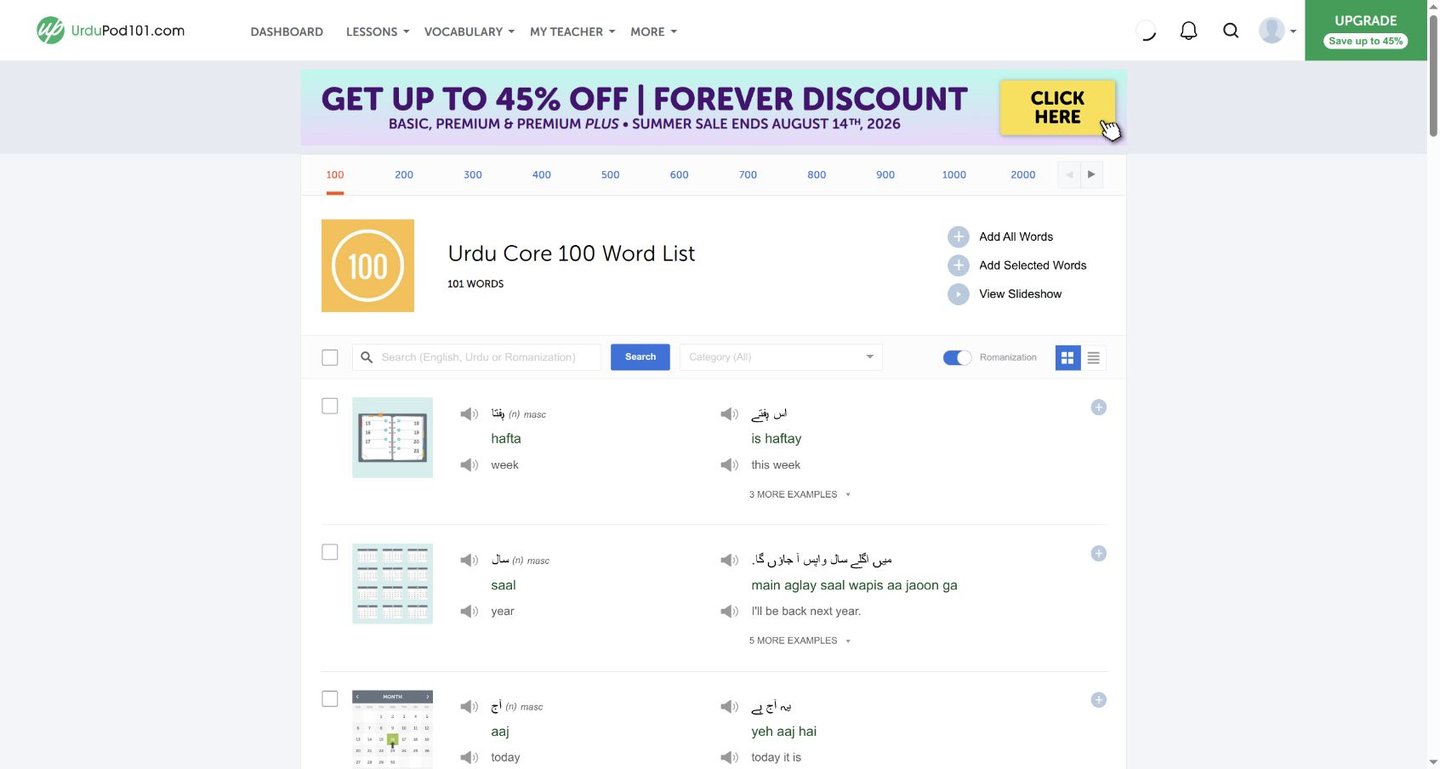
- Line-by-line audio isolates one Urdu sentence at a time.
- The voice recorder places your pronunciation beside the native version.
- A word bank and spaced-repetition flashcards collect vocabulary from lessons and lists.
- Multiple-choice assessments check recognition and comprehension along a pathway.
- Core-word collections and an audio dictionary give you reference material outside the next lesson.
The word bank is most useful when you add information the spelling does not show. Store a noun with its gender, keep the audio, and include a short sentence. If the word contains an unwritten short vowel, do not let the bare consonant shape become the only thing you review.
These tools still favour recognition and self-comparison. Choosing an answer or replaying a recording is not the same as finding a form during conversation. Premium PLUS adds hand-graded writing and speaking work plus teacher messaging, but the extra cost is worthwhile only if you will submit work regularly.
The Mobile App
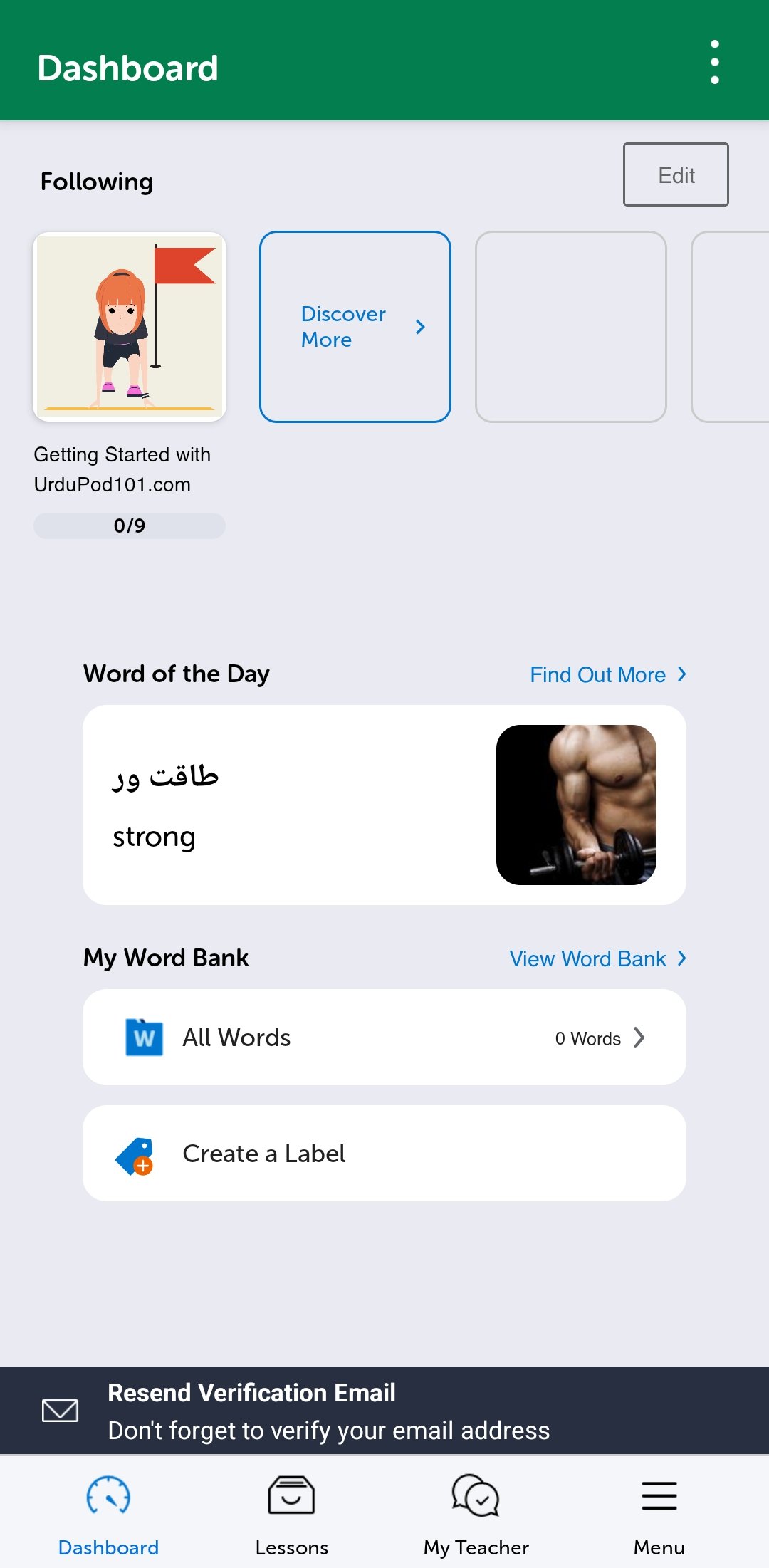
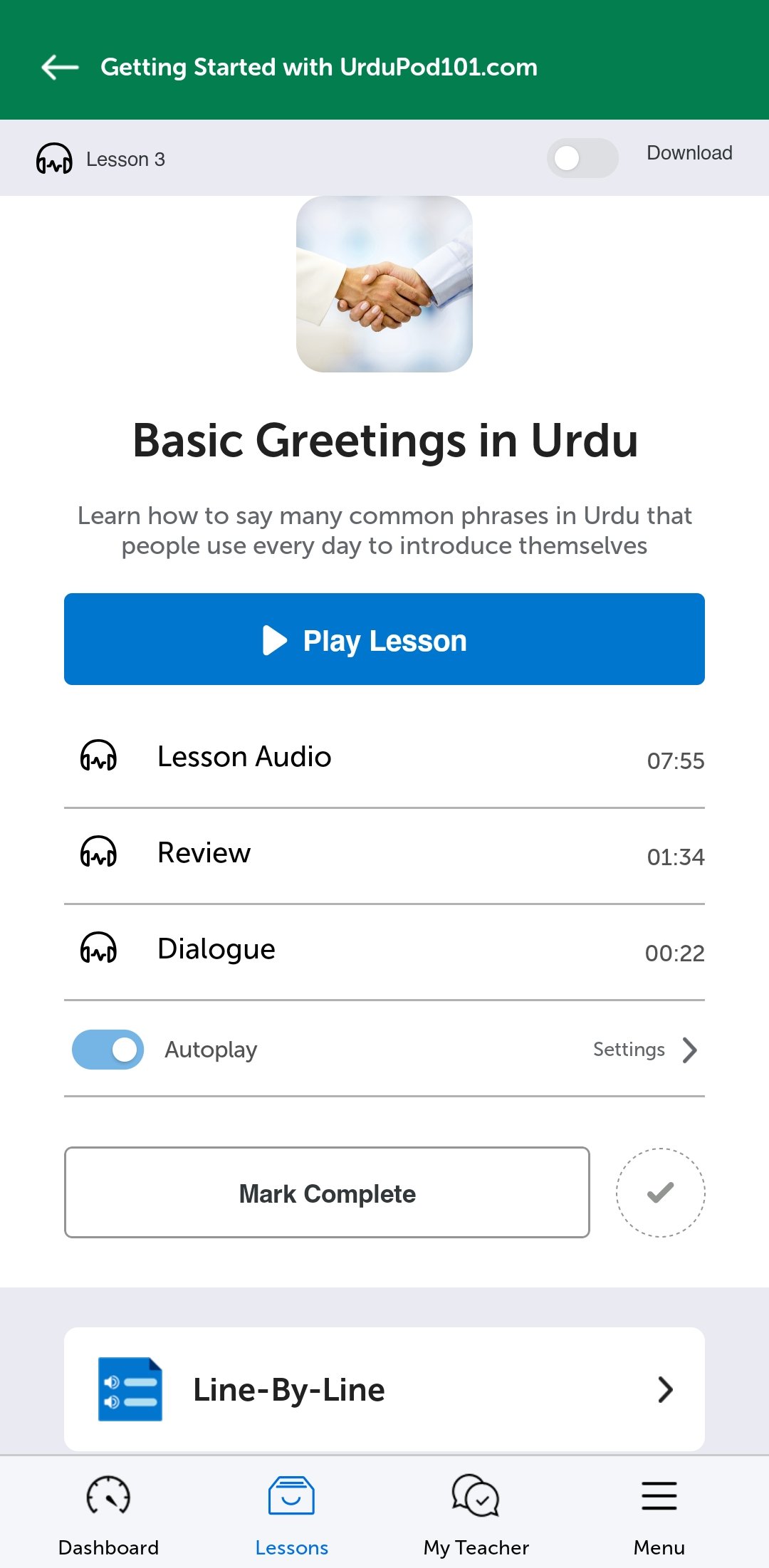
UrduPod101 uses the shared Innovative Language Learning app for iOS and Android. Progress syncs between the website and phone, and you can download lessons or whole series for offline study. Some detailed audio, including line-by-line and vocabulary audio, still needs an internet connection.
The app works well for repeating a dialogue while travelling or walking. The website remains better for deliberate Nastaliq work on a larger screen. Innovative’s current support page also says flashcards are not available in the app, although the word bank and eligible assessments are.
What Urdu Learners Say
The most useful independent comments praise UrduPod101 as a beginner source for vocabulary, grammar, short lessons and full transcripts. Learners who have limited access to polished Urdu courses value having native audio and written material in the same place.
The same comments keep raising a few reservations. The broader library can feel haphazard, some grammar needs a clearer explanation, and occasional examples are harder than the beginner lesson around them. One learner in Pakistan also found some phrasing too formal for everyday use. That is an individual experience, but it is a sensible warning to test course language against the people you actually want to speak with.
Learners generally describe UrduPod101 as a strong starting point or supplement, not a complete route to advanced speaking. They add flashcards, reading, Pakistani media and conversation. That is also how I would use it. The course can organise input and show you how a sentence is built, but spontaneous back-and-forth needs another person.
UrduPod101 Compared with Pimsleur
Pimsleur is the clearest alternative for a beginner who wants a fixed spoken routine. Its current Urdu course has one level of daily 30-minute lessons. It prompts you to answer aloud and retrieve phrases under time pressure, so there is less room to browse instead of speaking.
UrduPod101 is broader. It gives Nastaliq, transcripts, line-by-line audio, reading collections, lesson notes and vocabulary tools much more room. It can support you beyond one beginner sequence, but it expects you to follow a pathway and choose your review work.
Choose Pimsleur when your main problem is establishing a hands-free speaking habit. Choose UrduPod101 when you want listening, script and written explanation in one place. You can create some of Pimsleur’s active pressure by pausing before each response and answering aloud, though UrduPod101 will not force you to do it.
Pricing and Plans
UrduPod101 currently has four access levels. These are approximate monthly figures shown for a 24-month term; the exact checkout offer can vary:
| Plan | Rough monthly anchor | What it includes |
|---|---|---|
| Free | Free | A limited lesson selection, vocabulary resources, the app and a seven-day Premium trial |
| Basic | About US$4 | All lessons and in-depth lesson notes |
| Premium | About US$5.50–10 | Basic plus line-by-line audio, assessments, flashcards, word bank, pronunciation tools and the 2,000-word core collection |
| Premium PLUS | About US$13–23 | Premium plus a teacher, hand-graded work, personalised guidance and added speaking and writing practice |
The lowest monthly anchors require a long subscription paid for the term, and shorter plans cost more per month. The discount from our link is applied at checkout, but the amount varies, so check the live total. Paid plans include a 60-day money-back guarantee.
Premium is the useful middle for most Urdu learners. The line-by-line tool directly supports missing-vowel and pronunciation work, while flashcards and the word bank make review easier. Basic is enough if you mainly want the lessons and already have your own review system. PLUS makes sense when you will use the Nastaliq, writing and speaking feedback.
Pros and Cons
Pros
- Nastaliq practice appears inside the guided beginner pathway
- Native audio beside the script helps supply omitted short vowels
- Line-by-line playback supports dental, retroflex and aspirated contrasts
- Short dialogues come with transcripts, vocabulary and lesson notes
- Reading collections and vocabulary tools give beginners room to grow
- Free access, a seven-day trial and a 60-day guarantee
Cons
- The wider library can feel loose outside the recommended pathway
- Some grammar needs a more systematic companion
- Beginner lessons can contain too much English
- Some material may sound formal in casual conversation
- Open speaking and writing feedback are limited below Premium PLUS
- The mobile app lacks website features, including flashcards
Who UrduPod101 Suits
UrduPod101 suits beginners and lower-intermediate learners who want native audio, visible Nastaliq and English explanation in the same place. It is particularly useful for a heritage learner who understands some family conversation but cannot yet read Urdu confidently, or for a Hindi speaker who needs to turn spoken familiarity into Urdu literacy.
It is less suitable as your only resource if you want a strict daily syllabus, frequent live conversation or a cumulative grammar course. Advanced learners will need longer native texts, unscripted Pakistani audio and regular production outside the platform.
The Verdict
UrduPod101 handles Urdu better than its podcast-style name suggests. Nastaliq practice is built into the beginner pathway, and line-by-line audio gives learners the short vowels that ordinary writing often leaves out. The dialogues also put gender, politeness and verb-final sentences into a setting where they make sense.
You will still get more from the course with a companion. Use a grammar reference to organise what the lessons introduce, and speak with people who can tell you when a correct phrase sounds too formal for the situation. Once the recommended pathway is your spine, the large library becomes an advantage.
My rating: 4.2 out of 5.
You can start with UrduPod101 here. The discount from our link is applied at checkout, but its amount varies. Use the free account to test one script-heavy lesson and one dialogue before paying. If the line-by-line view helps you connect Nastaliq with the Urdu you hear, Premium is probably useful for you.

Social