


Handcrafted audio for remembering what you learn

Full disclosure: This post contains affiliate links. ?
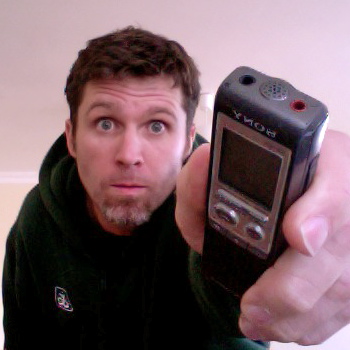
Today's guest post is from Aaron G. Myers. I met him while in Istanbul and he had some interesting ideas about language learning that he blogs about regularly, so I thought they'd be worth sharing here! Off you go Aaron!
One challenge language learners face is retaining the immense amount of new information taken in every day.
If you are like me, you regularly come across words that you know you learned once. You look them up again or ask for clarification and wonder if there is some way to remember them better. Flashcards help, but are a bit boring and lack the context necessary to connect them to the real world. They’re also difficult to use while washing the dishes or driving a car.
What we need is to integrate review into our daily routine in a way that puts the words, expressions and grammar forms we are learning, and have learned, in a context filled with both background knowledge and emotional connection. One way that I have found to do this is by creating and using handcrafted audio.
A note from the Fluent in 3 Months team before we get started: You can chat away with a native speaker for at least 15 minutes with the “Fluent in 3 Months” method. All it takes is 90 days. Tap this link to find out more.
Integrated review
Language learning is mostly an exercise in exposure. The more we are exposed to words and structures, the quicker they become a part of our usable language.
First we begin to understand them, then we are able to use them, and then we get to the point of using them naturally. I think this is why Benny is so successful as a learner: he makes it his priority to get the exposure he needs to learn the language. The reason learners so quickly master the core grammar structures, as well as the most common words and expressions of a language, is that these are the ones we are exposed to most. Their sheer volume causes them to be naturally integrated into the daily life of a language learner.
The trouble lies in the aspects of the language that are not part of the core grammar and vocabulary. Left to chance, we might only occasionally hear these, and thus we find ourselves in the cycle of learning and forgetting. Integrated review, then, is the process of creating intentional exposure to all of the words and structures we learn at each stage of our language-learning journey, effectively bringing them along for the ride. Handcrafted audio will allow you to create opportunities for intentional exposure and greatly increase your level of retention.
Handcrafted audio
Handcrafted audio is content that you have written in the language you are learning that is corrected and then recorded by a native speaker. These audio recordings then make their way to your iPod, where they can easily be listened to again and again as you wash the dishes or drive your car. By doing this, you can create a library of recorded materials that will be an interesting and time-sensitive way to review what you have learned in the context in which you learned it.
Let’s walk through the steps to making handcrafted audio. And since this is Benny’s blog, let’s use him as our example. If you have been reading here at Fluent in Three Months, you know that before tackling Turkish, Benny completed his Dutch mission. You also know that he faced an interesting challenge in finding folks with time to sit and talk. He did have two Dutch flatmates, however. By using handcrafted audio, Benny would have had one more way to maximise the opportunities that he did have. Here is what he would have done.
1. Writing in Dutch, Benny would have begun immediately to journal about his days. He would have written about the things he was doing and the people he was meeting, using the new words and grammar structures he was learning as much as possible.
He might also have written about his childhood, his language-learning missions or his future aspirations: things he would inevitably want to talk about with Dutch speakers. He would not have been overly concerned with grammatical correctness. If he had a hunch about a word, he would have experimented with it.
2. Next, Benny would have sat down with his Dutch flatmate and gone through the journals, getting the corrections and clarifications he needed. Then, using his iPad or laptop, he would have recorded his flatmate reading these corrected journals. He would then have moved these audio files to a newly created “Dutch Handcrafted Audio” file on iTunes. [Benny: I don't use iTunes, yuck! 😛 But I would use Audacity to create an MP3 and then transfer it to my Android device]
3. Benny would have listened to these files in his free time.
The handcrafted audio would have allowed him to review the words and grammar structures he had learned in a context he was familiar with and interested in, and to which he had an emotional connection. He could have listened to these files at any time: while washing the dishes, riding around town on the bike or waiting for one of his new but very busy Dutch friends.
By following this routine, writing and recording several one- to two-minute journals a week, Benny would have entered his last week of the Dutch mission with 25–30 minutes of Dutch audio containing a great majority of the new words, expressions and grammar forms he had learned. These would have been presented in a high-context environment that was interesting and extremely easy to listen to throughout the day.
Using handcrafted audio, even Benny might be able to speed up the journey toward fluency.
If you are wondering where to begin, first assemble the tools you will need to make handcrafted audio. Here’s what you need:
- A pen
- Some paper
- A recording device (most laptops and mobile phones are now equipped with easy-to-use recording equipment)
- A dictionary
- A native speaker (in person is optimal, but you can find a native speaker through language-exchange sites)
Handcrafted audio is not a method for learning a language. Instead, it is a way to effectively and efficiently integrate the review of what you have already learned (and are in danger of forgetting) into the regular routine of your day. I think you, too, will find that by using it, you will increase your retention of the words, expressions and structures you are learning. Give it a try, and good luck on your language-learning journey.

Social