



How monolingual parents can raise a bilingual child

Full disclosure: This post contains affiliate links. ?
Archive note: Christine Gilbert wrote this guest post in December 2013 from her family's experience. It is a practical account, not medical advice or a guarantee about any child's development. Current research notes have been added where the original made broad health or learning claims.
The issue of parents teaching their children comes up often and I've even had someone guest post on the blog about it before. That's great if you speak the languages yourself, but what if you are monolingual and still want to help your child build a relationship with another language?
Christine, who was writing at Almost Fearless and had been travelling with her husband since 2008, had thought long and hard about this while raising her own son and writing a book about the experience. Here is her take on what parents can do to help children learn languages the parents themselves don't yet speak fluently.
Over to you Christine!

First, my story.
There was a profile of Ellen Bialystok in the New York Times a few years ago, and it came out just after my grandfather had died from dementia. The observational research discussed in it found that some bilingual patients were diagnosed or showed symptoms later than monolingual patients. Later systematic reviews have found an association with later onset, but not a lower risk of developing dementia; they cannot show that bilingualism caused extra healthy years.
This study stuck with me because my grandfather, a Finnish-English bilingual, had led a long healthy life until he developed dementia in his last year. He stayed at a condo outside Palm Beach, Florida, in an area with a large Finnish population and even a Finnish newspaper. That community, along with Finnish speakers near his Massachusetts home, allowed him to use both languages throughout his life. I wondered whether bilingualism had helped him, but his story cannot answer that medical question.
Soon, with a child of my own, I knew I wanted to become bilingual, both for myself and to give my son an early relationship with another language. I hoped it would become a lasting part of his life, without treating it as a medical intervention.
A note from the Fluent in 3 Months team before we get started: You can chat away with a native speaker for at least 15 minutes with the “Fluent in 3 Months” method. All it takes is 90 days. Tap this link to find out more.
All material seems focused on bilingual parents
The first thing I did was to read about a dozen books on raising bilingual children, but I noticed something I hadn’t expected… whether through design or market-demand, many of the books focused on how bilinguals could introduce a non-dominant language at home.
A Spanish speaker living in the US might speak Spanish with their child, while a German-speaking partner uses German and the wider environment supplies English. That can create regular contact with three languages, although proficiency still depends on the amount, quality and continuity of meaningful use. Many of the books discussed what to expect from such an arrangement, as even bilingual parents can struggle. But I felt entirely left out.
What about people who just spoke English? What about parents who lived in a monolingual culture?
I came away with three questions:
- How could two English monolinguals (like my husband and I) teach my child a second language?
- How many languages can your child learn?
- Would there be any benefit if the child learned a non-dominant language (like Mandarin) in a country that spoke something else altogether (like Spanish)?
My son is now approaching four years old, and I don’t have all or even most of the answers, but I have some ideas about teaching children languages in a monolingual home that I discovered over our travels to China (to learn Mandarin), Lebanon (to learn Arabic) and Mexico (to learn Spanish).
How can monolinguals teach their child a second language?
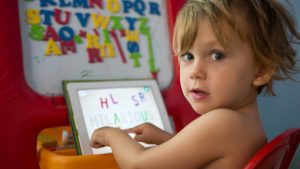
From my own experience, one useful place to start is learning the language yourself. Parents do not have to become the child's only language model, but their active support can make regular use easier to sustain.
I can appreciate and encourage my child’s piano playing without knowing how to read a lick of music, but languages are all about communication. It’s not a requirement – I read one story about a child who learned three different local dialects from the gardener, nanny and cook in India – and his parents only spoke English.
But for most of us, we don’t have an entourage of foreign language speakers following us around. A cheap and affordable way to achieve this is to learn it yourself. You can help your child to practice by speaking with them in the language, and as they get older you will understand and engage when they begin to use these new words.
The second conclusion I drew was that my child picked up a little from media, such as the cartoon Xi Yang Yang in China, but used much more language when he had responsive interaction with other speakers.
We tried different things in each country, in part because I wanted to test how things worked, and to be flexible and not commit too heavily to any one set of rules. Yet it was amazing how much he learned with his Chinese ayi verses what he picked up from Lebanese children on the playground for an hour a day. The focused one-on-one conversation with his ayi and her complete lack of English meant that he started introducing Mandarin words much more quickly than he did with Arabic.
At the end of the day, families have different resources. What matters is creating regular, responsive interaction with people who can comfortably use the language, whether they are parents, relatives, friends, carers, teachers or community members.
If you can learn the language and use it with your child regularly, that can help too. Books, music, cartoons and other media can support a routine, but for young children they should complement responsive human interaction rather than replace it. “Bilingual” also describes many different proficiency profiles; native-like ability in every domain is not the only valid outcome.
Ultimately raising bilingual children for monolinguals, especially in a monolingual culture (like my home country, the USA), means having either friends/neighbors who speak that language, childcare in the language or a school system available to you to assist.
If those things aren’t an option, any parent can still learn the language first hand and routinely use it with their child. Even if you’re not perfect. I know because my Mandarin, Arabic and Spanish all need quite a bit of work before I'll consider myself fluent. Yet it still works and you will learn as they learn (believe me, nothing increases your vocabulary like an inquisitive toddler).
There are a lot of useful tools, but in my experience children also need recurring opportunities for responsive communication. Playing foreign-language films by itself did not produce speech in our family.
We even accidently tested this theory during the 4 months we spent in Lebanon where my son watched lots of French cartoons (he went through a big Garfield in French phase), but never produced a single French word because we didn’t reinforce his French by speaking it with him – we were there to learn Arabic.
How many languages can your children learn?

There is no single evidence-based maximum number. The practical constraint is the time, continuity and range of meaningful use available for each language.
My son was encountering English, Mandarin, Arabic and Spanish, but he was still at the beginning: a few words and simple sentences at varying levels. In some contexts he understood more than he said, though comprehension and speaking do not follow one fixed timetable for every child.
But as adults, each of us have a lifetime of education in our native language, spending years learning the grammar, increasing our vocabulary and learning how to express ourselves in the written word. Let’s just take vocabulary for instance. I can teach my son the word in Spanish for moon, cat, or spoon, no problem. But depending on the education he receives, his language in the classroom is going to quickly outpace my ability to keep up.
Sure, I can figure out how to say “earthworm” for his biology class, but what about mathematics? Will I take the time (and will he let me) to explain quadratic formulas in three other languages? Will I do that for all his subjects, all the way through high school? Unlikely.
As a parent, I think it’s important to think about what language(s) you will want to focus on and what their use will be.
For us, we wanted our son to become highly proficient in Spanish and English, which meant planning his education around them. We also wanted him to speak Mandarin and Arabic with ease. Early, sustained experience can give a child more time to become familiar with their sound patterns, but exposure alone does not guarantee a particular accent or level.
However, realistically in those two languages, while he will be conversationally fluent, his vocabulary will lag. He most likely won’t learn to write in Mandarin until he’s older if at all, he won’t get all the Arabic jokes kids tell each other because he won’t grow up in the Middle East. If he goes to university in one of those languages he will have to catch up to translate his specialized Spanish and English vocabulary into the new language. We’re okay with that.
We’re prioritizing his language learning around one thing: communication.
We’d like to give him the ability to speak with lots of different people around the world, but as time goes on and we experiment more with each language, it’s clear that there are always compromises to be made. While I could enroll him in Saturday Mandarin school, and Sunday Arabic class, I think speaking the language is enough, for our family and our goals, and maybe instead he can go play with his friends. There’s a balance in there somewhere that we are still figuring out, but as any parent knows, you can’t do it all.
Is there any benefit to learning a language that isn’t spoken in the country you live in?
I think there is. I’m not an academic so I won’t go into the research (there are many exciting studies going on about the benefits for children).
However, just from watching my son, I think learning any language and getting that exposure helps you understand your first language better. The first week we sent him to bilingual school he came home not just speaking more Spanish (of course we were thrilled at this) but also speaking more and better English.
He was actually getting less exposure in English than before, but suddenly he was using new English words, excitedly telling us about his day, switching between languages to tell us about his new “novia” and the rules at school, “no running!”.
There’s a lot more to be written about this, and I recommend François Grosjean’s book Bilingual: Life and Reality. His bilingualism myths overview is also a useful starting point. A child learning more than one language is not, by itself, evidence of a language disorder; individual concerns still deserve assessment across all the child's languages by a qualified professional.
At the time, I was writing a book about my experiences for Penguin Random House and collecting accounts of how families, adults and researchers approached language learning.
The three research surveys that originally followed are now closed, so their expired links have been removed.
This article remains as Christine's 2013 account of what her family was trying and learning.

Social