



6 Tips to Learn Phrasal Verbs in English

Full disclosure: This post contains affiliate links. ?
Phrasal verbs are a common sticking point for English learners.
In nearly a decade of teaching English, I often heard students ask how they could sound more natural and feel more comfortable in conversation.
Learning phrasal verbs helped my students understand everyday English, and it has helped me as a language learner too. The trick is to learn more than a translation: you also need the grammar pattern and a useful context.
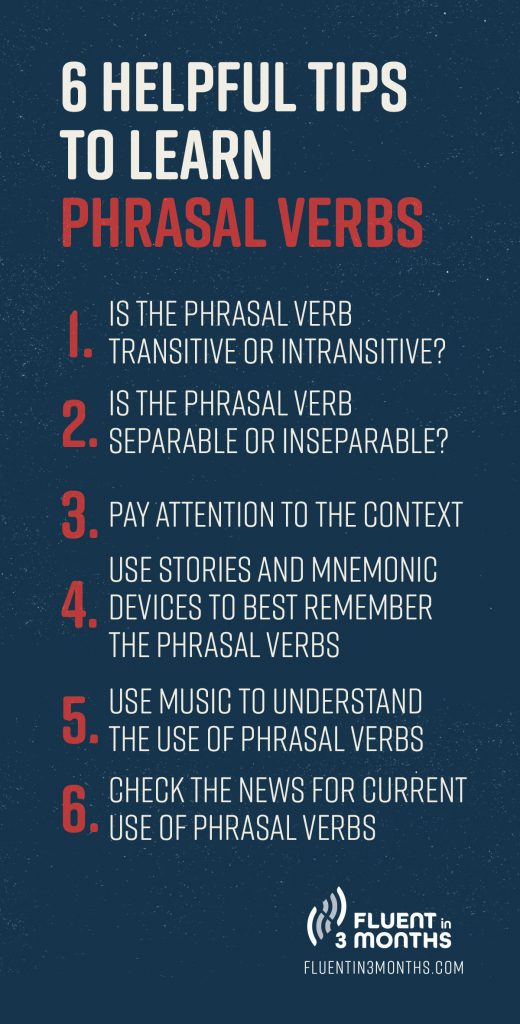
Here are my six tips for doing that.
A note from the Fluent in 3 Months team before we get started: You can chat away with a native speaker for at least 15 minutes with the “Fluent in 3 Months” method. All it takes is 90 days. Tap this link to find out more.
Table of contents
What is a Phrasal Verb?
A phrasal verb combines a verb with a particle, usually an adverb or preposition, to work as one unit. Its meaning may be difficult to predict from the individual words: give up, for example, can mean “stop trying”.
Grammar books do not all draw the boundaries in exactly the same place. Some use multi-word verb as a wider label for phrasal, prepositional and phrasal-prepositional verbs. A good learner’s dictionary will show both the meaning and the pattern you need.
Verb: “To Pick”
The verb pick can mean “select” or “choose”:
We need to pick which meal we’d like to eat.
Phrasal Verb: “To Pick Up”
Add up and the result has several meanings. Learn each meaning with its own example rather than expecting the particle to give you one fixed definition:
- Improve: Business is starting to pick up.
- Collect someone: Can you pick Jenny up after football practice?
- Collect something: Can you pick up my parcel from the post office?
- Learn informally: James picked up some Spanish while travelling.
That range is exactly why context matters. Now let’s add the grammar information that tells you how to build a sentence.
1. Is the Phrasal Verb Transitive or Intransitive?
These two grammar terms answer a practical question: does the verb need an object?
- Transitive: takes an object, which is the person or thing affected by the verb.
- Intransitive: does not take an object.
Transitive Phrasal Verbs
The multi-word verb bump into can mean “meet someone unexpectedly”. It needs the person you met:
Yesterday, I bumped into Sarah. I hadn’t seen her in years.
In a question such as “You’ll never guess who I bumped into”, who still supplies that missing person. It appears earlier in the clause rather than after into.
Intransitive Phrasal Verbs
Grow up, meaning “develop from a child into an adult”, is intransitive in these examples:
- They grew up in England.
- Your daughter is growing up so fast!
- When I grow up, I want to be a pop star.
Some phrasal verbs can be either transitive or intransitive. Compare “I wake up at seven” with “I wake Sarah up at seven”. In the first, I stop sleeping. In the second, I end Sarah’s sleep.
2. Is the Phrasal Verb Separable or Inseparable?
For a transitive phrasal verb, you also need to know where the object goes.
- Separable: a noun object can go between the verb and particle, and often after the particle too.
- Inseparable: the object stays after the complete multi-word verb.
Wake up is separable when it means ending someone else’s sleep. Both “I wake Sarah up” and “I wake up Sarah” are possible.
Pronouns give you the rule worth memorising: put them between the verb and particle. Say “I wake her up”, not “I wake up her”.
Other combinations are inseparable. Look up to someone means “admire and respect someone”, so we say:
I really look up to my older sister.
We do not say look my older sister up to. Record the whole pattern with each new item: meaning, object or no object, separable or inseparable, and one sentence you could really use.
3. Learn Phrasal Verbs in Context
Long alphabetical lists are easy to find, but topic groups make the differences easier to see.
At a motor race, a driver can pull up and stop, pull away and begin moving, or pull ahead and take the lead. At an airport, you check in, a plane takes off, and you look after your luggage.
Give one notebook page to a situation such as “in the classroom”. Add phrases only after you meet them in a dictionary, conversation or text, then write the sentence and meaning that fit that context.
Note the grammar pattern at the same time. It is much easier to learn hand something in as a complete unit than repair the word order later.
4. Use Phrasal Verbs in Your Own Stories
Once you have a topic group, use two or three items in a short story. The story gives you a reason to retrieve each phrase and decide which meaning fits.
You can write it, say it aloud or record it. If speaking is your priority, tell the story once without notes, check your phrases, then tell it again.
The story does not need to be polished or shared. A strange or funny scene can be useful if it helps you remember the context. You can also adapt the same idea into a memory palace.
5. Use Music to Notice Phrasal Verbs
Music can give a phrase rhythm and context, which is one reason people use songs for language learning.
Search for the phrase in quotation marks with a song title or the word lyrics. Carry On gives you carry on, while Wake Me Up shows the pronoun between wake and up.
Check the surrounding line and a learner’s dictionary before copying the phrase. Lyrics can use repetition, unusual word order and poetic meanings that are not good general sentence models.
If you want a starting collection, I made an English phrasal-verbs playlist.
6. Check Current Usage in the News
Search a news site for a phrasal verb in quotation marks, then open a result and read the whole sentence. A search snippet may cut off the object or show a different meaning.
News also helps you notice when the same words form a noun. Compare these:
- Verb: Sales picked up in May.
- Noun: There was a pick-up in sales in May.
- Noun: We arranged an airport pick-up.
You may see the noun written as pick-up or pickup, depending on the dictionary, region and house style. Keep the spelling from the source you are using, and do not assume every result contains the phrasal verb.
Time to Learn Phrasal Verbs
Choose three useful phrasal verbs this week. For each one, record the meaning, grammar pattern and a sentence from a real context, then use it in a short story or conversation.
Original article by Lindsay Dow, updated by the Fluent in 3 Months team.

Social