

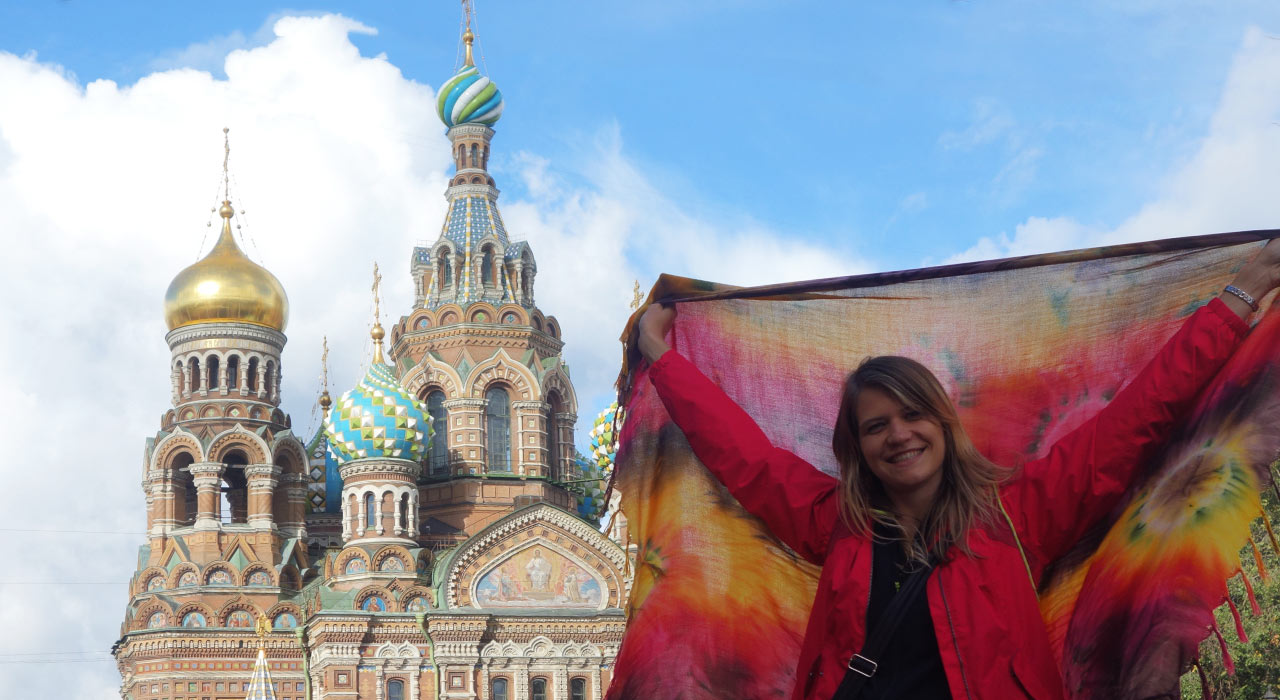
Lýdia Machová: Advice from Learning Nine Languages

Full disclosure: This post contains affiliate links. ?
“People expect to reach a point in their learning when they’ll be comfortable speaking. They put off their speaking until that moment arrives. It never does.” – Lýdia Machová
What a thrill to have interviewed Lýdia Machová for our Language Mentors series!
At the time of this 2019 interview, Lýdia described her repertoire as Slovak, English, German, Spanish, French, Polish, Esperanto, Russian and Swahili. She learned these languages without moving abroad or growing up in a multilingual environment.
Editor’s note: This interview was published in 2019. Lýdia’s answers have been lightly edited for punctuation and clarity; her examples and preferences remain her own.
At the time, she maintained seven languages at a fluent level and usually learned a new one every two years. After meeting dozens of polyglots, she began sharing the principles that helped her as a language mentor.
Lýdia organised the Polyglot Gathering in Bratislava, Slovakia, in 2017 and 2018. She holds a PhD in translation and has worked as a professional conference interpreter. Her clients have included Tony Robbins and Slovakia’s former prime minister and first lady.
She is based in Slovakia and helps people find language-learning methods that suit them. Her TED talk about the secrets of learning a new language was published in 2019.
You can find her on her website, where she shares language learning tips with her readers.
A note from the Fluent in 3 Months team before we get started: You can chat away with a native speaker for at least 15 minutes with the “Fluent in 3 Months” method. All it takes is 90 days. Tap this link to find out more.

Language Mentors: Lýdia Machová’s Learning Principles
Language Mentors is our interview series with polyglots, teachers, learners and people from beyond the language-learning field. We ask what helped them learn, stay motivated and use their languages.
Lýdia’s answers cover speaking, listening, vocabulary, books and the routines she uses to maintain several languages.
Her methods are personal examples, not a fixed timetable. Choose the ideas that fit your level, goals and available time.
Read on for practical ideas you can test in your own language routine.
You’ll also get to know the experiences behind Lýdia’s approach.
What Three Activities Help You Start Speaking?
- Collect vocabulary that is relevant to you. Learn to describe your life, work, dreams and past experiences. A long list of fruit and vegetables may be less useful at first. Unless you own a vegetable stand!
- Start speaking to yourself first. Self-talk is a great way to practise speaking and ease the fear of making mistakes. It also reveals the vocabulary you need to talk about your life. Whenever you need a word you don’t know, look it up. Regular sessions with a tutor can also give you feedback on your grammar.
- Listen a lot. Make it a habit to listen when it’s safe to do so. Keep a selection of simple recordings handy, especially ones you have already studied and understand.
What Are Your Three Favourite Study Tools When You Start a Language?
- I always start with a book, such as Teach Yourself, Colloquial or Assimil. I work through it using my favourite back-translation method. I translate the texts into my mother tongue in a notebook. Then I translate them back aloud as many times as needed to say the whole text fluently in the target language.
- If I’m learning a language that is available in the Michel Thomas or Pimsleur method, I start with those. They are great resources for getting acquainted with the language.
- I make sure I have a beautiful notebook for vocabulary, for example when using the Goldlist method. I am a freak when it comes to notebooks with pretty covers. It is important to me to have study tools that I enjoy looking at and using.
What Are Your Three Favourite Memories of a Language Win?
- I love the moment when I understand a written text for the first time. It may be a short, simple text, but a few weeks earlier I did not understand a word. Realising that I now know what it says is quite exciting.
- Another milestone is telling an anecdote or a joke in the new language. (One that people actually laugh at. Self-talk doesn’t count!) For me, this means I’m getting to B2, and it feels amazing. Telling a joke draws on fluency, a wider vocabulary and confidence. I associate that combination with more advanced learning.
- I love the moment when I know I have reached comfortable fluency. This usually happens when I’m out with friends who are native speakers of the new language and we communicate effortlessly. I can simply exist in the new language, freely and spontaneously. It is an addictive feeling and the reason I do this every two years with a new language.

What Are the Top Three Roadblocks You See Learners Face?
- Speaking is the biggest one in my experience. People expect to reach a point when they’ll feel comfortable speaking, so they put it off until that moment arrives. It rarely arrives on its own. Comfort and fluency grow through speaking practice. That practice does not necessarily need to start on day one; it depends on the person. But it often needs to start sooner than feels comfortable.
- Realising there are many words to learn in the new language. Many learners encounter this around the A2 level. At first, you may feel excited about making progress every day. After a few weeks, you may still understand very little in authentic texts or videos and realise how many words remain. That can be a scary moment. Previous experience can help: if you have learned another language before, you know you can keep making progress. Keep going.
- Grammar can feel scary too. I have had these moments in all my languages: the subjunctive in Spanish, separable and inseparable verbs in German, pronunciation and spelling in French, idioms in English, verbs of motion in Polish, irregularities in Russian declension and noun classes in Swahili. At some point, you may think you can never learn all those forms or remember the rules and exceptions. Yet the more you practise, especially with plenty of listening input, the more natural the patterns can become.
What Are Your Top Three Books in a Foreign Language?
I usually choose non-fiction because I find it easier to understand than fiction.
If I can get a self-help book related to one of these topics, that’s going to be my number one book to read.
- Self-improvement
- Relationships
- Time management
- Practical tips about everyday life
Some of my favourites are The Miracle Morning by Hal Elrod, anything by Brian Tracy and Men Are From Mars, Women Are From Venus by John Gray.
I have read The Alchemyst and The Little Prince in several languages, as well as Animal Farm. They are fiction stories, but very simple, nice, and enriching at the same time.
Harry Potter was my breakthrough book when learning English and Spanish. When I was a child, I read all the books in the series several times in Slovak. So I was able to follow them even in languages I was just beginning to learn. I knew the content well.
A book you love and know well can therefore be a good place to start reading in another language, even if it is fantasy and includes words such as pumpkin juice or Quidditch.
What Are Your Favourite Relaxing Study Habits for Laid-Back Days?
Honestly, if I have laid back days, I don’t learn anything. I either have a plan and follow it every day or I have a holiday from learning. These holidays often take several weeks. But to keep in touch with my previous languages, I like to watch TV series. Netflix is a wonderful source of those, for any language.
What Are Your Three Favourite TV Shows for Practising a Language?
- For language practice, I like watching simple, character-driven series about everyday relationships, such as Desperate Housewives and Sex and the City. They include plenty of everyday vocabulary, and events are mentioned several times, which is useful for revision. I draw the line at soap operas, though: I don’t enjoy very simple plots or excessive drama.
- Friends is a wonderful show if you can find it in your language, especially if you’re a fan like me and know each joke inside out.
- A few more suggestions for individual languages: when learning Russian, I really enjoyed Кухня. My favourite Polish series is Czas honoru. I also liked the first season of Las chicas del cable and Juana Inés in Spanish.
What Has Been the Biggest Surprise That Learning a New Language Gave You?
I had a 30-minute conversation with a Deaf man experiencing homelessness in Poland using sign language. I was using Slovak Sign Language and he was using Polish Sign Language. They are different, but we found signs we could both understand.
We were able to understand each other and that was one of the most amazing moments for me. I realized that all the effort I put into learning a language was totally worth it.
What Are Your Three Favourite Language-Learning Rituals?
- I love learning in the morning. I wake up, prepare a nice cup of tea, go back to bed, put my learning materials around me and start my current routine.
- I enjoy using the Goldlist method in a pleasant environment, such as a garden or terrace. I sometimes make it even cosier with a bowl of strawberries or some cashew nuts: nutritious food for my memory.
- When I discover a new podcast I like, it becomes part of my everyday life. I listen whenever I walk or do chores, as long as it’s safe to do so.
I can get many hours of listening practice within a few days or weeks, and it doesn’t even feel like learning.
What about You?
Which of Lýdia’s ideas fits your current goal? Choose self-talk, familiar books, repeated listening or a study ritual, and try it in your next session.
Small experiments make it easier to discover which methods you genuinely enjoy and can sustain.
A big thank you to Lýdia for sharing her experiences and approach with us. To learn more about her current work, visit the Language Mentoring website.
More from the Language Mentors series
- Lindie Botes
- Michele Frolla
- DamonAndJo
- Nikki Prša
- Michelle Dale
- Matt Kepnes
- Johan Tekfak
- Scott H. Young
- Luke Korns

Social