


How to Say “Hello” in Italian: 19 Italian Greetings

Full disclosure: This post contains affiliate links. ?
Italians love to chiacchierare (“chat”), so it’s no surprise that there are loads of Italian greetings. The one you use depends on the context and the time of day.
Whether you’re all’ufficio postale (“at the post office”) or in pizzeria (“at a pizzeria”), you won’t be stuck using the same greeting!
Italy’s regions also have their own local greetings. Most of the greetings in this list are standard Italian, and I’ve included a Florentine farewell at the end.
Before we get started, if you’re looking for an online Italian course, here’s the course I recommend: Italian Uncovered – Learn Italian Through the Power of Story, a course with a fascinating new method by my friend Olly. You can try it for free for 7 days!
Table of contents
- 1. “Hello” in Italian – Ciao
- 2. “Good morning” in Italian – Buongiorno
- 3. “Have a Good Day” in Italian – Buona Giornata
- 4. “Good Day” in Italian – Buon Dì
- 5. “Good Afternoon” in Italian – Buon Pomeriggio
- 6. “Hi” in Italian – Salve
- 7. “Hey” in Italian – Ehilà, Ueilà or Ehi
- 8. “How’s it Going?” in Italian – Come va?
- 9. “Good Evening” in Italian – Buonasera
- 10. “Have a Good Evening” in Italian – Buona Serata
- 11. “Good Night” in Italian – Buonanotte
- 12. “See You Soon” in Italian – A Presto
- 13. “Until next time” in Italian – Alla Prossima
- 14. “See You Around” in Italian – Ci Vediamo
- 15. “Bye” in Italian – Ti Saluto / Vi Saluto
- 16. “Take Care” in Italian – Stammi Bene / Statemi Bene
- 17. “Goodbye” in Italian – Arrivederci
- 18. “Farewell” in Italian – Addio
- 19. “Bye Guys” in Italian – Bona Raga
- What’s Your Favourite Italian Greeting?
1. “Hello” in Italian – Ciao
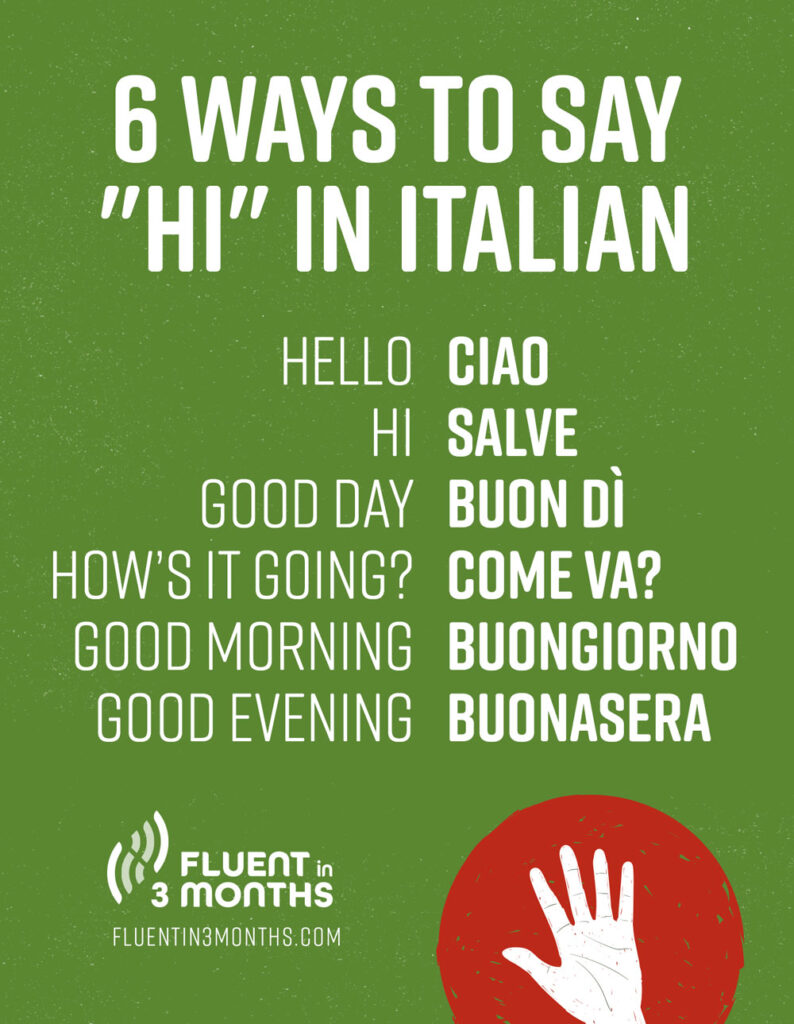
One of the most popular Italian words, ciao has been adopted as a friendly salutation all around the globe. It’s an informal greeting to say “hello” or “goodbye” and it originates from the Venetian s-ciao or s-ciavo, literally meaning “(I am your) slave”, once a deferential greeting.
The modern greeting ciao no longer carries that servile meaning. So you can say ciao when meeting someone or when leaving, and when you come across a friend: Ciao, bello!
2. “Good morning” in Italian – Buongiorno
Buongiorno is equivalent to “good morning” in English, but it’s also used in the first part of the day to mean “good day” as a formal alternative to ciao.
You can use it when introducing yourself or simply as a polite greeting when entering public places.
Here’s an example:
Buongiorno, vorrei un caffè. – “Hello, I would like a coffee.”
And here’s a popular question about this greeting: how do you reply to buongiorno? You can say buongiorno a te in an informal situation or buongiorno a Lei in a formal situation.
These replies can be translated as “good day to you”, but sound way less formal in Italian.
3. “Have a Good Day” in Italian – Buona Giornata
Replace giorno with the feminine giornata, and the phrase becomes buona giornata. You can use it formally or informally to wish someone a “good day” when you’re saying goodbye.
Ci vediamo stasera, buona giornata! – “I’ll see you this evening, have a good day!”
4. “Good Day” in Italian – Buon Dì
Buon dì is another, less common variation of buongiorno. It can be used formally or informally.
Dì comes from the Latin word dies meaning “day”.
Here’s an example:
Buon dì, come va? – “Good morning, how’s it going?”
5. “Good Afternoon” in Italian – Buon Pomeriggio
When the afternoon comes around, you can switch to buon pomeriggio, although many speakers simply continue with buongiorno.
If you enter una pasticceria (a “patisserie”) at 2 p.m., for example, you might hear either buon pomeriggio or buongiorno.
Here’s an example of how to use it:
Buon pomeriggio, due cannoli, per favore! – “Good afternoon, two cannoli, please!”
6. “Hi” in Italian – Salve
Salve is a polite, neutral greeting, useful when ciao feels too informal but you don’t need a time-specific buongiorno or buonasera. It’s normally used when you meet someone rather than when you leave.
Salve comes from the Latin verb salvere, to be well, in good health (essere in buona salute). In fact, the Italian verb salutare (“to greet”) comes from Latin salutare, derived from salus (“health”).
So if you want to greet a stranger in piazza (“in the square”), you can say Salve, come va? (“Hello, how’s it going?”).
7. “Hey” in Italian – Ehilà, Ueilà or Ehi
These very informal words are usually used with friends or family, often to express a pleasant surprise. Ehilà and ehi are standard Italian, while ueilà is a regional variant.
For example, Ehilà, chi si rivede! (“Hey, look who’s here!”).
But they also can serve as a warning: Ehi, chi è entrato in casa mia? (“Hey, who entered my home?”).
8. “How’s it Going?” in Italian – Come va?
When you run into a friend, you can say come va?, but be prepared: you may get a detailed answer and several minutes of storytelling over an espresso at the bar.
If you don’t have time to chat, just stick to ciao!
9. “Good Evening” in Italian – Buonasera
For the later part of the day, you can use buonasera (“good evening”) in formal and informal settings, both when you’re arriving and when you’re leaving. There isn’t one fixed time to switch from buongiorno: it varies by region and speaker, and in some parts of Italy buonasera starts in the early afternoon.
10. “Have a Good Evening” in Italian – Buona Serata
When departing in the evening, you’d say buona serata (“have a good evening”). It works like buona giornata, so it’s a wish when you’re leaving rather than a conversation starter. Here’s an example:
Ci vediamo domani, buona serata! – “See you tomorrow, have a good evening!”
11. “Good Night” in Italian – Buonanotte
If you’re on your way home or to bed, you say buonanotte (“goodnight”).
Unlike buonasera, it’s not a conversation starter, but is used when bidding someone a good night, as in this example:
È tardi, vado a casa, buonanotte. – “It’s late, I’m going home, goodnight.”
12. “See You Soon” in Italian – A Presto
This Italian greeting means “see you soon” and is common when you expect to meet again before long. You’ll also find it as an informal sign-off at the end of emails. For example: Arrivo da te tra poco, a presto! (“I’ll be at your place in a bit, see you soon!”).
13. “Until next time” in Italian – Alla Prossima
This salutation works fine whether you have plans to meet again, whether soon or not.
For example, you can say it to your teacher and classmates after an Italian lesson…alla prossima.
14. “See You Around” in Italian – Ci Vediamo
Here’s a more casual version of arrivederci, which you’ll find further ahead in this list. It translates as “we’ll see each other” or simply “see you”. You’ll often hear it among friends when they’re parting ways.
Here’s an example:
Antonio, ora scappo. Ci vediamo. – “Antonio, I must run off now. See you around.”
15. “Bye” in Italian – Ti Saluto / Vi Saluto
This casual farewell means “I say goodbye to you” or simply “bye”, rather than suggesting a military salute. Use the informal singular ti saluto with one person and the plural vi saluto with more than one. Here’s an example with the plural form:
Amici, vi saluto. – “Bye, friends.”
16. “Take Care” in Italian – Stammi Bene / Statemi Bene
The Italian version of “take care” also has singular and plural forms. Say stammi bene to one person or statemi bene to more than one.
Nonna, stammi bene. – “Grandma, take care.”
17. “Goodbye” in Italian – Arrivederci
Arrivederci is one of the trickier words to pronounce in this list, but it’s good practice for the rolled “r”. It means “goodbye” and expresses the hope that you’ll see one another again.
You can use it as a polite salutation when departing. For example: Arrivederci, professoressa. (“Goodbye, professor.”).
18. “Farewell” in Italian – Addio
This one creates quite a dramatic effect in films, such as the 1955 Italian film Addio, Napoli! (“Farewell, Naples!”).
It comes from the phrase a Dio, with an understood “I commend you”.
In standard Italian, it usually signals a final or long separation. In Tuscany, mind you, you may still hear addio used more casually, much like arrivederci. In most other cases, a simple arrivederci will do!
19. “Bye Guys” in Italian – Bona Raga
I lived in Florence for many years of my life, so of course, I couldn’t resist ending this list by sharing a Florentine farewell.
Bona raga is fiorentino, Florentine slang for “bye, guys” (ciao, ragazzi). It’s used when departing from your friends.
Here’s an example:
Bona raga, vo a casa. – “Bye guys, I’m going home.”
PS: If you want to hear about the experience of an Italian learner living in Italy, check out this episode of the Language Hacking Podcast:
What’s Your Favourite Italian Greeting?
So there you go, now you’ve got lots of Italian greetings, and ways of saying “hello” and “goodbye” in Italian. If you’re feeling creative you can use a combination of them.
You can practise using these greetings with your Preply tutor so they become more natural in conversation. A native speaker can help you get a feel for which greeting fits each situation.
Anyway, Stammi bene e alla prossima! (“Take care, until next time!”).
Original article by Mirella Colalillo, updated by the Fluent in 3 Months team.

Social