


Learn Colors in Italian (With Audio)

Full disclosure: This post contains affiliate links. ?
Learning the colours in Italian gives you an easy way to describe clothes, food and the things around you. Start with the 12 common words below, listen to the audio, then learn which endings change and which colours stay the same.
Table of contents
Before we get started, if you’re looking for an online Italian course, here’s the course I recommend: Italian Uncovered – Learn Italian Through the Power of Story, a course with a fascinating new method by my friend Olly. You can try it for free for 7 days!
Colors in Italian: I colori
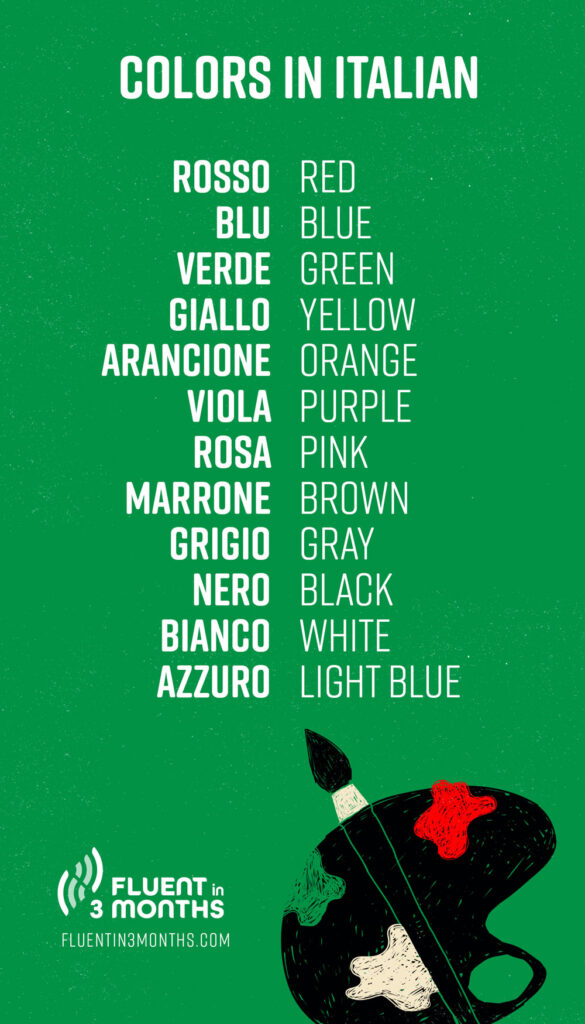
Colore means “colour” and its plural is colori. Here are 12 useful Italian colour words. Italian normally writes them with a lowercase letter unless they begin a sentence.
| Colors in Italian | ||
|---|---|---|
| Italian | English | Audio |
| rosso | red | |
| blu | blue | |
| verde | green | |
| giallo | yellow | |
| arancione | orange | |
| viola | purple | |
| rosa | pink | |
| marrone | brown | |
| grigio | grey | |
| nero | black | |
| bianco | white | |
| azzurro | light blue or sky blue | |
How to Use Italian Colors in a Sentence
Italian colour adjectives usually come after the noun. So “black jacket” is normally giacca nera. The form nera agrees with the feminine singular noun giacca.
Many common colours have four endings. Masculine singular words end in -o, feminine singular words in -a, masculine plural words in -i, and feminine plural words in -e:
- vestito rosso: “red dress”
- sciarpa gialla: “yellow scarf”
- vestiti rossi: “red dresses”
- sciarpe gialle: “yellow scarves”
This four-ending pattern also applies to grigio, nero, bianco and azzurro. With bianco, add h in the plural to keep the hard “c” sound: bianchi for masculine plural and bianche for feminine plural.
Colours ending in -e, including verde, arancione and marrone, use the same form for masculine and feminine nouns. Their plural ends in -i: verdi, arancioni and marroni.
Three useful exceptions are rosa, blu and viola. As colour adjectives, they do not change for gender or number:
- libri rosa: “pink books”
- porte viola: “purple doors”
- sedie blu: “blue chairs”
You can use a colour directly with a noun or after the verb essere, “to be”:
- Il gatto grigio ha fame. “The grey cat is hungry.”
- La mia amica vive nella casa rosa. “My friend lives in the pink house.”
Here is the present tense of essere:
| Italian | English | Audio |
| io sono | I am | |
| tu sei | you are (informal singular) | |
| lui/lei è | he/she is | |
| noi siamo | we are | Not recorded |
| voi siete | you are (plural) | |
| loro sono | they are |
- “What is your favourite colour?”
- “My favourite colour is green.”
- “The roses are red.” Here rose is the plural of the noun rosa, “rose”, rather than the invariant colour adjective rosa.
- “The plates are brown.”
The question Qual è il tuo colore preferito? uses informal singular tuo, so use it with someone you would address as tu.
How to Say Dark and Light in Italian
Add scuro, “dark”, or chiaro, “light”, after a colour to describe its shade. When this kind of two-word shade describes a noun, the expression stays unchanged.
- rosso scuro: “dark red”
- Il mio vestito è rosso scuro. “My dress is dark red.”
- viola chiaro: “light purple”
- La tua camicia è viola chiaro. “Your shirt is light purple.”
Make Your Italian More Colourful
Pick three objects around you and describe each one in Italian. Then make them plural and check whether the colour changes. When you are ready for more vocabulary, try these common Italian words for clothes, food and animals.

Social