


15 Korean Proverbs: Wisdom Through Words [with Audio]

Full disclosure: This post contains affiliate links. ?
Korean proverbs can make a point in a few memorable words. They can also trip up a learner: the dictionary form may differ from the sentence someone says, a literal translation may hide the real implication, and a familiar saying may sound teasing or blunt in the wrong setting.
The Korean word for “proverb” is 속담 (sokdam). Below you’ll find 15 expressions with checked Hangul, learner-friendly romanisation, literal senses, natural meanings, pronunciation notes, and honest usage caveats. I checked the standard forms primarily against the National Institute of the Korean Language’s dictionaries.
I’m a Korean learner myself, and I work with Koreans from both North and South Korea. The spellings and dictionary classifications in this article come from South Korean standard-language sources, so I won’t pretend every expression has identical currency, wording, or associations in every Korean-speaking community.
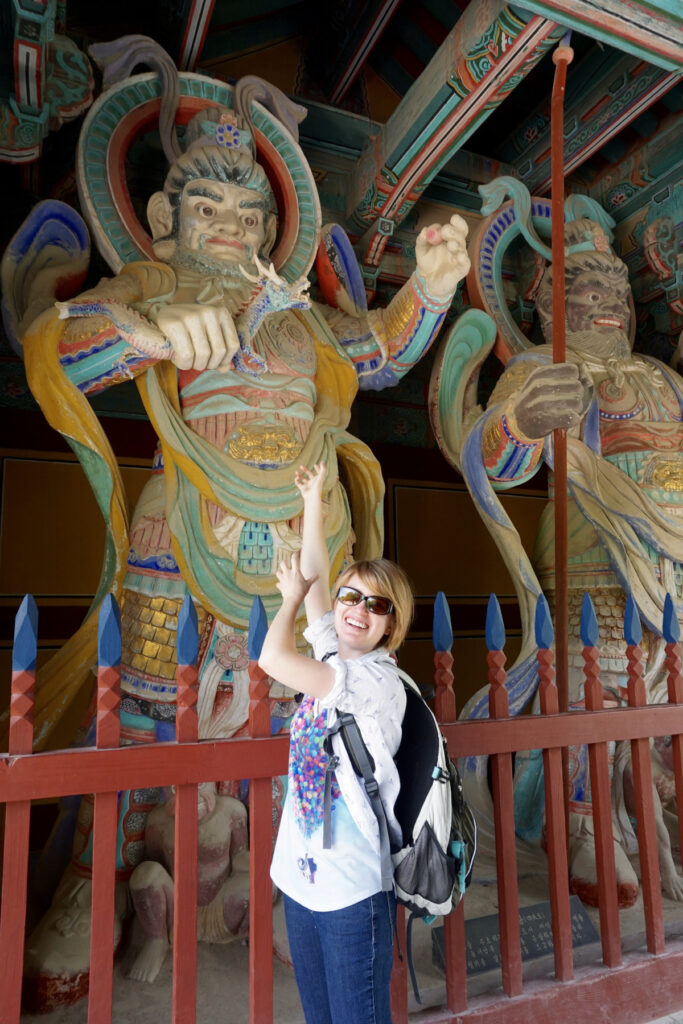
Here I am visiting South Korea in 2016.
If you want some broader context before the language lesson, this Fi3M video introduces ten Korean culture topics. They are starting points for curiosity, not rules that define every Korean person.
Korean Proverbs with Audio
This table gives the recommended reference form. The original 15 audio files are intact and playable. Several recordings add a sentence ending, and numbers 11 and 13 use shortened paraphrases instead of the traditional dictionary form; each difference is explained in the detailed entry.
| Korean reference form | Learner romanisation | Natural meaning | Audio |
|---|---|---|---|
| 제 눈에 안경 | je nune angyeong | People see what they personally like in a favourable light. | |
| 꿩 먹고 알 먹고 | kkwong meokgo al meokgo | Get two benefits from one action. | |
| 눈에서 멀어지면 마음에서도 멀어진다 | nuneseo meoreojimyeon maeumeseodo meoreojinda | Distance can weaken attention or affection: out of sight, out of mind. | |
| 고생 끝에 낙이 온다 | gosaeng kkeute nagi onda | Joy comes after hardship. | |
| 바늘 도둑이 소도둑 된다 | baneul dodugi sododuk doenda | Repeated small wrongdoing can grow into serious wrongdoing. | |
| 백지장도 맞들면 낫다 | baekjijangdo matdeulmyeon natda | Even an easy task is better when people help each other. | |
| 가재는 게 편 | gajaeneun ge pyeon | People tend to side with those close to them or in a similar position. | |
| 엎질러진 물 | eopjilleojin mul | Something already done cannot be undone. | |
| 장님이 코끼리 만지는 격이다 | jangnimi kokkiri manjineun gyeogida | A conclusion based on one small part can miss the whole picture. | |
| 다 된 밥에 재 뿌리다 | da doen babe jae ppurida | Spoil something after the work is essentially finished. | |
| 떡 줄 사람은 생각도 않는데 김칫국부터 마신다 | tteok jul sarameun saenggakdo anneunde gimchitgukbuteo masinda | Do not assume a hoped-for result before the other person has even agreed. | |
| 원숭이도 나무에서 떨어진다 | wonsungido namueseo tteoreojinda | Even an expert sometimes makes a mistake. | |
| 매도 먼저 맞는 놈이 낫다 | maedo meonjeo manneun nomi natda | If something unpleasant is unavoidable, it can be better to face it first. | |
| 옷이 날개다 | osi nalgaeda | Clothes can greatly improve how someone looks. | |
| 공자 앞에서 문자 쓴다 | gongja apeseo munja sseunda | Show off elementary knowledge in front of an expert. |
Table of contents
- Korean Proverbs with Audio
- 15 Korean Proverbs You Should Know
- 1. 제 눈에 안경 (je nune angyeong)
- 2. 꿩 먹고 알 먹고 (kkwong meokgo al meokgo)
- 3. 눈에서 멀어지면 마음에서도 멀어진다 (nuneseo meoreojimyeon maeumeseodo meoreojinda)
- 4. 고생 끝에 낙이 온다 (gosaeng kkeute nagi onda)
- 5. 바늘 도둑이 소도둑 된다 (baneul dodugi sododuk doenda)
- 6. 백지장도 맞들면 낫다 (baekjijangdo matdeulmyeon natda)
- 7. 가재는 게 편 (gajaeneun ge pyeon)
- 8. 엎질러진 물 (eopjilleojin mul)
- 9. 장님이 코끼리 만지는 격이다 (jangnimi kokkiri manjineun gyeogida)
- 10. 다 된 밥에 재 뿌리다 (da doen babe jae ppurida)
- 11. 떡 줄 사람은 생각도 않는데 김칫국부터 마신다 (tteok jul sarameun saenggakdo anneunde gimchitgukbuteo masinda)
- 12. 원숭이도 나무에서 떨어진다 (wonsungido namueseo tteoreojinda)
- 13. 매도 먼저 맞는 놈이 낫다 (maedo meonjeo manneun nomi natda)
- 14. 옷이 날개다 (osi nalgaeda)
- 15. 공자 앞에서 문자 쓴다 (gongja apeseo munja sseunda)
- How to Learn Korean Proverbs
- Use Korean Proverbs with Care
A note from the Fluent in 3 Months team before we get started: You can chat away in Korean for at least 15 minutes with the “Fluent in 3 Months” method. All it takes is 90 days. Tap this link to find out more.
15 Korean Proverbs You Should Know
Romanisation is a reading aid here, not a replacement for Hangul or audio. It stays close to the spelling, while the pronunciation notes flag important sound changes. English equivalents are shortcuts, so use the literal sense and usage note to understand what the Korean expression actually does.
1. 제 눈에 안경 (je nune angyeong)
Literal sense: Glasses for one’s own eyes.
Natural meaning: People see what they personally like in a favourable light.
Authenticity: The National Institute of the Korean Language (NIKL) lists 제 눈에 안경 as the head expression. The audio adds 이다, “to be,” to make a complete sentence. The existing recording says 제 눈에 안경이다, a sentence form or paraphrase discussed below.
Pronunciation: 눈에 links smoothly and sounds roughly like nu-ne. The final ㅇ in 안경 is the ng sound in English sing.
Use and nuance: The closest English saying is “beauty is in the eye of the beholder,” although the Korean expression can be teasing: even something other people find unimpressive can look good to the person who likes it. Be careful when using it about someone’s partner, because the joke may sound insulting. Check the source.
2. 꿩 먹고 알 먹고 (kkwong meokgo al meokgo)
Literal sense: Eat the pheasant and eat the eggs too.
Natural meaning: Get two benefits from one action.
Authenticity: Dictionaries and Korean teaching materials commonly give the balanced head form 꿩 먹고 알 먹고. The recording uses a grammatical sentence variant ending in 먹는다. The existing recording says 꿩 먹고 알 먹는다, a sentence form or paraphrase discussed below.
Pronunciation: The doubled ㄲ in 꿩 is tense. In 먹고, the following ㄱ is commonly pronounced tense, close to meok-kko. The audio’s 먹는다 undergoes nasal assimilation and sounds closer to meong-neun-da.
Use and nuance: This is a positive “two wins in one move,” similar to “kill two birds with one stone.” It describes one choice producing two useful results; it does not by itself claim a specifically Korean preference for efficiency. Check the source.
3. 눈에서 멀어지면 마음에서도 멀어진다 (nuneseo meoreojimyeon maeumeseodo meoreojinda)
Literal sense: If something grows distant from the eyes, it also grows distant from the heart or mind.
Natural meaning: Distance can weaken attention or affection: out of sight, out of mind.
Authenticity: Authentic and natural as a Korean maxim; lower confidence as a formally catalogued traditional 속담 than entries explicitly classified by NIKL.
Pronunciation: 마음 has two clear syllables, ma-eum. 멀어지면 is divided meo-reo-ji-myeon; do not turn eo into an English “oh.”
Use and nuance: This is a transparent maxim used about relationships, memories, or priorities. 마음 covers “heart,” “mind,” and feelings, so “out of mind” is only an approximate equivalent. It is widely understandable, but it should not be sold as a uniquely Korean ancient teaching. Check the source.
4. 고생 끝에 낙이 온다 (gosaeng kkeute nagi onda)
Literal sense: At the end of hardship, pleasure comes.
Natural meaning: Joy comes after hardship.
Authenticity: NIKL classifies this exact form as a proverb and defines it as good and joyful things coming after difficulty.
Pronunciation: Because 끝 is followed by the vowel in 에, its final consonant links forward: kkeu-te. In 낙이, the ㄱ likewise links into the next syllable, na-gi.
Use and nuance: Use it to encourage someone who has been working through difficulty. “No pain, no gain” is not exact: the Korean says that good times follow hardship, not that pain is required for every achievement. In a painful moment it can also sound dismissive, so context matters. Check the source.
5. 바늘 도둑이 소도둑 된다 (baneul dodugi sododuk doenda)
Literal sense: A needle thief becomes a cattle thief.
Natural meaning: Repeated small wrongdoing can grow into serious wrongdoing.
Authenticity: NIKL lists the exact spelling 바늘 도둑이 소도둑 된다 and defines it as small bad acts developing into major offences.
Pronunciation: 도둑이 links as do-du-gi. 소도둑 is one compound word in the standard dictionary spelling.
Use and nuance: This warns that overlooking or repeating a small offence can lead to a larger one. “Give someone an inch and they’ll take a mile” shifts the blame toward the person granting permission, so it is not a close translation. Check the source.
6. 백지장도 맞들면 낫다 (baekjijangdo matdeulmyeon natda)
Literal sense: Even a sheet of white paper is better if lifted together.
Natural meaning: Even an easy task is better when people help each other.
Authenticity: NIKL lists this exact proverb and the variants 백지 한 장도 맞들면 낫다 and 종잇장도 맞들면 낫다.
Pronunciation: 맞들면 is pronounced with a tense ㄸ after the final consonant, roughly mat-tteul-myeon. 낫다 is heard roughly as nat-tta.
Use and nuance: “Many hands make light work” is a good functional equivalent. The point is cooperation even when the task seems easy, not that Korean society has one uniform “communal” personality. Check the source.
7. 가재는 게 편 (gajaeneun ge pyeon)
Literal sense: The crayfish is on the crab’s side.
Natural meaning: People tend to side with those close to them or in a similar position.
Authenticity: NIKL gives the head form 가재는 게 편. The audio adds the connective/copular ending 이라, as it would appear before a comment such as “as the saying goes.” The existing recording says 가재는 게 편이라, a sentence form or paraphrase discussed below.
Pronunciation: 게 means “crab” here. 편 means a side or faction; it is not the adjective meaning “comfortable.”
Use and nuance: This can criticise favouritism or explain solidarity between similar people. “Birds of a feather flock together” focuses on association, while the Korean proverb specifically focuses on taking someone’s side. Check the source.
8. 엎질러진 물 (eopjilleojin mul)
Literal sense: Spilled water.
Natural meaning: Something already done cannot be undone.
Authenticity: Natural, established proverbial expression; medium confidence as a dictionary-classified 속담 in this exact shortened form. The existing recording says 엎질러진 물이다, a sentence form or paraphrase discussed below.
Pronunciation: The final ㄹ in 물 is an l-like sound made with the tongue at the ridge behind the upper teeth. The audio adds 이다, linking 물 and 이다 smoothly.
Use and nuance: This is more precisely a proverbial noun phrase than a full sentence. It can close discussion of an irreversible event: “it’s already spilled water.” It does not automatically carry the comforting message “move on”; tone and context supply that. Check the source.
9. 장님이 코끼리 만지는 격이다 (jangnimi kokkiri manjineun gyeogida)
Literal sense: It is like a blind person touching an elephant.
Natural meaning: A conclusion based on one small part can miss the whole picture.
Authenticity: Established Korean proverbial comparison; high confidence in meaning, with a required accessibility/register caveat.
Pronunciation: 격이다 links across the syllable boundary and sounds gyeo-gi-da. 코끼리 begins with the tense consonant ㄲ.
Use and nuance: The image comes from an ancient Indian parable transmitted through several religious and literary traditions, so it is not uniquely Korean. The proverb also contains 장님, an older word for a blind person that many speakers now avoid as a label. Recognise the proverb, but do not casually call a person 장님. Check the source.
10. 다 된 밥에 재 뿌리다 (da doen babe jae ppurida)
Literal sense: Sprinkle ashes on fully cooked rice.
Natural meaning: Spoil something after the work is essentially finished.
Authenticity: Established idiomatic/proverbial form; the audio’s negative imperative is a natural sentence adaptation rather than the head form. The existing recording says 다 된 밥에 재 뿌리지 마라, a sentence form or paraphrase discussed below.
Pronunciation: 밥에 links as ba-be. The doubled ㅃ in 뿌리다 is tense and unaspirated.
Use and nuance: The dictionary-style form ends in 뿌리다, “to sprinkle.” The recording turns it into a direct prohibition, “Don’t sprinkle ashes on it.” That imperative can sound blunt, so use it carefully when accusing someone of spoiling another person’s work. Check the source.
11. 떡 줄 사람은 생각도 않는데 김칫국부터 마신다 (tteok jul sarameun saenggakdo anneunde gimchitgukbuteo masinda)
Literal sense: The person who would give the rice cake has not even thought of it, but someone drinks kimchi broth first.
Natural meaning: Do not assume a hoped-for result before the other person has even agreed.
Authenticity: High confidence in the full standard form and spelling. The legacy table’s 김치국 omitted the required ㅅ, and its shortened sentence was incorrectly presented as the proverb itself. The existing recording says 김칫국부터 마시지 말라, a sentence form or paraphrase discussed below.
Pronunciation: The correct spelling is 김칫국, with 사이시옷. It is commonly pronounced with a tense ㄲ in the final word, roughly gim-chi-kkuk. 떡 also begins and ends with tense or unreleased consonants.
Use and nuance: This is close to “don’t count your chickens before they hatch.” The idea is that someone prepares for a benefit before it has been offered. The audio says only “Don’t drink the kimchi broth first,” which is an understandable allusion but not the full dictionary proverb. Check the source.
12. 원숭이도 나무에서 떨어진다 (wonsungido namueseo tteoreojinda)
Literal sense: Even a monkey falls from a tree.
Natural meaning: Even an expert sometimes makes a mistake.
Authenticity: NIKL lists this exact proverb and defines it as an experienced, skilled person sometimes making a mistake.
Pronunciation: 떨어진다 starts with tense ㄸ. Keep the eo vowels short and separate in tteo-reo-jin-da.
Use and nuance: Use this when a capable or experienced person slips up. It can reassure someone, but it can also tease them, so your relationship and tone matter. The meaning is about expertise, not a sweeping national value of humility. Check the source.
13. 매도 먼저 맞는 놈이 낫다 (maedo meonjeo manneun nomi natda)
Literal sense: Even with a beating, the person struck first is better off.
Natural meaning: If something unpleasant is unavoidable, it can be better to face it first.
Authenticity: NIKL uses the traditional form 매도 먼저 맞는 놈이 낫다. The recorded 게 version is natural and understandable, but it is a modern neutralising paraphrase. The existing recording says 매도 먼저 맞는 게 낫다, a sentence form or paraphrase discussed below.
Pronunciation: 맞는 undergoes nasal assimilation and sounds like 만는, represented here as manneun. 낫다 is heard roughly as nat-tta.
Use and nuance: The traditional head form contains 놈, a rough word for a person, and imagery of corporal punishment. The audio replaces the person with the neutral 게, “the thing or act,” producing a gentler paraphrase. Use it for minor unavoidable chores, not to trivialise harm. Check the source.
14. 옷이 날개다 (osi nalgaeda)
Literal sense: Clothes are wings.
Natural meaning: Clothes can greatly improve how someone looks.
Authenticity: Established Korean proverbial expression with high confidence in form and meaning.
Pronunciation: Before the vowel in 이, the final ㅅ of 옷 is resyllabified and pronounced like sh: o-shi. That is why the learner romanisation is osi rather than ot-i.
Use and nuance: This can be a light compliment after someone dresses up. “Clothes make the man” is stronger and unnecessarily gendered; the Korean expression is about the visible effect of clothing. It does not prove that appearance matters more in Korea than elsewhere. Check the source.
15. 공자 앞에서 문자 쓴다 (gongja apeseo munja sseunda)
Literal sense: Use learned writing or expressions in front of Confucius.
Natural meaning: Show off elementary knowledge in front of an expert.
Authenticity: NIKL teaching material identifies 공자 앞에서 문자 쓴다 as a Korean proverb; form and core meaning are high confidence.
Pronunciation: 쓴다 begins with tense ㅆ. 문자 is mun-ja; the second syllable starts with a j sound.
Use and nuance: This is close to “teach your grandmother to suck eggs” or “teach fish to swim,” but the point is showing off before a recognised master. 문자 here is broader than simply “write Hanja.” The saying may be playful among friends or sharp criticism in another setting; it is about expertise, not automatically age. Check the source.
How to Learn Korean Proverbs
Start with two or three expressions that fit situations you genuinely talk about. For each one, learn four things together: the Korean reference form, the image behind it, the real meaning, and one context where a native speaker might use it.
- Listen, then shadow. Play the clip and repeat the whole phrase, paying attention to the sound change mentioned in its entry.
- Build a situation card. Put the Hangul on the front. On the back, write a short scenario where the proverb fits, rather than only an English translation.
- Ask about tone. Show your example to a Korean speaker or tutor and ask whether it sounds warm, teasing, critical, old-fashioned, or too direct.
- Notice variants. When you hear an added ending or shortened version, compare it with the reference form instead of assuming one must be wrong.
For more guided listening and dialogue practice, see our KoreanClass101 review. Treat any course as input, then test what you learn with real speakers.
Use Korean Proverbs with Care
Recognising a proverb is easier than placing it naturally in conversation. Listen for who says it, to whom, and with what tone. Some entries here work as gentle encouragement; others criticise someone, contain rough wording, or carry an image that deserves explanation.
Pick one high-confidence expression such as 원숭이도 나무에서 떨어진다 (wonsungido namueseo tteoreojinda) and listen for it in context this week. When you can explain why it fits, rather than simply recite the English equivalent, it has become part of your Korean.

Social