


How to Learn the Korean Alphabet and Write in Korean [Step-by-Step Guide]

Full disclosure: This post contains affiliate links. ?
Learning Korean starts to feel much more manageable once Hangul stops looking like a wall of unfamiliar symbols. This guide walks you through the modern Korean alphabet, how its letters fit into syllable blocks, and a practical way to start reading and typing. Keep our Korean alphabet chart open beside you as a quick reference.
Hangul is systematic, but that does not mean every Korean sound has a neat English equivalent. Treat the romanisation below as a label, then use Korean audio to learn the sounds themselves.
Table of contents
Why Hangul Was Created: A Short History
Before Hangul, Korean was written with Chinese characters and systems adapted from them. That made literacy difficult for people who did not have the time or access needed to study Classical Chinese.
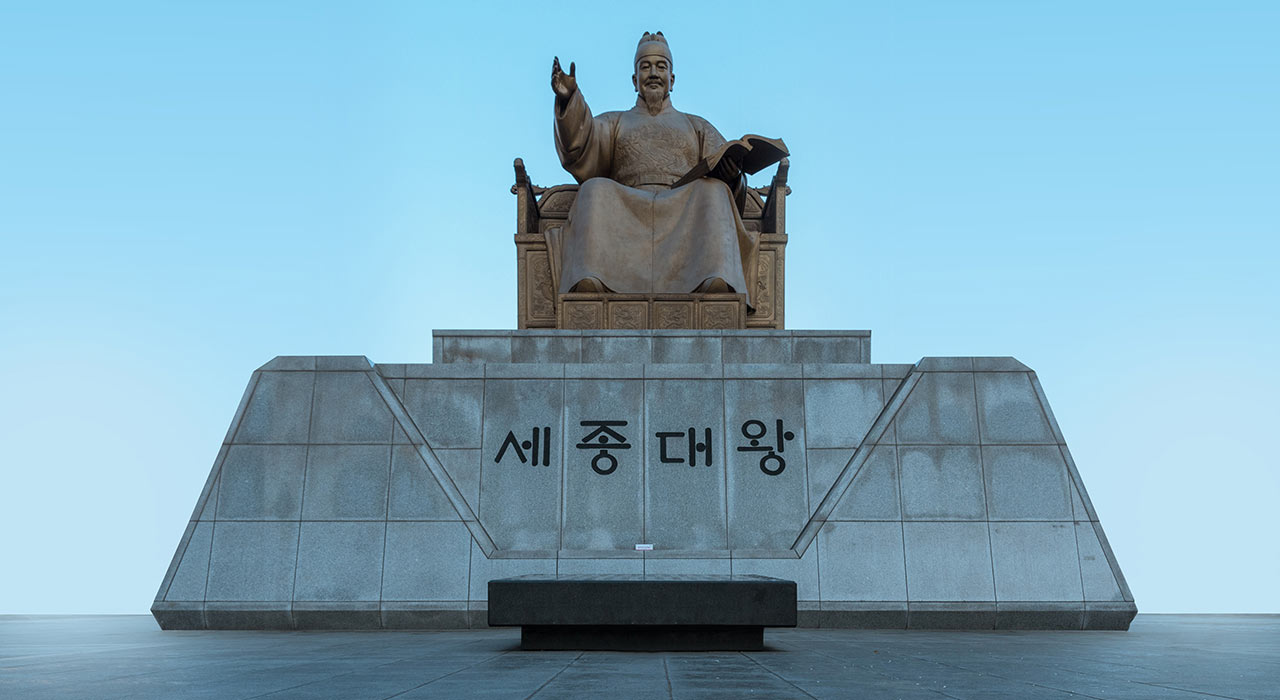
King Sejong created Hangul in 1443, and it was promulgated in 1446 with the Hunminjeongeum Haeryebon, a text explaining the new script's purpose and design. The original system had 28 letters. Modern Hangul uses 14 basic consonants and 10 basic vowels, with additional tense consonants and compound vowels. UNESCO's Hunminjeongum Manuscript record gives the dates and describes the surviving explanatory edition.
Five basic consonant shapes (ㄱ, ㄴ, ㅁ, ㅅ, and ㅇ) were modelled on speech organs involved in making the sounds. Other consonants were derived from basic shapes by adding strokes or doubling a letter. The vowel design grew from three elements representing heaven, earth, and humanity. That is more precise than saying every letter pictures the tongue.
The Korean Alphabet and Pronunciation
Modern Hangul has 19 initial consonant letters and 21 vowel letters. Those totals include five tense consonants and 11 compound vowels. The tables use South Korea's Revised Romanization.
Romanisation is useful for looking up a word, but it cannot show every pronunciation change. In particular, Korean distinguishes plain, aspirated, and tense consonants. Listen to recordings and copy the contrast rather than forcing each letter into an English sound.
Korean Consonants
| Letter | Romanisation | What to notice |
|---|---|---|
| ㄱ | g/k | A plain consonant; do not treat it as identical to one English sound. |
| ㄴ | n | An n sound. |
| ㄷ | d/t | A plain consonant. |
| ㄹ | r/l | Usually a tap-like sound between vowels and more l-like in a final position. |
| ㅁ | m | An m sound. |
| ㅂ | b/p | A plain consonant; ㅍ is its aspirated counterpart. |
| ㅅ | s | Often sounds more sh-like before ㅣ and y-vowels. |
| ㅇ | silent/ng | Silent in the initial position and ng in the final position. |
| ㅈ | j | A plain consonant. |
| ㅊ | ch | An aspirated consonant. |
| ㅋ | k | The aspirated counterpart of ㄱ. |
| ㅌ | t | The aspirated counterpart of ㄷ. |
| ㅍ | p | The aspirated counterpart of ㅂ. |
| ㅎ | h | An h sound whose pronunciation can interact with neighbouring consonants. |
A consonant at the bottom of a syllable block is called batchim (받침). Final consonants have fewer possible surface sounds than initial consonants, and the pronunciation can change again when the next syllable begins with a vowel or consonant. Learn batchim as a separate topic with audio instead of reading the romanisation letter by letter.
Korean Tense Consonants
The five doubled letters are tense consonants: ㄲ (kk), ㄸ (tt), ㅃ (pp), ㅆ (ss), and ㅉ (jj). These spellings do not switch between “g” and “k,” for example, according to a letter's position in the word. Tense consonants form their own contrast with the plain and aspirated series.
Korean Vowels
| Letter | Romanisation | Letter | Romanisation |
|---|---|---|---|
| ㅏ | a | ㅑ | ya |
| ㅓ | eo | ㅕ | yeo |
| ㅗ | o | ㅛ | yo |
| ㅜ | u | ㅠ | yu |
| ㅡ | eu | ㅣ | i |
The spellings eo and eu are romanisation conventions, not instructions to pronounce two separate vowels. Use a recording to learn ㅓ and ㅡ rather than relying on accent-dependent English comparisons.
Korean Compound Vowels
| Letter | Romanisation | Letter | Romanisation |
|---|---|---|---|
| ㅐ | ae | ㅒ | yae |
| ㅔ | e | ㅖ | ye |
| ㅘ | wa | ㅙ | wae |
| ㅚ | oe | ㅝ | wo |
| ㅞ | we | ㅟ | wi |
| ㅢ | ui |
Some distinctions in spelling are smaller in everyday speech. For many speakers, ㅐ and ㅔ sound alike, and ㅚ is often pronounced like ㅞ. The pronunciation of ㅢ varies with its position and grammatical role. Keep the spellings distinct even when the sounds overlap.
How Korean Syllable Blocks Work
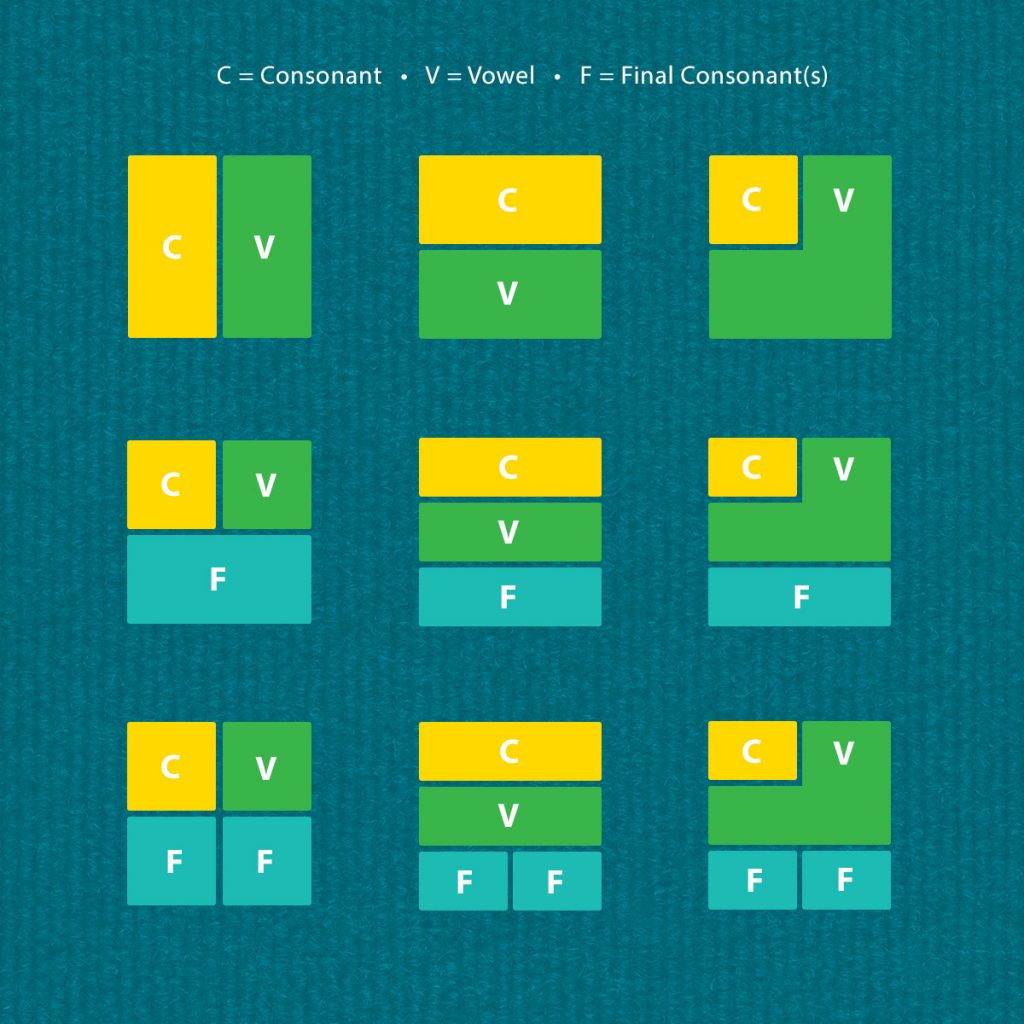
In standard Korean writing, letters are assembled into syllable blocks. Each block has an initial consonant and a vowel. When a spoken syllable begins with a vowel, ㅇ fills the initial position without adding a sound. A block may also have a final consonant, including one of the permitted two-letter final clusters.
The vowel shape controls the layout. With a vertical vowel such as ㅏ or ㅣ, the initial consonant sits to the left: 나, 니. With a horizontal vowel such as ㅗ or ㅜ, the initial consonant sits above it: 노, 누. A final consonant sits at the bottom: 한.
The diagram shows common consonant-vowel layouts, with and without one or two final consonant letters:
A word can contain one block, as in 저 (jeo, “I”), or several, as in 음악가 (eumakga, “musician”). 저는 음악가입니다 means “I am a musician” and is romanised jeoneun eumakgaimnida.
Korean does use spaces, but not according to exactly the same rules as English. Words and their attached particles or endings are commonly written together as an eojeol (어절), while spaces separate those units. Copy complete Korean sentences so you learn spelling and spacing together.
How to Practise Reading and Writing Hangul
I found spaced review useful when learning the Korean alphabet. Test yourself by looking at a letter or block and recalling its sound before checking the answer. Then revisit the items you missed after a delay. Our guide to spaced repetition explains how to organise those reviews with paper cards or an app such as Anki.
Move from isolated letters to real syllables and short words. Loanwords can give you familiar meanings while you practise Korean spelling: 케냐 (Kenya), 쇼핑 (syoping, “shopping”), 휴스턴 (Hyuseuteon, “Houston”), 컴퓨터 (keompyuteo, “computer”), and 오렌지 주스 (orenji juseu, “orange juice”). Their Korean pronunciation may differ from the source-language word, so listen as well as read.
Handwriting can help you notice how the strokes fit together. I used grid paper when I began. Write one block per square, then practise the same letters inside words rather than filling a whole page with a single character.
Tools for Learning the Korean Alphabet
- Fluent in 3 Months Korean alphabet chart: use the chart to review each letter and hear how the consonants and vowels are organised.
- 90 Day Korean: this is a paid partner course that teaches Hangul alongside Korean vocabulary and grammar. The link is an affiliate link, which means Fluent in 3 Months may earn a commission if you buy through it, at no extra cost to you.
- Eggbun: this Korean-learning app presents material through short chat-style lessons. I also used it when I was learning to type in Korean. Check the current free and paid options before subscribing.
- Scripts by Drops: its Korean course lets you trace Hangul letters on a phone or tablet. I would use this as one source of writing practice, then copy complete Korean words by hand.
- Anki: use your own flashcards to retrieve letters, sounds, and short words at spaced intervals. Audio cards are more useful than romanisation-only cards for pronunciation.
How to Type in Korean
Add Korean as an input language in your device's keyboard or language settings. The exact menu names vary by operating-system version. On a computer, an on-screen keyboard or keyboard viewer can show the Hangul layout while you learn where each letter sits. On a phone, switch keyboards with the globe or language key after adding Korean.
This Korean typing guide from 90 Day Korean shows the two-set layout and gives platform-specific setup directions. Check your device manufacturer's help page if its menus no longer match the screenshots.
Start by typing words you already know, then copy one short sentence at a time. Check the finished blocks against the source before you repeat them. Accuracy matters more than speed at this stage.
Your Next Hangul Practice Session
For your next session, choose five consonants and five vowels. Recall each sound, build a few syllable blocks, and write or type three real Korean words containing them. Finish by listening to those words and marking any sound-letter pairs you want to review tomorrow.
Once you can decode the blocks, keep reading small amounts of Korean in context. Menus, captions, song titles, and beginner dialogues all give you repeated contact with Hangul while you continue learning vocabulary and grammar.

Social