



Minority Languages: The Bliss of Learning Languages Less Spoken

Full disclosure: This post contains affiliate links. ?
“If you live with people and you share a life with them and you speak their language, they trust you.” – Peter Rohloff, MD, Wuqu' Kawoq (Maya Health Alliance)
I have always found languages to be beautiful.
Having learned to speak seven languages, some fluently and others at a more basic level, I have come to appreciate how all of them let people communicate complex human thoughts. That shared purpose does not erase the differences between Mandarin Chinese, American English, Arabic and Lingala.
Each language also has its own patterns, histories and associations. Let me give one example from my experience.
Haitian Creole has a frankness, or a directness in saying things, almost to the point of being comical. I remember the first few months that I spent living in Somerville, Massachusetts when the neighbourhood was still inhabited by large numbers of Haitians. It was just after the massive earthquake that struck Port-au-Prince in 2010. One taxi driver (this was before Uber) explained that Haitians always “say things straight.” He gave an example. Instead of saying Il pleut (French for, It's raining), they say Lapli ap tombe (Rain is falling). “When you say it's raining,” he asked, “What is raining?”
I laughed.
Also, I was amazed at how effortlessly Haitians inserted English words into Haitian Creole.
- L'ap vini kunye a. Li slow. (He (or she) is coming now. He (or she) is slow.)
- Fe bak. (Go back.)
- M vle achte kat. Yo buy one get one fwee.* (I want to buy four. They're buy one get one free.)
There is an expression in Haitian Creole, Kreol pale, kreol konprann, meaning “Creole is spoken; Creole is understood.” Haitian Creole has a complete grammar, though it uses systems different from French and has fewer inflectional categories in areas such as gender and verb endings. I found that, even though I was far from fluent, people often made themselves understood to me. I also enjoyed the humour I encountered in blunt turns of phrase.
Learning how people use a language can offer clues to their experiences and cultural context, but it cannot give an entire group one personality. Metaphors can still be revealing. In the United States, for example, people use expressions such as invest in your future, spend your time wisely, don't sell yourself short and it will pay off, even when money is not the subject.
A note from the Fluent in 3 Months team before we get started: You can chat away with a native speaker for at least 15 minutes with the “Fluent in 3 Months” method. All it takes is 90 days. Tap this link to find out more.
What is a Minority Language?
All of this brings me to the point of this article. What is a minority language and why is it worth learning one?
I had never heard the term minority language until I submitted an article to Fluent in 3 Months (Fi3M) about learning Tz'utujil where I offered tips for learning indigenous languages. The term appeared over emails sent back and forth between myself and the Fi3M team.
Officially, a minority language is one that’s spoken by a minority of people within a given country or territory. For myself, I have come to think of a “minority” language as one that is spoken by a small group of people in a limited geographical area. There are many good reasons to learn these types of languages, but you will also be sure to find people to discourage you.
“Why Would You Want to Learn That?”
Let me tell you a story…
It was October 31, 2016. Guatemala was having its annual kite festival in Sumpango where beautifully woven kites larger than billboards were flying high on display. Around that time in San Juan La Laguna, smaller kites were literally falling out of the sky and landing into my bowls of chayote carrot soup. The open-air kitchen concept, popular in Guatemala, has its advantages and disadvantages. I had just turned 31 that morning and was about to set off on an overnight journey to the Republic of Nicaragua, my second two-week vacation in just over a month. I was excited, chatting about my love of languages with an artist named Jesi Jordan on the lancha to Panajachel.
Eighteen hours later, I arrived in Leon, Nicaragua, exhausted but happy to have arrived safely. The next day as I explored the scorching capital of the Sandinista Revolution, it struck me as being worlds apart culturally from Guatemala.
Comparatively, the people I met seemed more reserved, and I heard only Spanish during my brief visit. I also encountered different political attitudes from those I had noticed in Guatemala. Already, I missed the warm smiles and the laughter of the indigenous Maya.
One day, while walking across the courtyard towards the Catedral de Leon past a large fountain adorned by ceramic lion figurines, I met an older gentlemen named Ernesto, a native of Leon, who loved traveling. He had been to San Juan La Laguna and shared my enthusiasm for foreign languages; he knew Spanish, English, French, Portuguese and Italian. I told him I was learning Tz'utujil, the indigenous language spoken in San Juan.
He looked at me like I was crazy.”Why would you want to learn that?” he asked.
Many people ask the same thing.
Ernesto learned languages to broaden his world, not to narrow it down. Like many others, he believed that learning an indigenous language spoken by a very small group of people (Tz'utujil has fewer than 100,000 speakers) was, to put it bluntly, a waste of time.
Many others gave me similar advice. “Focus on improving your Spanish,” they said, “Because once you leave San Juan La Laguna, your Tz'utujil will be worthless. But your Spanish will serve you across all of Latin America.”
They were right. But I already felt confident in my Spanish, and I knew that the more time I spent in Latin America, the more it would improve anyway. I wanted to connect with the San Juaneros.
6 Reasons I Love Learning Minority Languages
Which language or languages you choose to learn depends on your objectives. Learning broad, sweeping languages spoken by millions, or billions, is a great thing. Languages like Mandarin Chinese, English and Spanish are international and if you can speak them, they open up opportunities for business, pleasure and cross-cultural understanding through vast segments of the entire world.
But there's something cool about indigenous languages, and minority languages. The world is becoming more globalized, and increasingly cultures are becoming more homogeneous. International cities have more in common with one another across borders than they do with the rural countryside surrounding them. The wisdom embedded in “minority” languages is dying as more and more people switch to speaking dominant or mainstream languages.
In my experience, learning these languages has been a great source of bliss. Here are the reasons why:
1. People Open Up to You and Trust You
When I began working as a maternal and child nutritionist in Somerville, Massachusetts, a devastating earthquake had just struck Haiti. Haitian refugees were arriving in the Boston area by the thousands, and my French was of little use among the majority of them, who spoke only Haitian Creole. I wanted to communicate with them in that language, and I was determined to learn it. I found a textbook in the Somerville Public Library entitled “Ann pale kreyol”. At the time, I thought it meant Anne speaks Creole, but later on learned that it means Let's speak Creole.
After months of independent study and three weeks of intensive language courses at UMass Boston's Haitian Creole Summer Institute, I started using Haitian Creole with clients at work. When I began to do so, everything changed. Clients who had previously acted cold towards me and refused to answer any questions were now opening up to me. Instead of looking down or away when I spoke, they sat close and listened intently. Many were shocked that I'd taken the time to learn Haitian Creole, a language that, for the most part, is spoken only by Haitians. Some thought I'd spent a significant amount of time in Haiti, or was born there.
In the end, it boils down to trust. When you learn a language that is spoken by so few, people will begin to trust you almost immediately. Learning a language with a limited number of speakers proves your commitment to those people. If you weren't sincere, you would never have bothered. Even in Rwanda, if you just say a sentence or two in Kinyarwanda, people will say Uri umunyarwanda (you are Rwandan).
2. You’ll Find People are Eager to Help You Learn
Sometimes people complain about learning languages like French, because they go to Paris and no one will speak French with them. The French just respond in English as if to say, “Why are you even trying to speak my language?” In the same way, when immigrants come to the United States, few people give them credit for trying in English.
By contrast, it's been my experience that when learning “minority” languages, you're encouraged and pushed forward by native speakers every step of the way. People’s eyes light up when they see you're even trying, and they will go out of their way to help you learn whatever you want to know. I've been studying Kinyarwanda in Rwanda now for three months, and haven't had a teacher, though many people have offered to teach me for free. Instead, I go up to people and talk to them, and when I don't know how to say something, I ask. While riding the bus, I pull out flashcards and converse with people near me using the vocabulary words I'm learning. Rarely do other passengers not get excited about my learning process and try to help as much as they can.
I've had nearly identical experiences learning Haitian Creole and Tz'utujil.
Note: I don't know whether it's fair to call Kinyarwanda a minority language, as it's spoken by millions, but nevertheless it is a language whose speakers are concentrated in one specific, relatively small geographical location.
3. You Will Make People (and Yourself) Laugh
Many of the Indigenous Maya people I met laughed easily. In Rwanda, I've found, one of the best ways to engage with people and get them laughing is through singing. You can either ask Rwandans to teach you songs in Kinyarwanda, or offer to teach them songs in English. Either way you'll build rapport and share a good laugh during the learning process.
4. You Will Gain Insight Into a Different Worldview
There's something fascinating about Mayan languages. People are still speaking them. Despite centuries of Spanish influence and despite repeated attempts to eradicate Maya people and civilization, and unlike elsewhere in Central America, these pre-colonial languages are still thriving. Primarily, speakers of Mayan languages reside in Guatemala and Mexico, but they also extend into other neighbouring countries. This means that the worldview of a people who inhabited the Americas long before the arrival of the Spanish is still intact and alive, embedded inside indigenous languages. Many of these are at risk of becoming extinct as the younger generations are adopting Spanish for a variety of reasons, not the least of which are employment opportunities.
By learning such a language, spoken by so few, one can begin to appreciate other ways of framing and seeing the world, beyond what the framework of a Western language such as English or French provides. Granted, widely spoken majority languages throughout the world can provide insight into worldviews that differ significantly from a Western point of view. However, there is a richness in the sheer diversity of minority languages spoken by small groups which are dying out at a rapid rate globally.
I found several features of Tz'utujil grammar deeply intriguing, including the way relationships between participants in an action are marked. They reminded me of Michael Pollan's book The Omnivore's Dilemma: did we cultivate corn, or did corn cultivate us? Corn and humans rely on one another for propagation. I found interconnectedness a useful personal metaphor for thinking about the grammar, not proof that the language determines its speakers’ worldview.
The linguist Daniel Everett wrote Don't Sleep, There Are Snakes about his years learning Pirahã in the Amazon. His claims about number words, recursion and how Pirahã speakers talk about time have prompted substantial debate among linguists. Grammatical tense or number words do not set the limits of what speakers can think about. I remain fascinated by the questions his work raises, while recognising that his interpretation is contested.
Being able to see the world in a new way, for me, is one of the major motivating forces for learning an indigenous or minority language.
5. You Will Be a Bridge Over Massive Cultural Divides
This goes back to building trust. In many cases, the language barrier is what separates one group from another. Once you start speaking the language, though, a lot of walls come down. People feel they can trust you. This is what happened to me with Haitian Creole. If I'd made an assessment of “what Haitians are like” before speaking Creole with them versus after, it would be entirely different. It's hard to really understand culture as an outsider. You only learn how people treat you, someone who doesn't belong to the group.
Sometimes learning an indigenous or minority language can allow you to get a more inside view, just as it can when you learn a more widely spoken, but culturally distant language.
6. Work Becomes More Meaningful – and You’ll Open Yourself Up to New Opportunities
In late January, I received an email from a former dietetic internship director informing me of a research fellowship in Kigali, Rwanda. Three weeks later I was flying out of Logan Airport on Ethiopian Airlines headed for the land of a thousand hills (an underestimate by my count). On the plane, I wrote out my main objectives for the year. The two big ones were: pour my heart into the fellowship and learn to speak Kinyarwanda fluently.
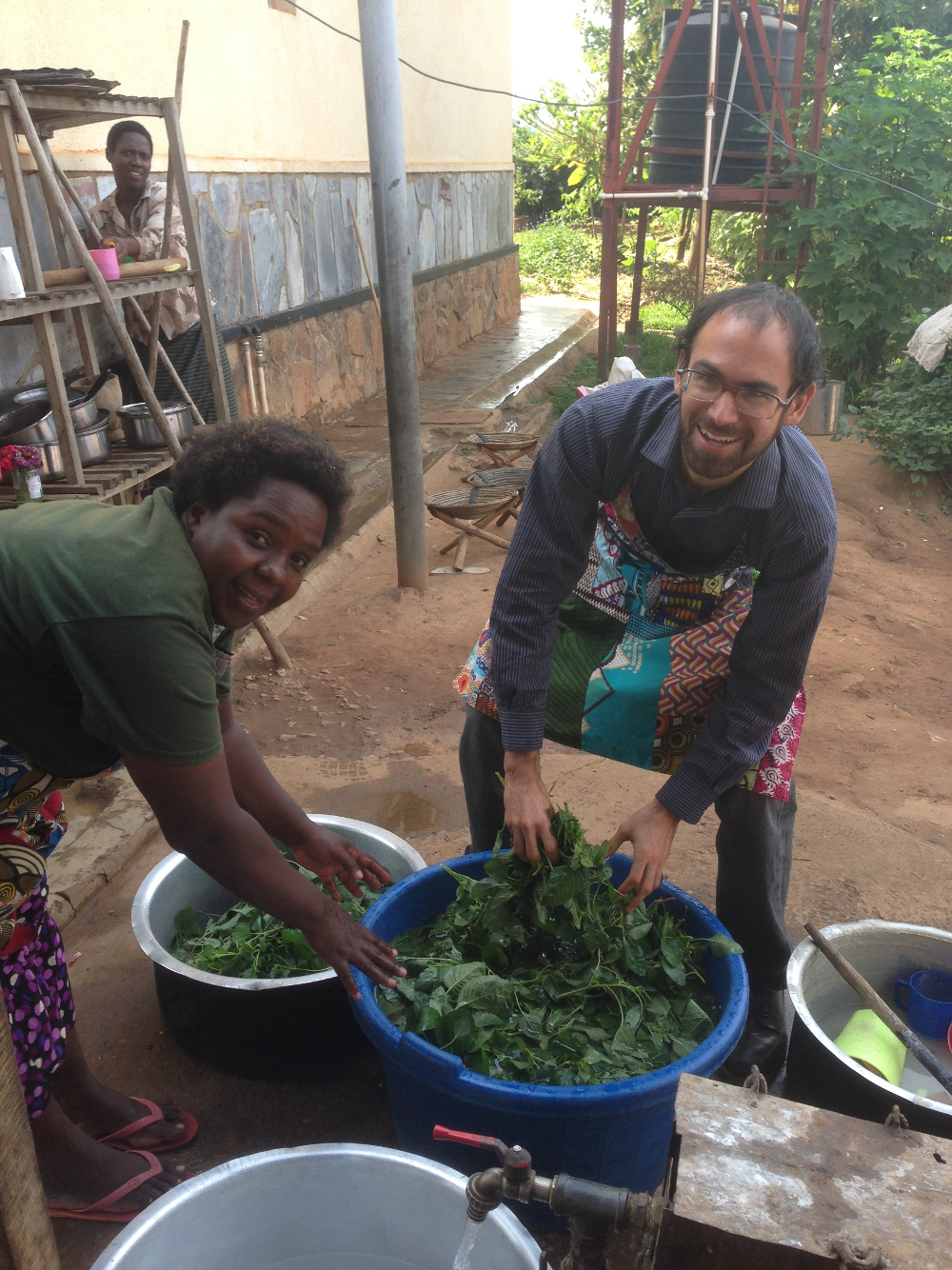
The non-government organization that I work for, which promotes nutrition-sensitive agriculture as a long-term sustainable solution to malnutrition, is comprised of 90% local Rwandese. The majority of them do not speak much English. The key people that I work with on a day-to-day basis are fluent in English, but without knowing some Kinyarwanda, I would be effectively cut off from a large proportion of our staff. Through my efforts learning Kinyarwanda, I'm able to communicate with everyone in the organization, from kitchen staff to farm workers to field educators to the mothers who utilize our program. In this way, I feel much more connected to what we do, and the work is also a lot more fun.

Social