


Learn Months of the Year in Italian (With Audio)

Full disclosure: This post contains affiliate links. ?
Learning the months in Italian gives you a practical way to talk about dates, the weather, yearly routines and seasonal traditions.
If you speak another Romance language or English, some of the words may look familiar. As a French and English speaker, I found that helpful. But watch the spelling and pronunciation: pairs such as “January” and gennaio, or “February” and febbraio, are similar rather than identical.
Before we get started, if you’re looking for an online Italian course, here’s the course I recommend: Italian Uncovered – Learn Italian Through the Power of Story, a course with a fascinating new method by my friend Olly. You can try it for free for 7 days!
Months of the Year in Italian: I mesi dell’anno
Let’s start by listing the twelve months of the year:
| Months in Italian | ||
|---|---|---|
| Italian | English | Audio |
| gennaio | “January” | |
| febbraio | “February” | |
| marzo | “March” | |
| aprile | “April” | |
| maggio | “May” | |
| giugno | “June” | |
| luglio | “July” | |
| agosto | “August” | |
| settembre | “September” | |
| ottobre | “October” | |
| novembre | “November” | |
| dicembre | “December” | |
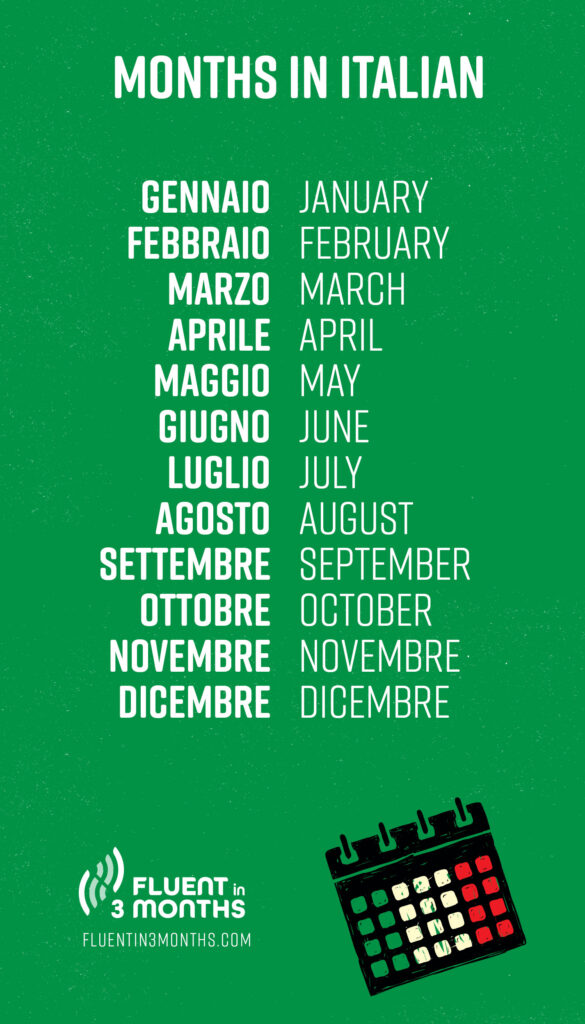
Italian month names are masculine and normally lowercase. You would write “It’s cold in January” as Fa freddo a gennaio, with a lowercase g. Both a gennaio and in gennaio can mean “in January”; you can also say nel mese di gennaio when you want to spell out “in the month of January”.
How to Pronounce the Italian Months of the Year
Italian spelling-to-sound patterns are relatively regular, but spelling and pronunciation are not identical. Before e or i, for example, the letter c usually has the “ch” sound in “chocolate”. In dicembre (“December”), that sound begins the stressed syllable: /diˈtʃɛm.bre/.
Here’s how all 12 months are pronounced:
| Months in Italian | ||
|---|---|---|
| Italian | IPA | Audio |
| gennaio | /dʒenˈna.jo/ | |
| febbraio | /febˈbra.jo/ | |
| marzo | /ˈmar.tso/ | |
| aprile | /aˈpri.le/ | |
| maggio | /ˈmad.dʒo/ | |
| giugno | /ˈdʒuɲ.ɲo/ | |
| luglio | /ˈluʎ.ʎo/ | |
| agosto | /aˈɡo.sto/ | |
| settembre | /setˈtɛm.bre/ | |
| ottobre | /otˈto.bre/ | |
| novembre | /noˈvɛm.bre/ | |
| dicembre | /diˈtʃɛm.bre/ | |
Seasons and Months in Italian
In Italy and elsewhere in the Northern Hemisphere, the months are commonly grouped into four seasons. Here are le stagioni with some useful example sentences.
Primavera: “Spring”
The spring months are marzo, aprile and maggio.
- Marzo è il primo mese di primavera: “March is the first month of spring.”
- I fiori sbocciano a maggio: “The flowers bloom in May.”
Estate: “Summer”
Giugno, luglio and agosto are the summer months.
- Dove andrai in vacanza quest’estate? “Where will you go on holiday this summer?”
- Andrò a Firenze a luglio: “I will go to Florence in July.”
Autunno: “Autumn/Fall”
Settembre, ottobre and novembre belong to autumn.
- Roma è ancora calda in autunno: “Rome is still warm in autumn.”
- Sono nato/nata a settembre: “I was born in September.”
Inverno: “Winter”
The winter months are dicembre, gennaio and febbraio.
- Voglio andare a sciare quest’inverno: “I want to go skiing this winter.”
- A febbraio, andiamo all’Alpe di Siusi per vedere la neve: “In February, we go to Alpe di Siusi to see the snow.”
Get Creative With Months in Italian
Add a few common Italian words and build sentences around dates that matter to you. You might pair dicembre with these Italian Christmas traditions, or learn the month of a birthday, trip or local festival. Personal examples give each word a reason to stick.

Social