


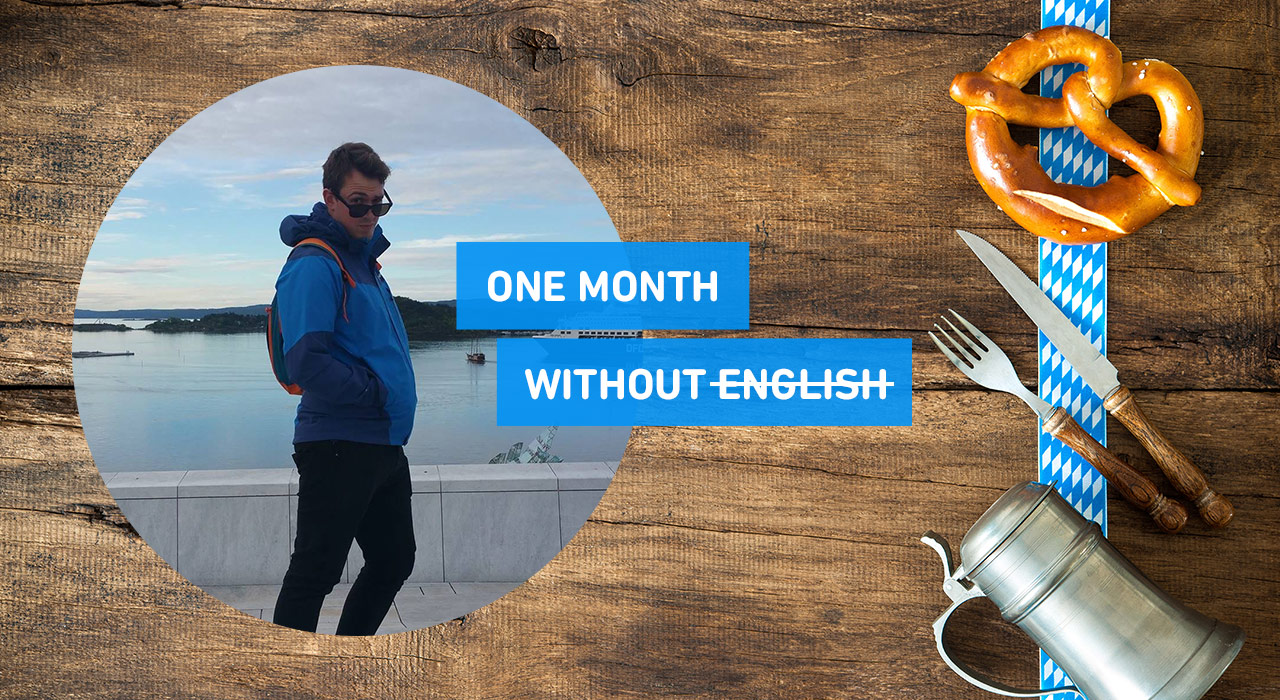
My One-Month German Immersion Mission

Full disclosure: This post contains affiliate links. ?
Have you ever reached a plateau in your language learning that you just couldn’t break through?
From the blog’s mission archive: kept as a first-person account of the experiment. See all the missions.
I did.
It didn’t seem to matter how many German lessons I took, calls I made or grammar books I read. I couldn’t get to the next stage.
I kept making the same mistakes and forgetting the same words.
When a routine stops helping, a different kind of practice can reveal what to work on next.
For some people it’s using podcasts instead of books. For others, it’s taking an intensive course.
Me? Well, I decided to stop speaking English.
For 30 days, I took on a Month Without English language mission. Outside work and essential exceptions, I used German instead of English.
In this article I explain my goals for the mission, and how I prepared for it. I’ll also share what you can expect over the next series of blog posts.
A note from the Fluent in 3 Months team before we get started: You can chat away with a native speaker for at least 15 minutes with the “Fluent in 3 Months” method. All it takes is 90 days. Tap this link to find out more.
Why Try a Month Without English?
One of the mistakes I’ve made learning German (and Spanish in the past) is that I spend a lot of time speaking English around my target language. While I may be speaking and learning German 10 hours a week, that still leaves 102 waking hours a week where I’m living in English. If I’m socialising, relaxing or reading a book there’s a good chance I’m doing it in English.
So I asked myself: “What could I achieve if I wasn’t able to speak English?”
What if I used more of those waking hours in German and made it my most-spoken language? How would my German change?
Then I watched an Fi3M video in which Benny described giving up English for a month to focus on Spanish. The idea gave my project a clear shape.
Seeing as I was about to move to Germany in just a few days, it made sense to tie the two together and turn them into one big project.
Over the following few weeks there would be lots of times that I’d be forced to use my German. Registering as a resident, meals with friends, rugby training, housewarming and the upcoming carnival to name but a few.
I knew I would have frequent reasons to use German.
What Is The Goal?
At the end of my month without English is the Cologne Carnival.
It’s a big festival where the whole city comes together, parties, wears fancy dress and has a lot of fun. So my goal was heavily centred around that:
I’d like to reach B2 level in speaking and listening by the first day of Carnival
At day zero, I estimated my level at around B1. I could speak enough to get by. With creative vocabulary and plenty of gestures, I could make my point on many everyday topics. Sometimes, though, I caught only key words or struggled with an unfamiliar idea.
People often switched to English because they thought it would be easier for me. I wanted to sustain a German conversation confidently enough that they didn’t feel they had to switch.
What Are The Rules for the Month Without English?
For my month without English, I set rules for myself. They describe this experiment rather than a universal programme.
At the time, I was Fi3M’s social media manager as well as a writer and blogger. Much of my work was in English, so work had to remain an exception.
So, taking work out of the equation, here are the rules I needed to stick to:
- German by default: If someone could speak German, I answered in German. I kept exceptions for work, health, safety and anything important.
- German entertainment: I chose films, music and books in German during the mission.
- Describe first, ask second: When I didn’t know a word, I tried to describe it in German with the vocabulary I had. If that didn’t work, I asked for the word.
- Conversation first: I paused my usual grammar and vocabulary sessions so that most new learning came from conversation. If a recurring grammar point blocked me, I could use a relevant GermanPod101 episode.
I also allowed myself to use dictionaries such as LEO or Dict.cc to look up a word when I needed it.
How to Prepare for a Month Without English
With moving to Germany my time was pretty limited to prepare. I certainly didn’t have hours a day to focus on improving my German skills.
I relied on two resources to review useful German before the mission.
When I was in the car or walking the dog, I listened to an episode of GermanPod101. Short listening sessions fitted into time I already had.
I also used Benny’s Language Hacking German book. I originally used this before I joined Fi3M to get to A2 level. But there are always grammar points and vocabulary lessons to review.
Otherwise, I did little intensive preparation, and none of it required travel.
My Feelings Before My Month Without English
Honestly? I felt really freaking nervous.
This would be my first month living in Germany, and I knew I might feel detached from home in England. Using much less English could make that distance feel greater.
I don’t know what it is about language learning, but the thought of saying something wrong or not being understood really played on my mind a lot. More so than I feel if I play a chord wrong on the guitar or if I overcook an egg when making breakfast.
But there was also a part of me that felt really excited. I’d be connecting with German people on a whole new level.
My biggest worry? Speaking German when my girlfriend wasn’t around to help me.
Before this mission, most of my German conversations happened when she was there. She knew how to explain an idea using grammar and vocabulary I understood, which made her a patient guide.
At rugby training or while shopping, I would need to manage conversations without relying on her help.
Want to Follow My Month Without English?
I’ll be sharing more updates on Fluent in 3 Months.
Next, read what happened during the first couple of weeks without English.

Social