



5 Hacks to Learn Languages by Reading Literature

Full disclosure: This post contains affiliate links. ?
A good book can give you a story or idea worth keeping. Read it in a language you’re learning and the wording becomes part of the experience too.
Reading in your target language can reinforce vocabulary, sentence patterns and comprehension, but the book still needs to suit your level and hold your interest.
So how can you read without turning every page into a dictionary exercise?
A language is more than grammar and vocabulary. When you read a book in another language, you also meet the author’s choices: how a scene is described, how dialogue moves and which expressions carry the tone.
You don’t need to begin with a literary classic.
Children’s books, comics and graded readers can all be useful starting points. Choose by readability and interest, not by whether a book looks impressive.
Here are five ways to learn from books while keeping the reading itself enjoyable.
Start with a book you care enough to keep opening.
A note from the Fluent in 3 Months team before we get started: You can chat away with a native speaker for at least 15 minutes with the “Fluent in 3 Months” method. All it takes is 90 days. Tap this link to find out more.
1. Keep a Dictionary Close to Hand
A dictionary is useful, but looking up every unknown word can make a book hard to finish. Pause when a word blocks the meaning, keeps returning or seems useful to you. Guess from the context first, then check a reliable dictionary and note only what you want to revisit.
I have used this technique hundreds of times, and two small changes made my notes much easier to use.
The biggest mistake I made was scattering notes across scraps of paper and notebooks, then forgetting them in a drawer. Keeping everything in one dependable place made it far more likely that I would see the vocabulary again. Mixing subjects is fine if you can still find what you need.
My second change was to keep a pocket notebook. I could carry it away from home and review a few notes while waiting for a bus, riding the metro, standing in a queue or sitting in a waiting room.
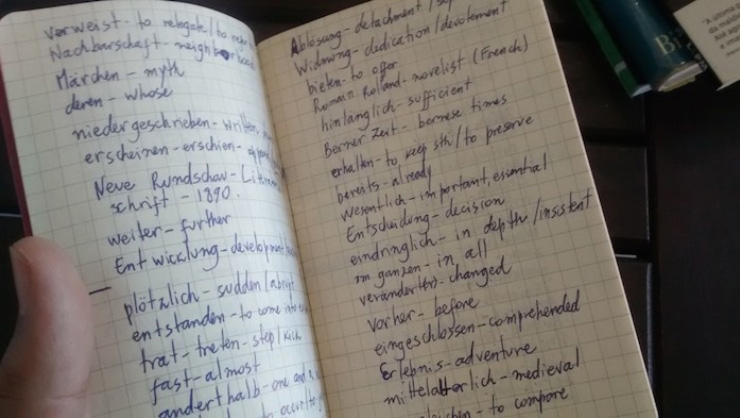
A notes app is the modern alternative. Text, audio and photos can all work, as long as you use a simple system you will actually return to.
For words worth keeping, you can use spaced repetition with an app such as AnkiMobile. Make each card a prompt that asks you to retrieve the meaning, rather than a note you only reread, and keep the sentence from the book for context.
2. Comparative Reading: Keep Two Books Side by Side
This takes more work than keeping a dictionary to hand. I call it “comparative reading”: read a passage in the original first, then check a translation to see how meaning and style were handled.
The comparison can give you useful notes too. Record a phrase, an interesting translation choice or a comment that helps you understand the passage. You don’t need to copy everything.
I’d like to share part of my own notebook. It has scribbles and probably a few mistakes, which is normal for working notes. These pages are from Siddhartha by Hermann Hesse, my favourite German writer. Most of the page is commentary on the story, with only two copied excerpts.
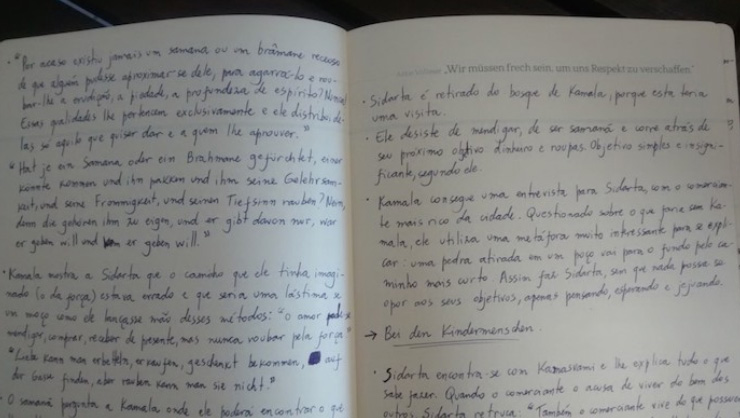
I haven’t read many books this way, and I have only used the method for German. One was Der Steppenwolf (Steppenwolf), which took me more than twice as long as an ordinary read.
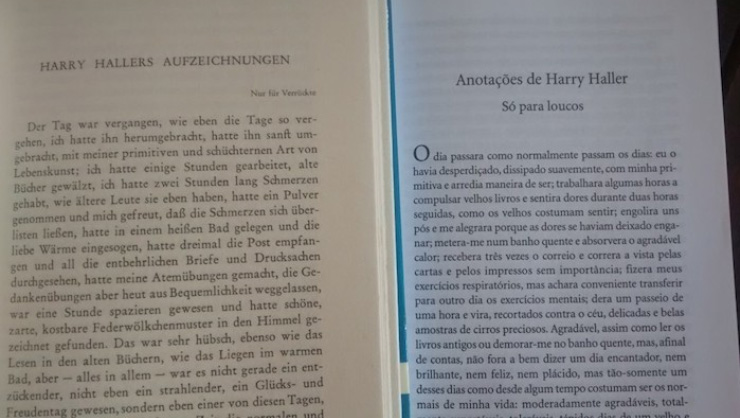
A bilingual book makes the same method easier because both languages are in one volume. Read the target-language passage before looking across at the translation, then note only the passages and vocabulary you want to keep.
I used this technique for the first book I read in French. I had just entered university and had never taken a French course; I knew enough to pass the entrance exam after studying for the three months before it. This is the bilingual book I used:

Reading a book in two languages can be slow, but that closer look is the point. You notice how each version solves a sentence instead of treating the translation as an answer key.
3. Read Comic Books (Pictures Aren’t Cheating!)
I started reading French with Rimbaud, but I didn’t start Italian with Ungaretti. I was nine when I began learning Italian and was already a voracious reader of comics. When I turned 10, an Italian friend posted me a series of comic books as a Christmas present.
I could now read the kind of book I enjoyed most in the language I was learning. The magazines had travelled all the way from Italy, and that made them feel even more special to me.
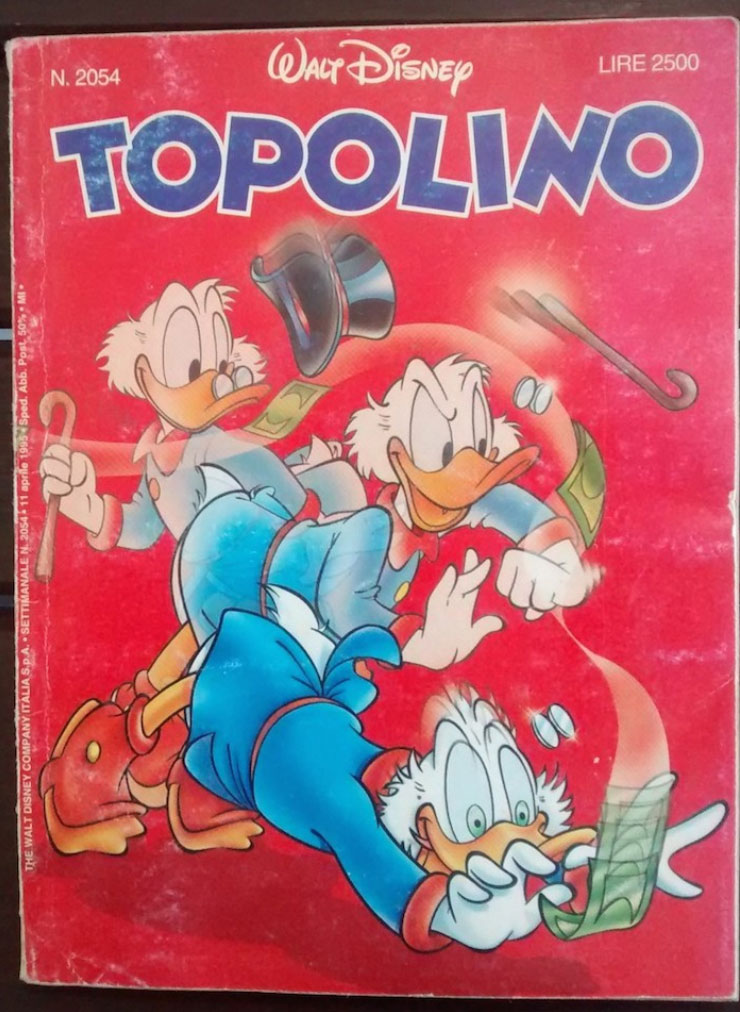
I read it often, and I still enjoy both comic books and comic strips. The pictures give you context for unfamiliar language, while short speech bubbles make the page less intimidating.
Comics also give you dialogue, jokes and visual clues in small pieces. Try reading a page once for the story, then return to the words you could not work out from the pictures.
4. Read While Listening to the Audiobook
This is my favourite method. Read the text while listening to an audiobook that matches the same edition, so you can follow each sentence as it is spoken.
Following both at once can feel awkward at first. Start with a short passage, slow the playback if your app allows it, and pause when the audio gets ahead of your reading.
Listening as you read can strengthen the connection between spelling and sound. You may notice that a word sounds different from your guess, or that the narrator’s pronunciation varies from one you already know.
You don’t have to start with a novel. A poem, short story or single chapter gives you enough material to test the method without committing to a whole book.
This method also helped me focus on difficult books required by my university. I used it for authors from Shakespeare to Proust when the text alone was hard to stay with.
LibriVox offers free volunteer-read audiobooks in several languages. It records texts that are in the public domain in the United States, although copyright status can differ elsewhere, so check the rules where you live before downloading a recording.
5. Use Graded Readers
If the original Jane Austen is too difficult, try an adapted version for English learners. These books are usually called graded readers.
Graded readers use controlled vocabulary and grammar, and publishers label them by level. Choose one that lets you follow the story without constant dictionary stops; an intermediate learner does not need to drop all the way back to the easiest books.
Because these books are made for learners, many include comprehension, grammar or vocabulary exercises. Check the specific edition rather than assuming every reader has the same extras.
Some editions include downloadable or streaming audio. If it matches the text exactly, you can use the reading-while-listening method from section 4.
Graded readers exist in languages besides English. Search for “graded reader” plus your language, then check the stated level, sample pages and audio format before buying or borrowing one.

Social