



AfrikaansPod101 Review for Learning Afrikaans

Full disclosure: This post contains affiliate links. ?
What is AfrikaansPod101?
AfrikaansPod101 is part of the Innovative Language family, built to get you understanding and speaking Afrikaans from the first lesson. Audio and video lessons taught by native speakers are its main feature.
- what it’s for:
- First contact with Afrikaans, listening practice, the guttural g and unfamiliar vowels, double negation, word order, vocabulary, and practical phrases and conversation material
- languages:
- Afrikaans
- level:
- Absolute Beginner to Advanced
+ PROS
- Plenty of native audio for the guttural g, unfamiliar vowels and natural rhythm
- Direct lessons on Afrikaans pronunciation, negation and word order
- Line-by-line playback and recording for close comparison
- Transcripts and lesson notes for deliberate study
- A recommended beginner pathway plus a broad lesson library
- Free access, a seven-day trial and a 60-day guarantee
- CONS
- Learners have reported occasional translation, labelling and audio errors
- Grammar needs a more systematic companion
- Beginner material can contain too much English
- Open speaking and writing feedback are limited below Premium PLUS
- The mobile app doesn’t include flashcards
Quick Fire Review
A substantial Afrikaans audio library with strong pronunciation tools and useful transcripts, best paired with a grammar reference and native feedback. 4.0/5.
Afrikaans gives an English speaker plenty of encouragement at the start. It uses the Latin alphabet, shares Germanic roots with English, has no grammatical gender and barely changes its verbs for different subjects. A surprising amount of basic vocabulary looks as if it ought to make sense.
Then someone speaks. The written word goed no longer sounds like English “good”, vowels combine in unfamiliar ways, and a negative sentence ends with an extra nie. Longer sentences also move their verbs around according to rules that English learners don’t instinctively follow.
AfrikaansPod101 is built around short audio and video lessons, native-speaker dialogues, transcripts and vocabulary tools. That format is a natural fit for the jump from recognisable text to real Afrikaans speech. The question I’m answering here is how well the course handles Afrikaans pronunciation and sentence structure, and how much else you’ll need beside it.
What Makes Afrikaans Different
Afrikaans is relatively approachable for an English speaker, but six features deserve proper attention.
1. Familiar vocabulary can flatter your reading. Afrikaans, English and Dutch belong to the same Germanic family, so words and sentence fragments often look recognisable. That is useful, but guessing from the page can give you an English-shaped pronunciation and a false sense that you’ll understand the same words at native speed.
2. The alphabet is familiar but the sound system isn’t. The guttural g comes from the back of the mouth, the r may need new tongue work, and Afrikaans has vowel combinations that don’t map neatly onto English. Final consonants can also sound different from what their spelling suggests. Native audio matters more here than another page of phonetic hints.
3. The verb system is light. Most verbs keep the same form across I, you, we and they, and Afrikaans has no grammatical gender on nouns. This removes much of the early memorisation. Past forms and the small group of irregular verbs still need attention, but there is far less conjugation to carry than in many European languages.
4. Negation often comes in a pair. Learner material normally calls the nie … nie pattern the Afrikaans double negative. Linguists describe it more precisely as negative concord, because the two negative elements work together instead of cancelling each other. Knowing the label is easy. Putting each nie in the right place while speaking takes practice.
5. Word order gets stricter as sentences grow. A simple statement can follow the familiar subject-verb-object order. In main clauses, the finite verb normally takes second position, while other verbs gather towards the end. Subordinate clauses usually move the verb group to or near the end. Vocabulary alone won’t teach you to build those sentences reliably.
6. Standard Afrikaans is only part of the picture. A standard variety gives learners a shared written and formal base, while everyday Afrikaans varies by region, community and register. Kaaps is one established variety, not careless Standard Afrikaans. AfrikaansPod101 distinguishes formal from informal phrasing in some material, but one set of lesson voices cannot represent every accent or colloquial form.
AfrikaansPod101 handles the sounds and everyday patterns well through repetition. Its dialogue-first approach is less convincing as a complete map of the grammar, especially if you jump around the library instead of following a pathway.
Getting Started with AfrikaansPod101
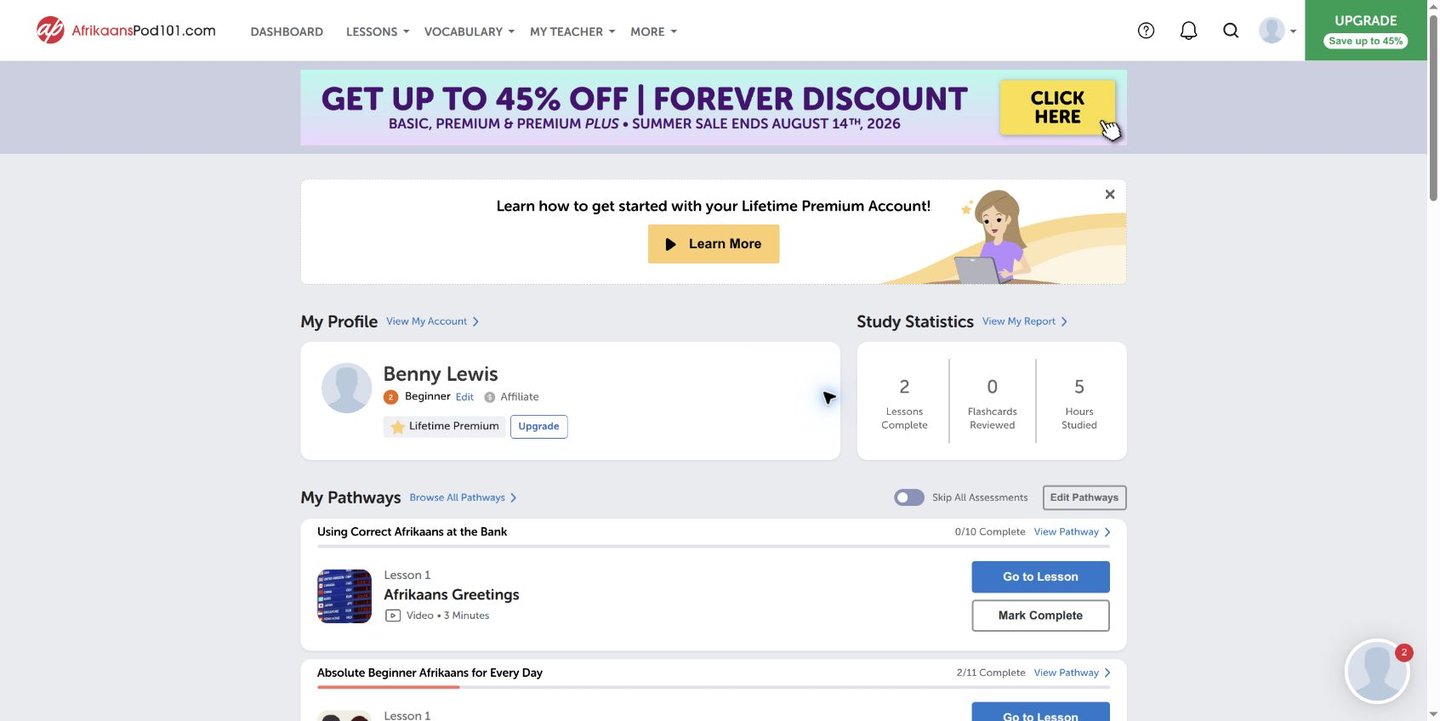
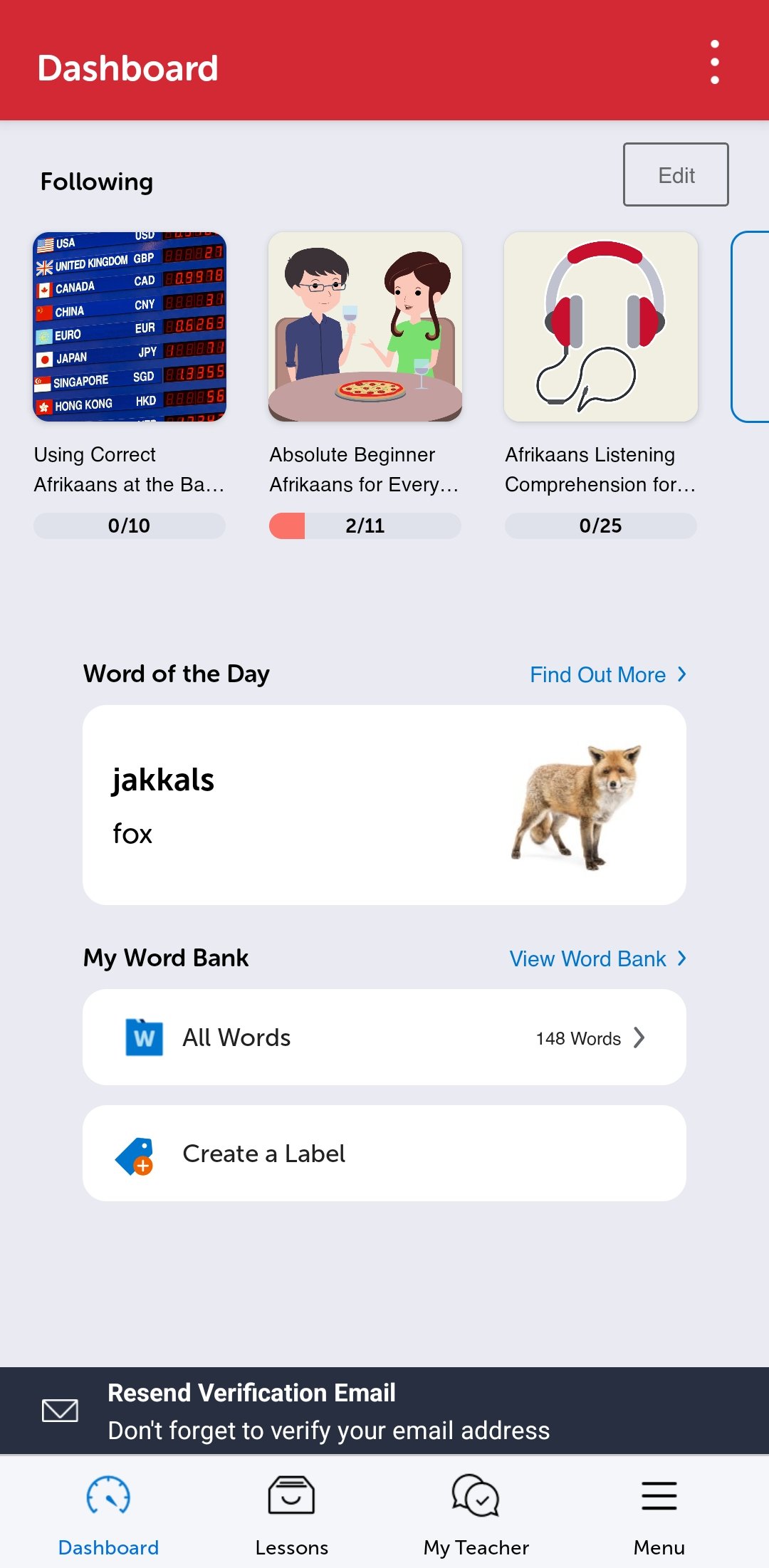
You can open a free lifetime account with an email address and no payment card. Free access includes the first three lessons in each pathway, the Word of the Day, vocabulary lists, the mobile app and a seven-day Premium trial. That is enough to inspect the lessons and paid study tools before deciding.
The dashboard asks for your level and recommends a pathway. Follow it at the beginning. AfrikaansPod101 also has culture lessons, vocabulary collections and specialist material, which is useful once you can identify a gap. At absolute beginner level, browsing can leave you with ten ways to greet someone and no clear grasp of how a negative sentence works.
The current getting-started material covers practical phrases, the writing system, grammar and separate lessons on vowels and consonants. Since the alphabet itself is familiar, you can move quickly into pronunciation without spending days learning a script.
How It Handles Afrikaans Pronunciation
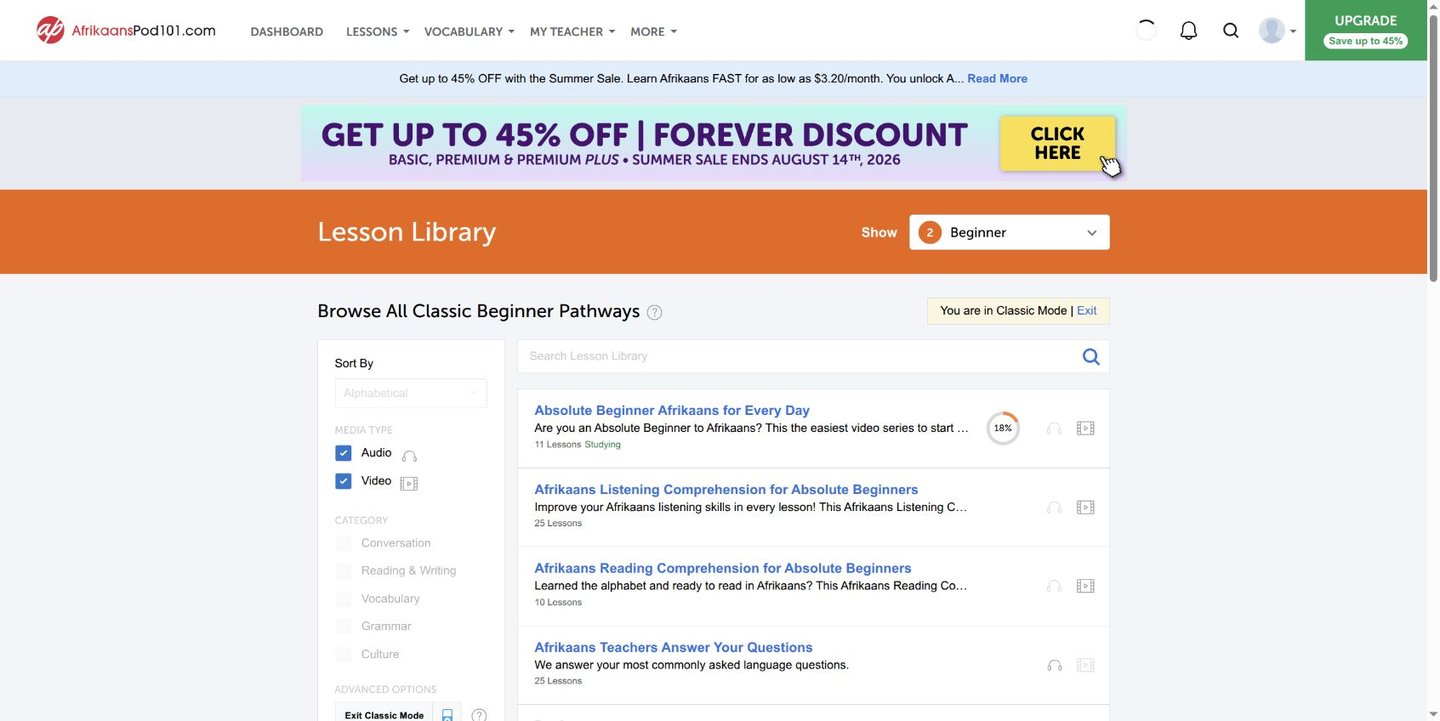
AfrikaansPod101 has dedicated material on vowels, consonants, accent marks and alphabet sounds. Its consonant lesson identifies g, j and r as the main departures from English and demonstrates the guttural g with native audio. The vowel lessons are equally important, because familiar letters can hide an unfamiliar sound.
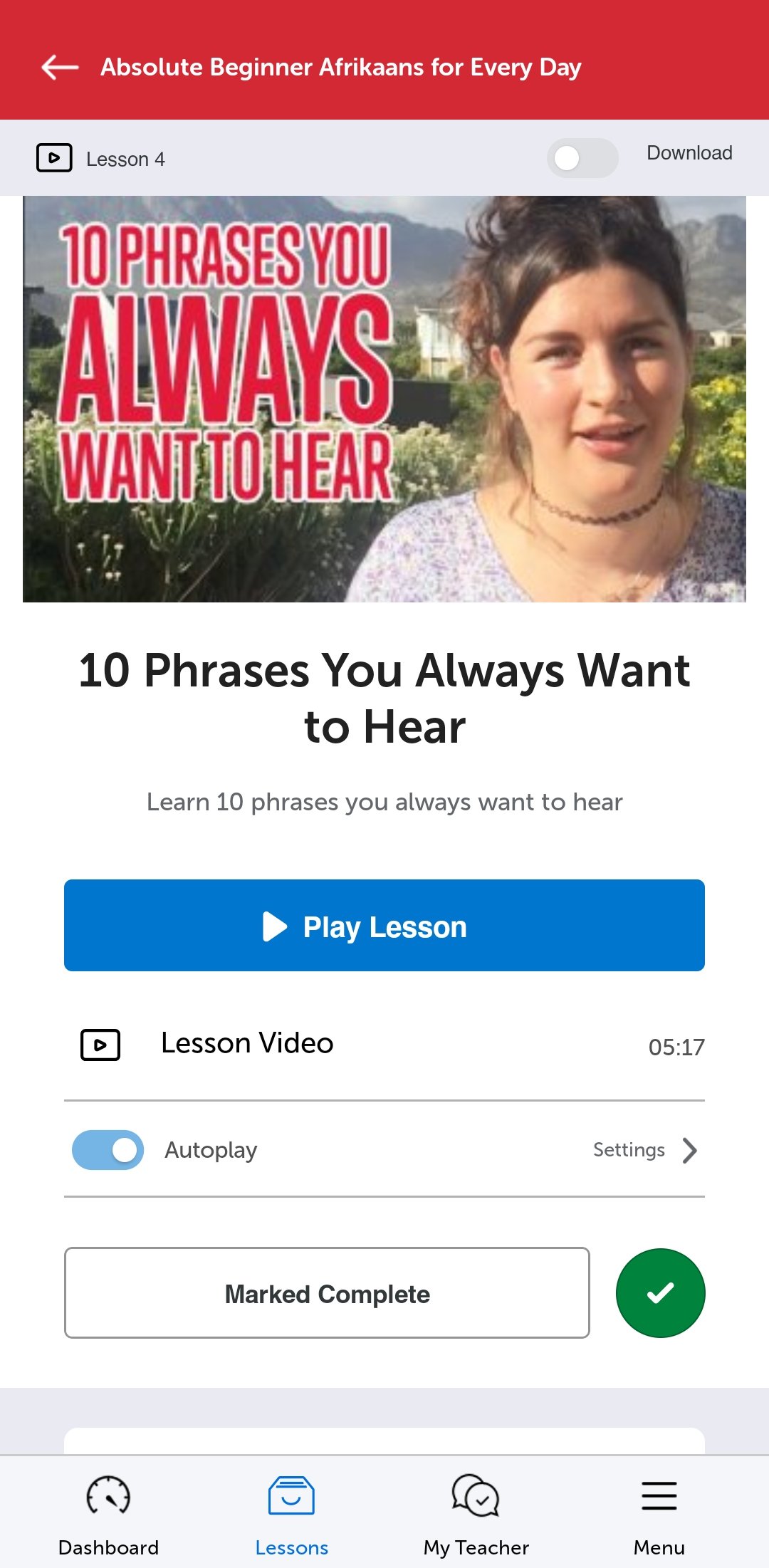
The most useful pronunciation work happens inside regular lessons. Premium members can play one line at a time, hear it at native speed and record their own version beside it. That is far more practical than trying to understand a written description of where the g comes from. It also helps with diphthongs, stress and the rhythm of a full phrase.
Use the recorder as a comparison tool, not a pronunciation examiner. It lets you hear the difference, but it doesn’t reliably tell you which sound went wrong. Premium PLUS adds teacher feedback. A tutor through italki is another option if you want someone to correct your mouth position and then keep you talking.
The familiar spelling can tempt you to read first and listen second. Reverse that for new vocabulary. Hear the word, repeat the full line, then connect it to the spelling. You’ll build an Afrikaans sound in your head instead of an English approximation.
Inside an AfrikaansPod101 Lesson
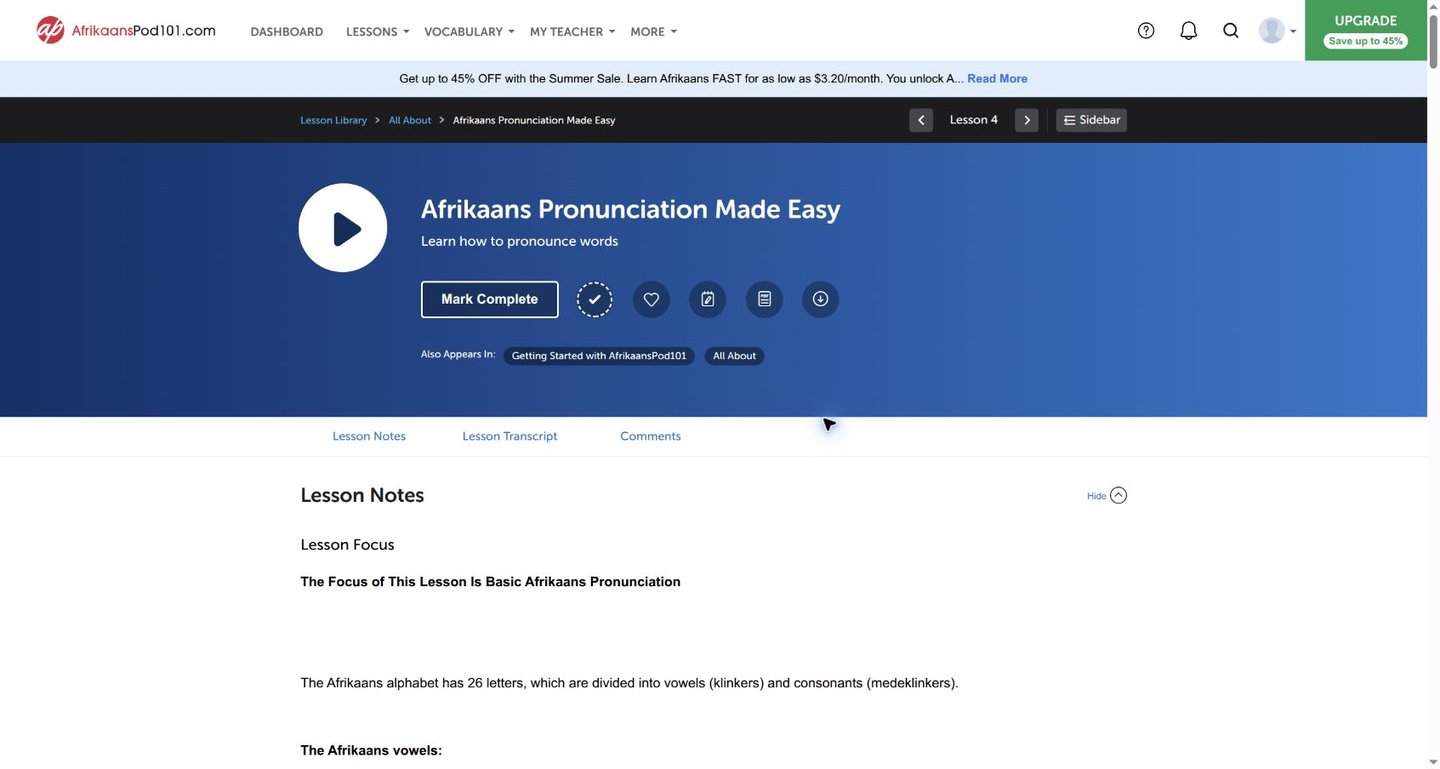
A typical lesson starts with a short native dialogue and then breaks it into individual lines, vocabulary and an English explanation of the grammar or cultural context. A transcript is available, and Basic or above adds detailed lesson notes. Lessons are short enough to repeat, which is exactly what the pronunciation needs.
The format works nicely for the nie … nie pattern. You hear where both pieces land in a complete thought, then compare the affirmative and negative forms. The same is true of word order: a spoken example makes the verb bracket easier to notice than a rule on its own.
The limitation is accumulation. One dialogue can explain the sentence in front of you without building a full grammar sequence in your memory. Keep a small sentence notebook beside the course. When a lesson uses negation or moves a verb, copy the whole Afrikaans sentence and write one variation of your own. This takes the course beyond recognition and makes you produce the pattern.
Beginner lessons use plenty of English. That helps when the grammar is new, but it can become a comfortable way to spend most of a lesson listening to English. Once you understand the explanation, replay the clean dialogue and work from the Afrikaans transcript before hearing the teaching track again.
The Study Tools
Premium wraps several useful tools around the lesson library:
- Line-by-line audio isolates a sentence so you can hear the guttural consonants and vowels clearly.
- The voice recorder lets you compare your attempt with the native line.
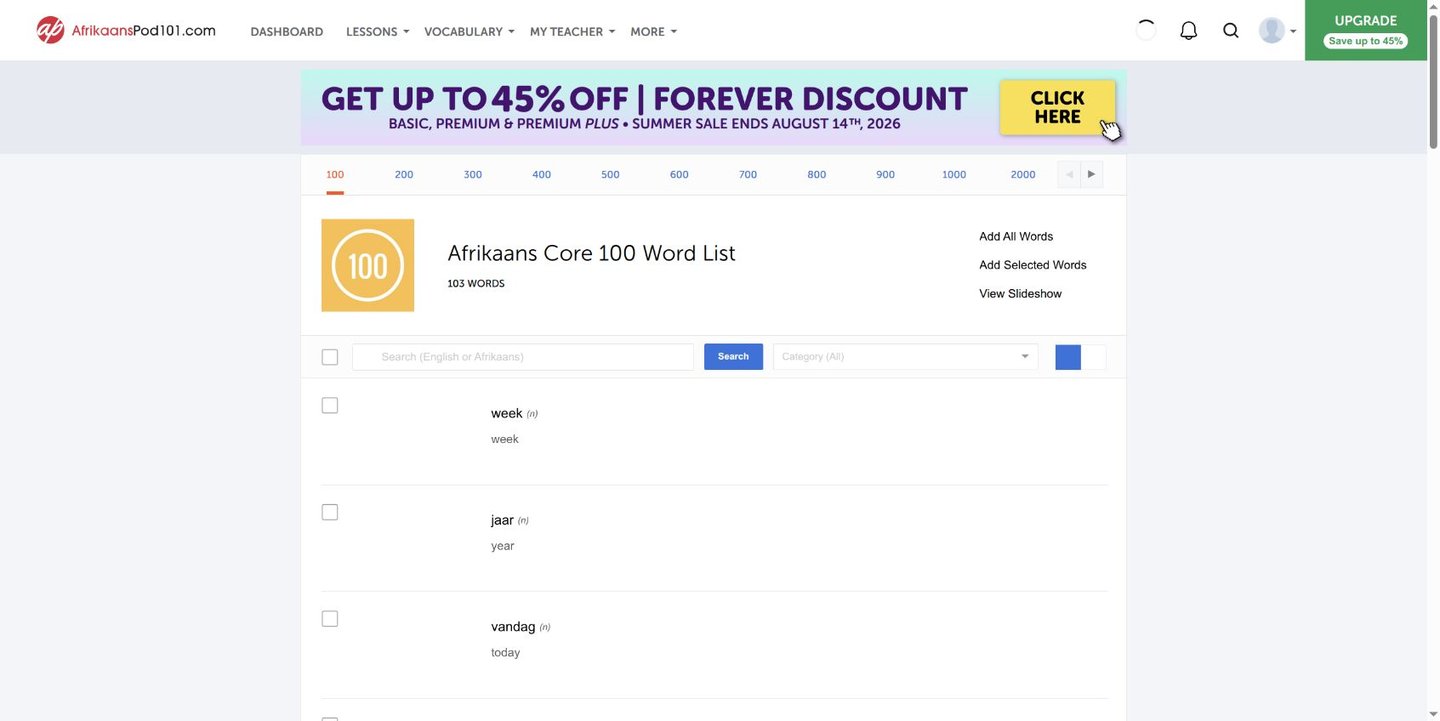
- A personal word bank and spaced-repetition flashcards turn lesson vocabulary into review material.
- Multiple-choice assessments check recognition and reading after a section.
- The 2,000 core-word collection gives you a frequency-led route outside the main pathway.
For Afrikaans, save phrases instead of bare cognates. A word that resembles English is easy to recognise and just as easy to pronounce badly. Keep the audio, include the article or surrounding words, and save both halves of a negative construction when the lesson gives you one.
These tools still lean towards recognition. Flashcards and quizzes can confirm that a form looks familiar without showing whether you can place the verb or final nie during a conversation. Use them to prepare a small set of sentences, then say or write those sentences without looking.
The Mobile App
AfrikaansPod101 uses the shared Innovative Language Learning app. Your progress syncs with the website, you can add pathways and download lessons, and eligible plans include line-by-line content, assessments and the word bank. It works well for repeat listening while walking or travelling.
The browser is still the better place for a deliberate study session. Innovative’s current support page says flashcards aren’t available in the app. Some line-by-line, vocabulary and expansion audio also needs an internet connection even after you download a lesson. I would use the app for listening and the website for notes, flashcards and detailed review.
What Afrikaans Learners Say
The positive feedback is straightforward. One learner in the Afrikaans subreddit said AfrikaansPod101 was how they learned the language and praised the amount of learning and listening material, although they found the paid subscription far more useful than the free account. Other learners have called the beginner material helpful and valued the native-speaker audio.
There is also a specific accuracy concern that shouldn’t be brushed aside. An Afrikaans learner reviewing the shared app reported mislabeled parts of speech, misspellings, occasional incorrect or missing audio, and what they believed was a Dutch word in place of Afrikaans. They still described the programme as rich and continued using it. Another Afrikaans learner warned that some translations can be wrong.
Those are individual reports, so they don’t prove that every pathway has the same problem. They are detailed enough that I wouldn’t use AfrikaansPod101 as the final authority for a disputed word. If an entry looks odd, check it in a good dictionary or with a native speaker before adding it to your flashcards. You can also report the lesson so the team has a chance to correct it.
Learners commonly combine the platform with native media, writing and conversation. That makes sense. AfrikaansPod101 gives you organised listening material and explanations; television, radio and real people give you the range and spontaneity that a lesson library cannot.
AfrikaansPod101 vs Mondly
Mondly is the sensible app-style alternative for Afrikaans. It offers a tidier gamified sequence, short daily practice, slowed audio and microphone exercises. A learner using Mondly specifically for Afrikaans praised the replay and pronunciation features, while another Afrikaans learner described the course as fairly basic.
AfrikaansPod101 gives you more to investigate: longer explanations, transcripts, downloadable notes and a much broader bank of listening material. Mondly gives you less choice and more immediate direction. Choose Mondly if you want a neat daily app routine. Choose AfrikaansPod101 if you want native dialogues you can study closely and don’t mind organising part of the curriculum yourself.
Neither supplies enough open conversation on its own. Speaking prompts and self-recording are useful preparation, but another person is still the better test of whether your Afrikaans sentence arrives in the right order.
Pricing and Plans
AfrikaansPod101 has four access levels. These are the approximate list-price anchors shown on 2026-08-13:
| Plan | Approximate monthly anchor | What it includes |
|---|---|---|
| Free | Free | A limited lesson selection, vocabulary resources, the app and a seven-day Premium trial |
| Basic | About US$4 | All lessons and detailed lesson notes |
| Premium | About US$10 | Basic plus line-by-line audio, assessments, flashcards, word bank, pronunciation tools and the 2,000 core-word collection |
| Premium PLUS | About US$23 | Premium plus a teacher, graded work, personalised guidance, and writing and pronunciation practice |
Those monthly figures are based on paying for 24 months. Shorter terms cost more per month, and sale pricing changes, so check the billing period and total at checkout. Paid plans come with a 60-day money-back guarantee.
Premium is the sensible tier for most learners. Basic gives you the course and notes, but line-by-line audio, the recorder and review tools are the features that best match Afrikaans. Premium PLUS is worth considering only if you’ll use the teacher and submit work regularly.
Pros and Cons
Pros
- Plenty of native audio for the guttural g, unfamiliar vowels and natural rhythm
- Direct lessons on Afrikaans pronunciation, negation and word order
- Line-by-line playback and recording for close comparison
- Transcripts and lesson notes that make the audio easier to study
- A recommended beginner pathway plus a broad library for later gaps
- Free access, a seven-day trial and a 60-day guarantee
Cons
- Specific learner reports raise concerns about occasional translation, labelling and audio errors
- Grammar appears across lessons more than as one cumulative syllabus
- Beginner material can contain too much English
- Open speaking and writing feedback are limited below Premium PLUS
- The size of the library can make self-directed study feel loose
- The mobile app doesn’t include flashcards and some audio needs an internet connection
Who AfrikaansPod101 Suits
AfrikaansPod101 suits a beginner or lower-intermediate learner who likes short audio lessons and wants far more native listening than a phrasebook provides. It is particularly useful if Afrikaans already looks readable but still sounds like a blur when someone speaks.
It is less suitable as your only course if you want a tightly cumulative grammar syllabus, extensive writing correction or a conversation in every lesson. It also isn’t the right fit if a reported error will make you doubt every entry. In that case, use the free trial to inspect the material and choose a textbook-led course with a native tutor.
The Verdict
AfrikaansPod101 addresses the gap that matters most after the easy first impression. The alphabet and cognates may get you reading quickly, but native dialogues and line-by-line playback help those familiar words sound like Afrikaans. Its lessons also give useful context to the nie … nie pattern and Germanic word order.
I wouldn’t treat it as a complete or unquestionable curriculum. The grammar needs deliberate organisation, speaking needs another person, and the accuracy reports mean doubtful entries deserve a second check. Used as an audio spine beside a grammar reference and regular conversation, it has plenty to offer.
My rating: 4.0 out of 5.
You can start with AfrikaansPod101 here. The discount from our link is applied at checkout, but the amount varies, so check the live price and billing term. The free account and seven-day trial let you test the lessons before paying.

Social