


ArabicPod101 Review: Does It Actually Handle One of the World’s Hardest Languages?

Full disclosure: This post contains affiliate links. ?
What is ArabicPod101?
ArabicPod101 is part of the Innovative Language family of podcast-based courses covering Modern Standard Arabic alongside Egyptian and Moroccan Arabic. Audio and video lessons taught by native speakers are its main feature.
- what it’s for:
- Learning Modern Standard Arabic, learning Egyptian Arabic, learning Moroccan Arabic (Darija), building Arabic script literacy, everyday conversational practice, structured self-study
- languages:
- Arabic
- level:
- Absolute Beginner to Advanced
+ PROS
- Dedicated alphabet series that tackles unwritten short vowels head-on
- Strong Moroccan Arabic (Darija) content
- Excellent line-by-line audio for unfamiliar sounds
- Mature catalogue with dozens of Beginner pathways
- Voice-recorder pronunciation tool for emphatic and guttural consonants
- Downloadable lesson notes and full transcripts
- CONS
- Some vocab lists mix MSA and dialect without always flagging it clearly
- Uneven production quality between older and newer videos
- Intermediate tier noticeably thinner than Beginner
- Upsell prompts continue for paying members
- The mobile app doesn’t have all the best features
Quick Fire Review
A mature, well-built Arabic course that tackles the script and dialect questions honestly
Arabic sits in the US State Department’s toughest language bracket, Category IV, alongside Mandarin, Japanese and Korean. The official estimate is around 2,200 hours of study for a native English speaker to reach working proficiency, three to four times what it takes to get an equivalent standard in French or Spanish. That number alone tells you Arabic isn’t a language you can bluff your way through with a phrasebook and a bit of confidence.
Our team at Fluent in 3 Months has used Innovative Language’s Pod101 and Class101 courses for real language missions over the years, so I already knew roughly what to expect from the format: bite-sized audio lessons, a huge back catalogue, and a study-path system that holds your hand through the early stages. What I didn’t know going in was whether ArabicPod101 specifically could handle the parts of Arabic that actually trip learners up: the script, the grammar logic, and the elephant in the room every Arabic course has to face: which Arabic are you even teaching me?
What Makes Arabic Different
Arabic works on a completely different logic to English or the Romance languages, well beyond the obvious differences in alphabet and word order. Most of the difficulty comes from a handful of specific, learnable quirks, not some vague notion that it’s “just hard”.
The script runs right to left and hides most of its vowels. Arabic is written in an abjad, a script built mainly from consonants, where short vowels are usually left out entirely or shown with small optional marks above and below the letters called diacritics (fatha, kasra and damma). Native readers infer the missing vowels from context, the same way you’d read “Ths sntnc mks sns” without much trouble once you know English. For a learner, that means you often can’t sound out a word from the page the way you can in Spanish or German. You have to already half-know the word to read it properly. Numbers are the exception here: digits run left to right even inside Arabic text, and our guide to Arabic numbers covers how they work.
Letters change shape depending on where they sit in a word. Most of the 28 Arabic letters take four different forms: isolated, and then a different shape again when they start, sit in the middle of, or end a word. It’s a bit like learning cursive English, except the “join-up” rules apply to almost the whole alphabet, and you need to recognise all four shapes on sight before reading gets fluent.
Whole word families grow from three consonants. This is the one that surprises people. Arabic builds vocabulary through root-and-pattern morphology: take the three consonants k-t-b, which carry the core idea of “writing”, and slot them into different patterns to get kitab (book), kaatib (writer), and maktaba (library). Once you know the pattern system, you can often guess the meaning of a brand new word just from its root, which is a completely different mental skill to memorising individual words the way you would in French.
Sounds English speakers have never had to make. Arabic has a set of guttural and emphatic consonants with no real English equivalent, the throaty ع (ʿayn) and ح (ḥa), and the “emphatic” versions of letters like ص and ض that are pronounced further back in the mouth. On top of that, the definite article ال (al-) assimilates into the following consonant with certain “sun letters” and stays put with others, so “the sun” is ash-shams, not al-shams. None of this is obvious from the spelling alone.
Which Arabic are you actually learning? This is the question every Arabic learner asks eventually, and it deserves a proper answer, not a shrug. Modern Standard Arabic (MSA) is the formal, written variety used in news, books and official contexts across the Arab world, and it’s what Arabic-speaking children study formally at school. But nobody actually speaks MSA at home. Every country and region has its own spoken dialect, Egyptian, Levantine, Gulf, Moroccan and more, and these dialects can be different enough from each other, and from MSA, that speakers from opposite ends of the Arab world sometimes default to MSA to understand one another. It’s a genuine diglossia, and any course that pretends this doesn’t exist is setting you up for a rude surprise the first time you try to use your textbook Arabic on the street. For a feel of how the language works in real use, our guide to Arabic phrases is a good place to start.
Getting Started with ArabicPod101
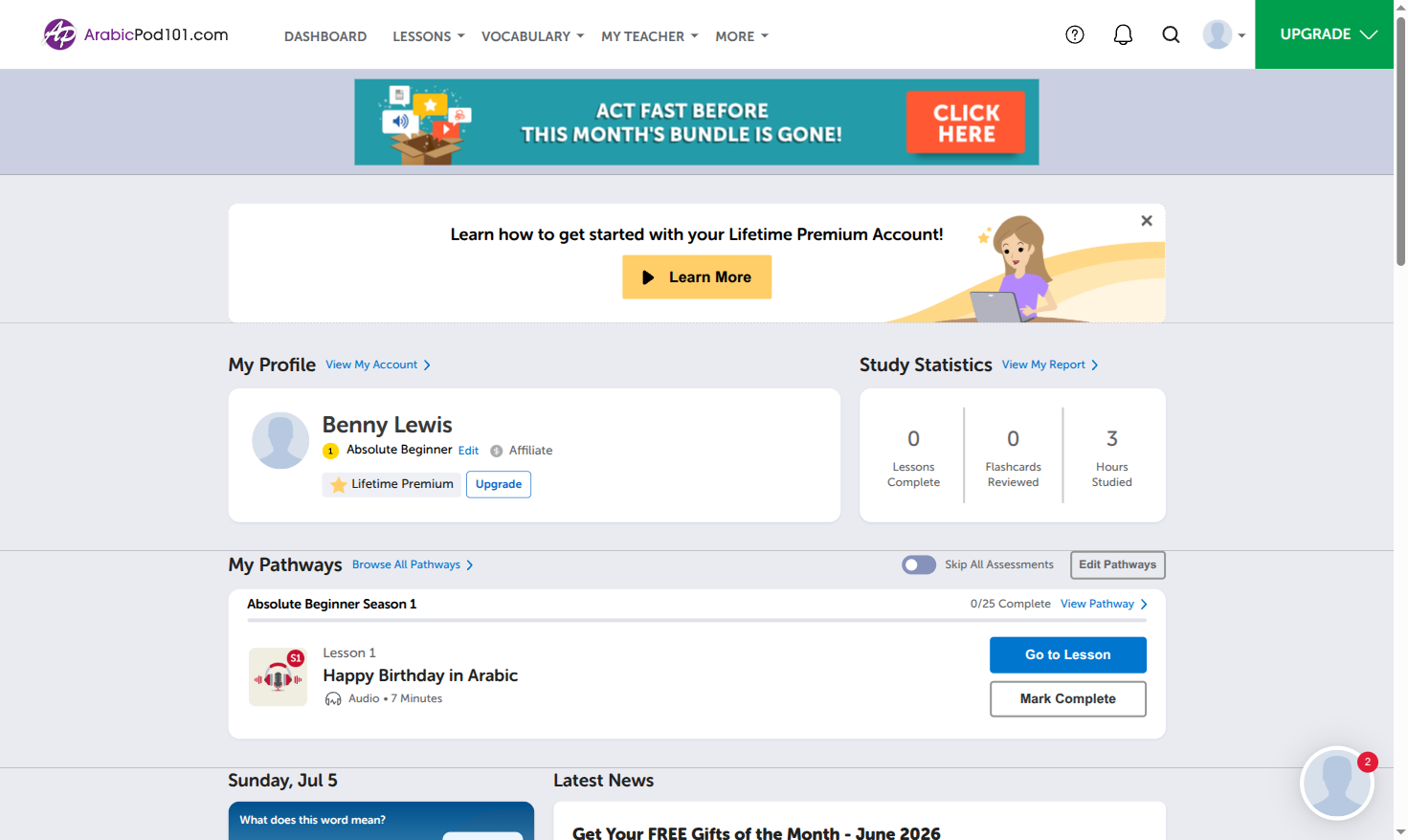
Signing up costs nothing and doesn’t ask for a card, just an email address. You pick a starting level (Absolute Beginner through to Advanced), and if you’re not sure, you can change it later without losing progress. ArabicPod101 then builds you a guided study path through its enormous lesson library, so you’re not left scrolling through thousands of lessons wondering where to start. You can create a free ArabicPod101 account here and have a poke around before deciding anything.
How ArabicPod101 Teaches the Script
Given how central the abjad and its hidden vowels are to Arabic’s difficulty, this is one of the areas I paid closest attention to, and it holds up well. ArabicPod101 runs a dedicated alphabet video series of short lessons, each covering just two or three letters at a time. Review lessons periodically loop back to introduce the short-vowel diacritics in manageable batches rather than dumping them on you at once, there’s a lesson specifically on the glottal stop, and a final review pulls the whole alphabet together. It’s a sensible, incremental way to tackle the exact problem I flagged above: you build up letter recognition and vowel awareness in parallel instead of being thrown at unvowelled text on day one.
Romanisation is used throughout as scaffolding, though the site itself is upfront that there’s no single standardised way to romanise Arabic, so treat it as training wheels, not gospel. The line-by-line audio tool, which lets you slow down and isolate individual phrases of native-speaker dialogue, is brilliant for getting your ear tuned to sounds like ع and ح that simply don’t exist in English.
Inside an ArabicPod101 Lesson
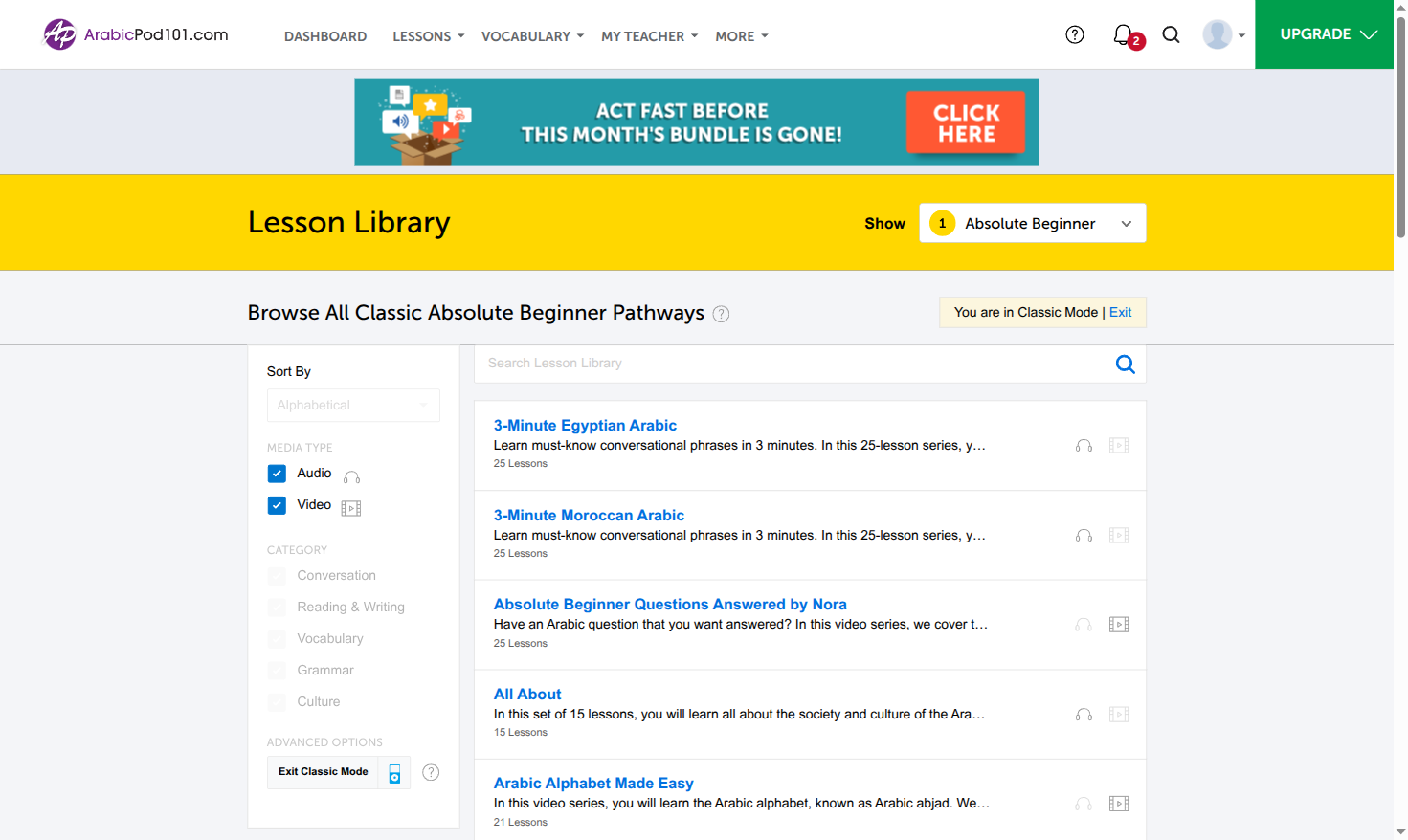
Most lessons run three to fifteen minutes and follow a consistent structure: a short scripted dialogue, a breakdown of that dialogue at natural and then slowed speed, a vocab list with native audio, a grammar point explained in plain English, and a cultural note tied to the topic. Everything comes with a full lesson transcript and downloadable lesson notes as a PDF, so if you’re someone who needs to see a word on the page as well as hear it (I generally am), you’re well covered. You can click through individual vocab words or dialogue lines to add them straight to your flashcard deck or word bank as you go, which saves you loads of manual copying.
Study Tools: Flashcards, Word Bank and the Pronunciation Tool
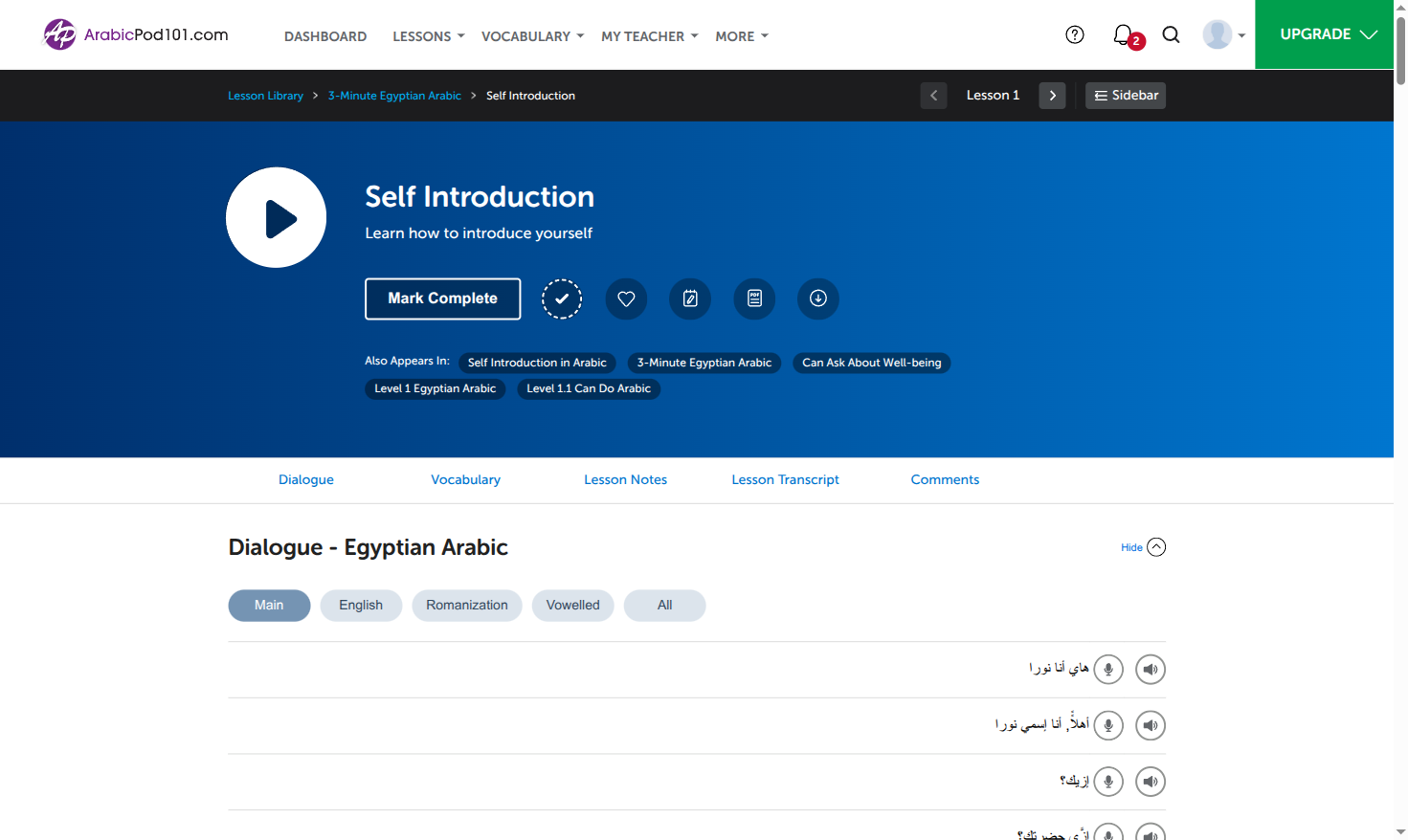
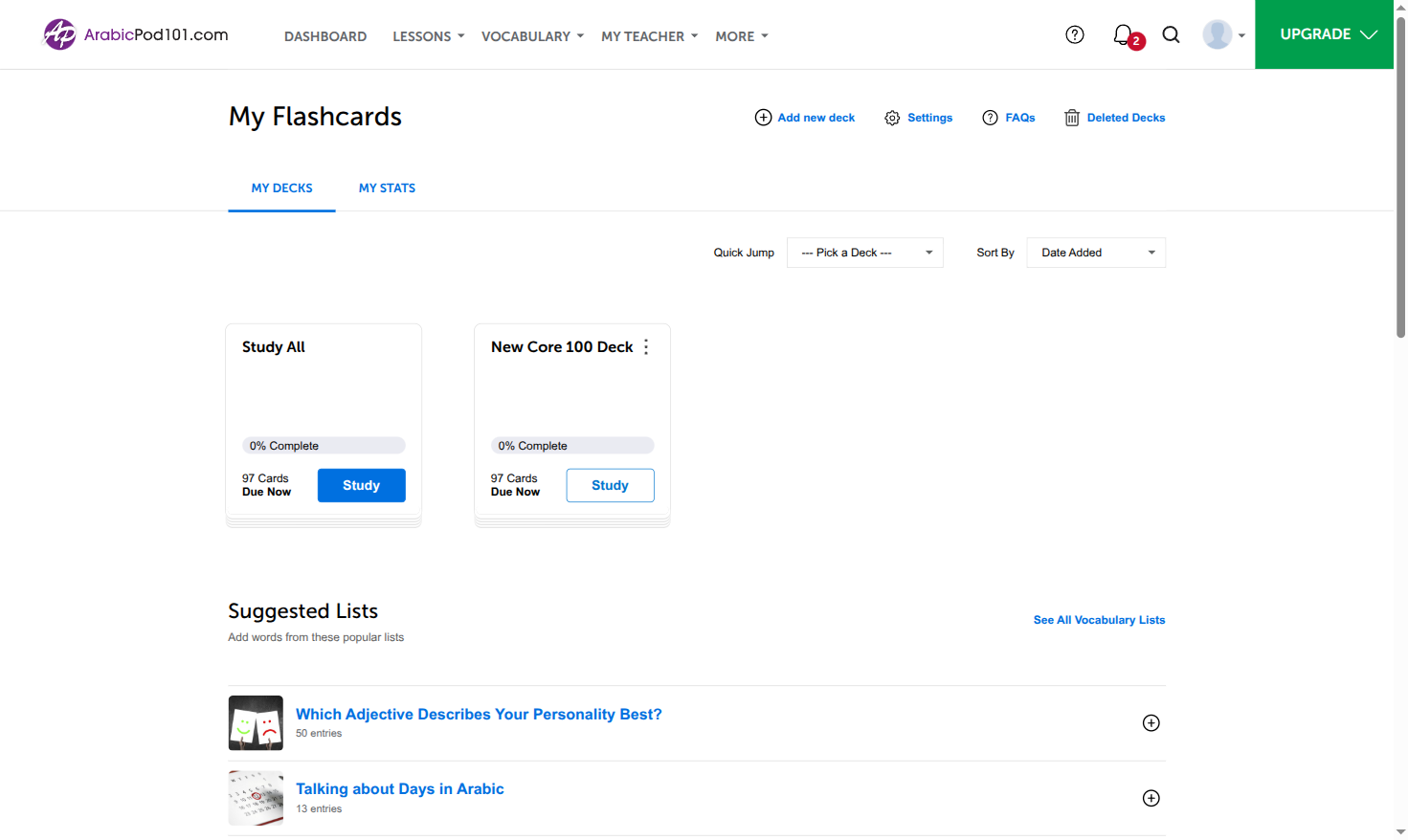
Premium opens up the toolkit that turns passive listening into active practice: spaced-repetition flashcards built from the vocab you’ve encountered, a searchable word bank, a grammar bank collecting every grammar point you’ve studied, and access to the 2,000 core Arabic words list, a solid frequency-based target if your goal is real conversational fluency rather than just surviving a holiday. The voice-recording and pronunciation-comparison tool matters more for Arabic than for most languages, given how much of the difficulty is about producing sounds your mouth has never had to make before. Being able to record yourself saying ḥa or ʿayn and compare it directly against a native speaker’s clip is a feedback loop a textbook simply can’t give you.
The ArabicPod101 App
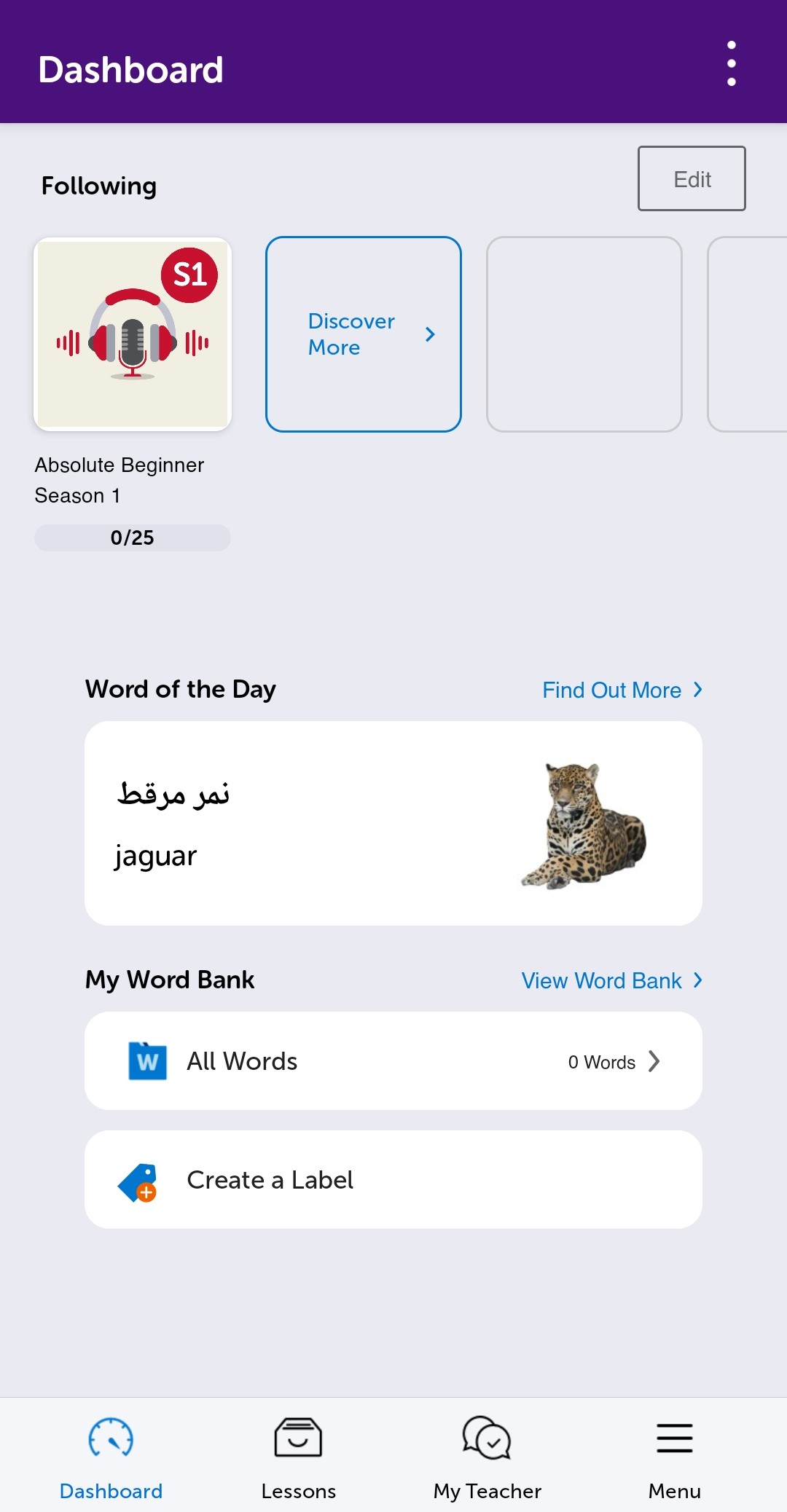
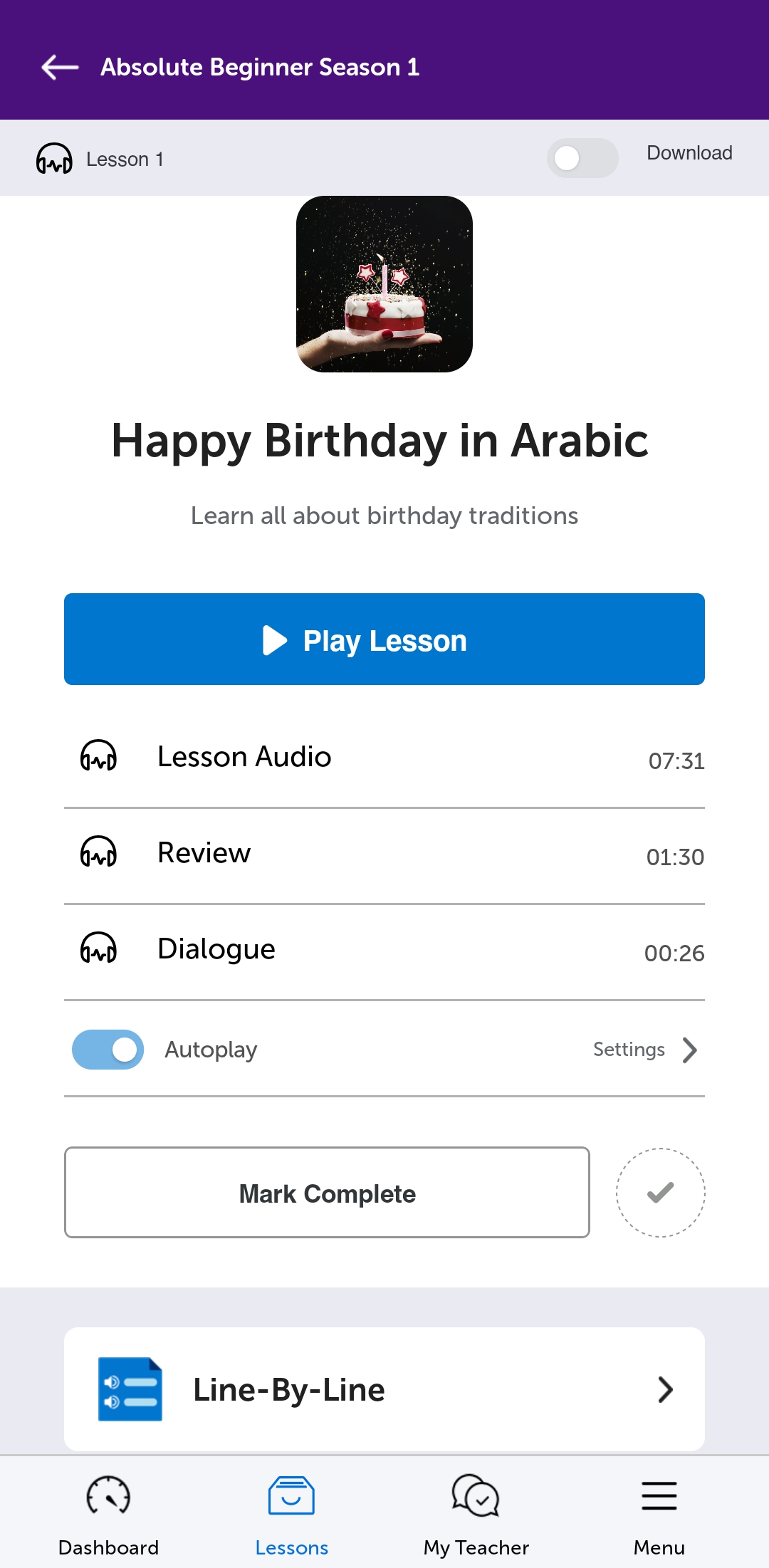
The mobile app syncs your progress with the website, so lessons you finish on the commute show up as done back at your desk. It’s a lighter, more streamlined experience than the full site, good for working through a season of lessons on the go, but it doesn’t carry over your full guided study path or the practice quizzes, so you’re picking seasons and episodes manually. The workaround the whole Innovative Language family shares is opening the site in your phone’s browser when you want the study path; it works fine, just isn’t as slick as a native app screen.
What Other Learners Say
The recurring praise across reviews and learner forums lines up with what I found: the bite-sized lesson format works well for people trying to fit Arabic study around a real life, and the line-by-line audio breakdown gets singled out repeatedly as the standout feature for parsing native-speed Arabic into something learnable. ArabicPod101 also deserves real credit for its Moroccan Arabic (Darija) content. It’s one of the only mainstream resources with a substantial dedicated Darija pathway, with its own dialogue and short-video series, which makes it a strong option if you’re heading to Morocco rather than the Gulf or Egypt.
The honest criticism, and it’s the one I take most seriously given how central the MSA-versus-dialect question is to Arabic, is that the labelling hasn’t always been clear enough. ArabicPod101 openly states that variety (MSA, Egyptian or Moroccan) is indicated in the lesson or series title, and the core numbered course progression (Newbie, Absolute Beginner, Beginner, Intermediate, Advanced) is built on Modern Standard Arabic, with dedicated Egyptian and Moroccan pathways running alongside it. But learners have flagged, including in live forum threads, that some core vocab lists mix MSA words with Egyptian or Moroccan example sentences without always spelling out which is which upfront. If you’re the kind of learner who wants total clarity on exactly which Arabic you’re absorbing at every moment, keep a close eye on series titles as you go, and don’t assume everything under the “Beginner” banner is the same variety. Beyond that, some older video lessons feel dated compared to the newer content, the Intermediate tier is noticeably thinner than Absolute Beginner, and there’s a bit of upsell pressure even once you’re already a paying Premium member. The standalone Innovative Language 101 app, shared across every language in the family, also gets mixed reviews on app stores, so check its current ratings before committing to app-only study.
Pricing and Plans
| Plan | Roughly | Unlocks |
|---|---|---|
| Free | Free forever | First 3 lessons of every series, Survival Phrases, Word of the Day, 100+ vocab lists, the app, a 7-day Premium trial |
| Basic | ~$4/month | All lessons plus in-depth lesson notes |
| Premium | ~$10/month | Everything in Basic, plus flashcards, word bank, line-by-line audio, assessments, grammar bank, the pronunciation tool, and the 2,000 core words list |
| Premium PLUS | ~$23/month | Everything in Premium, plus a 1-on-1 teacher, hand-graded assignments, and personalised guidance |
Those headline figures are the 24-month rate, and shorter terms cost more per month, so check the live checkout for the actual numbers; the discount applied does vary. There’s a 60-day money-back guarantee too, which takes most of the risk out of trying Premium properly for a couple of months before deciding if it’s earning its keep. For most learners, Premium is the sweet spot: the flashcards and pronunciation tool are well worth having for a language where the sound system is this unfamiliar, and you’ll want the 2,000 core words list if serious conversational fluency is the goal.
Pros and Cons
Pros:
- A dedicated, well-paced alphabet series that tackles Arabic’s unwritten short vowels directly rather than glossing over them
- Strong, well-signposted Moroccan Arabic (Darija) content, rare among mainstream Arabic resources
- The line-by-line audio tool is excellent for training your ear on sounds English simply doesn’t have
- A mature catalogue with dozens of Absolute Beginner pathways alone, so there’s always something on-topic to study
- The voice-recorder pronunciation tool gives direct feedback on emphatic and guttural consonants
- Downloadable lesson notes and full transcripts mean you’re never relying on audio alone
Cons:
- Some core vocab lists mix MSA and dialect vocabulary without always flagging the switch clearly upfront
- Production quality is uneven between newer and older video lessons
- The Intermediate tier is noticeably thinner than the Absolute Beginner catalogue
- Upsell prompts continue even for paying Premium members
- The mobile app doesn’t have all the best features, so you’ll need the study path and quizzes on the full site
Who ArabicPod101 Is (and Isn’t) For
This suits you well if you want a structured, guided route into MSA as your foundation, with the option to branch into genuinely useful Egyptian or Moroccan dialect content once you’re ready, and if you like having audio, transcripts, PDFs and flashcards all bundled together instead of hunting across separate apps. It’s a particularly strong pick if Darija specifically is your target, since the dedicated Moroccan content here is hard to match elsewhere.
It’s a weaker fit if you want one single, unambiguous dialect taught from lesson one with zero MSA mixed in at any point, or if you’re comfortable enough with self-directed study to work from a dialect-specific app or a private tutor from day one. Whichever camp you’re in, pair it with real conversation practice, whether that’s a tutor, an exchange partner or a trip, since no audio course alone gets you speaking Arabic under real pressure.
The Verdict: 4.5 Stars
Given that Arabic sits in the same “super-hard” FSI bracket as Japanese, Mandarin and Korean, a course needs a mature, well-built catalogue to be worth recommending at all, and ArabicPod101 has that in spades. It tackles the script problem head-on with a well-designed alphabet series, it takes the MSA-versus-dialect question seriously rather than dodging it, even if the in-lesson labelling could still be clearer, and its Moroccan Arabic content is a real differentiator you won’t find matched elsewhere. The thinner Intermediate tier and some dated older videos keep it just short of a perfect score, but it earns its place near the top of anyone’s Arabic study stack all the same.
If you’re ready to get started, our link takes you straight to the current plans with Innovative Language’s near-permanent discount already applied at checkout, so you won’t be paying full list price.

Social