



BulgarianPod101 Review for Learning Bulgarian

Full disclosure: This post contains affiliate links. ?
What is BulgarianPod101?
BulgarianPod101 is part of the Innovative Language family, built to get you understanding and speaking Bulgarian from the first lesson. Audio and video lessons taught by native speakers are its main feature.
- what it’s for:
- First contact with Bulgarian, Cyrillic, listening practice, unwritten stress, noun articles, verb aspect, vocabulary, and practical phrases and conversation material
- languages:
- Bulgarian
- level:
- Absolute Beginner to Advanced
+ PROS
- A low-pressure introduction to Bulgarian Cyrillic
- Plenty of native audio for unwritten stress and natural rhythm
- Line-by-line playback and recording for close listening
- Dialogues that put articles and verb aspect in context
- Transcripts and notes for deliberate study
- Free access, a trial and a 60-day guarantee
- CONS
- Alphabet material is introductory, not a full literacy course
- Verb aspect and wider grammar need a systematic companion
- Beginner lessons contain too much English
- The library can feel less linear than a textbook course
- The app lacks some browser tools, including flashcards
Quick Fire Review
A substantial Bulgarian audio library with useful transcripts and pronunciation tools, best paired with systematic grammar and regular conversation. 4.1/5.
Bulgarian gives you a quick visual victory. Its Cyrillic alphabet is compact, the sound-to-letter relationship is far more regular than English spelling, and many letters become familiar after some focused study. The harder work begins after you can sound out the menu.
Stress is normally unwritten and can move between related forms. The definite article attaches to the end of a noun. Verbs carry aspect and a rich set of forms. Bulgarian has largely lost the noun declension found in many other Slavic languages, but pronoun cases and some vocative forms survive. Calling it “Russian without cases” would hide more than it explains.
The US Department of State’s current schedule places the languages outside its easier groups and four named super-hard languages in Category III, with a normal intensive course of 44 weeks. Bulgarian falls into that group by the category definition, although the 44-week line does not name Bulgarian individually. It is a demanding project for an English speaker, even if Cyrillic is not the main reason.
BulgarianPod101 follows the familiar Innovative Language format: short native-speaker dialogues, transcripts, level pathways, vocabulary tools and a shared mobile app. In this review, I’m looking at how well that format handles Bulgarian’s sound, grammar and script, and where a learner still needs a more systematic resource.
What Makes Bulgarian Different
A useful Bulgarian course needs to prepare you for five features.
1. Cyrillic is the entrance, not the mountain. Modern Bulgarian uses a 30-letter Cyrillic alphabet. Several letters look and sound familiar, while others either look unfamiliar or resemble Latin letters with a different sound. Once those false friends are under control, the spelling is relatively transparent. Staying in transliteration for months usually makes pronunciation and dictionary use harder than learning the alphabet.
2. Stress matters and the spelling usually does not show it. Bulgarian stress is lexical, so you learn it with the word. It can fall on different syllables and move between forms in the same family. Unstressed vowels may also be reduced in speech. A transcript tells you the letters, but native audio tells you where the word actually lands.
3. Nouns have largely lost case endings. This is unusual among Slavic languages and removes a large memorisation burden. It is not a complete disappearance of case. Personal pronouns keep case distinctions, and a limited vocative survives. Bulgarian relies heavily on prepositions and word order where a more case-rich language might change the noun ending.
4. The definite article comes after the noun. “The book” is built by adding the article to the end of the noun. The suffix changes with gender, number and, for some masculine nouns, grammatical role. You need whole phrases in context, not an English word followed by an isolated Bulgarian equivalent.
5. Verb aspect is central. Bulgarian commonly organises actions through imperfective and perfective verbs. The distinction is about how an action is viewed, not simply whether it happened in the past. Tense, mood and evidential forms add further choices. A light noun system does not make Bulgarian grammar light overall.
Those features suit an audio-led course in some ways. Stress and aspect become clearer inside a sentence. They also expose its limits, because a succession of dialogues does not always give you the cumulative overview that Bulgarian verbs deserve.
Getting Started with BulgarianPod101
You can create a free lifetime account with an email address and no payment card. It opens a limited selection and starts a seven-day Premium trial, giving you time to inspect line-by-line audio, the word bank and other paid tools. After choosing your level, the dashboard recommends a pathway.
Follow that recommendation at first. BulgarianPod101 contains level courses, vocabulary lists, listening material, culture lessons and small specialist collections. Browsing is useful when you know your gap, but it can turn into a trail of disconnected lessons when you are still building foundations.
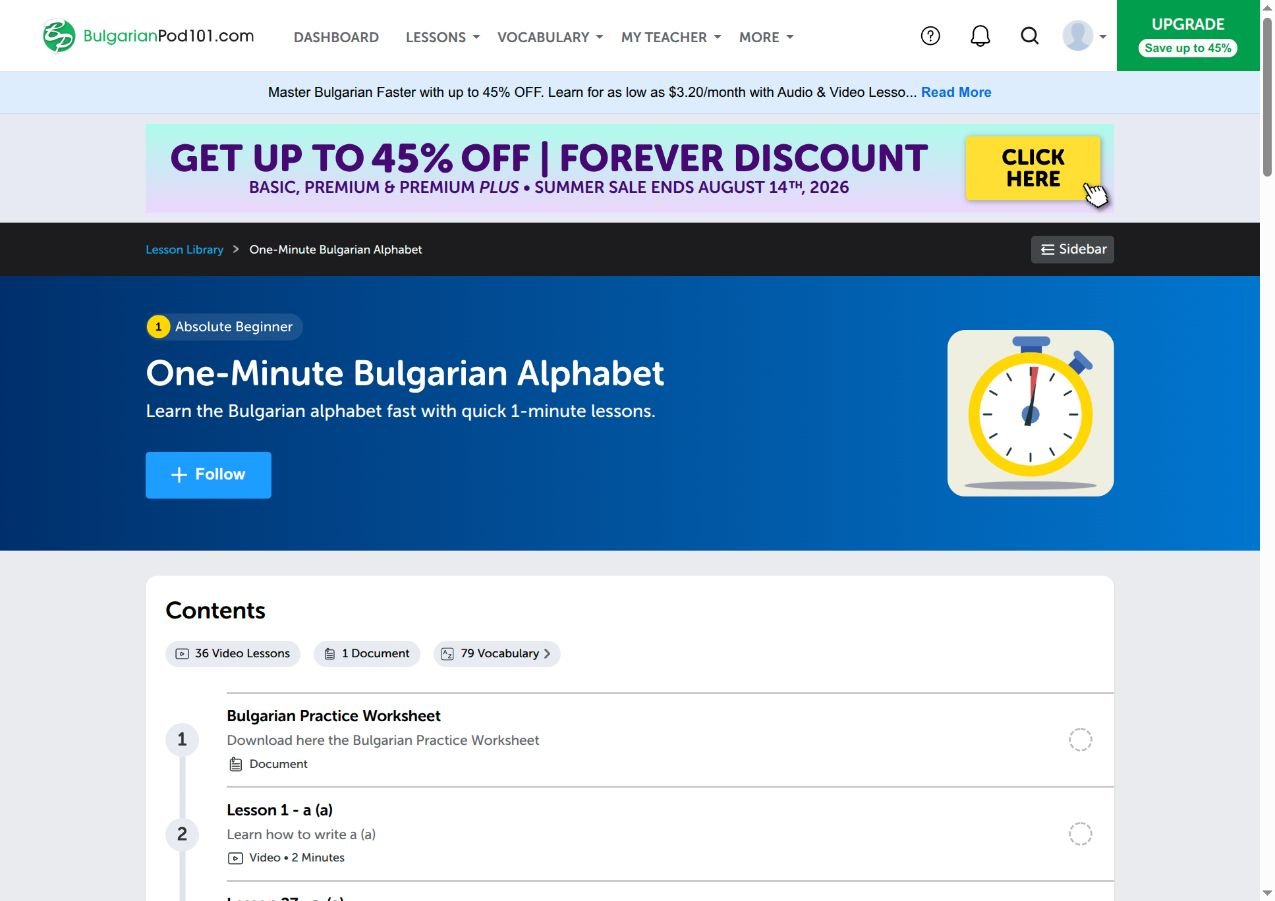
The first level introduces practical exchanges and the grammar needed to understand them. Add the alphabet material immediately if Cyrillic is new. BulgarianPod101 has a short alphabet series and an overview of the writing system, but the alphabet is small enough that it should become a daily reading tool, not a course you keep “working on” for weeks.

How It Handles Cyrillic and Pronunciation
BulgarianPod101’s alphabet material introduces the letters and gives you native audio for their names and sounds. The broader pronunciation material covers the sound system and common patterns. This is enough to get Cyrillic off the page and into your ear, especially when you replay the examples and write the letters yourself.
The strongest pronunciation practice appears inside ordinary lessons. Premium members can isolate each dialogue line and record their own version beside the native speaker. That comparison is valuable for Bulgarian stress. If you store only the spelling of a word, you can rehearse the wrong stressed syllable for weeks. Saving a word with audio and repeating it in a phrase makes that less likely.
Line-by-line work also exposes vowel reduction and consonant clusters that a neat transliteration can conceal. Keep the native-speed line as your target. Repeating a short line helps you locate a sound, but Bulgarian rhythm will not emerge if you never return to native speed.
The recorder does not evaluate your stress or explain why a consonant sounds off. Premium PLUS adds teacher feedback, while a tutor through italki gives you another route to individual correction and spontaneous speech.
Inside a BulgarianPod101 Lesson
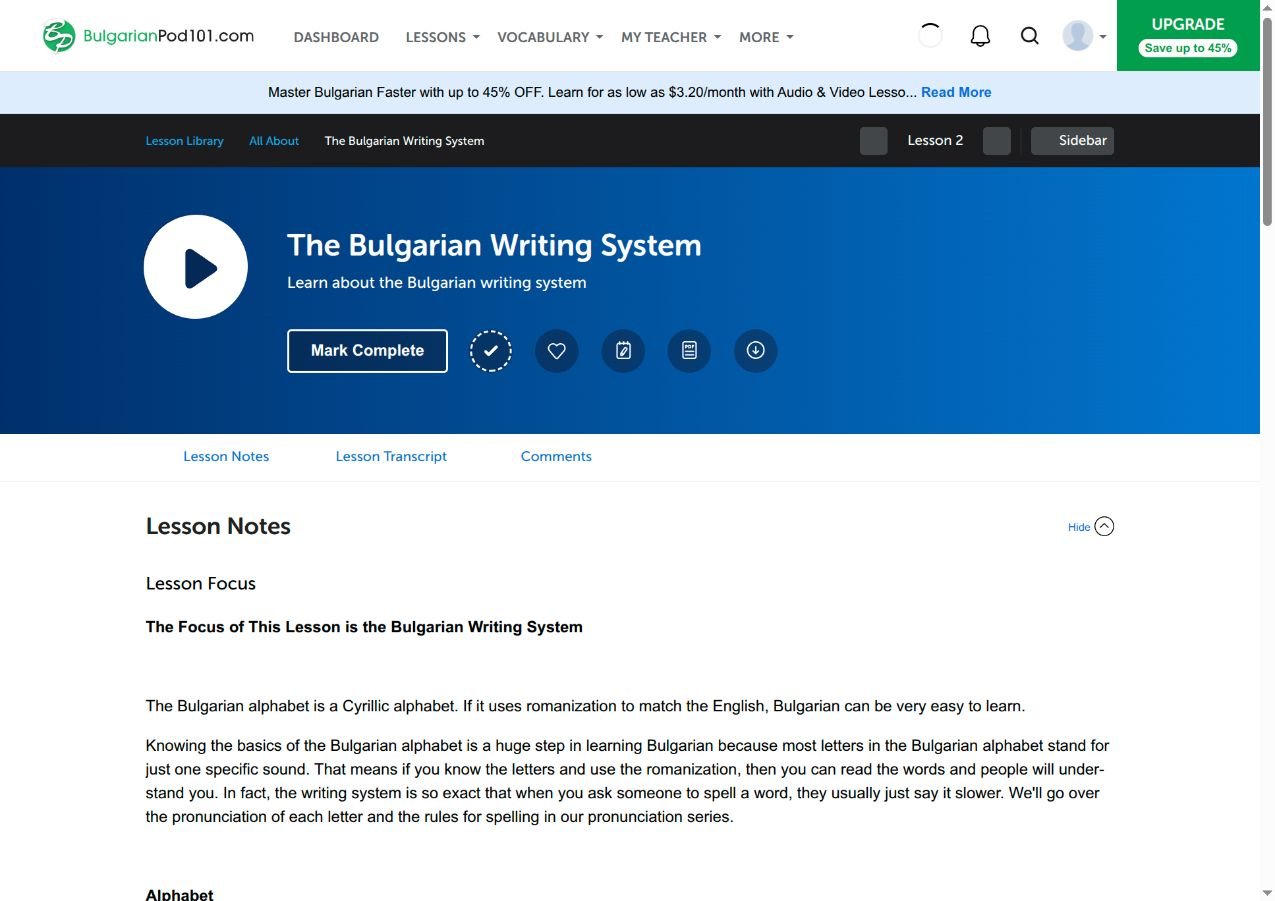
A typical lesson centres on a short native dialogue. You hear the exchange, work through individual lines and vocabulary, then get grammar and cultural explanation. A transcript and detailed lesson notes are available on the relevant plan. The short format makes it realistic to repeat the same material several times.
The dialogue approach is helpful for the postposed article. You meet an article attached to a noun inside a usable sentence, with an adjective or preposition around it, instead of memorising a suffix in isolation. It also lets you compare perfective and imperfective verbs in contexts where the speaker’s view of the action makes sense.
The difficulty is accumulation. Bulgarian verb aspect is not one lesson you understand and finish. You need to collect common verbs in pairs, notice which forms appear after particular particles and revisit the contrast across tenses. The lesson notes can explain the example in front of you without becoming a complete map of the system.
Keep a small aspect notebook beside the course. Record the imperfective and perfective verb together, include the stressed syllable, and copy one sentence for each. Do the same for nouns with their article form. That turns the course’s contextual strength into a reference you can actually review.
Beginner episodes use plenty of English. The support is useful while Cyrillic and basic sentence patterns are new, but it can crowd out listening time later. Once the dialogue becomes understandable, repeat the clean conversation track and read the Bulgarian transcript before returning to the explanation.
The Study Tools
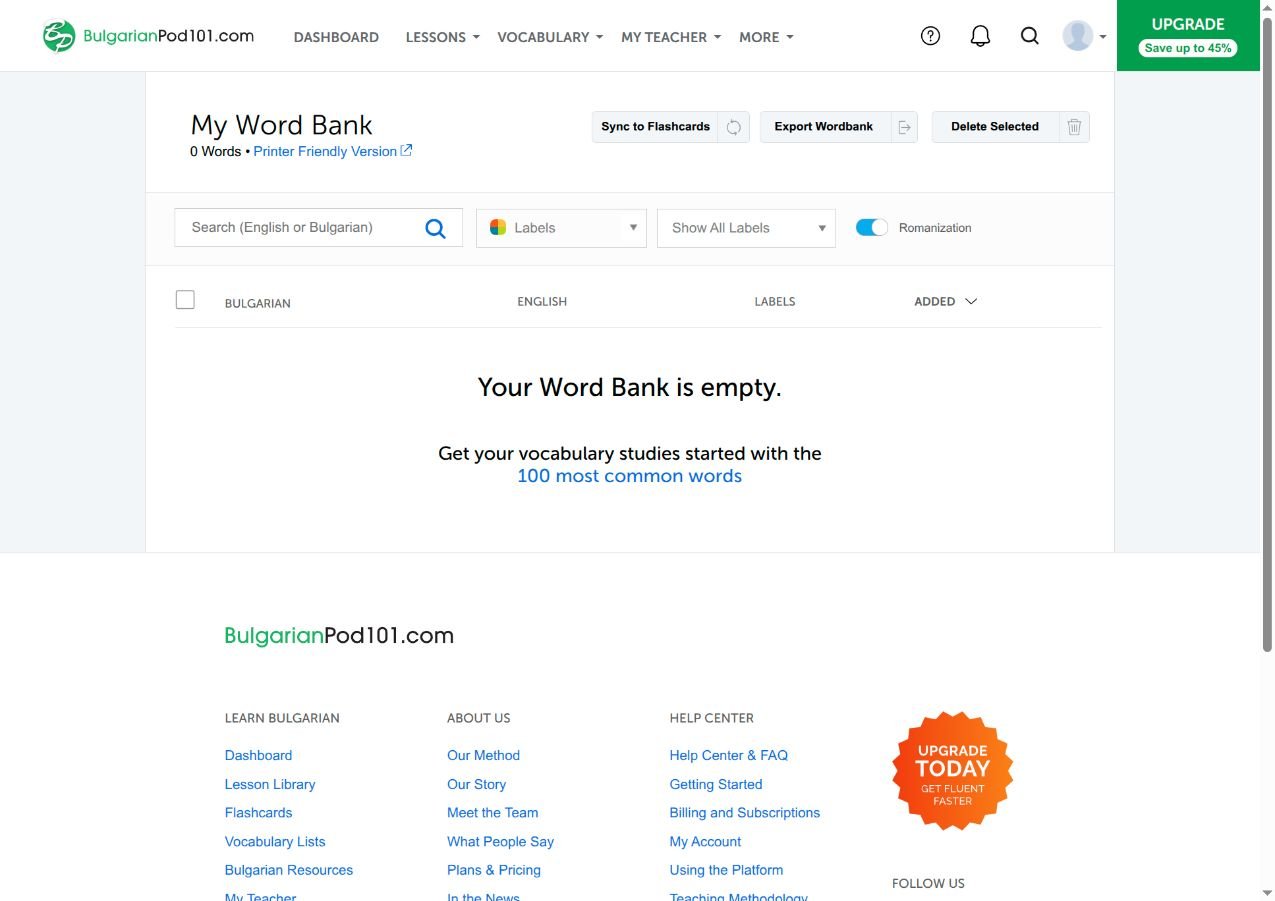
Premium places several study tools around the lessons:
- Line-by-line audio isolates one Bulgarian sentence at a time.
- A voice recorder makes stress, vowel quality and rhythm easier to compare with the native line.
- A personal word bank and spaced-repetition flashcards collect lesson vocabulary for review.
- Assessments check recognition and comprehension after a section.
- A core-word collection offers reference material outside the pathway.
The word bank becomes more useful when you refuse to save bare headwords. Add the stress to your note, keep the article with a noun, and pair aspectual verbs where possible. The built-in entry may leave some of that organisation to you. A consistent convention keeps crucial Bulgarian information from disappearing.
These tools still favour recognition. Multiple-choice checks and self-recording can confirm that you know a form without proving you can choose it in an open conversation. Use them to prepare language, then produce that language with another person or in short written messages.
The Mobile App
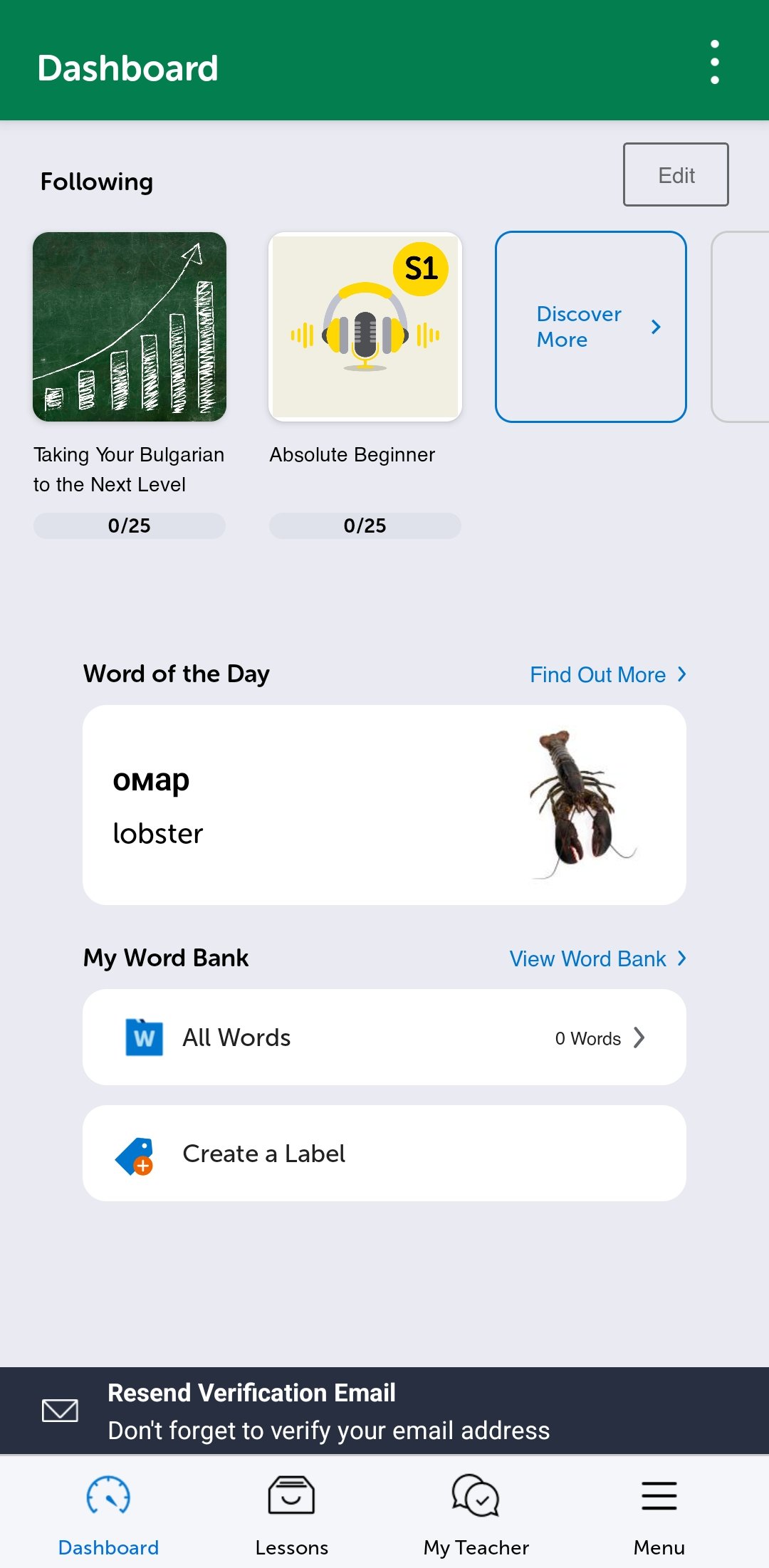
BulgarianPod101 uses the shared Innovative Language Learning app. It syncs progress between devices and supports lesson downloads, making it easy to replay Bulgarian audio while walking or travelling. Eligible subscribers can also use line-by-line material and the word bank in the app.
The website remains the fuller study environment. Innovative’s support documentation says flashcards are not currently available in the app, and some detailed audio requires an internet connection. Use the app for repeat listening and the browser for a session involving notes, grammar and deliberate review.
What Bulgarian Learners Say
Independent reviews of the Innovative Language family consistently value the short native dialogues, transcripts and practical cultural notes. The Bulgarian edition offers far more guided audio than a phrasebook, and the ability to replay a single line addresses a real weakness for learners who can decode Cyrillic but cannot yet follow speech.
The common reservation is that the platform works better as a substantial supplement than as a complete curriculum. The library contains useful beginner material, but navigation can feel loose and the progression is less systematic than a dedicated textbook. English-heavy presentation and limited open speaking are part of the same problem.
Bulgarian learner discussions also show why no single app settles the choice. People commonly combine a structured course with grammar reference, native media and conversation. Learners who know another Slavic language may move through the basics quickly but still need Bulgarian-specific attention for the article, clitic placement and verb system.
Mondly is the most visible app-style alternative with Bulgarian. It offers a cleaner gamified path and short interactive practice. BulgarianPod101 is stronger for extended native audio, transcripts and lesson notes. Mondly feels tidier; BulgarianPod101 gives you more material to investigate. Neither replaces sustained speaking or a proper grammar reference.
Pricing and Plans
BulgarianPod101 offers four access levels:
| Plan | Rough monthly anchor | What it includes |
|---|---|---|
| Free | Free | A limited lesson selection, vocabulary resources, the app and a seven-day Premium trial |
| Basic | About US$4 | All lessons and detailed lesson notes |
| Premium | About US$5–10 | Basic plus line-by-line audio, assessments, flashcards, word bank, pronunciation tools and the larger core-word collection |
| Premium PLUS | About US$13–23 | Premium plus a teacher, graded work, personalised guidance and added speaking/writing practice |
The lowest monthly anchors require a long billing period. Check the term and the total at checkout. The discount from our link is applied at checkout, but its amount varies, so check the live price. Paid plans include a 60-day money-back guarantee.
Premium is the useful middle for most Bulgarian learners. Basic gives you the lessons and notes, but line-by-line audio and review tools are where the course becomes more than an audio library. Premium PLUS makes sense if you will submit work regularly and want one teacher involved in the plan.
Pros and Cons
Pros
- A low-pressure introduction to Bulgarian Cyrillic
- Plenty of native audio for unwritten stress and natural rhythm
- Line-by-line playback and recording for close listening
- Dialogues that put articles and verb aspect in context
- Transcripts and notes for turning audio into deliberate study
- Free access, a trial and a 60-day guarantee
Cons
- The alphabet material is an introduction, not a full literacy course
- Verb aspect and the wider grammar need a more systematic companion
- Beginner lessons contain too much English
- The library can feel less linear than a textbook course
- Open speaking and writing feedback are limited below Premium PLUS
- The mobile app lacks some browser tools, including flashcards
Who BulgarianPod101 Suits
BulgarianPod101 suits a beginner or lower-intermediate learner who likes short audio lessons and wants a large bank of native speech with transcripts. It is particularly helpful if you can read Cyrillic slowly but still lose the word when a Bulgarian speaker says it at natural speed.
It is less suitable as your only resource if you want a cumulative grammar syllabus, extensive writing correction or conversation in every lesson. Learners beyond the beginner stage should use the free trial to inspect the available pathways and decide whether the library covers their specific gaps.
The Verdict
BulgarianPod101 makes its best contribution after the alphabet has stopped looking intimidating. Its native dialogues and line-by-line playback help you connect written Bulgarian with mobile stress, reduced vowels and the rhythm of a real sentence. The lesson context also gives articles and aspect more meaning than an isolated chart can.
Its structure is not enough on its own for Bulgarian’s verb system. You will get more from it with a grammar reference, an aspect notebook and regular speaking. Treat the pathway as your audio spine and use the wider library deliberately, and the amount of material becomes an advantage instead of a distraction.
My rating: 4.1 out of 5.
You can start with BulgarianPod101 here. The discount from our link is applied at checkout, but its amount varies. The free account lets you test the lessons before paying. Learn the alphabet promptly, then spend your real effort making written Bulgarian sound like Bulgarian in your head.

Social