



RomanianPod101 Review for Learning Romanian

Full disclosure: This post contains affiliate links. ?
What is RomanianPod101?
RomanianPod101 is part of the Innovative Language family, built to get you understanding and speaking Romanian from the first lesson. Audio and video lessons taught by native speakers are its main feature.
- what it’s for:
- First contact with Romanian, listening practice, pronunciation, suffixed definite articles, cases, gender and plural patterns, verb forms, vocabulary, and practical phrases and conversation material
- languages:
- Romanian
- level:
- Absolute Beginner to Advanced
+ PROS
- A familiar alphabet taught with proper attention to Romanian sounds
- Native audio for unmarked stress, diphthongs and palatalisation marked by final i
- Guided pathways from absolute beginner through advanced
- Line-by-line playback and recording for close listening
- Dialogues and notes that put articles and cases in context
- A useful free account, trial and 60-day guarantee
- CONS
- Some lessons spend too much time in English
- The large library can encourage disconnected study
- Cases, plurals and verb forms need a systematic companion habit
- Open speaking and writing feedback are limited below Premium PLUS
- The app lacks flashcards, and some detailed audio needs a connection
Quick Fire Review
A strong Romanian audio and vocabulary course with useful pronunciation and grammar support, best paired with organised form review and regular conversation. 4.3/5.
Romanian looks reassuring at first. It uses the Latin alphabet, loads of the vocabulary has Romance roots, and an English speaker who knows some French, Italian or Spanish will recognise words before studying them. You can read a café menu without first learning a new script.
The harder work starts when you build sentences. The definite article attaches to the end of the noun. Romanian keeps case forms that most major Romance languages have lost. A neuter noun behaves broadly like a masculine noun in the singular and a feminine one in the plural. The spelling is relatively regular, but stress is normally unmarked, and sounds such as ă, â/î and the palatalisation often written with final i need proper listening.
The US Department of State places Romanian in Category I and assigns it a normal intensive course of 24 weeks for its professional target. That makes it one of the more approachable languages for an English speaker by that measure, although it is not a promise that an app will make you fluent in six months.
RomanianPod101 follows the familiar Innovative Language format: short native-speaker dialogues, transcripts, level pathways, vocabulary tools and a shared mobile app. The question I’m answering here is how well that format handles Romanian’s deceptively familiar spelling, suffixed articles and surviving case system, and where you still need something more systematic.
What Makes Romanian Different
A Romanian course needs to prepare you for five features that are easy to underestimate.
1. The alphabet is familiar, but some sounds are not. Romanian uses a 31-letter Latin alphabet, including ă, â, î, ș and ț. Much of the spelling is predictable once you know the rules. The difficult part for many English speakers is hearing and producing the central vowel written with â or î, distinguishing ă, and noticing what a word-final i does to the preceding consonant.
2. Stress usually stays off the page. Romanian normally does not mark the stressed syllable in ordinary writing. A word can look easy and still sound unfamiliar at native speed, particularly when a diphthong or a final i that palatalises the previous consonant is involved. Saving the written word without its audio is an easy way to learn a slightly imaginary pronunciation.
3. The definite article attaches to the noun. English puts “the” before a noun. Romanian usually adds it to the end, so băiat (“boy”) becomes băiatul (“the boy”). That ending also interacts with gender, number and case. It is better to learn the noun and its useful forms together than to treat the article as a small extra rule.
4. Romanian retains a case system. The main form patterns combine nominative with accusative and genitive with dative, while the vocative survives for direct address. This is lighter than a language with six or seven separate noun paradigms, but it still changes articles, pronouns and some noun endings. A learner coming from Spanish or Italian cannot rely on Romance vocabulary alone.
5. Gender, plurals and verbs need organised study. Romanian school grammar recognises masculine, feminine and neuter nouns. Neuter nouns usually take masculine-like agreement in the singular and feminine-like agreement in the plural, while plural endings can be difficult to predict. Verbs add several conjugation patterns, and Romanian often uses să plus the subjunctive where another Romance language would use an infinitive.
These are good reasons to learn through full sentences. They are also good reasons not to let a course become a playlist. You need to see patterns across lessons, write down the forms that belong together and use them without a prompt.
Getting Started with RomanianPod101
You can create a free lifetime account with an email address and no payment card. It opens a limited lesson selection and begins a seven-day Premium trial, which is enough time to inspect the guided pathway, line-by-line audio, word bank and other paid tools.
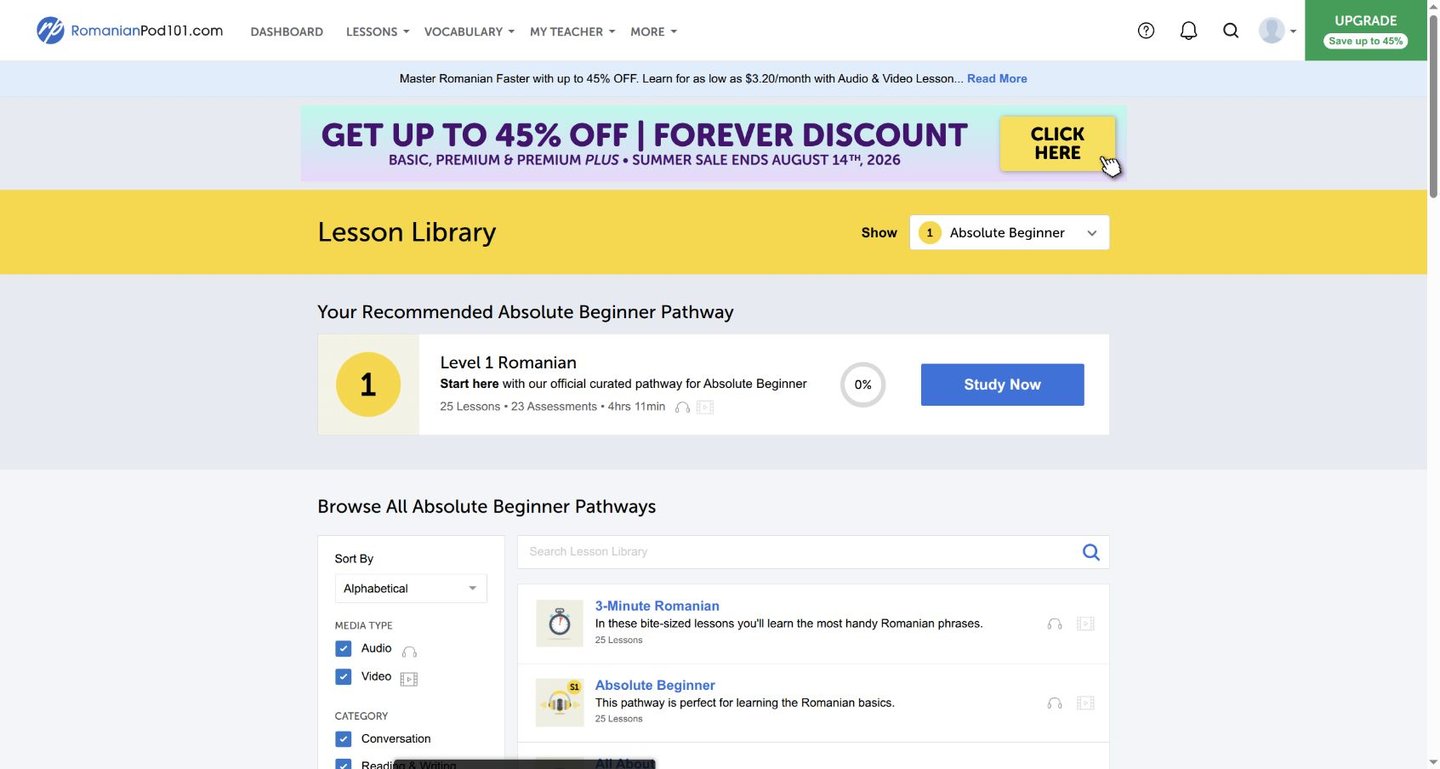
Choose the level that matches what you can currently do and begin with the recommended pathway. The current Romanian library has guided routes from absolute beginner through advanced, alongside pronunciation, listening, vocabulary, culture and specialist collections. That breadth is useful once you can name your gap. At the beginning, it can tempt you to study greetings on Monday, slang on Tuesday and an advanced culture video on Wednesday without building a base.
The curated beginner route combines practical dialogues with gender, present-tense verbs, formal and informal language, writing work and assessments. Add the dedicated pronunciation material early. Romanian’s alphabet is not a multi-week obstacle, so the purpose is to connect each letter and combination to a sound, then use that knowledge in normal lessons.

How It Handles Romanian Pronunciation
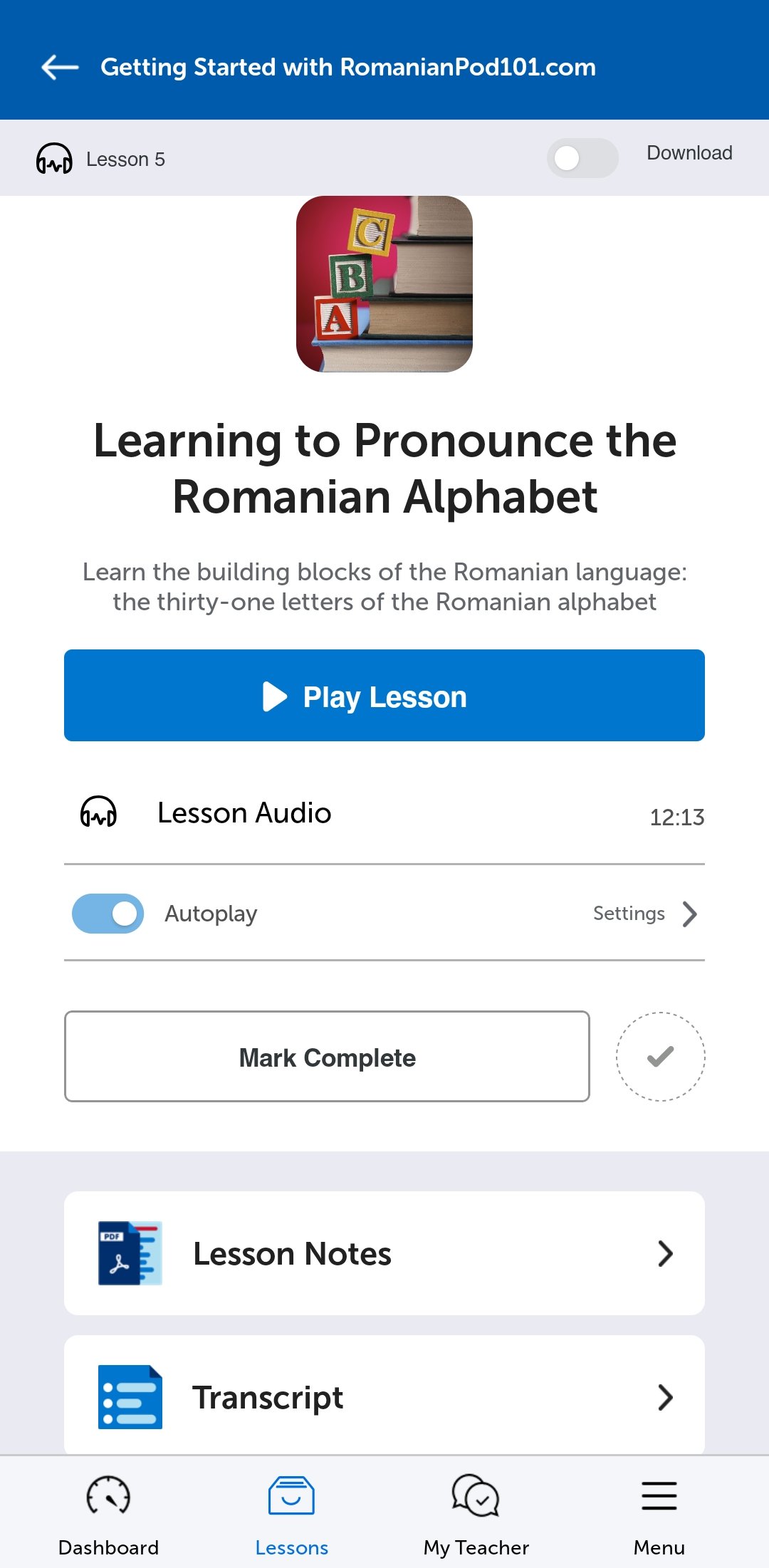
RomanianPod101 has a focused pronunciation pathway covering the 31-letter alphabet, vowels, consonants, diphthongs, hiatus and word stress. That is a sensible sequence for Romanian because the script gives you a strong start, but audio supplies information the ordinary spelling leaves out.
The useful work continues inside each lesson. Premium members can isolate and replay a dialogue line, then record their own version beside the native speaker. Use that comparison for ă, â/î, the rhythm of a phrase and the palatalisation often marked by final i. The recorder does not grade every sound, so it works best when you choose one feature to listen for instead of asking whether the whole sentence “sounds native”.
Keep the native-speed dialogue as the final target. Slow audio helps you locate a difficult sound, but a learner can become excellent at understanding slow Romanian while normal speech remains a blur. Listen once without the transcript, check the line-by-line breakdown, then return to the clean dialogue and shadow a short section.
If you cannot hear why your version differs, Premium PLUS adds teacher feedback. A Romanian tutor through italki is another route to individual correction and unscripted conversation.
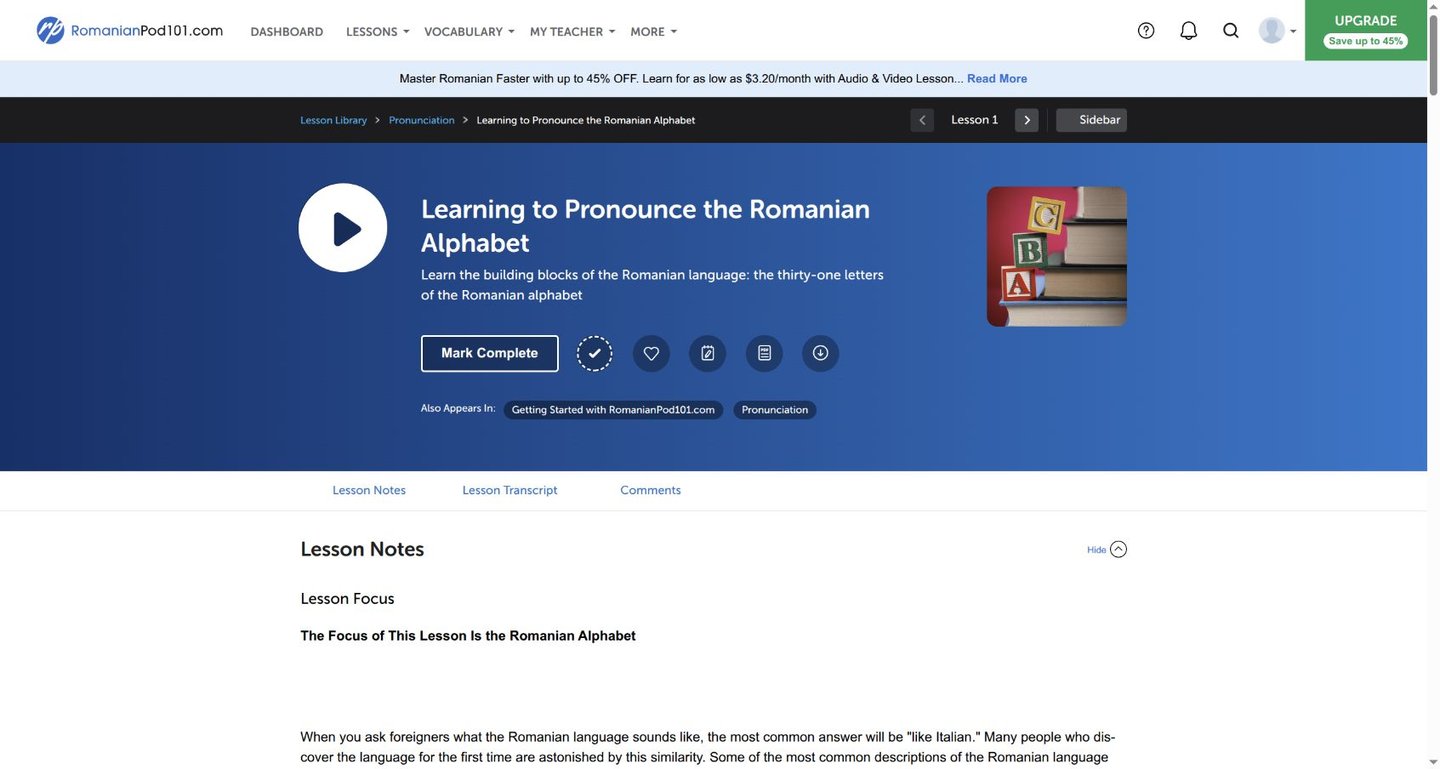
Inside a RomanianPod101 Lesson
A typical lesson is built around a short native dialogue. You hear the exchange, work through individual lines and vocabulary, and use the transcript and lesson notes for grammar and cultural explanation. Most lessons are short enough to repeat instead of ticking them off once.
That structure works well for Romanian articles and cases. You see băiatul inside a sentence instead of learning -ul as an isolated equivalent of “the”, and a genitive-dative form appears beside the words that trigger it. The current beginner material explicitly covers Romanian cases, including genitive and dative usage, so the grammar is not being ignored.
The issue is accumulation. One lesson can explain why a noun has a particular ending without giving you a durable map of the noun, its plural, its definite form and its genitive-dative form. Verb lessons have the same problem. You can understand the example in front of you and still fail to retrieve the right form when speaking.
Keep a compact Romanian forms notebook beside the course. Record a noun with its gender, plural and definite singular. For a high-frequency verb, keep the present forms and one sentence with să. Do not copy every table from the notes. Capture the pattern that you are likely to use, then look for it again in later dialogues.
Some lessons use plenty of English explanation and host conversation. That can make the material approachable, but it reduces the amount of Romanian in a ten-minute session. Once you understand the explanation, repeat the native dialogue and line-by-line audio without replaying all the English.
The Study Tools
Premium puts several useful tools around the lessons:
- Line-by-line audio isolates one Romanian sentence at a time.
- The voice recorder lets you compare your pronunciation with the native line.
- The word bank and spaced-repetition flashcards collect vocabulary for review.
- Assessments check recognition and comprehension after a section.
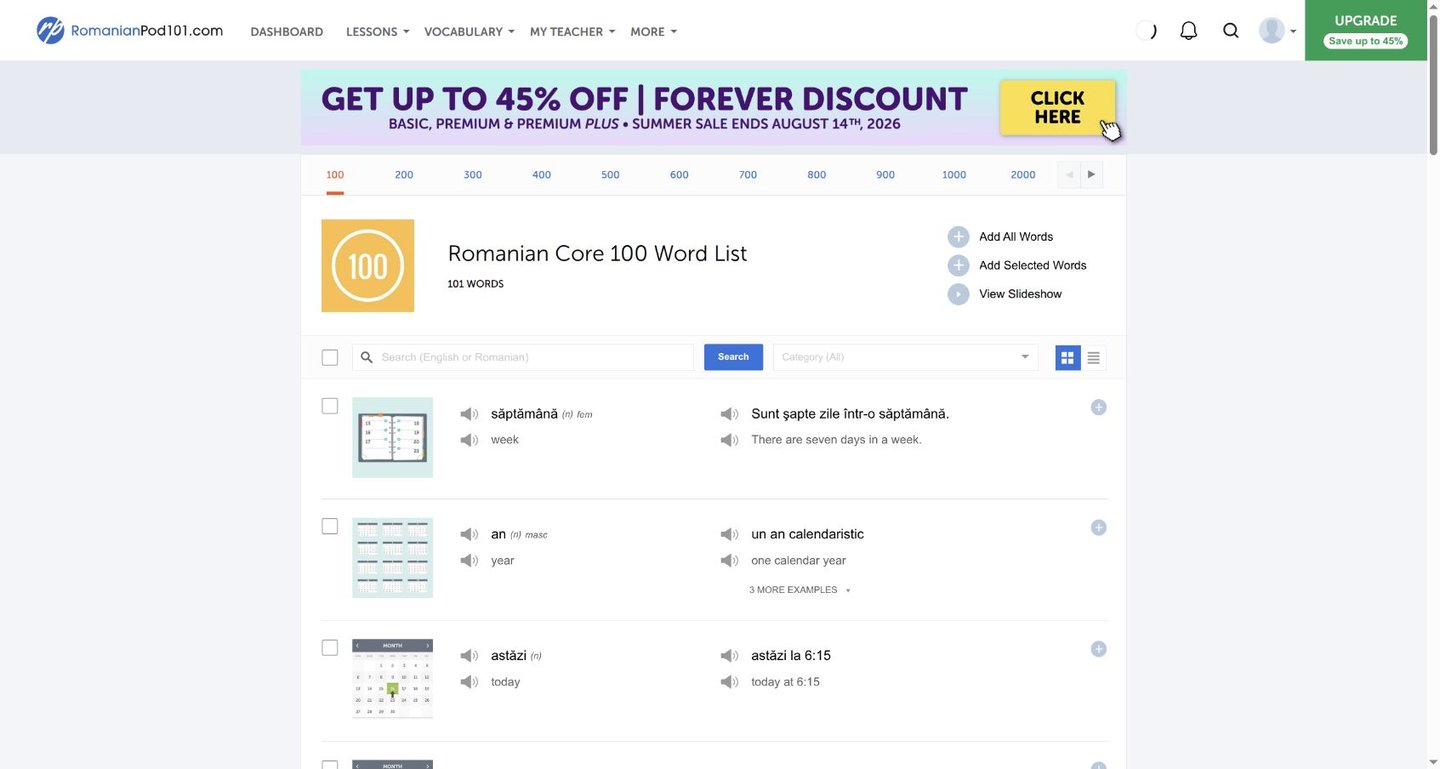
- The core-word collection gives you a larger reference outside the pathway.
The tools become more useful when you adapt them to Romanian. A bare noun is incomplete study material if you do not know its gender or plural. A written word without audio may hide the stressed syllable. Add a short note with the missing form and save a whole phrase when the article or case is the point.
Recognition is still the platform’s natural strength. Flashcards, multiple-choice checks and self-recording can show that a form looks familiar without proving you can choose it during a conversation. Use the tools to prepare language, then close the screen and describe your day, send a short message or speak with someone.
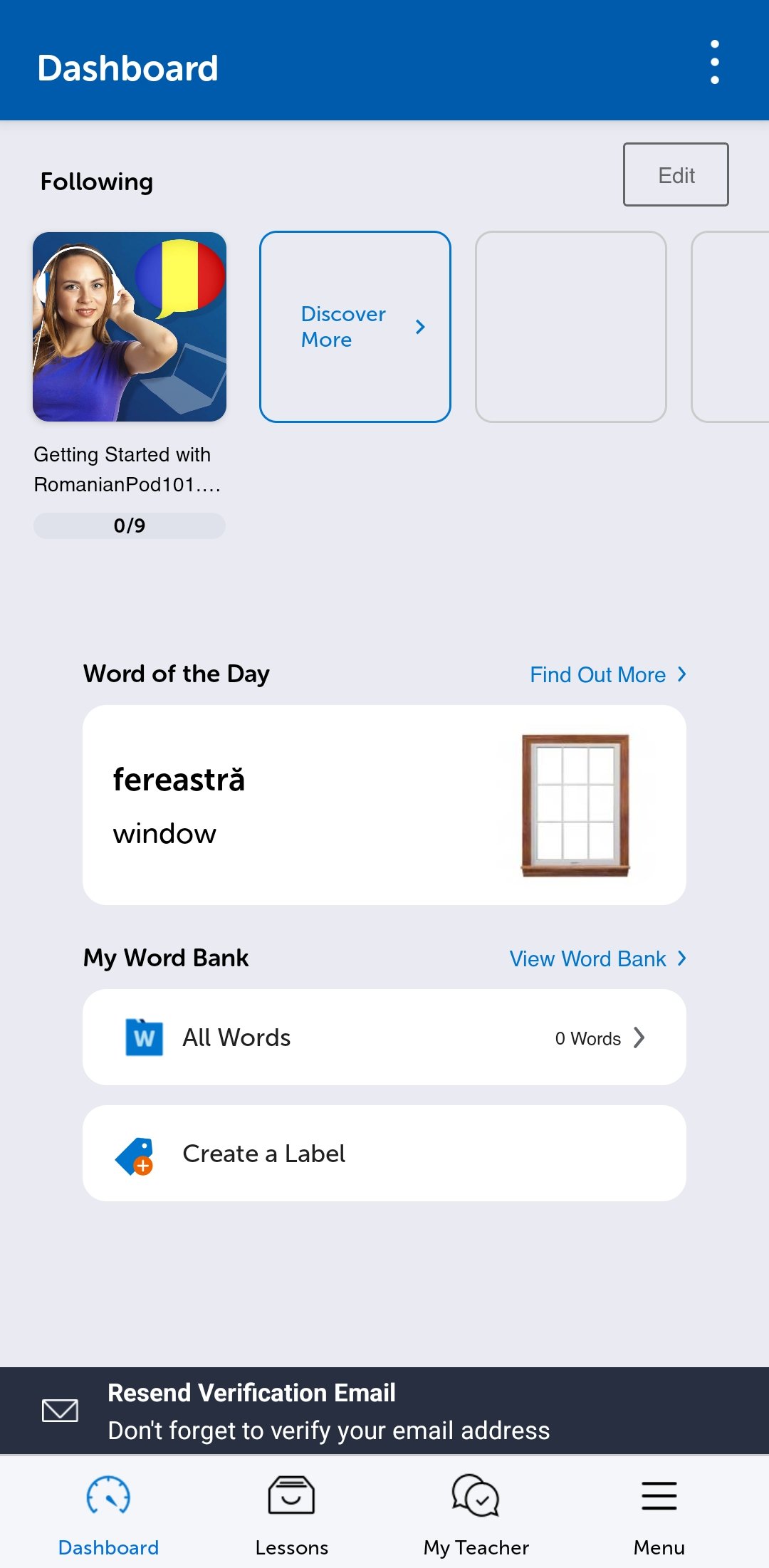
The Mobile App
RomanianPod101 uses the shared Innovative Language Learning app on Android, iPhone and iPad. It syncs progress with the website and lets you download eligible lessons for offline study. The app also carries lesson notes, line-by-line transcripts and vocabulary audio on the relevant plans.
There are two current limits. Flashcards are not available in the app, and detailed line-by-line and vocabulary audio still needs an internet connection even when the main lesson has been downloaded. The app remains useful for repeat listening on a walk or while travelling, while the website is easier when you need flashcards, want several tools open or are updating your grammar notebook.
What Romanian Learners Say
The Romanian-specific learner reports I found are positive about the audio. People recommend RomanianPod101 for listening practice, practical beginner phrases and clearer spoken material than the robotic audio found in some alternatives. One learner also called the lower paid tiers worthwhile because line breakdowns and vocabulary access make lessons easier to revisit.
The most repeated complaint is too much English in some lessons. One learner found that the course helped with words but improved listening slowly until Romanian media and repeated native-speed audio became a bigger part of the routine. That is a fair warning about how to use the platform: the explanations support the lesson, but they cannot be the majority of your listening forever.
Other Romanian learners describe the wider problem with app-only study. Cases, plural forms, articles and pronouns become difficult when the app presents them one example at a time, and speaking remains weak if every answer is prompted. RomanianPod101 has more grammar explanation than a game-first app, but you still need a reference habit and real production.
Mondly is the sensible app-style alternative. It offers a tidier daily route, speech recognition, short interactive exercises and conjugation review. One Romanian learner praised its real-life situations and higher-quality audio, while another found that it did not explain features such as the suffixed article well enough. Mondly is easier to open for ten minutes; RomanianPod101 gives you longer native dialogues, transcripts and more explanation. Neither replaces open conversation.
Pricing and Plans
RomanianPod101 has four access levels:
| Plan | Rough monthly anchor | What it includes |
|---|---|---|
| Free | Free | A limited lesson selection, survival phrases, vocabulary resources, the app and a seven-day Premium trial |
| Basic | About US$4 | All lessons and detailed lesson notes |
| Premium | About US$5–10 | Basic plus line-by-line audio, assessments, flashcards, the word bank and pronunciation tools |
| Premium PLUS | About US$13–23 | Premium plus a teacher, hand-graded work, personalised guidance and speaking and writing practice |
The lowest monthly anchors require a long billing period, currently 24 months, so check the term and total at checkout. The discount from our link is applied at checkout, but its amount varies. Paid subscriptions bought through the site come with a 60-day money-back guarantee.
Premium is the sensible middle for most Romanian learners. Basic gives you the lesson library and notes, while Premium adds the line-by-line audio and review tools that make the course particularly useful for Romanian pronunciation and forms. Premium PLUS makes sense when you will regularly submit work and use the teacher. There is little value in paying for that extra support if it sits unused.
Pros and Cons
Pros
- A familiar alphabet taught with proper attention to Romanian sounds
- Native audio for unmarked stress, diphthongs and palatalisation marked by final
i - Guided pathways from absolute beginner through advanced
- Line-by-line playback and recording for close listening
- Dialogues and notes that put articles and cases in context
- A useful free account, seven-day trial and 60-day guarantee
Cons
- Some lessons spend too much time in English
- The large library can encourage disconnected study
- Cases, plurals and verb forms need a more systematic companion habit
- Open speaking and writing feedback are limited below Premium PLUS
- Progress can stay recognition-heavy unless you add real production
- The app currently lacks flashcards, and some detailed audio needs a connection
Who RomanianPod101 Suits
RomanianPod101 suits a beginner or lower-intermediate learner who likes short audio lessons and wants clear native speech with transcripts. It is particularly useful if Romanian looks easy on the page but disappears when someone speaks, or if you understand a case explanation and then forget the form a week later.
It is less suitable as your only resource if you want a tightly cumulative grammar syllabus, constant correction or conversation in every lesson. An advanced learner should use the free access or trial to inspect the current pathways and decide whether the listening material fills a real gap.
The Verdict
RomanianPod101 handles Romanian’s familiar-looking surface well. The pronunciation pathway and native dialogues help you hear the information that spelling does not always show, while the lesson notes give articles, cases and verbs more context than a phrase app can manage.
Its broad library is both the appeal and the weakness. Follow one pathway, keep a small forms notebook and replay the clean Romanian audio, and it becomes a strong listening-and-vocabulary core. Browse at random and count completed lessons, and the case endings will remain facts you recognise rather than language you can use.
My rating: 4.3 out of 5.
You can start with RomanianPod101 here. The discount from our link is applied at checkout, though the amount varies, and the free account lets you inspect the lessons before paying. Let the familiar vocabulary give you momentum, then put most of your attention into the sounds and endings that make Romanian its own language.

Social