



ThaiPod101 Review for Learning Thai

Full disclosure: This post contains affiliate links. ?
What is ThaiPod101?
ThaiPod101 is part of the Innovative Language family, built to get you understanding and speaking Thai from the first lesson. Audio and video lessons taught by native speakers are its main feature.
- what it’s for:
- First contact with Thai, listening practice, the five tones, vowel length, Thai script and tone rules, vocabulary, and practical phrases and conversation material
- languages:
- Thai
- level:
- Absolute Beginner to Advanced
+ PROS
- A proper alphabet pathway covering handwriting, consonant classes and tone rules
- Loads of native-speaker audio for Thai’s five tones and vowel length
- Line-by-line playback and recording for close pronunciation work
- Script, audio and translation kept together inside dialogues
- Useful cultural context for particles and politeness
- Free access, a trial and a 60-day guarantee
- CONS
- The route through intermediate material can feel uneven
- Main pathways need more sustained reading and writing practice
- Beginner lessons contain too much English
- The size of the library makes useful features easy to miss
- The app lacks some browser tools, including flashcards
Quick Fire Review
A strong audio-and-script course for Thai’s tones, vowel length and writing system, best with added natural input and live pronunciation feedback. 4.3/5.
Thai grammar gives an English speaker a welcome early gift. Verbs do not change for person or number, there are no sprawling conjugation tables, and time is often shown through context, time words and particles. Then Thai asks you to hear five tones, distinguish long and short vowels, learn a new script, and find the word boundaries in a sentence that usually has no spaces between individual words.
Under the US Department of State’s current catch-all definition, Thai falls in Category III, with a normal intensive course lasting 44 weeks. Thai is not individually named beside that figure. The difficulty is unevenly distributed: light inflection comes with a demanding sound-and-writing system, and the easy-looking grammar does not cancel the work your ear has to do.
ThaiPod101 uses short native-speaker dialogues, transcripts, level pathways, vocabulary tools and the shared Innovative Language app. Thai gives that format a particularly clear job. The course needs to train your ear for tone and vowel length while helping you move beyond romanisation into the script early enough to read pronunciation clues for yourself.
What Makes Thai Different
These are the features a useful Thai course has to face directly.
1. Five lexical tones change meaning. Standard Thai uses mid, low, falling, high and rising tones. Tone belongs to the word, so a change in pitch can produce a different word instead of a different mood. English speakers already use pitch expressively, but Thai asks you to attach a particular contour to each syllable and recognise it at natural speed.
2. Four tone marks do not map neatly onto five tones. A written tone depends on the consonant class, vowel length, whether the syllable is “live” or “dead”, and any tone mark that appears. Some syllables have a tone mark; many do not. Memorising four marks without the consonant classes leaves you unable to read the system.
3. The script has 44 consonant symbols. Those letters represent fewer distinct consonant sounds, and two are obsolete in ordinary modern words, but all remain part of the alphabet. Vowel signs can sit before, after, above, below or around the consonant they belong to. Sources give different vowel totals because they count base symbols, combinations and short/long forms differently. The useful fact is the layout, not winning an argument over whether the number is 28 or 32.
4. Ordinary text does not put a space after every word. Thai does use spaces, often at a larger phrase or sentence boundary, but a beginner cannot rely on them to separate the vocabulary. Reading means learning to recognise syllable patterns and likely word groups while your eyes move through a continuous string.
5. Vowel length and aspiration matter alongside tone. A learner can produce the right general pitch and still say the wrong word because the vowel is too short or a consonant is unaspirated. Listening only for “the tones” misses half of Thai pronunciation.
6. No conjugation does not mean no grammar. Thai verbs do not inflect for person, number or tense in the way Spanish or French verbs do. Speakers still express completion, duration, time, mood and politeness through particles, auxiliaries, word order and context. The forms are lighter; choosing the natural construction still takes exposure.
That makes my preferred Thai starting principle simple: ear-first, with the script early. Romanisation can get your first phrases moving, but it should not become a permanent crutch.
Getting Started with ThaiPod101
A free lifetime account needs an email address but no payment card. It opens a limited set of lessons and starts a seven-day Premium trial, which is enough to explore the line-by-line audio, word bank and other paid tools. You choose a level, and the dashboard recommends a learning pathway.
The recommendation is important because ThaiPod101 is a library as well as a course. You can find survival phrases, vocabulary lists, listening practice, culture material and specialist pathways. That range is useful once you have a plan, but it can feel scattered if you choose lessons by whatever thumbnail catches your eye.
Start with the official beginner route and add the alphabet pathway alongside it. That gives you practical language to say now while the script builds underneath it. Waiting until you feel “ready” to read often means months of trying to decode inconsistent romanisation systems.

How It Teaches the Thai Script and Tones
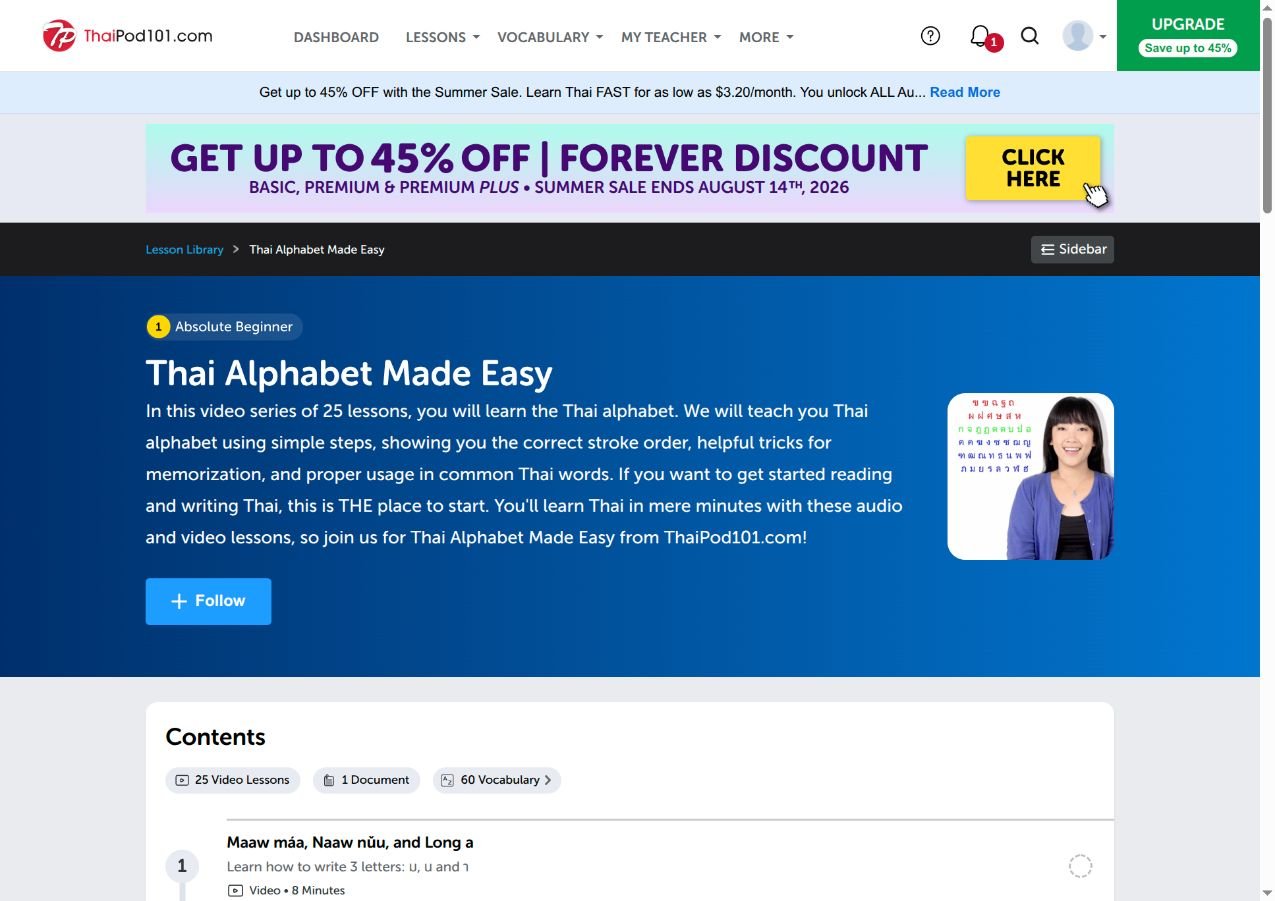
ThaiPod101’s strongest language-specific feature is its dedicated alphabet pathway. It teaches consonants in manageable groups, introduces vowel signs with them, includes handwriting, and connects the three consonant classes to the tone rules. Separate lessons cover the four tone marks, so the script does not stay trapped inside a decorative chart.
This matters because “learn the Thai alphabet” can mean two very different things. Memorising 44 letter names is one job. Using the initial class, vowel length, final sound and tone mark to predict a syllable’s tone is the skill that makes reading useful. ThaiPod101 teaches that relationship instead of presenting the alphabet as a decorative chart.
The pathway uses one common convention that speaks of 32 vowel forms. Other reputable sources count them differently, depending on whether they mean symbols, spoken vowels or written combinations. You do not need to memorise a disputed total. You need to recognise where a vowel is written, how long it lasts and what it contributes to the tone rule.
Once you move into ordinary lessons, Premium’s line-by-line audio lets you replay each sentence and record yourself beside it. That is exactly the kind of repetition Thai needs. Work on one contrast at a time: tone first, then vowel length, then aspiration, before putting the whole sentence back together.
Fi3M already has a practical guide to reading Thai and working out the tones, which makes a useful companion when the consonant-class tables start to blur.
Inside a ThaiPod101 Lesson
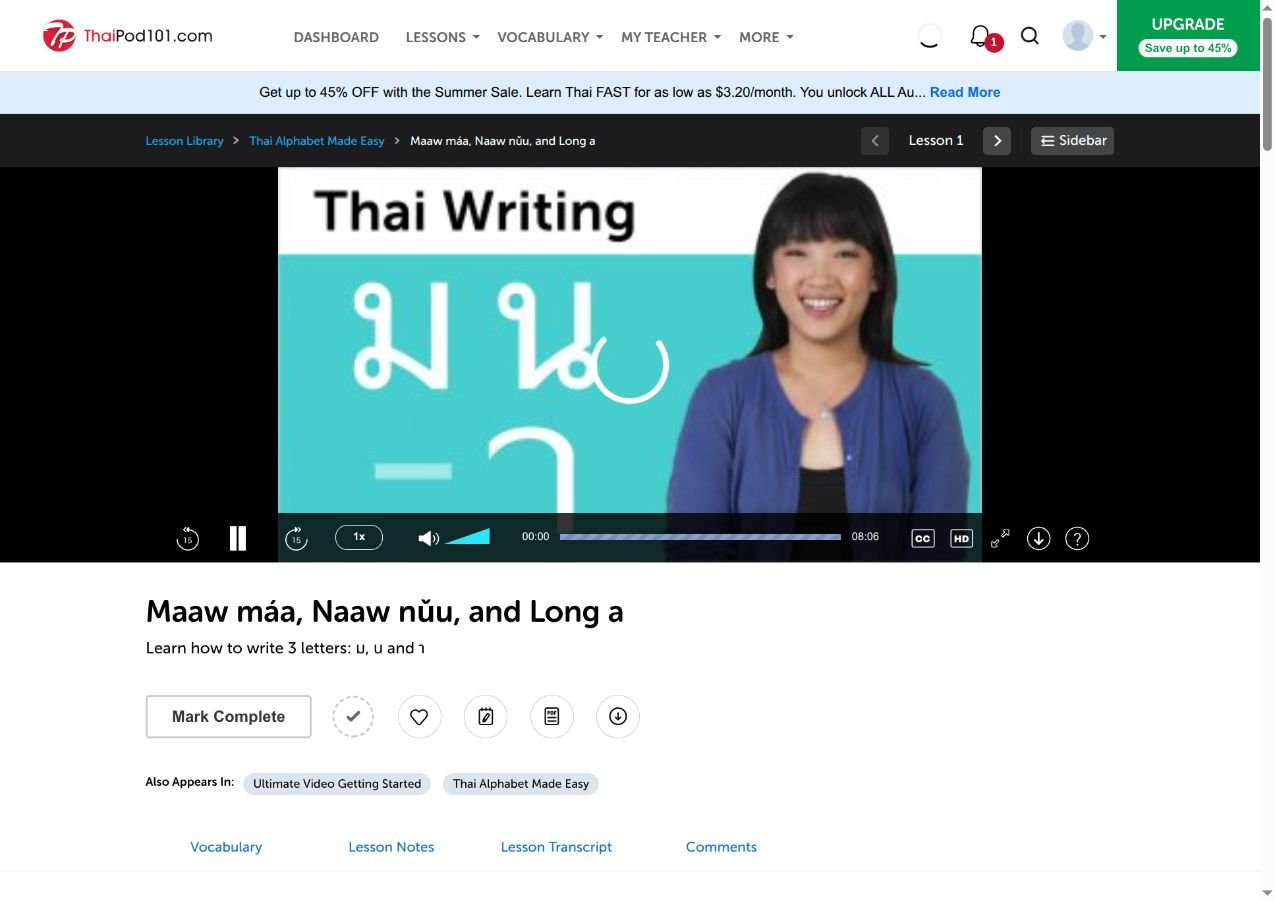
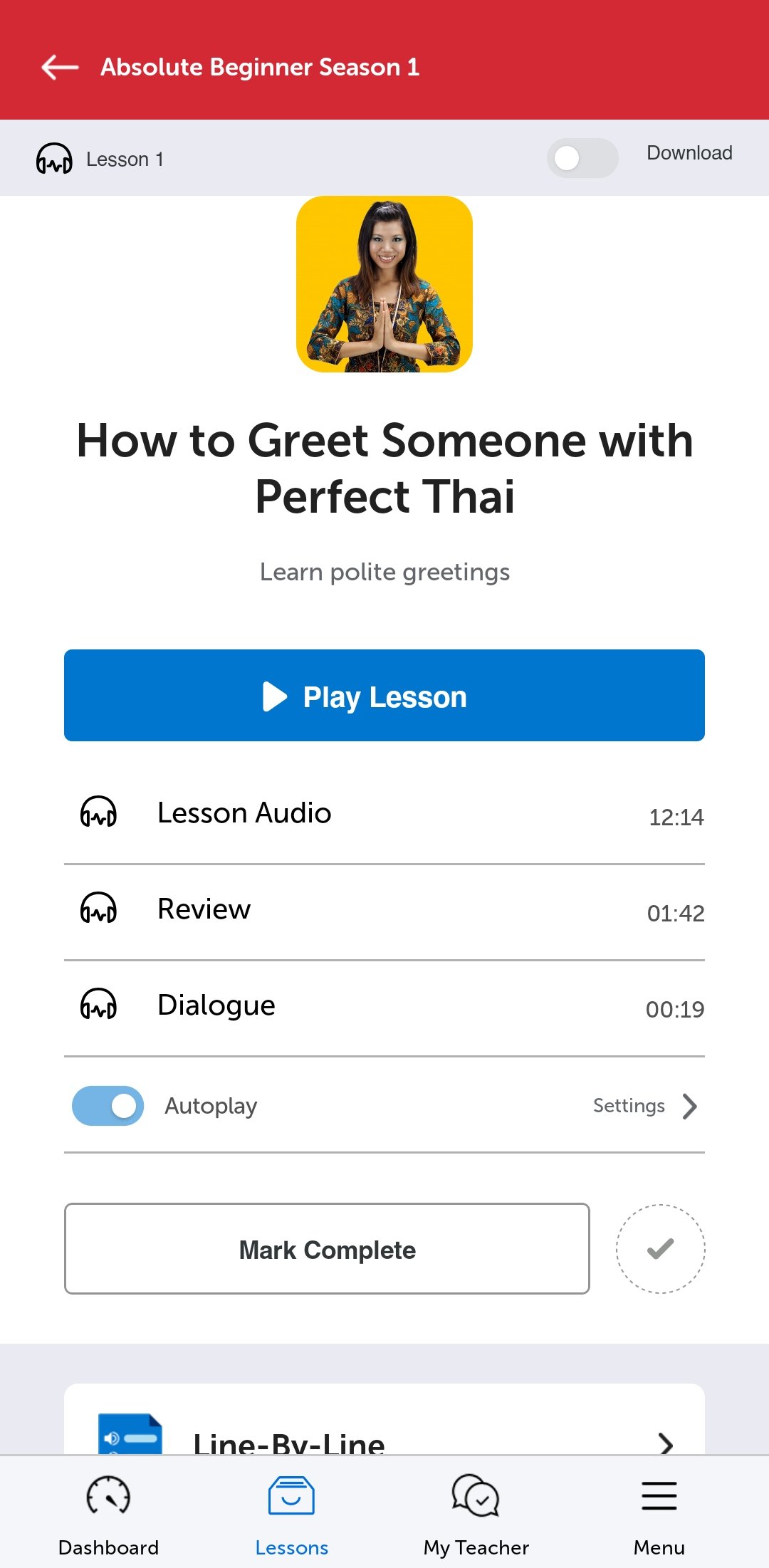
A typical lesson is built around a short native dialogue. You listen to the exchange, work through vocabulary and individual lines, then get grammar and cultural explanation with a transcript and detailed notes on the appropriate tier. Most lessons are short enough to repeat without turning a review session into a project.
For Thai, the line-by-line view earns its keep. It keeps the script, translation and sound together, so you can learn where one word ends without waiting for a space that will not appear. The native recording also shows how a careful dictionary form changes inside a real sentence.
The cultural notes are useful because Thai politeness lives in language choices, particles and relationships. A literal sentence can be grammatically possible and still sound abrupt in the wrong setting. Dialogue gives those choices a social frame.
The course is less convincing as a single grammar and literacy syllabus. Independent reviewers note that the main experience contains limited writing practice, despite the separate alphabet pathway, and learners report awkward pacing between the foundations and intermediate material. A lesson may explain its grammar point clearly without guaranteeing that the next lessons will revisit it often enough for production.
Use the dialogue course for listening and usable phrases, the alphabet pathway for literacy, and a reference grammar for the particles and aspect patterns you want organised in one place. Keeping those roles clear makes the library much easier to use.
The Study Tools
Premium adds several tools around the lessons:
- Line-by-line dialogue for replaying one sentence at a time
- A voice recorder for comparing your tone, vowel length and rhythm with the native line
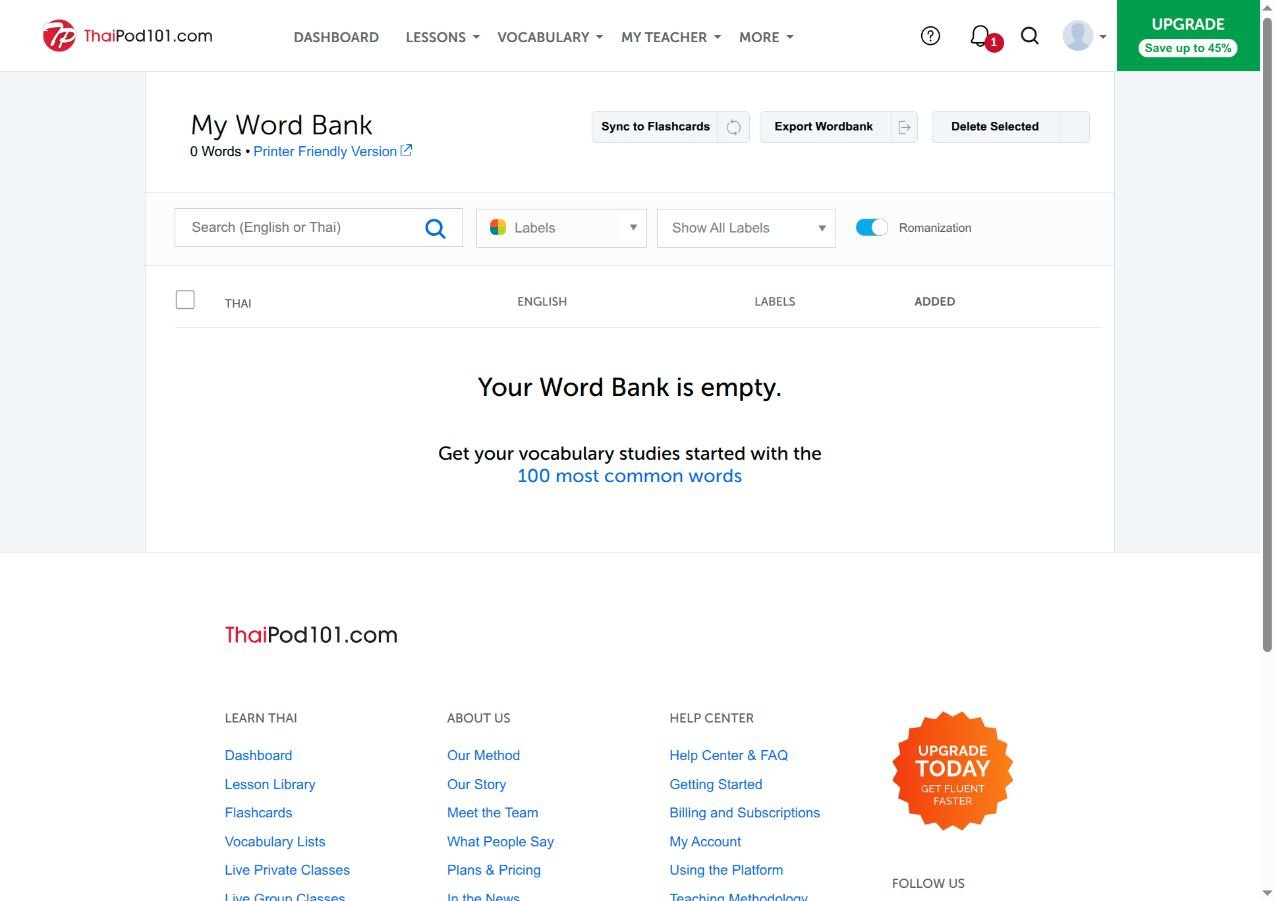
- A word bank and spaced-repetition flashcards for vocabulary from the lesson library
- Multiple-choice assessments for checking recognition and comprehension
- A Grammar Bank and core-word collection for reference and systematic vocabulary
The recorder is the standout for Thai, provided you use it carefully. Listening to your version immediately after the native one makes a wrong tone or vowel length easier to notice. It cannot tell you why the attempt is wrong, and self-assessment becomes less reliable when the contrast is still new.
Premium PLUS adds a teacher, graded work and personalised guidance. That is the in-family answer for correction. Another option is Premium plus a tutor found through italki, especially once you want unscripted conversation and feedback on which pronunciation differences are blocking understanding.
The Mobile App
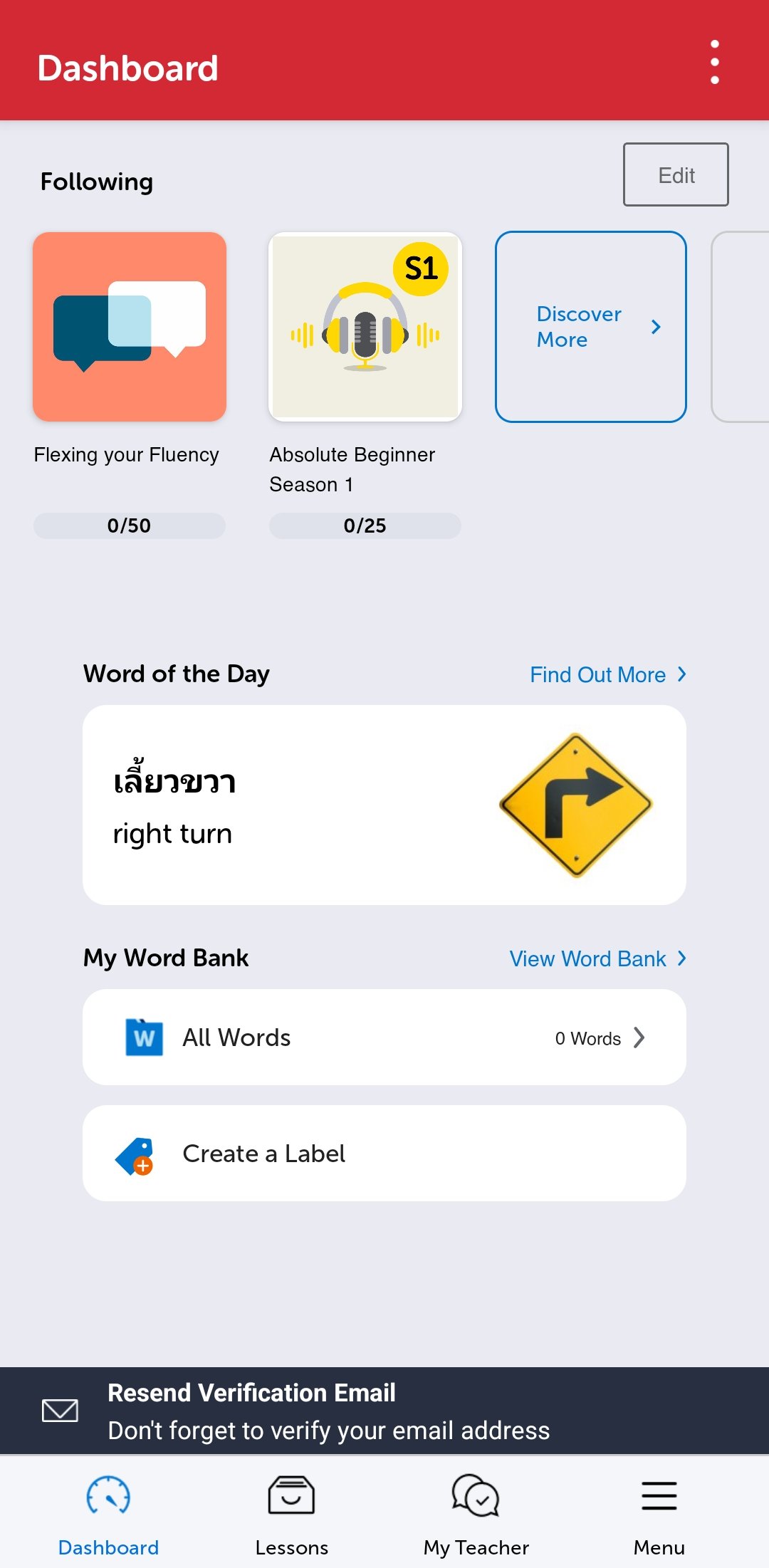
ThaiPod101 uses the shared Innovative Language Learning app. It syncs your progress and supports downloaded lessons, so you can keep native Thai in your headphones without sitting at a computer. Eligible subscribers can open line-by-line material and the word bank in the app.
The app is well rated overall, but the browser remains the better place for serious script work. Innovative says flashcards are not currently supported in the app, and some line-by-line and vocabulary audio still needs an internet connection. Handwriting a consonant while a phone bounces in your other hand is not ideal anyway. Use the app for listening and the website plus paper for literacy.
What Thai Learners Say
The positive learner reports focus on the same things the product does best. The alphabet videos are repeatedly singled out as solid, and learners use the scripts plus repeated audio to build a foundation. One recent learner described reading each dialogue and listening until every part was clear as the method that got them into real conversations.
Independent reviews also praise the native audio, natural phrases, detailed grammar notes and cultural explanation. For a complete beginner, the English support can make a very unfamiliar language feel manageable.
The recurring complaint is structure after the early stage. Some learners feel the pathway jumps from basic travel language towards material that is too advanced, leaving the middle less satisfying. Others describe the site as a collection of content without enough guidance. Too much English and useful features hidden around the interface add to that impression.
Learners commonly move towards comprehensible Thai video and real tutors once they want natural-speed input and open conversation. That does not make ThaiPod101 a failed course. It defines the job it does well: build a base in sounds, script, vocabulary and short dialogues, then feed those skills into wider listening and speaking.
Pimsleur Thai is the main paid alternative for someone who only wants a linear audio routine. It prompts more speaking and removes most decisions. ThaiPod101 is the one with a dedicated alphabet-and-tone pathway. Choose Pimsleur for a strict hands-free habit; choose ThaiPod101 for broader material and serious script support.
Pricing and Plans
ThaiPod101 has four subscription levels:
| Plan | Rough monthly anchor | What it includes |
|---|---|---|
| Free | Free | A limited selection of lessons, vocabulary resources, the app and a seven-day Premium trial |
| Basic | About US$4 | All lessons and detailed lesson notes |
| Premium | About US$5–10 | Basic plus line-by-line audio, assessments, flashcards, word bank, Grammar Bank, pronunciation tools and the larger core-word collection |
| Premium PLUS | About US$13–23 | Premium plus a teacher, graded work, personalised guidance and added speaking/writing practice |
The lowest monthly figures are based on long billing periods. Check both the term and the total before paying. The discount from our link is applied at checkout, but the amount varies with the current offer, so check the live price. Paid plans carry a 60-day money-back guarantee.
Premium is the best match for most Thai learners because line-by-line audio, the recorder and the review tools serve the language’s hardest early features. Basic makes sense if you mainly want lessons and PDFs. Premium PLUS earns its higher price when you will submit work and use the teacher consistently.
Pros and Cons
Pros
- A proper Thai alphabet pathway with handwriting, consonant classes and tone rules
- Loads of native-speaker audio for the five tones and vowel-length contrasts
- Line-by-line playback and recording for close pronunciation work
- Thai script, audio and translation kept together inside lesson dialogues
- Useful cultural context for particles, politeness and natural phrases
- Free access, a trial and a 60-day guarantee
Cons
- The route through intermediate material can feel uneven
- Main dialogue pathways need more sustained reading and writing practice
- Beginner lessons contain too much English
- The size of the library makes useful features easy to miss
- Self-recording cannot replace individual tone correction
- The app lacks some browser tools, including flashcards
Who ThaiPod101 Suits
ThaiPod101 suits a beginner who wants to speak useful phrases quickly but is also willing to learn the script. It is particularly good for a learner who benefits from replaying short audio, reading a transcript and breaking one sentence into manageable pieces.
It is less suitable as the only resource for a learner who wants extensive handwriting, a single cumulative grammar curriculum or spontaneous conversation in every session. Intermediate learners should browse the trial carefully and check that the available pathways match the gap they want to fill.
The Verdict
ThaiPod101 gets the central method right. Thai needs ear-first training because tone, vowel length and aspiration cannot be solved on paper. The script also belongs early because it carries information romanisation handles inconsistently. Native dialogues, line-by-line playback and a dedicated alphabet-and-tone pathway give you both sides.
The platform still needs an active learner. Follow a defined route, write the script on paper, repeat the dialogue tracks and take your pronunciation to a real person when you can. If you simply browse random lessons, the library can feel like a pile of useful parts without an engine.
My rating: 4.3 out of 5.
You can start with ThaiPod101 here. Our link applies a discount at checkout, but the amount varies. The free account lets you test the audio and alphabet material first. Listen closely, start the script early, and make sure the Thai you can recognise on a page also works in your ear.

Social