



VietnamesePod101 Review: Does It Handle the Hardest Part of Vietnamese?

Full disclosure: This post contains affiliate links. ?
What is VietnamesePod101?
VietnamesePod101 is part of the Innovative Language family of courses, teaching Vietnamese from absolute beginner to advanced through structured audio and video lessons taught by native speakers.
- what it’s for:
- Learning Vietnamese tones and pronunciation, building conversational vocabulary, understanding Northern vs Southern dialects, structured beginner-to-intermediate study, self-paced study with downloadable lesson notes
- languages:
- Vietnamese
- level:
- Absolute Beginner to Advanced
+ PROS
- Strong, name-based tone teaching with line-by-line audio and a voice recorder
- Explicitly covers both Northern (Hanoi) and Southern (Saigon) pronunciation
- Grammar explanations stay short so lesson time goes on pronunciation
- Free lifetime account with no card needed
- Downloadable lesson notes and vocab lists
- 60-day money-back guarantee on paid tiers
- CONS
- Catalogue is mid-tier, well below flagship Pod101 courses
- Content thins noticeably past beginner level
- Diacritic drilling feels secondary to tone teaching
- The mobile app misses key features like the study path and assessments
- Real speaking practice needs the pricier Premium PLUS tier
Quick Fire Review
A genuinely strong beginner-to-intermediate course for Vietnamese’s real challenge, the tones, though the catalogue thins as you climb.
Vietnamese sits in FSI Category III, the “hard” tier of the US State Department’s difficulty scale, alongside languages like Russian, Greek and Turkish, at around 1,100 class hours to reach professional working proficiency. That surprises people who assume any tonal language with a diacritic-covered script must be in the same bracket as Mandarin or Arabic, but Vietnamese actually lands a full category below the “super-hard” languages, and once you understand why, the whole shape of learning it starts to make sense.
Our team at Fluent in 3 Months has used Innovative Language’s Pod101 and Class101 courses for language missions for years, so I sat down to review VietnamesePod101 with a fair idea of what the platform does well and where it falls short. Vietnamese’s difficulty comes almost entirely from pronunciation, so the real question is whether this course actually teaches you to hear and produce the sounds, or whether it leans on the same generic lesson format it uses for every other language and hopes for the best.
What Makes Vietnamese Different
Six tones, unless you’re in the south. Northern Vietnamese, the Hanoi standard, has six tones: ngang (level), huyền (low falling), sắc (high rising), nặng (heavy, glottalised and cut short), hỏi (dipping-rising) and ngã (creaky-rising). Southern or Saigon speech merges hỏi and ngã into one tone, so you’re effectively dealing with five. Every syllable carries one of these, and getting it wrong can change the word entirely. This is the wall most learners hit first, and the one part of Vietnamese that genuinely deserves the word hard.
A friendly-looking script that hides a nasty trick. Chữ Quốc ngữ, the Latin-based writing system devised by Portuguese missionaries in the seventeenth century, is a huge advantage over Chinese characters: you can read it on day one. The catch is that tone marks stack on top of separate vowel-quality diacritics (ă, â, ê, ô, ơ, ư), so a single vowel can end up wearing two marks at once, one for quality and one for pitch. The real hurdle is the diacritic density, not the alphabet.
A vowel inventory that doesn’t map onto English. Vietnamese has around fourteen distinct vowel nuclei, with length and quality contrasts (a versus ă, ơ versus â) that English speakers simply don’t listen for by default. That’s a separate wall from the tones, and it trips people up even after they’ve got those roughly under control.
Grammar that’s honestly easy. After all that, some relief: Vietnamese is analytic, meaning there’s no case, no grammatical gender, no verb conjugation for tense, and no plural endings on nouns. Word order is strict subject-verb-object, and you can drop pronouns once context makes them clear. If you’ve studied a European language with its tables of endings, Vietnamese grammar will feel like a weight coming off your shoulders. The difficulty budget goes almost entirely on sound.
Classifiers that are simpler than they look. Vietnamese has roughly two hundred classifier words that go between a number and a noun, which sounds like loads to memorise. In practice, three of them cover about ninety per cent of everyday speech: cái for inanimate objects, người for people, and con, which most textbooks gloss loosely as “animate things” but which is really about motion or directionality, covering everything from animals to a knife (con dao) to a road (con đường). Once that clicks, classifiers stop being scary.
A pronoun system that tracks age and status, not just “you”. This is the one learners on forums like r/learnvietnamese consistently call the hardest part, tones included. Words like anh, chị, em, cô and chú shift depending on the relative age, gender and social standing of whoever you’re talking to, so instead of reaching for one stable word you’re constantly recalculating how to address someone. It’s a different way of thinking about a conversation, and it belongs right alongside the tones as one of the language’s real challenges.
On top of all this sits a north-south dialect split. Hanoi and Saigon Vietnamese differ in consonants, tone count and some vocabulary, and there’s no single “correct” version, only the one that matches where you’ll actually use the language.
Getting Started
Signing up works the same way across every Innovative Language course: you create a free lifetime account with just an email address, no card required, choose a starting level from Absolute Beginner through to Advanced, and the platform builds you a guided learning path from there.
Once you’re in, the dashboard shows your study path, the newest lessons and vocab lists, and a tally of lessons completed and hours studied. Because the free tier gives you the first three lessons of every series plus a seven-day Premium trial, you can get a proper feel for the pronunciation content before paying anything.

The Writing System and Pronunciation
This is where a Vietnamese course lives or dies, and it’s the section I looked at most carefully. The core pronunciation series, including a dedicated lesson series on Vietnamese tones, uses the Northern or Hanoi standard, which staff have confirmed directly in response to learner questions, and it teaches the tones by name (ngang, huyền, sắc and so on) rather than by the numbered system some textbooks prefer. That matters, because tone names carry meaning about how the sound behaves, which numbers don’t.
For Premium subscribers, the Line-by-Line Audio tool isolates each sentence of a dialogue so you can listen to a single tone-heavy phrase on repeat rather than the whole recording, and the voice recorder lets you compare your own pronunciation directly against the native speaker’s. The course also explicitly distinguishes Northern and Southern dialects instead of pretending Vietnamese is one uniform accent.
What I couldn’t find was a dedicated, standalone curriculum for drilling the diacritics themselves, separate from the tone lessons. The tone marks get thorough coverage; the vowel-quality diacritics seem to be picked up more incidentally through reading practice. That’s not a dealbreaker given how much tone content there is, but if you want a systematic pass through every diacritic combination before reading real sentences, you may need to supplement.

Inside a Lesson
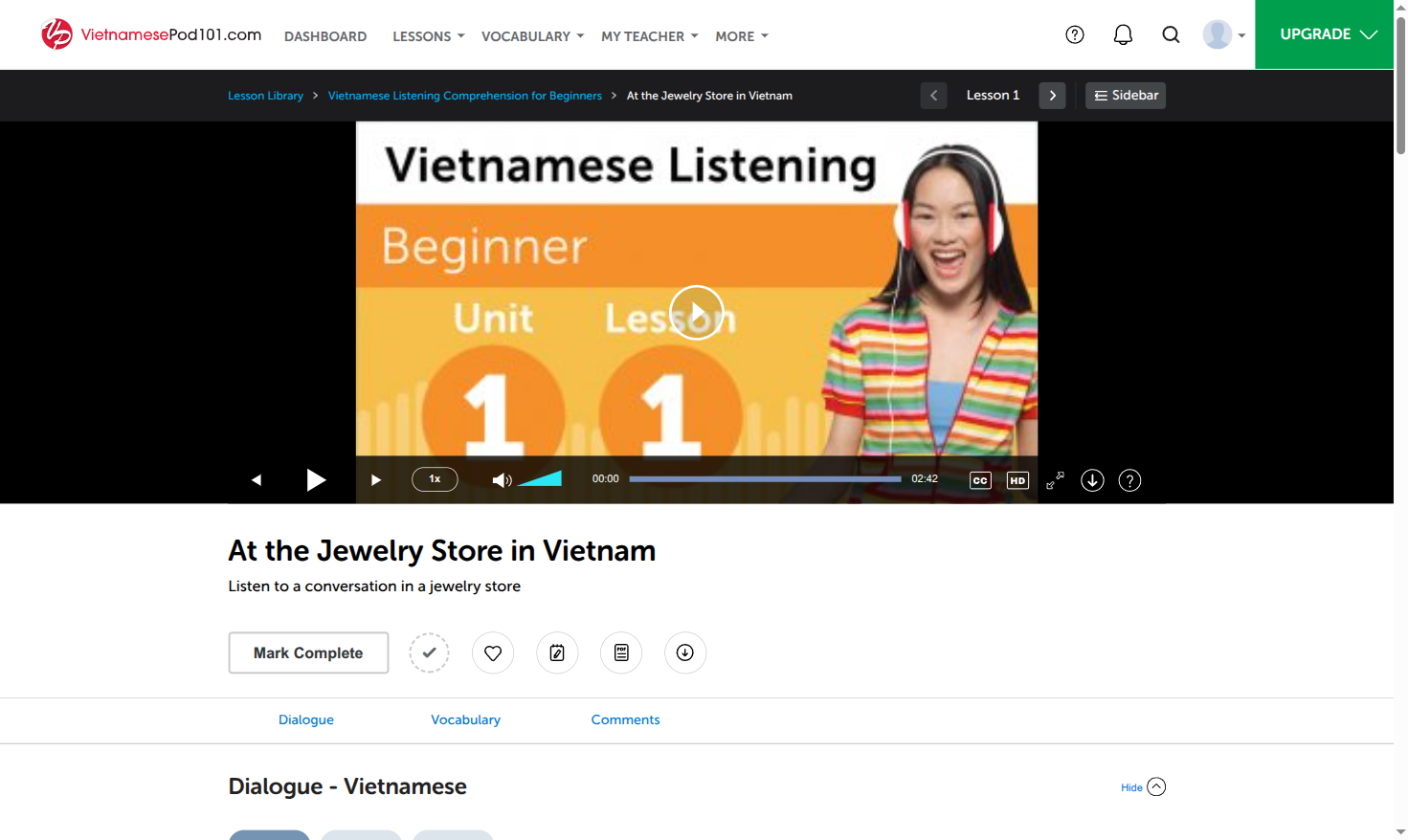
Most lessons run three to fifteen minutes and follow a format that will be familiar if you’ve used any Pod101 course before: a short dialogue in Vietnamese, a breakdown at natural and slowed-down speed with English translation, a vocabulary list, an explanation of the grammar or tone point, a cultural note, and a final replay of the dialogue. Lesson notes download as a PDF for reviewing away from a screen, and you can add your own notes to each lesson.
Because Vietnamese grammar is so light, the grammar segment of each lesson tends to be short: word order rules, classifier use, a particle or two. The bulk of the teaching time goes on pronunciation and vocabulary instead. That’s exactly where the effort belongs for this language.
Study Tools
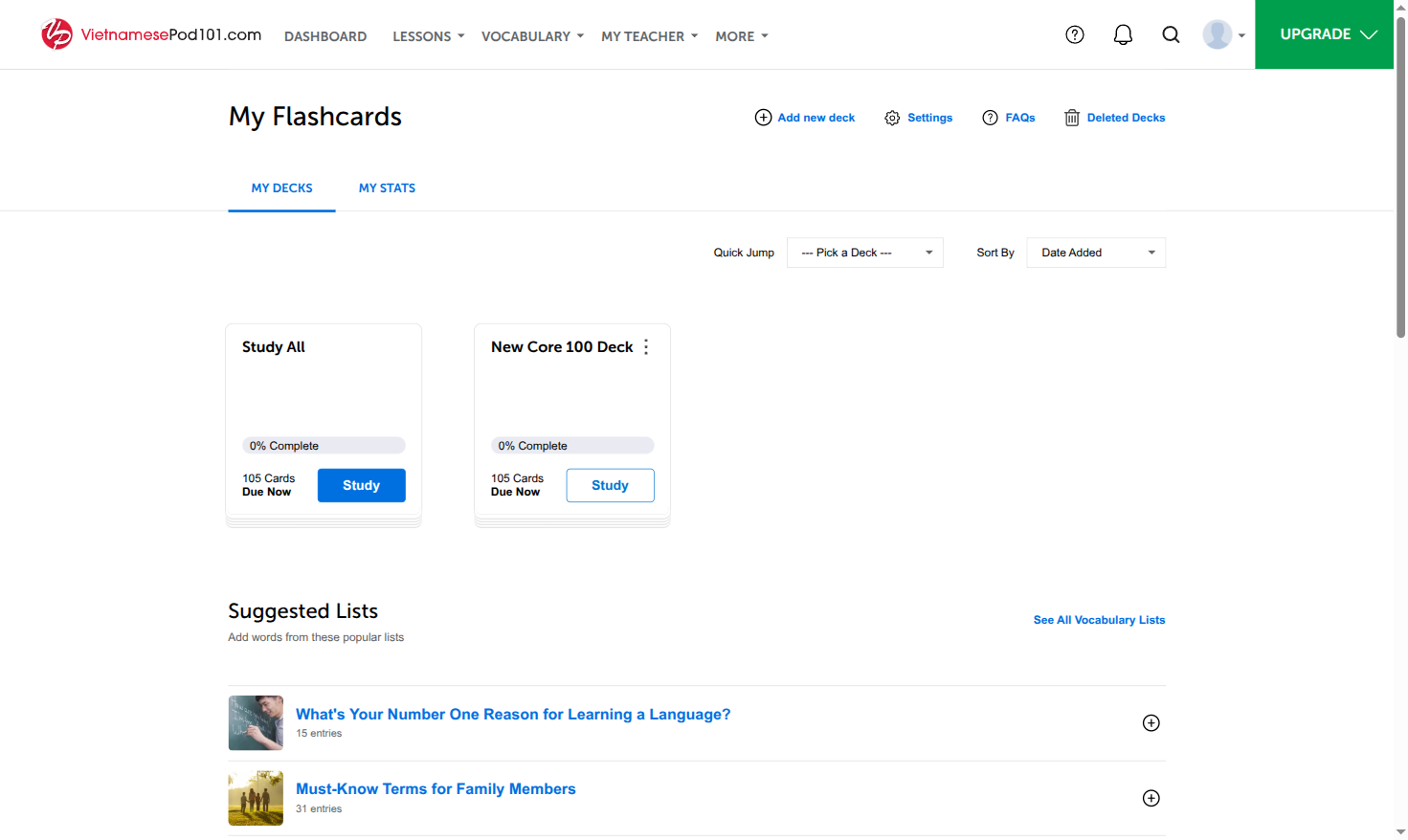
Premium opens up the SRS flashcard decks, a searchable word bank, the grammar bank, assessments, and the 2,000 core words list, a solid target vocabulary for real conversational ability. The flashcards let you quiz yourself by word, by picture or by audio, which suits a tonal language where you want to be tested on sound as much as on meaning.
The voice recorder and pronunciation-comparison tool sit in this same tier, and they’re the feature I’d point Vietnamese learners towards first. Recording a tone-heavy sentence and hearing it back next to a native speaker’s version is worth way more here than in most languages, because tone errors are so easy to miss in your own head and so obvious to a Vietnamese speaker’s ear.
The App
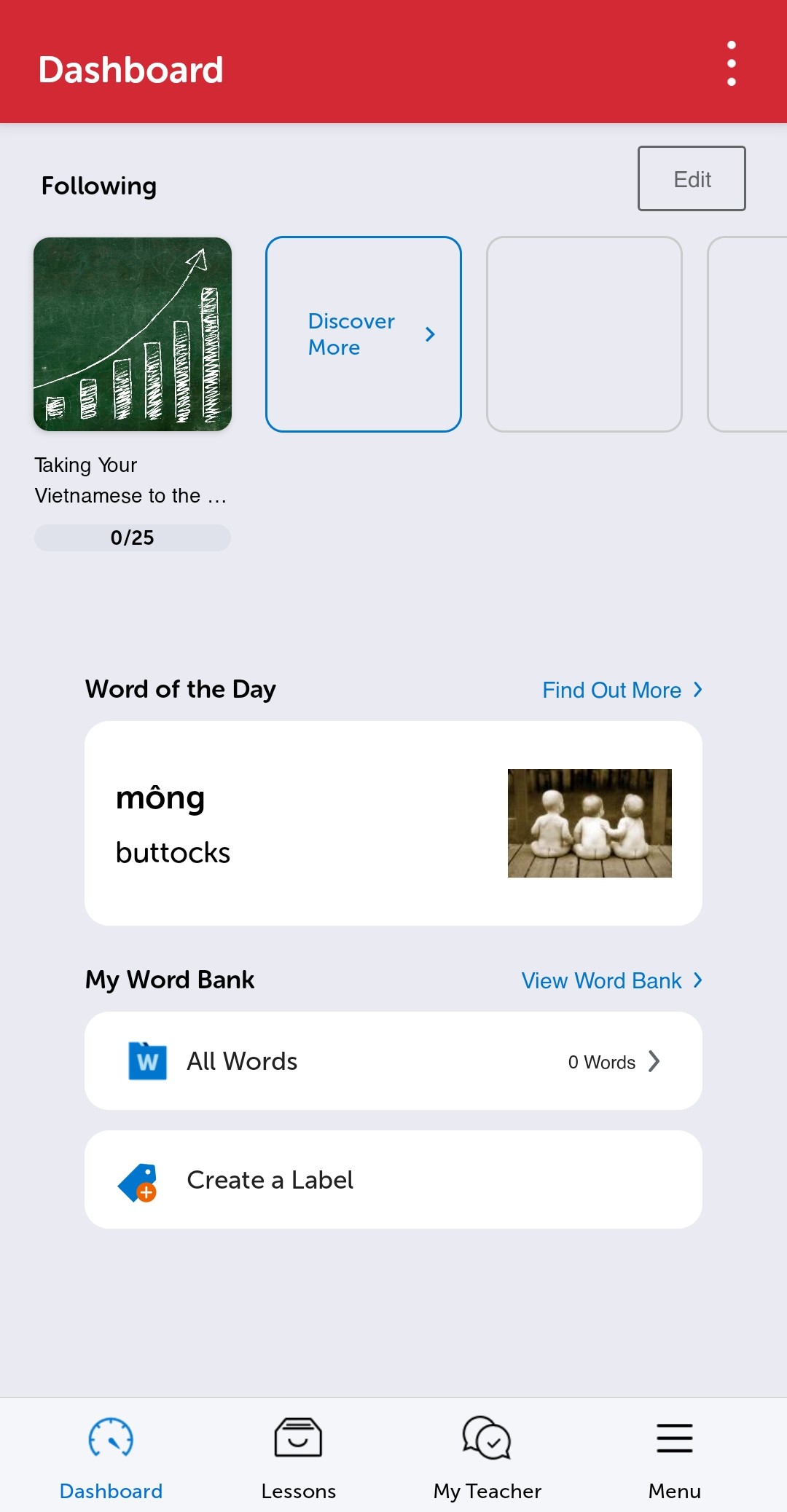
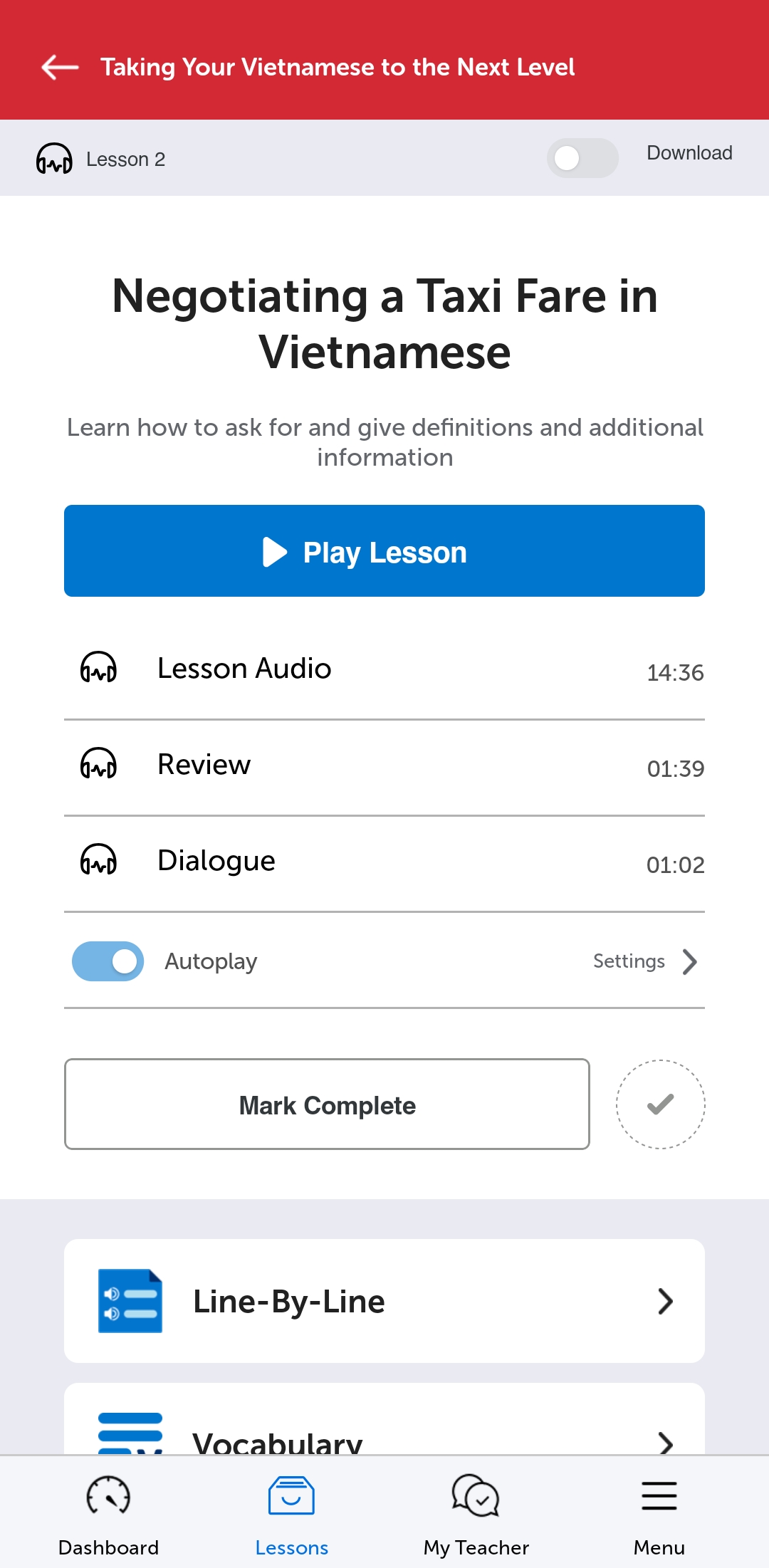
The mobile app syncs with your desktop account and carries most of the same lesson content, including the line-by-line audio and vocab lists. It’s noticeably lighter than the website though, and the same gap shows up here as in every other course in the family: you can’t follow your assigned study path or take assessments from within the app, so you’re picking a season and episode manually instead.
The workaround is simple enough: open the site in your phone’s browser when you want to follow your study path, and switch to the app for listening on the move. It’s a minor extra step, but know about it before assuming the app alone will carry your routine.
What Other Learners Say
The Innovative Language apps share one rating across every language they teach, and they’re well rated on both app stores, so there’s no Vietnamese-only score to point to.
The Vietnamese-specific praise lines up with what I found myself: solid grammar notes and vocab tools, real credit for distinguishing Northern and Southern dialects, and energetic native-speaker hosts. The criticisms came up independently from more than one source, so they deserve repeating too. The community around Vietnamese learners on the platform is thin, less the course’s fault than a reflection of Vietnamese being less commonly studied, but it does mean less peer interaction than you’d get with Spanish or Japanese. Speaking practice below Premium PLUS is limited to the recording tool, which can start to feel repetitive without a live conversation partner. Most notably, the lesson content thins out considerably past beginner level: two separate sources described the intermediate and advanced material as way less detailed than the beginner series, with one reviewer saying flatly they didn’t feel they learned much new even in the advanced section, and another recalling that the higher-level content used to be far more thorough.
Pricing and Plans
| Plan | Roughly | Unlocks |
|---|---|---|
| Free | Free forever | First 3 lessons of every series, survival phrases, Word of the Day, 100+ vocab lists, the app, 7-day Premium trial |
| Basic | ~$4/month | All lessons plus in-depth lesson notes |
| Premium | ~$10/month | Flashcards, word bank, line-by-line audio, assessments, grammar bank, pronunciation tool, 2,000 core words |
| Premium PLUS | ~$23/month | A 1-on-1 teacher, hand-graded work, personalised guidance |
Those headline prices reflect the 24-month rate, and Innovative Language runs discount promotions fairly often, so check the live checkout for the current price. There’s also a 60-day money-back guarantee, which takes loads of the risk out of trying Premium properly rather than judging the course from the free tier alone. For most learners, Premium is the sweet spot: it’s where the line-by-line audio and voice recorder live, and those are the two features that matter most for a language like this one.
Pros and Cons
Pros:
- Strong tone teaching, using the Northern standard with tone names rather than numbers, plus dedicated audio and recording tools
- Explicitly distinguishes Northern (Hanoi) and Southern (Saigon) pronunciation instead of treating Vietnamese as one accent
- Grammar explanations stay appropriately short, freeing up lesson time for the pronunciation work that actually matters
- Free lifetime account with no card required, so you can trial the tone lessons before paying
- Downloadable lesson notes and vocab lists make offline review straightforward
- Line-by-line audio and voice recorder give focused, repeatable pronunciation practice per sentence
Cons:
- Catalogue is mid-tier for Vietnamese, with noticeably fewer lessons than flagship Pod101 courses like Japanese
- Content thins out noticeably past beginner level, with intermediate and advanced material feeling less developed than the earlier lessons
- Diacritic drilling for vowel-quality marks feels secondary to tone teaching, so you may want extra practice with reading diacritics specifically
- The mobile app misses key features: you can’t follow your study path or take assessments from within it
- Speaking practice beyond the recording tool requires the priciest Premium PLUS tier
Who It’s (and Isn’t) For
VietnamesePod101 is a strong fit if you’re starting from zero and want a course built around Vietnamese’s real difficulty, the tones and the north-south split, instead of a generic template with Vietnamese vocabulary bolted on. It’s also a sensible choice if you already know which dialect you need, since the course addresses that distinction directly rather than assuming it away.
It’s a weaker fit if you’re aiming for advanced fluency and expect the paid tiers to carry you all the way there. The beginner and lower-intermediate content is where this course earns its keep; past that point, you’ll want to bring in native podcasts, a tutor or another advanced resource to keep progressing. It’s also not the right primary tool if speaking practice is your priority from day one, since real conversation only enters at the top pricing tier.
Verdict: 4.1 out of 5
VietnamesePod101 does the one job that matters most for this language and does it properly: it teaches tones by name, in the correct regional standard, with tools built for comparing your own pronunciation against a native speaker’s, and it’s honest enough to teach both Northern and Southern Vietnamese without picking one and ignoring the other. For a language where the entire difficulty budget sits in sound rather than grammar, that’s brilliant to see.
Where it falls short of a flagship rating is catalogue depth. It’s a well-built course for getting from zero to a confident low-intermediate level, but it’s thinner than Innovative Language’s biggest courses, and it thins further the higher you climb. I’d recommend it without hesitation as your starting point for Vietnamese, with the expectation that you’ll add other resources once you’re past the beginner stage.
Our affiliate link takes you to a plan-selection page with Innovative Language’s current discount already applied, so you won’t pay the full list price shown elsewhere on the site. If you’re ready to tackle Vietnamese’s tones head-on, check out VietnamesePod101 here.

Social