


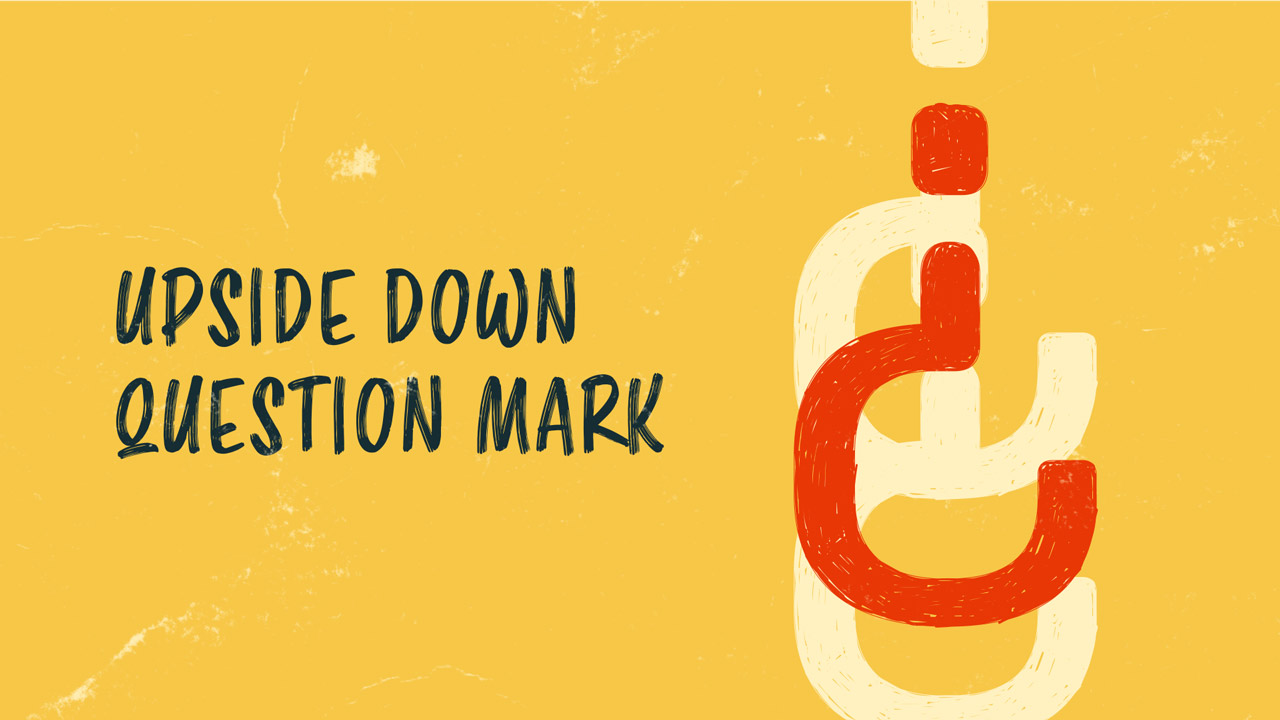
Upside-Down Question Mark (¿): How to Use and Type It

Full disclosure: This post contains affiliate links. ?
The upside-down question mark, ¿, can catch you off guard when you start learning Spanish.
Also called the inverted or opening question mark, it tells you that a direct question is beginning. That matters because Spanish questions do not always have a special word order to warn you in advance.
Here’s where ¿ goes, when you do and don’t need it, and how to type it on your computer or phone. Once you’ve got it, you can take your written Spanish to the next level.
If you want a clear structure for putting your Spanish into practice, take a look at the Fluent in 3 Months Bootcamp. It’s a 90-day programme with weekly coaching calls, a private community and a focus on speaking from day one.
Table of contents
- What Is the Upside-Down Question Mark?
- Why Does Spanish Use the Upside-Down Question Mark?
- How and When to Use the Upside-Down Question Mark
- How to Type the Upside-Down Question Mark
- Examples Using the Upside-Down Question Mark
- More Sentences with the Upside-Down Question Mark
- Is the Upside-Down Question Mark Used in Casual Spanish?
- Typing It in Google Docs and Other Apps
- Question Marks in Other Languages
- Get Used to the Upside-Down Question Mark
What Is the Upside-Down Question Mark?
The upside-down question mark, ¿, is the opening half of the question-mark pair used for direct questions in Spanish. English normally uses only “?” at the end. Spanish uses ¿ at the beginning of the question and “?” at the end:
- English: “How old are you?”
- Spanish: ¿Cuántos años tienes?
The opening mark goes immediately before the part that is actually being asked, even when the question starts partway through a longer sentence:
- Tú lo viste, ¿verdad? “You saw it, right?” The statement sits outside the marks, while the short confirmation question ¿verdad? sits inside them.
- Mañana hay clase, ¿pero igual vas a ir a la fiesta? “There’s school tomorrow, but are you still going to the party?” Only the final clause is a direct question.
That opening mark is not standard English punctuation. If you see ¿ in an English sentence, it is usually part of quoted Spanish or a deliberate stylistic choice.
Why Does Spanish Use the Upside-Down Question Mark?
The Real Academia Española (Royal Spanish Academy) first recommended opening question and exclamation marks in its 1754 orthography. Today, the RAE and the Association of Academies of the Spanish Language treat both marks as standard for a direct question.
The opening mark helps you spot the question before you reach the end. Spanish does not have one fixed question word order, so a sentence can begin like a statement and turn into a question. In writing, ¿ removes that ambiguity straight away.
This convention applies across Spanish-speaking countries, even though everyday expressions vary. You might hear ¡Qué lata! (“How annoying!”) in Chile or ¿Qué bolá? (“What’s up?”) in Cuba. In standard writing, each direct question or exclamation has its opening and closing mark.
How and When to Use the Upside-Down Question Mark
Put ¿ where the direct question begins and “?” where it ends. If the whole sentence is a question, the marks enclose the whole sentence:
- ¿Vas a comprar un coche nuevo? “Are you going to buy a new car?”
If the question appears inside a longer sentence, the marks enclose only that direct question:
- Jimena me preguntó: «¿Qué harías tú en esa situación?», y no supe qué decir. “Jimena asked me what I would do in that situation, and I didn’t know what to say.”
Indirect questions report or embed a question rather than asking it directly, so they do not take question marks:
- Julia me preguntó si yo quería ir al cine. “Julia asked me if I wanted to go to the movies.”
- Me pregunto dónde está. “I wonder where he, she or it is.”
A long indirect question follows the same rule. It does not take question marks unless the whole sentence is itself a direct question:
- Quiero saber cuánto tiempo pasará hasta que pueda ver los resultados del examen porque necesito hacer planes. “I want to know how long it will be until I can see the exam results because I need to make plans.”
The opening mark always needs a closing partner. If you write two separate questions, give each one its own pair:
¿Quieres ir al banco? ¿O prefieres que vaya yo? “Do you want to go to the bank? Or would you prefer me to go?”
How to Type the Upside-Down Question Mark
You can always copy ¿ from this page, but a keyboard shortcut is quicker when you write Spanish regularly. The exact keys depend on your device and keyboard layout.
Windows
On a keyboard with a numeric keypad, hold Alt, type 0191 on the keypad, then release Alt. Num Lock may need to be on. Without a numeric keypad, press Windows key + . (full stop), choose Symbols, and look under punctuation. Microsoft’s Windows keyboard guide documents both routes. You can also search for Character Map from the Start menu, select ¿, and copy it.
Mac
On the ABC or US keyboard layout, press Option + Shift + /. If you use another layout, open macOS Keyboard Viewer and hold Option and Shift to see which key produces ¿. Character Viewer is another reliable option.
Chromebook
Add a Spanish or US International input method in Settings → Device → Keyboard → Change input settings. With the US International layout selected, hold the right Alt key and press /. The Spanish layout also gives you direct access to the opening mark.
iPhone and iPad
Tap 123 to show punctuation, then touch and hold the ? key. Slide your finger to ¿ and release.
Android
Android keyboards vary. In Gboard, add a Spanish keyboard under Settings → Languages → Add keyboard, switch to it, and open the punctuation keys to find ¿. Some layouts also show it when you touch and hold ?.
Examples Using the Upside-Down Question Mark
In speech, intonation often tells you whether the speaker is asking a question. In writing, the opening and closing marks do that job.
For example, Vas a venir conmigo. means “You’re going to come with me.” Add question marks, and ¿Vas a venir conmigo? means “Are you going to come with me?” The words can stay in the same order while the punctuation and spoken intonation change the function.
Use these recordings to compare each statement with its matching question.
| English | Spanish | Audio |
|---|---|---|
| “Will you come with me?” | ¿Vas a venir conmigo? | |
| “You will come with me.” | Vas a venir conmigo. | |
| “Can you help me?” | ¿Puedes ayudarme? | |
| “You can help me.” | Puedes ayudarme. | |
| “Are you ready to leave?” | ¿Estás listo para salir? | |
| “You are ready to leave.” | Estás listo para salir. | |
| “Does she eat pasta?” | ¿Ella come pasta? | |
| “She eats pasta.” | Ella come pasta. | |
| “Does he want to come?” | ¿Él quiere venir? | |
| “He wants to come.” | Él quiere venir. |
More Sentences with the Upside-Down Question Mark
In standard prose, direct Spanish questions take both marks. This applies to a short question such as ¿Qué hora es? (“What time is it?”) and to a surprised question such as ¿¡Qué has hecho!? (“What have you done?!”). When a sentence also includes a statement, condition or name, place the opening mark where the direct question begins.
| English | Spanish | Audio |
|---|---|---|
| “What do you want to eat?” | ¿Qué quieres comer? | |
| “Can you tell me how to get to the post office?” | ¿Puedes decirme cómo llegar al correo? | |
| “Do you like coffee?” | ¿Te gusta el café? | |
| “Are you crazy?” | ¿¡Estás loco!? | |
| “Is all this for me?!” | ¿¡Todo esto es para mí!? | |
| “When you get home, can you call me?” | Cuando llegues a casa, ¿puedes llamarme? | |
| “If you go to the supermarket, could you buy milk?” | Si vas al supermercado, ¿podrías comprar leche? | |
| “Paula, did you get my message?” | Paula, ¿recibiste mi mensaje? |
Is the Upside-Down Question Mark Used in Casual Spanish?
In standard Spanish writing, use both ¿ and “?” for a direct question. You may see people drop the opening mark in quick texts or social posts, but that casual shortcut does not change the standard rule. As a learner, writing ¿Qué tal? rather than Que tal? also helps you remember the accent on qué.
The RAE does recognise a few narrow typographical exceptions, including some titles framed as questions. Those exceptions are not a reason to omit ¿ in ordinary sentences.
Typing It in Google Docs and Other Apps
In Google Docs, go to Insert → Symbols → Special characters, then search for “inverted question mark” or draw the symbol in the search box. In Microsoft Word, use Insert → Symbol → More Symbols. You can also copy this one and paste it: ¿
Question Marks in Other Languages
Spanish is distinctive because it marks the beginning and end of a direct question. Other writing systems have different conventions. Modern Greek uses a semicolon-shaped question mark, ;, while Arabic-script languages including Arabic, Persian and Urdu use ؟. These are separate punctuation systems, not alternatives to Spanish ¿…?.
Get Used to the Upside-Down Question Mark
The upside-down question mark can look unusual at first, but its job is simple: it shows you exactly where a direct question begins. You’ll see it in common Spanish phrases such as ¿Cómo estás? (“How are you?”) and ¿De dónde eres? (“Where are you from?”). Use both marks when you write, and it will soon feel normal.

Social