


40+ Ways to Say “Thank You” in Vietnamese (Comprehensive Guide)

Full disclosure: This post contains affiliate links. ?

Question: What do you call a cat that knows how to say “Thank you”?
Cat-titude! This is my cat, Vinyasa, aka Vinny.

This is my wife giving me a strange upward left jab to the head. I must have forgotten to say cảm ơn em the night before…
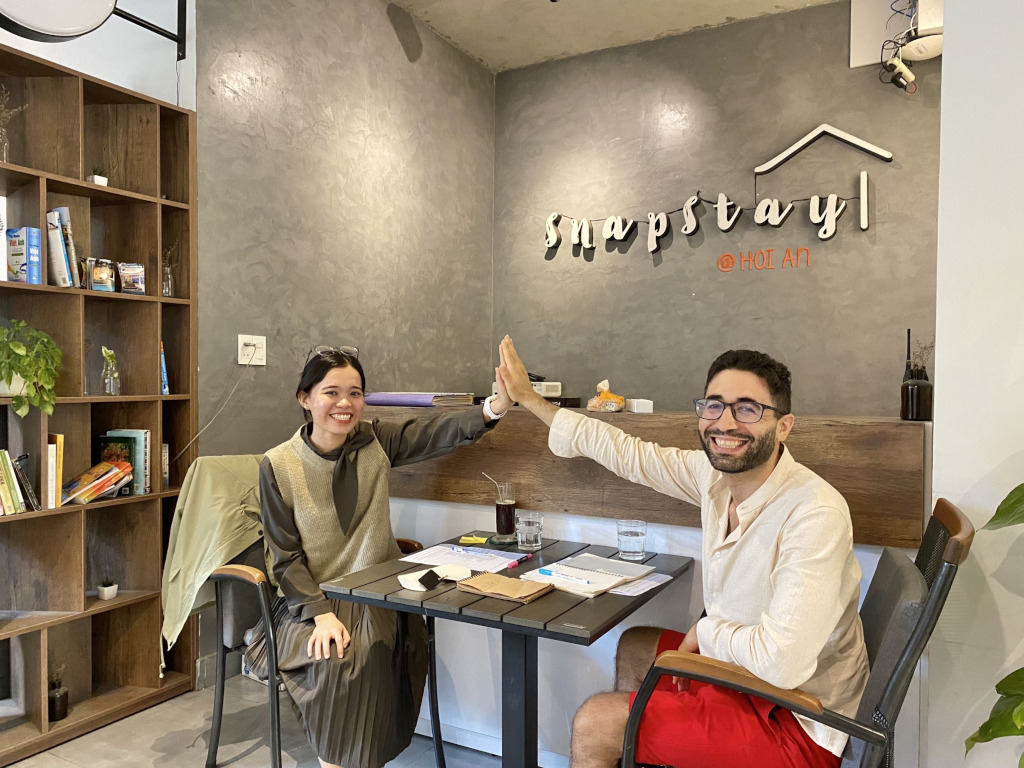
Cô Thuý, my Vietnamese teacher and friend. She helped edit this post. Cảm ơn Cô nhé!

Doing my Vietnamese homework with a view. Learning Vietnamese is much like growing rice: it takes patience and dedication, but the end result is nourishing.
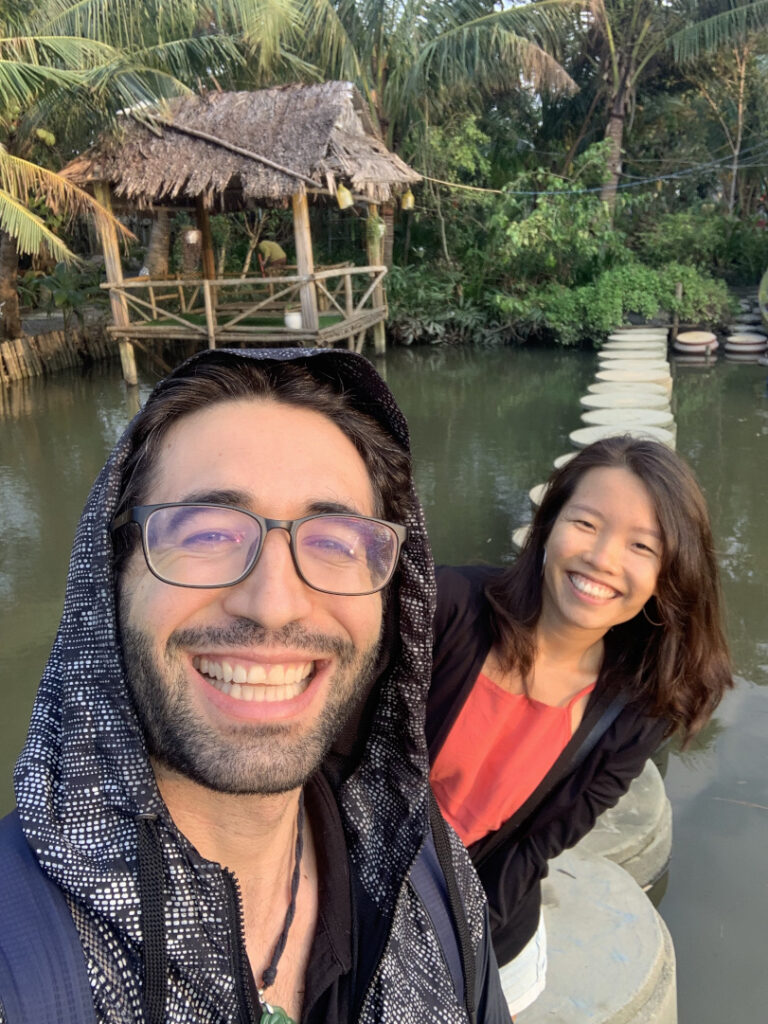
Anh rất là biết ơn vợ anh (“I am very grateful to my wife.”).
A note from the Fluent in 3 Months team before we get started: You can chat away with a native speaker for at least 15 minutes with the “Fluent in 3 Months” method. All it takes is 90 days. Tap this link to find out more.
Table of contents
- The Importance of Expressing Gratitude: How to Say Thank You in Vietnamese
- How to Say Thank You in Vietnamese: Basic Phrases and Pronunciation Guide
- Finding The Pronoun So You Can Say “Thank You” In Vietnamese Correctly
- The Most Common Examples of “Thank You” In Vietnamese Including Pronouns
- How To Add A Personal Touch To Your “Thank You” In Vietnamese
- How to Say Thank You in Vietnamese Based on the Situation
- How To Say “No Thank You” In Vietnamese
- “You’re Welcome” in Vietnamese
- Other Related Words & Expressions Of Gratitude
- Advanced Pronunciation Tip: Northern, Central, and Southern Accents
- Be Grateful and Express It!
The Importance of Expressing Gratitude: How to Say Thank You in Vietnamese
One could argue that “thank you” is the most important word you should learn when you are just beginning to learn a language. At the very least, you can express your appreciation to others! I believe that being polite is usually a good choice wherever I find myself and whatever language I am learning.
Gratitude is part of daily life in Vietnam. Whether you’re planning a visit or speaking Vietnamese with a friend, it’s useful to know how to thank someone in a way that fits the relationship.
In this comprehensive guide, we’ll cover the basics of how to say “thank you” in Vietnamese, including some pronunciation tips, common scenarios, and cultural norms.
By the end of this article, you’ll have a clearer sense of how Vietnamese speakers express appreciation, plus plenty of phrases to practise. And of course, you can thank me later, in Vietnamese. 🙂
How to Say Thank You in Vietnamese: Basic Phrases and Pronunciation Guide
The easiest and shortest way to say “thank you” in Vietnamese is cảm ơn. This expression works in both formal and informal settings, although the pronoun or address term you add can change its tone.
Once you’ve got this phrase, learn a few more Vietnamese words for everyday conversations so you can keep the exchange going.
The exact pronunciation varies by region, and English respellings lose the tones that distinguish Vietnamese words. Keep the spelling cảm ơn, and listen to the regional comparison video later in this post.
Another way to say “thank you” is xin cảm ơn. Adding xin makes the phrase more formal or deferential, so you will often hear it in public, professional, or ceremonial settings. In everyday transactions at cafés, restaurants, hotels, and shops, plain cảm ơn is common.
You may also see the spelling cám ơn. The authoritative Hoàng Phê dictionary records cảm (cám) ơn, and usage varies by speaker and region; this article uses cảm ơn consistently.
With friends and family, speakers often add a kinship or address term such as anh, chị, em, mẹ, or ba. This makes the thanks more personal and shows how the two speakers relate to each other. Bare cảm ơn is still understandable; it isn’t automatically disrespectful, but it can sound less warm in a close relationship.
It took me a while to understand this, but the difference can be best illustrated through a texting example. When someone writes “Thank you, Jeremy,” to me in a message, it lands differently than if they write “thx” or simply send an emoji. Writing it out fully and using my full name just feels more sincere and personal.
That texting comparison helps explain why an address term can make cảm ơn sound warmer. In a close relationship, include the pronoun or kinship term that fits; in a formal setting, use xin cảm ơn.
Vietnamese has a relationship-based system of pronouns and address terms. The words used for “I” and “you” change with relative age, generation, gender, family position, role, and familiarity, so the English glosses below are only starting points.
Finding The Pronoun So You Can Say “Thank You” In Vietnamese Correctly
Here are the most common pronouns you will come across:
- Tôi – “I” (neutral or formal, often used with strangers and in public settings)
- Bạn – “You; friend” (often used with peers)
- Mình – “I/me” in informal speech; it can also mean “we” or work reciprocally in close relationships
- Bố/Ba/Cha – “Father”
- Má/Mẹ – “Mother”
- Cháu – “Grandchild; niece/nephew” / Con – “Child; son/daughter”
- Anh – “Older brother”
- Chị – “Older sister”
- Em – “Younger brother/sister”
- Ông – “Grandfather”
- Bà – “Grandmother”
- Bác/Chú – Older-generation kinship terms; the exact family meaning and social use depend on age, family side, and region
- Cô/Dì – Female kinship terms whose exact family meaning and social use depend on generation, family side, role, and region
These kinship terms also work as pronouns and forms of address beyond the literal family relationship. The choice reflects how the speakers place themselves in relation to each other, which is why age alone never gives you the whole answer.
Adding an appropriate pronoun or address term often makes Vietnamese thanks sound more natural and personal. Here are some common patterns.
- “Thank you” to a younger person in your broad generation: Cảm ơn em.
- “I thank you” when the speaker is younger and the addressee is a somewhat older man: Em cảm ơn anh. Here, em names the speaker’s role and anh addresses the listener.
- “Thank you” in Vietnamese to an entire family: Mình cảm ơn cả gia đình, literally, “I thank all of the family” or mình cảm ơn cả nhà (“I thank the entire household”).
- “Thank you, mom” in Vietnamese: Cảm ơn mẹ (Northern) or cảm ơn má (Southern).
- “Thank you, dad” in Vietnamese: Cảm ơn bố (Northern) or cảm ơn ba (Southern).
- “Thank you” to both parents in Vietnamese: Cảm ơn bố mẹ (Northern) or cảm ơn ba má (Southern).
- “Thank you” to a very close friend: Cảm ơn mày is widely understood but can be rough or insulting outside an established intimate register; regional mi is especially associated with Central Vietnamese. Copy neither term until you know the relationship allows it.
- “Thank you” to your older sister or to a woman slightly older than you: Cảm ơn chị.
- “I thank you” to your grandmother or a woman of her generation: Cháu cảm ơn bà.
- “I thank you” to your grandfather or a man of his generation: Cháu cảm ơn ông.
The Most Common Examples of “Thank You” In Vietnamese Including Pronouns
You can use cảm ơn ông/bà for an elderly man or woman, roughly someone of grandparent age. Age, gender, generation, role, and relationship all affect pronoun choice; teachers, bosses, and officials aren't automatically addressed as ông/bà.
With a peer of roughly the same age, you can use cảm ơn bạn for “thank you.” For a younger person, a kinship term such as em may be more appropriate, depending on the relationship.
You can use cảm ơn em when addressing a younger person in the same broad generation. The choice is based mainly on relative age, generation, and relationship, not simply on a person having lower social status.
Cảm ơn em is what I use at cafés and restaurants unless the staff appears to be significantly older than me. As I get older, I may sometimes use cảm ơn con with someone much younger, when that relationship feels natural.
You can use cảm ơn anh for a somewhat older male and cảm ơn chị for a somewhat older female in your broad generation.
Kinship terms and pronouns also appear in workplaces and transactions, not just in families. In my experience, even an older taxi driver has sometimes referred to me as anh when I was the customer, which shows that role can interact with age.
The address term matters because it reflects the relationship between speaker and listener. A well-chosen term can make your thanks sound warmer and more respectful, but Vietnamese speakers also know that this system takes learners time to understand.
If you choose imperfectly, most people will hear that you’re a learner. Notice which terms the other person uses, or ask a Vietnamese friend which pair fits the relationship. Age matters, but so do generation, family position, work roles, and regional habits.
For example, a woman in roughly your parents’ generation may be cô, while chị often suits a woman only somewhat older than you. Neither term is automatically “more polite”; the relationship decides.
If you’re unsure, you can avoid choosing an address term by saying xin cảm ơn, though it can sound formal in casual conversation.
How To Add A Personal Touch To Your “Thank You” In Vietnamese
You can add the sentence-final particle nha or nhé to make the thanks sound friendlier or softer. Usage varies by region and speaker, and neither particle has a single word-for-word English equivalent.
If you haven’t memorised all the pronouns yet, saying cảm ơn nhé or cảm ơn nha can sound friendly in an informal setting. The particle adds a softening nuance rather than naming the listener, and it can also follow a pronoun:
- Cảm ơn anh nhé : “thank you, older brother”
- Cảm ơn chú nhé : “thank you, uncle”
- Cảm ơn em nhé : “thank you, younger sister/brother”
Nhé and nha signal friendliness; they aren’t the main respect markers for an elder or formal exchange. Vietnamese can place dạ at the beginning and ạ at the end, while the pronouns still need to fit the relationship:
- Dạ, cháu cảm ơn ông ạ : respectful thanks to a grandfather or man of his generation
- Dạ, cháu cảm ơn bà ạ : respectful thanks to a grandmother or woman of her generation
How to Say Thank You in Vietnamese Based on the Situation
Saying “thank you” is just the foundation. Next, let’s look at some common scenarios and the appropriate expressions to use:
- Cảm ơn bạn nhiều – “thank you very much”
[Note: Remember, bạn can be replaced with an appropriate pronoun or address term depending on the situation.] - Cảm ơn rất (là) nhiều – “Thank you very much”
- Xin cảm ơn quý khách. – “Thank you, valued customer”
- Cảm ơn bạn đã giúp đỡ tôi – “Thank you for helping me”
- Cảm ơn bạn đã dành thời gian cho tôi – “Thank you for spending time with me”
- Cảm ơn bạn đã tặng quà cho mình – “Thank you for giving me a gift”
- Cảm ơn cả nhà đã mời mình – “Thank you all for inviting me”
- Cảm ơn bạn đã ủng hộ mình – “Thank you for your support”
- Cảm ơn bạn đã thông cảm cho tôi – “Thank you for understanding/sympathizing with me”
- Cảm ơn vì đã hiểu (cho) mình – “Thank you for understanding me”
- Cảm ơn bạn đã đối xử tốt với mình – “Thank you for treating me kindly”
- Cảm ơn bạn vì mọi thứ – “Thank you for everything”
- Cảm ơn bạn đã chia sẻ – “Thank you for sharing”
- Cảm ơn bạn đã lắng nghe – “Thank you for listening”
Next, let’s look a little closer at some of the phrases above and what situations they may be used in.
Cảm ơn rất (là) nhiều – “Thank you very much”
When you want to express stronger gratitude, you can say cảm ơn rất nhiều, meaning “thank you very much”. Adding là gives the phrase a more conversational, emphatic feel: cảm ơn rất là nhiều.
This works whenever you want to emphasise the thanks. Formality comes more from the full sentence, pronouns, and particles than from rất nhiều alone.
Cảm ơn cả nhà đã mời mình – “Thank you all for inviting me”
In my experience, Vietnamese hosts can be extremely hospitable. I’ve seen hosts offer a guest their own bed or wave away help in the kitchen, although every household is different.
The phrase above is more often used in place of “thank you for your hospitality”. If you’ve just finished a delicious meal, you can say: Cảm ơn cả nhà đã mời mình. Đồ ăn hôm nay ngon quá! It means: “Thank you to everyone for inviting me. The food today was delicious!”
Cảm ơn bạn đã ủng hộ mình – “Thank you for your support”
If someone has supported or encouraged you, you can say cảm ơn bạn đã ủng hộ mình. The exact pronouns can change with the relationship.
Cảm ơn vì đã hiểu (cho) mình – “Thank you for understanding me”
Cảm ơn vì đã hiểu mình thanks someone for understanding you. Adding cho in hiểu cho mình leans towards “being understanding towards me”.
Cảm ơn bạn đã đối xử tốt với mình – “Thank you for treating me kindly”
If someone has treated you kindly, you can say cảm ơn bạn đã đối xử tốt với mình. Replace bạn and mình if a different relationship calls for other pronouns.
Lòng can refer to the heart, feelings, or inner disposition, depending on context. In lòng tốt, it combines with tốt to mean kindness or goodness. Pronunciation varies by region, so copy a native recording rather than an English spelling or a mouth-position shortcut.
Cảm ơn bạn vì mọi thứ – “Thank you for everything”
This phrase is a great way to express your deep appreciation for someone who has helped you in many ways. To be honest, I should probably say this to my Vietnamese wife more! 🙂
Cảm ơn bạn đã tặng quà cho mình – “Thank you for giving me a gift”
If someone has given you a gift, you can say cảm ơn bạn đã tặng quà cho mình. It thanks the person for the act of giving, without repeating bạn in a word-for-word English pattern.
Cảm ơn bạn đã chia sẻ – “Thank you for sharing”
This can be used in the context where someone is telling a personal story or revealing something deep about themselves. Or, you can say this to children who simply like to talk a lot. If you heard what they said but have no idea exactly what to respond to because it was a bit all over the place, you can simply say, “thanks for sharing”.
Cảm ơn bạn đã lắng nghe – “Thank you for listening”
This fits when someone has listened without interrupting while you shared something personal.
How To Say “No Thank You” In Vietnamese
A direct không, cảm ơn means “no, thank you” and is understandable. A softer refusal can use thôi, cảm ơn (roughly, “I’ll pass, thank you”). My Vietnamese wife confirmed that the direct version is used too, although my own experience has shown me how much the context matters.
In some of my conversations, a person I offered food to smiled and said dạ, cảm ơn, a polite “thank you”, without taking the food.
At first, this was a bit confusing to me. If someone offered me something and I said “thanks”, it would mean that I am accepting their gift. However, here it seems that they are saying “thank you” but implying a “no, thank you”.
Vietnamese cảm ơn can accompany either accepting or refusing an offer. In my own conversations, the person’s words, movement, and the situation together have made the intended answer clear, so treat this as a contextual pattern rather than a fixed body-language rule.
“You’re Welcome” in Vietnamese
A common way to say “you’re welcome” is không có gì, literally “there’s nothing” or “it’s nothing”. The reply can be adjusted for familiarity, respect, and region.
With someone you know well, có gì đâu (“it’s nothing”) is a natural casual reply. For a more respectful exchange, you can add dạ at the beginning or ạ at the end, as in dạ, không có gì ạ. You may also hear the regional alternative không có chi, especially in Central and Southern Vietnamese.
Other variations of “you’re welcome” in Vietnamese include:
- Không sao – “It’s okay”
- Không sao đâu – “It’s okay”
- Không có gì hết – “It’s nothing at all”
In shops and restaurants, I’ve often heard the other person reply with another cảm ơn after I say cảm ơn nhé. The exchange is reciprocal thanks rather than a literal “you’re welcome”.
So, the conversation looks like this at a convenience store or a market.
Me: Cảm ơn chị nhiều (“Thank you very much,” addressing a somewhat older woman as chị, as I’m leaving).
Woman: Cảm ơn! (“Thanks!”)
Other Related Words & Expressions Of Gratitude
Vietnamese doesn't use one universal equivalent of English “please” in every context. Depending on the request, speakers may use xin, làm ơn, or vui lòng, together with appropriate pronouns and particles. The marker hãy can introduce an imperative or exhortation, but it doesn't mean “please” by itself.
Vietnamese politeness is often expressed through pronouns, kinship terms, particles, and sentence structure rather than by inserting one fixed word wherever English uses “please.” That doesn't make forms such as xin, làm ơn, or vui lòng unnecessary; their appropriateness depends on context and register.
Anyhow, here are some other related words that are useful to know:
- Biết ơn – “grateful”
- Sự biết ơn – “gratitude”
- Vô ơn – “ungrateful”
- Quý trọng – “to value or hold in high regard”
- Trân trọng – “to value highly or treat with respect”; also used in formal closings
- Quan tâm – “to care about or take an interest in someone or something”
- Thông cảm nha – “please understand” or “please bear with me” (informal)
Thông cảm nha is often used when you are slightly inconveniencing the other person. In English, if I am running late I may say “sorry to keep you waiting” or “thanks for your patience”, or just a simple “sorry.”
In an informal relationship where a male speaker refers to himself as anh, he could say anh tới trễ 10 phút, thông cảm nha (“I’ll be ten minutes late, please understand”).
Here’s another example of thông cảm. During the pandemic, the Vietnamese government would blast announcements through the neighbourhood loudspeakers twice a day, at 5:30 a.m. and 5:30 p.m. As you might imagine, this was not something I enjoyed.
One day, I angrily asked my landlord if she could talk to the local government and see if it was possible to lower the volume of these extremely obnoxious announcements. She explained why the government was doing what they were doing, and ended her response with thông cảm nhé (“please understand”). Funny, because it was actually me who wanted some sympathy!
Truth be told, I did not have much sympathy at the time. But I did learn a new word that day, so I guess I came out ahead. 🙂
Advanced Pronunciation Tip: Northern, Central, and Southern Accents
By the time I wrote this in 2023, I had lived in Vietnam for more than five years and was starting to grasp some of the differences between regional accents.
If you want to hear the regional differences, this video I made compares cảm ơn in Northern, Southern, and Central Vietnamese:
For more guided audio practice, read our VietnamesePod101 review.
When I wrote this, I lived in Hội An. I often used a local pronunciation that I wrote as cổm ơn nghe, and people there usually understood the playful imitation. Central Vietnamese varies widely, so treat this as my Hội An experience rather than a pronunciation rule for the whole region.
Be Grateful and Express It!
Remember, learning a new language is not just about memorising vocabulary and grammar rules. It also means noticing how people relate to one another. A well-placed xin cảm ơn, or a warmer thanks with the right address term, can help you show respect and connect.
So, next time someone does something kind for you, big or small, remember to say cảm ơn nhé or xin cảm ơn and show your gratitude. It’s good for both you and the person you’re thanking.
Cảm ơn đã đọc nhé! “Thanks for reading!”

Social