

Join over ¼ million
monthly
readers!

Contact Me

Current mission

Travel China using
the Mandarin I
learned in 3 months!

Previous post:

Next post:

Are Germans rude? Killing the stereotypes after living in Berlin

| 71 comments | Category: particular languages, travel

Rather than learning languages for academic or professional reasons, I do it to vastly improve my travel experience by allowing me to socialise almost entirely with residents of the country I am visiting.

Even though all the studying I did in for my exam in Berlin prevented me from socialising as much as I would have liked, after spending four months there I can say that I have a better understanding of German (and in particular Berlin) culture and I am ready to challenge the silly stereotypes that too many people have of the Germans and the German language.

German sounds horrible!

It might be true that more typical languages that English learners tend to go for like French and Spanish can sound pleasant to listen to even if you don’t understand them, but it’s better to think outside of those limitations. Comparing German to Italian, for example, is like comparing ice cream to pizza. The most enjoyable food doesn’t have to be “hot” and certain aspects of communicating in German can be more pleasant than in other languages.

English and German are in the same language family (Germanic), so a lot of what makes German sound “different” can actually be its similarities that we don’t notice in English and may not expect to encounter in other languages. Listen to this video of what English sounds like to non-natives (from an Italian perspective) and you’ll get a better idea of how strange it can be!

English also has weird strings of consonants that can cause problems to non-natives but seem totally normal to us. Words like catchphrase and thousandths have several consecutive consonants together that German doesn’t outdo much (definitely not as much as a language like Czech).

The tone and musicality of German is actually something that makes it much easier to understand and leaves less room for misinterpretation, as is the case in other languages. The clear separation of words vastly helps you to understand them (compared to French for example where words are merged together when spoken). I find the discussion of whether this is “pretty” or not to be totally irrelevant myself. We may as well argue about which colour is the “best”.

Why are they so angry?

This superficial argument is like saying you understand what the elephants are thinking as you see them through binoculars on safari. Without the right context and understanding of how German works, any conclusions you might make may amount to nothing remotely close to the truth.

The clear way that Germans speak is something that we would tend to do in English if we were angry and wanted to make it clear what we are angry about. For example, you can imagine an angry mother sternly warning her son: “Don’t – you – dare – do – that!” clearly enunciating each word.

This is a style of expressing anger in English. Applying it to German just doesn’t work in the same way. In understanding what they were saying I can generally say that from my (albeit limited) experience, Germans lose their temper way less than many English-speakers would do. In fact, Germans tend to be way more patient from what I’ve seen. What sounds harsh to the untrained ear can actually be a funny joke or helpful advice etc. when you listen to the actual words.
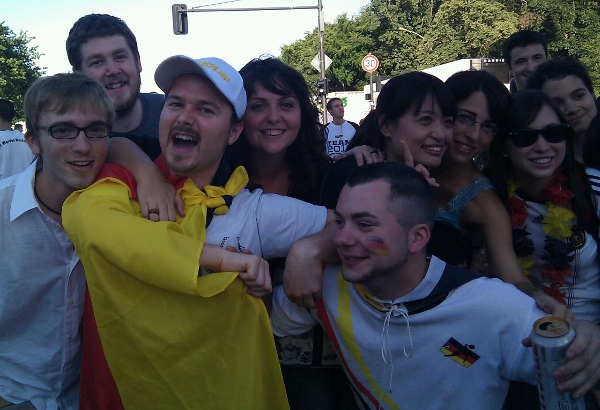
When you actually pay attention to what they are saying, rather than applying the wrong non-verbal cues (using English tone and body language rules) to imagine what you think they are saying, you’ll see that they are talking about the same things you and your friends talk about in other languages.

They all speak English and will never help you with your German

As expected, when I announced that I’d be in Berlin for this mission (rather than some small unknown village), many people told me that I’d find it extremely difficult to convince Berliners to help me with my German, since they all speak “perfect” English.

Like in other places there are people who did poorly in school, or don’t expose themselves to foreigners enough to maintain a good level. But for the most part, they do indeed have a better level of English than southern Europeans or some Asian countries.

Despite this, it was extremely easy to convince all Germans to help me. Even in my first week I was successful and for the main three months of the mission I almost never spoke English with Germans – the few times I did were because other foreigners (not learning German) were present or in my final weeks before leaving. When they saw how devoted I was to my project they were happy to give me lots of encouragement to boot!

This confusion is another issue that results from the Germans being accused of something that is actually entirely the lazy learners‘ fault. Germans are actually usually really helpful so if you look like you are undergoing medieval torture as you struggle to speak the language, they’ll want to save you from that discomfort and may speak English because of that.

I made sure to make it clear that I was enjoying myself, that I was devoted to making serious progress and used all my usual social (Language Hacking) tricks when out and speaking with new people, and without exception I never even had to work hard to convince anyone to help me, even when my level was quite poor. They simply went with the flow. Sadly the flow many expats command is “German is too hard and Germans don’t want to hear me try” and that mantra becomes a self-fulfilling prophecy.

German is one of the hardest languages in the world

Since I’m supposedly learning another one of the “hardest languages” in the world right now, I will discuss this ridiculous concept another time soon. But first, I can confirm that German itself isn’t particularly inherently harder than many other languages in the world. It all depends on the learner and his/her attitude.

Expats I had met who had been living in Germany for a long time would complain about how German is too hard to speak and I could see very clearly and told them very frankly that this complaint and devotion to believing in it was what was actually holding them back from speaking it.

I was attempting the exact same language as they were – the main difference I see is that they simply focus on the negative and look for more reasons to prevent them from speaking it. An optimistic approach can dramatically change their potential to make progress. What helps me to get through languages quicker is not some magic part of my brain that has sprouted up in recent years to turn me into a language-guru – it’s actually the ability to focus on the positive and have new information about the language help me to progress rather than hinder me.

But simply telling someone “Chin up! It’s not that bad!” is not enough, since there are aspects to the language that can seem intimidating at first, especially if its your first foreign language and if its explained to you in traditional dull academic ways.

Because of this I will be writing in great detail about Why German isn’t as hard as you think and will take all the “hardest” aspects of the language and attempt to explain them in such a way as to turn some pessimists into optimists and help struggling learners dramatically improve their progress by attacking what I feel is the route of the problem for a lot of them: the wrong attitude that German is hard.

I learned German for five years in school and the wrong attitude kept me believing that aspects of German were too complicated for me to get my head around them, and so I did poorly in my exams and never truly dived into properly speaking German until this year. Starting over fresh and forgetting the overly technical way that the language was explained to me in school saved me from being doomed to never speaking it.

Some time in August I’ll work on and release a guide to hacking the German language: giving short-cuts to get around seemingly difficult aspects, explaining a better way to look at the Accusative, Dative, Genitive problem, and seeing that the word order and remembering vocabulary is actually way easier than people think it is. Sometimes all you need is to hear these things explained in the right (non-overly-technical) way and it all makes perfect sense. This guide will not attempt to replace any courses, but augment them for learners already vaguely familiar with the language but feeling intimidated by it.

I am positive that what I have to say can help people to progress in their German, as I have been giving this advice to other learners throughout my time in Berlin to help those struggling with the language themselves and it worked to help some of them get out of their shell and finally speak.

If you’d like me to mention any aspect of German you find particularly hard, let me know! More on that guide soon…

Are Germans strict/rude?

There are many stereotypes I won’t even dignify with a response, but the strict one comes up a lot. I imagine this is influenced by the “German sounds harsh” idea, and perhaps gets combined with the Germans’ fame for efficiency. How well they design cars was the least of my concerns for my time there though.

I did find it curious that Berliners would almost always wait at red traffic lights before walking across the road, even when there were no cars for miles. Most other places I’ve been would have people “jaywalking” in this situation quite frequently (I personally consider the red man a suggestion rather than a rule; it’s a good suggestion only if cars are actually on the road).

You will also see bus stops indicate the minute the bus is expected to arrive at any given stop – I remember how hilarious Brazilians found this concept when I mentioned it to them, but I think things like this are helpful and it’s something I’ll miss in other countries. Conveniences like this have come so naturally to me over the last few months that I simply consider other countries as doing it wrong to be honest :P

One thing that may influence the idea of them being “rude” is that I did find Germans to be very honest. Nobody will ever argue about this being bad, but some Germans tend to be very frank about the truth and this will probably hurt your feelings if you are too sensitive. I actually found it quite refreshing, but it took some getting used to!

For example, I was dancing for several hours one night and a girl I had just met told me that I smelled and could do with a shower! It was true of course (it was a hot night and I was dancing enthusiastically – you can’t trust the 24 hour anti-persperant ads!) but this is not something that you would hear from people you have just met in many cultures. I suppose this level of non-sugar-coated honesty could be read as rudeness if you jump to conclusions too quickly, but that girl continued to dance with me after sharing the “interesting” information.

So, if you’re sensitive about your weight etc. you should probably not ask Germans if those jeans make you look fat! ;)

But this isn’t rudeness. You could argue that many other countries are way too sensitive – to the point of dancing around issues and never being direct enough.

Germans have no sense of humour!

As for the humour – this one got mentioned by a few Americans I had met and I find it quite annoying to judge another country’s humour based on your own. I personally don’t enjoy American humour nearly as much as I do from other countries, but what actually annoyed me a little in the states was the insistence of acknowledging jokes with a laugh, even when it’s a bad joke. Canned laughter TV shows get on my nerves quite a bit with this overuse of laughter until it means nothing.

When Germans laugh and smile, it’s because something is genuinely funny. I don’t like the fake “thank you for shopping at Wal-mart” smile that is overused even in social situations in the states. Many European countries don’t go around laughing and smiling at every single thing, and this means that when they do smile/laugh you know its genuine.

What this means is that if someone doesn’t laugh at your joke (either because they do think it’s funny but not enough to guffaw out loudly, or because it’s actually a terrible joke) you might think that they don’t have a sense of humour. I don’t know if it’s my personality or being Irish, but I didn’t find this at all in Germany and found many Germans quite hilarious and content people.

Anywhere you go requires a change in mindset

The fact of the matter is, if you truly believe any of the above headings, you will filter out any information that doesn’t support it and only look for confirmation, and you’ll probably find it. I know this because I did it myself when I refused to be open minded about a culture I didn’t like in the past. I’ve met people who insist that I’m not “really” Irish because I don’t drink, and not surprisingly if they spent time in Ireland, most of it was in pubs.

If I had a weird stereotype of all Belgians being hair stylists for example, I could confirm this by spending all my time in Belgium in hairdressers. No matter where you go, you will find your stereotypes answered if you look for them. I prefer to start with a clean slate if possible and get to know the people as directly as possible. Perhaps more Germans are rude, strict, humourless and angry than I think, but because I wasn’t looking for these signs, I didn’t find them.

After discovering all the interesting cultural differences, what I usually find is that we aren’t that different after all. It’s one reason I can feel at home so quickly in many places. Berlin was one of these places and I will miss it!

—————

Have you had a different experience with the Germans? Agree or disagree with anything in the post? Leave a comment below and share the post on Facebook! Thanks :)

***********************

Want more language learning tips and cool links delivered to your inbox, as well as two free chapters of the Language Hacking Guide? Join the Language Hacking League by entering your e-mail on the top-right of the site!


This article was written by

Comments: If you liked this post or have anything to say, please leave a comment! I love reading them :) You don’t even have to write in English! I will reply to all comments in any language listed on the right with the flags.
Just keep in mind that I’ll delete any comments that:
1. Are unnecessarily nasty and mean to me or any other commenter or otherwise totally inappropriate.
2. Are irrelevant to the particular post they follow, or leave a link to a site that is totally irrelevant or are clearly spam. If you have a general language learning question, please ask it in the forums.
3. Use a commenter name of a business or brand instead of a human being or a spammy temporary disposable e-mail service, or a clearly fake address.
But that’s not you, so don’t worry! Can’t wait to see what you have to write… don’t be shy!! :)


———————————–

  • guest

    If there are no difficult languages, why aren’t you aiming for fluency in Hungarian?

  • http://www.ihatemymessageboard.com/ Tracy O'Connor

    I grew up on an US Army post in Germany so I don't think I had the full cultural immersion but I did meet and speak with enough people to get a feel for the culture. I do think Germans are, in general, different than Americans but we're all individuals and I can't say that any particular personality trait is better or worse than others.

    So, so, so miss the importance placed on being punctual.

    Funny how people do think they know all about somebody based on where they are from. My husband is Irish and now lives in the US with me and people are always assuming he'll want to drink and tell him all sorts of things they “know” about Irish people based on having one Irish grandparent or something!

    Looking forward to your guide. I feel like I never learned German properly because my teachers were very intent on explaining it in a very technical, dry way that only confused me. Vocabulary came easy to me but to this day I get an anxious gnaw in my belly thinking about conjugating verbs. My parents would have been better off sending us to a German school to sink or swim!

  • Itzenca

    > I could confirm this by spending all my time in Belgium in hairdressers.
    Aren’t you taking this whole ‘immersion’ thing a bit to literally ? :D

  • Itzenca

    > I could confirm this by spending all my time in Belgium in hairdressers.
    Aren’t you taking this whole ‘immersion’ thing a bit to literally ? :D

  • http://www.b-speak.com William

    Who said “speaking German is like having a war within your mouth”?

    Most German people I met were really rigorous. I remember my boss asking me about a missing 1€ receipt when we were doing the accounting. ;)

  • http://www.fluentin3months.com/ Benny the language hacker

    Hopefully you'll like what I have to say in the German guide – I will not be technical at all, except to use academics terminology (like “accusative” etc.) and turn it into something that human beings can understand!

  • http://www.fluentin3months.com/ Benny the language hacker

    They are rigorous indeed! I used to have a German flatmate who would sit us down and argue about 50c for 10 minutes on the phone bill :P I thought it was charming :D

  • http://faoiseamh.blogspot.com/ oranje68

    When I lived there I nearly always spoke German to people I met and many of them had good English (I knew this because sometimes I had to say I don't that in German, can you translate and they inevitably did straight away). They actually were far more from the camp that yoiu should learn German if you are living in Germany. It is not like with Dutch people or Scandinavians who will often point blank refuse to engage with you in their language unless you are pretty fluent.
    I have to say though that I found German people to be quite serious which was a good thing for me. Coming from Ireland where there is a very superficial friendliness (often drink induced) it was a relief to meet people who normally meant exactly what they said.

    • James

      Funny… my first time in Sweden I went up to the bar armed with the pathetically small amount of Swedish that I knew and ordered a drink. The bar tender (who was rather busy) instantly got excited, smiled, and proceeded to speak back to me (very slowly) in Swedish. We made the transaction and we were both happy.

      I think these types of generalizations are best avoided. If you put off positive energy you will get it in return.

      • http://www.fluentin3months.com/ Benny the language hacker

        Well said James!! People don’t realise that it’s their own attitude that is influencing the outcome. The problem is that it’s a vicious circle. If you are treated badly once, you may expect this in future and not be as friendly yourself. Putting some extra energy in at any stage will give you so many benefits with ANY culture :)

  • http://www.howtogetagrip.com/ Matt at How To Get A Grip

    Dude, as a Belgian resident, I can confirm that all Belgians are INDEED hairdressers.

    (Except those of them that aren't)

    I love the Germans. As a proud Brit (but definitely not in the Lionheart/Cross of St. George/Little Britainer mold) I can say that their sense of humour is as close as I've found – after fairly extensive European travel – to that of the good folks in the UK. Our sense of humour is our saving grace.

    But not nearly as good as the sense of humour of the Irish, of course …

    Wonderful post. Thanks.

  • http://howlearnspanish.com/ Andrew

    I really think I'd enjoy it in Germany, Berlin is one of those places that I just have to visit and would seriously consider moving to.

    Right, well, onto the important stuff:

    Are German girls hot? Does being foreign give you a bit of an advantage? Where are the best bars/clubs to go to find a lovely frauline to take home with you? :D

    Is the beer really that good? Is it cheap?

    What are living expenses like in Berlin? I've heard that even though it's one of the largest cities in Germany and the world, it's actually QUITE affordable and it's entirely possible to survive there on $1500-$2000 a month (so that's like 1300-1800 Euros)–that true? Sounds great.

    Thanks again for providing such awesome value in your content, Benny.

    Cheers,
    Andrew

  • http://www.fluentin3months.com/ Benny the language hacker

    Glad you enjoyed it :) I definitely appreciate British humour waaay more than American for example! I can see the parallels with German humour for sure! Thanks for the comment!

  • http://www.fluentin3months.com/ Benny the language hacker

    Some day I'll have a Dutch/Scandinavian mission and we'll see if they refuse ME ;)
    Germans are definitely among the least superficial I've met – if people see past the frankness they'd see the genuine friendship involved :)

  • http://www.fluentin3months.com/ Benny the language hacker

    1. The German mission exhausted me so I want a difficult challenge, not an extremely difficult one as usual.
    2. I'd be confident at this stage of being able to reach fluency in 3 months in an Indo European language. Based on my Hungarian experience I can scope my chances of Asian etc. languages and how far I'd feel I'd be able to progress in a short time. Hungarian is an experiment in serious non-Indo-Europeanism for me, so I want to aim high but not promise anything.
    3. There are no difficult languages. It all depends on the person. And this person has decided to aim for conversational level. Conversational level is extremely complex – just that it doesn't fit with my own definition of fluency. It will fit with some people's though.

  • http://www.fluentin3months.com/ Benny the language hacker

    I loved German girls personality and directness – if you are into tall and blond you'll be in heaven. I actually prefer Latinas, but I won't say no to a blond!
    I don't bar-prowl. I met all the prettiest and most fun girls during the day in parks etc.
    I don't drink. Can't tell you anything about German beer.
    It's quite affordable. For me 1k euro would be more than enough – depending on your living style.
    Glad you're enjoying the blog!

  • http://faoiseamh.blogspot.com/ oranje68

    That would be interesting. In my experience with Dutch (before I was fluent), Swedish and Danish people always reply in English so you can keep speaking their language all you want but they will ignore this fact. It is a reason why I know very few English speakers who speak good Dutch though it is one of the easiest languages for an English speaker to learn.

  • http://www.fluentin3months.com/ Benny the language hacker

    It's not just a case of constantly speaking their language. It involves making it interesting for the listener – talking about stuff they are personally involved in (rather than giving your life story as many people do) and generally having the kind of personality that invites people to help you more. These psychological and social tools are a big part of what I do when attempting to speak a language. I am absolutely confident that I'd have no problems with the Dutch.

  • Itzenca

    > It is not like with Dutch people or Scandinavians who will often point blank refuse to engage with you in their language unless you are pretty fluent.

    Excuse me ? Is this really the case, even after you explain that you want to learn their language ?? Maybe we assume (I'm Dutch) that you 'just' want to communicate, and yes, in that case, speaking English may be the most economical option.

  • Itzenca

    >I am absolutely confident that I'd have no problems with the Dutch.
    I'm curious about this statement. Does it imply that you foresee problems with other nationalities like, for example, Russians, Vietnamese or Peruvians ?

  • http://www.fluentin3months.com/ Benny the language hacker

    It implies what I said – I think I'll have no problems with the Dutch. If you want to draw your own conclusions from that, be my guest, but I'm not implying anything about other cultures in the statement! I also don't think I'd have problems with the countries you listed.

  • http://twitter.com/madokat madokat

    Since I was in Munich for most of my stay in Germany I can't say much about Berlin, but I LOVED the Germans.
    I understand where the “Germans are rude” stereotype comes from. I have to admit, I was not used to some of the customer service – or lack of- when shopping. But being back in Hawaii, I really miss the straight forwardness of Germans. I'm sick of the “thank you for shopping at Wal-mart” smiles like you mentioned. (I work in retail and I hate the overly cheesy smile that we have to put on while working).
    I did feel a bit out of place sometimes in Munich since I'm an Asian girl. I'm not saying that there aren't any Asians in Munich, but I stick out a little more there than in Hawaii where I totally blend in with everyone since we have a huge Asian population here. I didn't mind feeling out of place, but there were two occasions where I encountered some racist slurs (once on the S-Bahn and once just walking down the area around Marienplatz). But they weren't from Germans! Both of the racist slurs came from British guys. :( I'm not convinced that all Brits are rude because of those two occurrences though. :) They were just a bunch of drunk British teenage punk tourists I guess. argghhh, racism makes me angry. haha
    Oh, and speaking of drunk… (I know you don't drink) but I appreciate the way that Germans drink (in the Munich beer gardens) or just the way Europeans drink (well, the ones I've met anyway). A few of my friends and I went to a bar to get a drink, and it was a very nice experience as we just sat around and talked. It was a totally different from how majority of the people drink in the US (or maybe just the state of Hawaii?) where everyones “waaaaasteddd” and puking into things and drinking just to get laid. I will really miss the Gemütlichkeit I felt in Germany where everyone drank to be social as if they were going out to have a cup of coffee or something.
    I really miss the efficiency of public transportation there too!
    Thanks for this post! :) I hate it when my friends make fun of me for learning German. (They can't even speak a language other than English!! HA.) There's too many stereotypes of it being a language that consists of mainly guttural and spitting noises spoken by big men drinking beer in lederhosen. x_x German's a beautiful language! ;)
    Ich vermisse Deutschland!!!
    (don't you miss hearing the words “doch” and “genau”? haha)

  • Sujeewa de Silva

    Benny,

    I think you're really spot-on with your observations. As someone who learned German years ago, and worked with Germans for about 20 years, I can readily agree with everything you've said.

    And I enjoy reading all your posts. Way to go!

  • http://faoiseamh.blogspot.com/ oranje68

    Itzenca,
    Yes, it is the case. I speak fluent Dutch so they don't do it to me any more but when I was first learning Dutch it was extremely difficult to find any Dutch person who would reply in Dutch.
    In fact my (Polish) wife still gets people relying in English all of the time. If you read any forum for foreigners in Holland (http://www.expatica.com for example) this is the recurrent complaint everybody has about learning Dutch.

  • http://www.google.com/profiles/108211145653718284448 Russ

    That all rings true for me as well. I have really enjoyed my visits to Germany and could easily imagine living in Berlin. Very cool city!

    BTW I'm also recently relearning German (after unsuccessful years in high school long ago), so I'm enjoying reading about your ideas and experiences with learning German in particular.

  • http://addictedtolanguages.blogspot.com Lisa

    I'm Dutch and if someone would ask me to speak Dutch, I would. You shouldn't say EVERYONE here will refuse to speak Dutch to foreigners, I'm sure most people will speak Dutch if you ask them nicely :) I can imagine it's more likely to have that problem in the west/big cities though.. there are a lot more foreigners there. I was in Amsterdam this week, and I was behind some British girls in the queue at the Mc Donalds. The girl who worked there thought I was with them, and spoke English to me. I responded in Dutch and.. she continued speaking English! o_o Here in Groningen when people mistake me for a foreigner and I respond in Dutch, they apologize and switch to Dutch.

  • http://faoiseamh.blogspot.com/ oranje68

    You are right Lisa, it was a generalization and there are always exceptions.
    That doesn't take away from the fact that most foreigners I know cannot speak Dutch and the reason they inevitably give for giving up is because (most) Dutch people kept replying in English.
    It happens to my wife nearly every day though her Dutch is reasonable (albeit with an accent).
    I will give you a quote from my very early days in NL (in Eindhoven in the 1990s) so that you can understand what I mean.
    Me – Maar waarom spreek je engels tegen mij? Ik heb je in het nederlands aangesproken.
    Other person – Because I would rather use my good English than listen to your shit Dutch.

    What I did actually was to read as much Dutch as possible and watch Dutch television all of the time. That meant that I had a good enough vocabulary to start pushing back when people replied in English. Most English speakers especially cannot be bothered to put that kind of effort in so they never bother to learn Dutch.
    If you go to Spain, France, Poland etc. nobody will speak English back to you so it is much easier to totally immerse yourself in the language. In Holland you have the choice of using English even if you don't want that choice.
    Just to repeat what I said earlier this also happened to me in Sweden and Denmark when I tried to speak their languages imperfectly. I have heard it happens in Iceland too. Basically where lots of people speak fluent English you can expect this to happen, especially when they can hear from your accent that you are an English speaker.

  • http://www.fluentin3months.com/ Benny the language hacker

    Many foreigners I have met in MANY places in the world don't learn the local languages. This is also true in Spain, France and Poland. Holland is not special for this even if there are way more opportunities to speak English. This isn't an issue with the locals forcing English on you – it's the learner not adapting well enough and embracing an English-protective bubble. Maybe this bubble is easier to find in Holland, but it's the same phenomenon that happens everywhere else.

    I can confirm that the level of English in Budapest is not very impressive, and yet I met someone who doesn't speak any Hungarian and has maintained an English-speaking bubble for six years. This is certainly not the Hungarian's fault – he just didn't try hard enough, but of course gave me plenty of excuses why it wasn't possible.

    If you met someone who was rude to you then don't talk to that person. I find people willing to help me with my language missions and socialise with them and I am absolutely sure that I can find these people in Holland when I go there. If I meet assholes I'll avoid them. If 95% of the Dutch are assholes (although I seriously doubt it) then I'll find the 5% and spend most of my time with them.

    Where lots of people speak fluent English you can expect to get replies in English if you get used to it and accept it as the norm. Most of what you said is something I have heard about Berliners and yet I didn't find it true. If it happens to “most” people, so be it, but I'm trying to get readers of this blog out of the “most people” mindset ;)

  • http://www.fluentin3months.com/ Benny the language hacker

    I also love the Germans! German will of course be a permanent language for me that I will continue to improve on so I can get to know many more of them in future :)

    I didn't mention the customer service issue because that is actually present in several European countries, especially France.

    My favourite words in German are “naja” and “ach so!” :)

    • David Moraes

      hahaha those are my favorite words too =) But “doch” IS also amazing. What a great way to contradict someone!

  • http://www.fluentin3months.com/ Benny the language hacker

    Thanks! Glad you've been enjoying it :)

  • http://www.fluentin3months.com/ Benny the language hacker

    Thanks Russ – I'll definitely miss Berlin!
    Hopefully you'll enjoy what I have to say about German!

  • http://faoiseamh.blogspot.com/ oranje68

    >This isn't an issue with the locals forcing English on you – it's the learner not adapting well enough and embracing an English-protective bubble.
    - Agreed, you have to make a much bigger effort if you want to speak the native language in countries where everybody is effectively bilingual (with English as the other language). It is not comparable with Poland or countries where very few people speak English, in those countries you get cut off from the society if you cannot speak the language so it is sink or swim.
    > This is certainly not the Hungarian's fault
    - No it's not because the guy you are talking about will have had countless chances to speak Hungarian on a daily basis. That's not the same as somebody taking Dutch 1 who keeps getting replies in English every time he tries out his Dutch. Of course he can (and should) keep trying but not everybody has the stamina. It is a real issue for people that demotivates them.
    >I find people willing to help me with my language missions and socialise with them and I am absolutely sure that I can find these people in Holland when I go there.
    - Of course, in that case you are creating the right environment. In Poland you wouldn't have to go out of your way to find people who would speak Polish back to you, being in Poland is enough.It's just a different level of effort.
    >If it happens to “most” people, so be it, but I'm trying to get readers of this blog out of the “most people” mindset ;)
    - Thanks, you are doing a very good job encouraging folks to have the 'yes we can' mentality.

  • http://twitter.com/madokat madokat

    and how can people say that Germans don't have a sense of humor? Just look at the Oktoberfest top hit from last year!
    http://www.youtube.com/watch?v=a2p6bukyCfc
    They're making fun of models and with a bayerische Dialekt! ;)

  • Lisa

    Regarding rudeness – having lived in Berlin for 23 years, I beg to differ!!! Are you sure you were in Berlin, Germany, and not Berlin, Vermont or something? ;-)

    I have visited 17 different countries but by far, the rudest people I have ever encountered were here, despite the fact that I am now fluent in German and speak without an accent. Perhaps they were kinder to you because they noticed you were essentially a tourist.

    Whether it is the cashier who practically shoves your groceries on the floor to make you bag faster and get the hell out of the store, the bus driver who slams the bus door closed in front of your nose out of Schadenfreude (a great German word!) and makes you wait 20 minutes in the snow and cold for the next one, or the car driver who practically runs you over when you try to cross the street with a baby carriage (zebra crossings are a foreign concept for the most part), Berliners are the epitome of rudeness. It was not always like this, but in the years ensuing Reunification, people have become ruder and unfriendlier. This may be in part due to their financial situations (the unemployment rate is high), but that is not my fault and should not be taken out on me!

    I used to give people the benefit of the doubt, but I came to the realization that I was just being “blauäugig.” However, it is unfortunately currently not feasible for me to return to my native country or move elsewhere, otherwise I would be long gone.

  • http://www.fluentin3months.com/ Benny the language hacker

    Sorry Lisa, but I'd have to argue that you are simply looking for confirmation that Berliners are rude. I did the same thing in Paris myself and it made me have a horrible experience until I decided to start over fresh this year. I am sure the same thing is happening to you. In my 4 months there, the only person who was rude to me was the bouncer at Berghain.
    Cashiers work quickly and that gets you through the queue and out faster. In other countries I'd complain that the entire process is way too slow and I'd rather waste less time in supermarkets. Until you mentioned it there I didn't even realise that they are more efficient in supermarkets. Buses and supermarkets don't require me to speak so much and I dress normally so I am absolutely sure that most people presumed I was German until I started to speak with an accent. They would have treated me the same as anyone else in non-speaking situations.
    I think you have your filter set to “find proof they are rude” so I am sure you can give me thousands of examples. My filter was set to finding proof they are nice so I only have one example. You'll notice other comments here agreeing with me about Berliners. Please read this post about my negative experience in Paris and consider if 23 years of calling Berliners the rudest people you have ever encountered and perhaps the way you talk to them etc. is actually what is causing the problem…

  • adventurerob

    My experience of Germans as a kid was 'they all wake up early and reserve the sunbeds with their towels'. It was generally negative.

    However in my travels, I only met fun, nice, honest and humourous people from Germany. The sense of humour is definitely similar to British which is why I tend to get on with them better than American's

  • Lisa

    Hi Benny,

    I can understand your support of Berliners, but either we have a different definition of “rude” or I have higher expectations than you. If you travel to other parts of Germany you shall notice the difference, and then perhaps you shall understand.

    As I said, Berliners were not always like this. There has been a definite change over time, and had you lived here 20 years ago for an extended period, you would know what I am talking about. Over the years I have given Berliners chance after chance, each time my good intentions were shot down. That does not mean that one is closed minded, it means that one is observant. Culture and customs are not stagnant things, they gradually evolve.

    Actually, friends have described me as overly polite. Perhaps this is why Berliners see me as the perfect victim – they assume I will not “fight back”. For example, it is easier to pick on a little old lady than a guy who is 6 foot 4 and weighs 250 lbs. There have been numerous experiments and studies done on how appearance and sex effect the way people deal with others. I can give you one simple example. One very close friend of mine is Turkish. He is not very tall for a man, probably about 5 foot 8. However, he says that when he wears a certain hat, everyone suddenly leaves him alone. Amazing what a difference a simple hat can make!

    However, I too had decided to start over fresh. I finally realized that I cannot change them, and that I either have to accept it or move elsewhere.

  • Lisa

    Sorry, I forgot one thing that does indeed support your opinion. Here I will give them credit: I now have a daughter who is almost 8 months old and I must say that I have definitely noticed a difference in how Berliners treat me now that I walk around with a baby carriage. Now they are more inclined to be helpful and polite, and strangers even strike up conversations with me. People often also make room for me in the subway, which they didn't do when I was obviously pregnant.

  • Ariane

    I in no way find German as offensive sounding as people claim it to be. As for the other things you wrote about Germans, I haven't met enough Germans to judge.

  • Ariane

    Can you give examples of American humor that falls flat, please?

  • http://www.fluentin3months.com/ Benny the language hacker

    Americans that I have met in my travels (although those who are well travelled get globalised of course so this counts less) and all the rubbish on American TV. There are some shows that I do actually find very funny, but it seems to be the exception rather than the rule. I lived in the states for about 8 months and I found this aspect of American culture frustrating. Whenever I myself or others don't acknowledge bad jokes people simply said that us Europeans have no sense of humour. Germans tell bad jokes too but there are no fake laughs to comfort the joke-teller and encourage them to keep at it.

    I find American humour to lack subtelty and as I said in the article I dislike it that you have to acknowledge every single joke with laughter whether it's good or not. To me this devalues the concept of laughter. There are exceptions and I have met dozens of hilarious Americans though.

  • schoenewaelder

    (1) Germans are polite. Berliners are rude.
    (2) Germans are humourless. Berliners are funny.

    (1) More specifically middle-aged berliners. The funny thing about Berlin is that the old people are miserable and rude, but the young are polite, well educated, cosmopolitan etc.

    (2) I believe also Hamburgers, possibly northern Germans generally.

  • Ariane

    Thanks for the clarification.

  • http://findalanguageteacher.com Tom

    Very nice post. Most people I have heard saying that Germans are rude have never been in Germany, and those who said that the language was harsh never heard more than some World War II movies.

  • Fullmetalrunt

    Just a question, did your throat ever hurt trying to pronounce German as you were learning? Every time I read out loud or practice for over half an hour, my throat feels like it’s been laced with liquor and set ablaze. x____x Especially all those guttural sounds

    • David Moraes

      I’m guessing you are way past that if you kept learning German, but just to document an answer for future readers, this is normal.

      When your throat isn’t used to making a sound, it goes through some pain before it gets in shape :) I went through it when learning the guttural “ch” sound and am now going through it again because I finally stopped pronouncing the ‘ r’ like a French ‘r’ and found out how to pronounce the German ‘r’ correctly.

  • Fullmetalrunt

    Just a question, did your throat ever hurt trying to pronounce German as you were learning? Every time I read out loud or practice for over half an hour, my throat feels like it’s been laced with liquor and set ablaze. x____x Especially all those guttural sounds

  • http://www.learnweekdays.com Paolo

    Differences between different countries are always interesting. In Italy also we have some stereotypes about German, but they are just it.

  • http://www.learnweekdays.com Paolo

    Differences between different countries are always interesting. In Italy also we have some stereotypes about German, but they are just it.

  • http://godlessgirl.com godlessgirl

    I can't wait to read your German guide! I need to strap down and dedicate more regular time to learning and practicing German, and I think grasping some of those difficult concepts will increase my confidence as I learn on my own here in the States. Great post!

  • http://godlessgirl.com godlessgirl

    As an American, I heartily agree that much of our mass-produced humor is heavy-handed, simplistic, predictable, and fairly boring. Oh, I laugh if something is amusing, but European humor (we mostly get British humor over here with tv shows) is often more enjoyable because you usually need half a brain cell to catch it.

    One thing my friends and I often lament is that the American tv execs will steal a British show, re-package it for American audiences, and thus dumb it down and take much of the fun and subtle writing out of it. If there is a smart tv comedy (“Arrested Development,” for example), then it's likely that it won't last past a season or two before some inane sitcom is shoved in its place. Le sigh!

  • schoenewalder

    I’ve realised that in my anxiousness to counter Benny’s excessive politically-correct anti-stereotyping, I’ve really just proved his point, and outed myself as a stereotypist.

    The second point in particular is based on the slimmest anecdotal evidence and conjecture. Berliners being funny i’s 100% true. In fact their sense of humour is very similar to the English. And friendly. Much friendlier than the English. And friendlier than the French. Don’t know about the Irish, they have a reputation for being friendly, but maybe that’s just stereotyping. The rest of the conjecture is based on one Berliner telling me that Berliners are much funnier than other Germans, a Hamburger saying the same thing about Hamburg, and hearing a couple of jokes about the Swiss being a bit dull (which I used my stereotypic license to expand to meaning South Germany) and having met a handfull of Germans previously in my life who didn’t say anything very funny.

    And that generalisation of other Germans as “humourless” is incorrect. Now it’s true I have met Germans who didn’t say anything funny. But of course I’ve also met English who weren’t very funny. Lots of them. Lots of English think the funniest thing a person can do is take their trousers down and stick their arse out of the car window, which admittedly is very funny the first time you see it, but the tenth time is about as funny as hearing any joke for the tenth time. But if you say something funny to a humourless Englishman, he will probably nod and smile rigidly, implicitly acknowledging that a joke had been told and that such exchanges are an important part of our cultural heritage. Whereas if you say something funny to an humourless German he will probably politely respond something like “Could you explain why the vicar was entertaining the actress…” which from an English perspective is considered worse than nodding and smiling.

    Now I must go and hug some Germans.

  • Godlark

    I think that a good point would be writing with Germans. At writing we don’t hear their voice and we would tell that Germans are nice ;)