Join over ¼ million
monthly
readers!

Contact Me

Current mission

Travel China using
the Mandarin I
learned in 3 months!

Previous post:

Next post:

New Mission: Fluent Mandarin in 3 months!

| 112 comments | Category: mission

As explained in the video, I’m currently in Taipei, Taiwan, and this is day one of my mission to speak fluent Mandarin in 3 months! :)

That’s fluency as in being able to do most of what I can do in English, in social situations in Mandarin. I’ll still make some mistakes, but I won’t hold up the flow of conversations (on either my side or the person I’m talking to) i.e. conversational fluency rather than professional level fluency. (Or something along the lines of level C1, specifically for the oral component of the European Common Framework of languages testing system, although I don’t plan to sit any tests this time).

As always, I’ll update you with videos as I progress, starting with a quick look at my home in a week or two, which I’ll be giving on camera entirely in Mandarin (with a script prepared in advance), and hopefully ending with a spontaneous interview with a native at the end of March! This is coming from a start point of only knowing “ni hao” as I boarded my flight!

And yes, I will be incorporating reading abilities into this mission, as I’d otherwise be illiterate, and not able to function socially. My priority will be to be able to read menus and signs, but soon after, I do want to be able to get the gist of almost anything I see, with an effortless ability to recognise the most common 1,500 symbols (about half of what most people would consider the number needed to be proficient, so I won’t call my reading abilities fluent). For this mission I won’t go as far as to try to be able to read the likes of full newspaper articles beyond headlines, as that will take too much focus away from my main spoken objective.

[Edit: People are suggesting that I focus on the first 500, as that will be enough for my purposes and the extra work would take away too much from my spoken mission, so I may stick to just 500 to start with and see from there if I've learned quickly enough to learn some more.]

Also note that I am learning traditional Chinese, which is used in Taiwan and not the simplified one (used in mainland China), further complicating the reading aspect of the mission! The good news is that this investment will make it easier to learn simplified Chinese, and even read Japanese, whenever I decide to go in that direction for a later mission.

I chose Taiwan, rather than mainland China, because a communist country with many Internet restrictions do not work well for someone who is a full time blogger, and an outspoken loudmouth in what he writes about ;) (Yes, there are workarounds to access some sites, but they seem rather annoying and inconvenient to apply all the time, and I’d be breaking the law and doing it publicly). Also, I’ve had no bureaucracy at all to get a passport stamp on arrival (no visa) to stay for 3 months, which is not going to happen in China. Also, for the reason given above, I’d prefer to start with traditional rather than simplified Chinese.

But forgetting about such nitty gritty things, the real reason I’ve come here is because I’ve heard so many good things about the Taiwanese people, and have met a few in my travels and wanted to get to know the country and culture much better! So here I am :)

Having said that, I will still definitely visit China for a week or two, possibly immediately after this mission.

Chinese study material

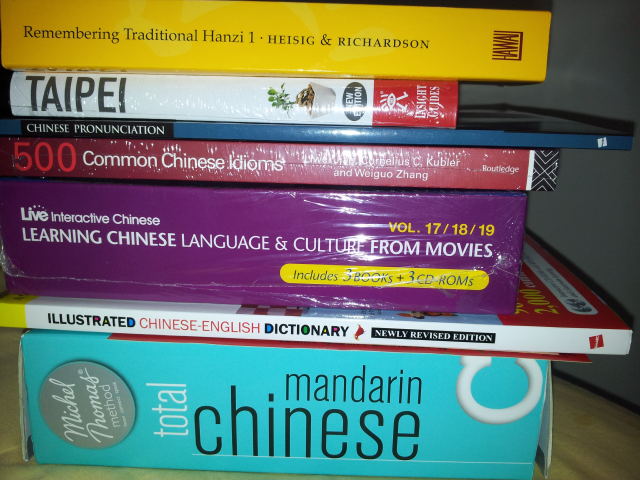
A few books/courses to help me start

I don’t ever consider my language missions to be linguistic objectives, but rather social ones. Everything I work on will be for the purpose of improving my ability to interact with the Taiwanese and ultimately have deep friendships, without limiting myself just to those who speak good English as too many expats would.

I plan to use all the techniques discussed in depth in the Speak from day 1 & Language Hacking Guide package, however, I will make regular updates about how I’m tackling issues specific to Chinese, and if I have really good ideas I’ll make videos about them to add some to the blog and most to the Speak from Day 1 series.

As you can see, I’ve already got some material I’ll use to help me learn, and I’ll be sure to keep you up to date and let you know which books or other resources I’d recommend!

Thanks for reading along, and I hope to successfully reach fluency in Mandarin in 3 months! Any thoughts, or advice? Let me know in the comments below!

***********************

Want more language learning tips and cool links delivered to your inbox, as well as two free chapters of the Language Hacking Guide? Join the Language Hacking League by entering your e-mail on the top-right of the site!


This article was written by

Comments: If you liked this post or have anything to say, please leave a comment! I love reading them :) You don’t even have to write in English! I will reply to all comments in any language listed on the right with the flags.
Just keep in mind that I’ll delete any comments that:
1. Are unnecessarily nasty and mean to me or any other commenter or otherwise totally inappropriate.
2. Are irrelevant to the particular post they follow, or leave a link to a site that is totally irrelevant or are clearly spam. If you have a general language learning question, please ask it in the forums.
3. Use a commenter name of a business or brand instead of a human being or a spammy temporary disposable e-mail service, or a clearly fake address.
But that’s not you, so don’t worry! Can’t wait to see what you have to write… don’t be shy!! :)


———————————–

  • http://TokyoJim.com Jim Gottlieb

    Taipei isn’t the best place to learn Mandarin.  Too many people in Taipei speak English, so that whenever I would speak to someone in Chinese, even the clerk at the 7-11, they would answer in English.  Also, you can’t go more than a minute on the streets without passing another 老外。

    I did a lot better in Chengdu, China, where you need to speak Chinese to get through your daily life.

    • http://www.fluentin3months.com/ Benny Lewis

      This has been the exact opposite of my experience so far. I’ve spent most of the last 36 hours (apart from sleep) outside of my apartment, and every single time I ask “Ni huishao Yingwen ma?” I’m given a blank look and am forced to use the 20 words I’ve learned, without appropriate tones yet, to explain what I want. Almost nobody I’ve met speaks English.

      Also, in all this time I’ve been walking around, shopping, eating, taking metros and getting to know the area I live in, I HAVE NOT SEEN A SINGLE OTHER CAUCASIAN. Not one, out of hundreds or thousands of people I’ve passed by. It would have stood out because I was looking hard, since it’s the longest I’ve ever been in such a populated area without seeing one.

      Sorry but to be frank, it seems to me like you chose a stupid part of the city to live in. Either that or you didn’t even live here, and are talking about areas by the tourist spots or beside a university.

      I think Taipei was an excellent choice, and I will find it as easy to speak the local language here as I’ve done in all cities that expats complain about there being “no opportunities”. Your complaints are nothing short of ludicrous.

      I expect the same broken record of “Chinese is too hard”, “Nobody will speak the local language to you” etc. that I hear in every single other place and for every single other language mission I have… without fail. It’s why I generally avoid many English speaking expats, to be frank. They seem to live in a different reality to the rest of the world.

      • Zach

        I’ve found the same thing in Korea.  I think a lot of it is starting with a bad habit.  I know that was the case for me, I was convinced for about the first three months that I was here that Korean was just too difficult to learn (convinced by my fellow expat buddies), and so I didn’t try to speak that much.  It started a really bad habit of assuming that I wouldn’t actually be able to have any real communication, so even when I was technically trying to speak Korean, my mind was actually looking for chances to switch to English, leading me to believe that Koreans didn’t want to speak English with me. I also stopped going to “language exchange parties,” which are really just a bunch of white guys only interested in hooking up with Korean girls and the most stubborn Koreans about insisting on practicing English.  You should come to Korea next since you’re in the area anyway :)
        Also, I saw in your resources that you’re using Heisig’s method to learn the characters, which I’ve been using to learn kanzi.  Are you going to be sticking to his recommendation of learning the English definition first and then applying the pinyin to them later?  I’ve learned about 125 in a week (and learning the kanji is a pretty small focus), so it’s certainly an effective method.

        • http://www.fluentin3months.com/ Benny Lewis

          I’m definitely NOT going to apply his suggestion of learning pinyin later. I’ll learn that in parallel. His advice in the intro that I’ve read so far is spot on about mnemonics, and adults learning differently to children, but I find this lack of pinyin to be silly, and the advice to avoid it is impractical for someone in my situation.

          But he makes up for it, and looking just at the actual characters the book looks fantastic.

          • https://www.google.com/accounts/o8/id?id=AItOawnvRX352aKL8dcRTSgK9uk8Ych86zJQ06c Victor

            The pronunciation thing makes more sense for Japanese, where every character has several pronunciations (so that, in effect, you have to learn the pronunciation separately for every word except the enormous amount of Chinese loan words [hint, hint]). In Chinese, you have more “phonetic components” to give away the (usually) single pronunciation, so you definitely should ignore his advice on that. :)

      • Anonymous

        Ahaha tell him what you really think Benny! Don’t be shy!!!
        Good luck my son, this is the mission I’ve been waiting for!

      • http://twitter.com/wyromaster Brian/병욱

        Maybe the people just give you blank stares because they recognize you and don’t want to spoil your mission by speaking English :P

        • http://www.fluentin3months.com/ Benny Lewis

          Ha! I really don’t think my blog in English is popular in Taiwan… yet ;)

  • http://twitter.com/chinesebookshop Chinese Bookshop.com

    The accent in Taiwan and mainland China is different also (to me it sounds like in Taiwan the sound is more nasal/higher pitched rather than from the throat like China) and the tones are slightly different for some words.

  • http://twitter.com/faHd_min_OR b liddy

    Benny,
    You are a man after my own heart.  You took up Hungarian right after I did and now MANDARIN!  My goals are a little different than yours and I am going to try and do it from Oregon but WOW that is so exciting.  If you are interested you can see my goals here:

    http://mainlymagyar.wordpress.com/2011/12/08/mainly-mandarin/

    ( I got the idea of starting a blog from your guide!)

    Best of luck,  I will definitely follow along with you!!

    • http://www.fluentin3months.com/ Benny Lewis

      Best of luck with your blog – glad you are still writing in it! :)

      • http://twitter.com/faHd_min_OR b liddy

        Thanks man!   Did you notice the hyperlink to FI3M in the margin? :-)
        回頭見!Huítóu jiàn!

  • http://twitter.com/gracet07 Grace

    How exciting! I’ve always wanted to learn Mandarin, but I’m working on my start-up and have a family so I cannot travel at the moment. BUT, I contacted someone from Couchsurfing who speaks Mandarin and wants to learn Spanish. I can’t wait! It will be a wonderful exchange!

  • Anonymous

    When you challenge yourself you don’t fool around! Conventional wisdom has it that Mandarin takes years to master to a C1 level. You’ve never been conventional.  This will be a very interesting journey and I’m looking forward to following your progress. Good luck, Benny!

    • http://www.fluentin3months.com/ Benny Lewis

      Conventional wisdom isn’t very wise if you ask me ;)

    • http://twitter.com/faHd_min_OR b liddy

      ….”Conventional wisdom has it that Mandarin takes years to master to a C1 level.”   ….    It sure does!  
      Unless of course you know the tricks…  Benny not only knows the tricks,  he preaches them!!

  • WC

    I’m duly impressed.  And I look forward to watching your success with the usual awe.  :)

  • http://www.fluentin3months.com/ Benny Lewis

    “Stop learning languages” is hardly great feedback. And I find it arrogant that you think my missions are not worthwhile. But to each his own. Equating ambition to simple selfish marketing is very narrow minded and cynical.

    As I said in the video I’ve sat many exams, and studied many languages, so I know what I’m getting into. I think C1 in a short time IS possible (especially since I’m specifying that it’s only for oral, not written etc.), and would like to see how, even if I don’t do it this time. This has nothing to do with marketing, and I find it sad that you ignored what I said at the end of the video, which gives the point of it all.

    • chris

      I have to agree with north sea driller, Where did he say “stop learning languages”?.

      • http://www.fluentin3months.com/ Benny Lewis

        “much more inspiring to me than someone who strives to speak “some”…”
        i.e., it’s better to stop right now, and perfect my current languages and stop learning new ones.

  • http://www.fluentin3months.com/ Benny Lewis

    Thanks a lot for the tips! I’ve used Pimsleur and here are my thoughts on it: http://fi3m.com/pimsleur-review

  • http://www.fluentin3months.com/ Benny Lewis

    Keep in mind with the reading challenge, that I want recognition abilities rather than writing abilities. It would seem to me that a lot of people’s work would be in being able to reproduce the characters themselves, which I’m not concerned with for this mission.

    But yes, I’ll obviously focus on 500 first and then keep going IF it’s not making me antisocial ;)

  • http://www.fluentin3months.com/ Benny Lewis

    “How could they possibly know I spoke English?”
    Unlike in Italy, skin colour is a dead give away here ;)

    Sadly there are cases of Poles/Italians etc. getting a reply in English, but it would be rare for many nationalities to be well travelled and not speak English, especially independent westerners who would think of English as a lingua franca to them, so this perhaps wouldn’t be a huge problem, although I imagine it’s annoying when it happens if you are passionate about learning the local language.

  • http://www.fluentin3months.com/ Benny Lewis

    A lot of people enjoyed that email so I think I’ll make it a blog post next week!

  • http://www.fluentin3months.com/ Benny Lewis

    No problems at all. Stamp on the passport with no advance visa and I can stay for 90 days!

    I hear that Mandarin is more common here in Taipei, but less common in the rest of the country. Obviously I wouldn’t know since right now it all sounds the same to me :P

    • http://profiles.google.com/drumond.douglas Douglas Drumond

      Mandarin is the official language and Hokkien is recognized as second language. 

  • http://www.fluentin3months.com/ Benny Lewis

    You say hard, I say a fun challenge :D Thanks! ;)

  • http://www.fluentin3months.com/ Benny Lewis

    Several people are suggesting 500 instead of 1500 for my purposes, so I think I will focus on that as an objective instead and continue IF it’s not taking too much time away from my spoken focus.

    Sorry but rote learning is a TERRIBLE strategy. Sorry the mnemonic systems that were suggested to you didn’t work, but it’s important to try these harder, as nothing is worse than no hook and just drilling things in. I have no intention of using rote learning, and that’s why it takes years for so many people.

    Thanks for the encouragement! :)

  • http://www.fluentin3months.com/ Benny Lewis

    Aw, you spoiled the surprise :P lol
    Thanks! :D

  • http://www.fluentin3months.com/ Benny Lewis

    Nah, they don’t intimidate me ;) I look forward to learning them! Logic like your example seems like it will be everywhere!

  • http://www.fluentin3months.com/ Benny Lewis

    I expect a new wave of nay-sayers and trolls for this one as the post gets shared :D But I’ve dealt with their kind before, so I’ll have no problem brushing them off ;)

  • http://www.fluentin3months.com/ Benny Lewis

    Thanks for the support!

  • http://www.fluentin3months.com/ Benny Lewis

    Thanks!

  • http://www.fluentin3months.com/ Benny Lewis

    Yes, I’m having that issue – next week I’ll update with an in-depth explanation of my first week (I wrote about my first day to those in the email list), but I expect to get around it soon enough!

  • http://www.fluentin3months.com/ Benny Lewis

    I’ll learn it if it helps me retain the characters, but it really will not be a priority.

    • https://www.google.com/accounts/o8/id?id=AItOawnvRX352aKL8dcRTSgK9uk8Ych86zJQ06c Victor

      You don’t need to write every character, though. You could pick a few useful characters and practise writing them nicely, to get a feel for it. Heisig also recommends not writing so much, although I think he wants you to write them at least once.

      • http://www.fluentin3months.com/ Benny Lewis

        I’m certainly not ignoring his writing instructions, so I may remember a few. But committing it to memory for now is not something I’m focusing on.

  • http://www.fluentin3months.com/ Benny Lewis

    Thanks!

  • http://www.fluentin3months.com/ Benny Lewis

    I didn’t say I didn’t want to hear opinions, but I *will* share mine too. And those reading the blog know that I don’t mince my words ;) “Professional” be damned, I’d rather be straight with people, and I believe what he said was ludicrous and other commenters with more experience than me are confirming it.

  • http://www.fluentin3months.com/ Benny Lewis

    Time will tell! :)

  • http://profiles.google.com/drumond.douglas Douglas Drumond

    About traditional vs simplified. For me, it’s easier to find logical connections on traditional characters than simplified.
    Concerning pinyin, a lot of cell phones in Taiwan uses zhuyin (bopomofo) for input. It’s not hard to learn bopomofo, you can do it in a few hours.

    • http://www.fluentin3months.com/ Benny Lewis

      It looks like the keyboard I bought for this new computer has bopomofo printed on it, so I’ll learn it :)

  • http://www.andrewcaldwell.org/blog Andrew Caldwell

    Good Stuff Benny, listened to a few German lessons on the ol’ iPod this morning, forgot the feeling of learning some new words.

    Cheers,

    Andrew

  • https://www.google.com/accounts/o8/id?id=AItOawnvRX352aKL8dcRTSgK9uk8Ych86zJQ06c Victor

    This is definitely your most interesting mission so far. I’m so tired of all the people saying Chinese is so difficult. I bet once you get the hang of the pronunciation, it’ll be a breeze. I’m not sure about the characters, though. Not that they are difficult, but there are so many of them. But I see you got Heisig; good choice! I used him for Japanese, and it crushed all my bad feelings for Chinese characters completely, and they make learning new words a lot easier!
    How do you plan on studying the readings of the characters?

    I support this mission! :)

    • http://www.fluentin3months.com/ Benny Lewis

      Thanks! Apart from Heisig, I think I’ll get plenty of exposure to the characters in trying to eat out, read signs, using the metro etc. :)

  • Stephen Angell

    Best of luck Benny. Really very interested to see how this works out – and also interested to hear more about the books and cd’s and other tools you have chosen for this mission.

    • http://www.fluentin3months.com/ Benny Lewis

      I’ll outline the best of them at the end of the mission! So far Heisig’s book is looking like a definite recommendation ;)

  • Roman Duda

    Hey Benny, I’m excited that you’re learning Mandarin! I’m sure I don’t need to tell you, but Mandarin has so many things which make it easy (no plurals, no genders, no tenses, no cases…) You’ll be totally fine! Enjoy your time in Taiwan! :)

  • Ubik00

    The mission I’ve been waiting for since I started following your blog!

    I’m really happy to hear your doing this mission, as you’ll be learning my native language. I’m sure you’ll make a lot of progress in a short amount of time and taking the C1 after the 3 months should be quite doable. After all, your well-equipped to take on the tones in this language since you’ve already had exposure to Thai and focus on accent-reduction in all your other languages; things that many other people ignore.

    Although I’m originally from the Mainland and would be even more excited if you started there, Taiwan is a good choice to set up base, you’ll certainly free yourself from some of the inconveniences from the Mainland and keep distractions to a minimum.  

    Looking forward to talking to you in Mandarin eventually : ) 祝你好运!

    • http://www.fluentin3months.com/ Benny Lewis

      謝謝!

  • http://twitter.com/m_kuykendall Miranda Kuykendall

    加油, Benny! I’m excited to see how this goes for you. I’ll admit to having been slacking in learning Chinese, and this mission is motivating me to get back to it. I have several Chinese and Taiwanese friends here in my city, so no excuses! 

    You also picked a great time to go, since you’ll be there for Chinese New Year. And since it’s cold there, you’ll probably get to enjoy lots of hot pot. It’s delicious!

    For the motivation, 谢谢!

    • http://www.fluentin3months.com/ Benny Lewis

      Yes, I’m looking forward to the new year!

  • http://twitter.com/andrewsmatt Matthew Andrews

    Had a wonderful experience on a flight from Shanghai to Dubai sitting next to a non-English speaking French girl who could speak perfect Chinese. She complained that, despite her protests, however many times she insisted that she couldn’t speak English, some locals refused to accept it and opted to communicate with her in English, rather than their native Chinese.

    The looks we got from the other – predominantly Chinese – passengers on that flight as the two of us laowai merrily chatted away for hours in -prettydamngoodifidosaysomyself – Mandarin was just magic.

  • http://www.littlegirltravels.com/ Unisse Chua

    Wow! I’m Chinese and I’m not even that fluent!

    Reading Chinese is easier than writing it, but good luck nonetheless.

    And I think that choosing Taiwan over mainland China for studying Mandarin is a good thing because Taiwan still uses the traditional characters for writing, not the simplified one. I’ve studied Mandarin for 13 years here in the Philippines in a Filipino-Chinese school and what was taught to us was the traditional way of writing and not the pinyin either.

    Learning Mandarin should be fun. Maybe you can also learn 台語? It’s kind of like Fukien.

    • http://www.fluentin3months.com/ Benny Lewis

      First I’ll work on Mandarin, but I’ll be happy to learn a few phrases of Taiwanese in the process (not much to start off with or it will get confusing).
      Yes, I’m starting to see that having such exposure and motivation to learn the traditional writing system will definitely be a great long term investment!

  • http://www.fluentin3months.com/ Benny Lewis

    Ha! Funny. I’ve already been awake for over 60 hours this week though, and I can’t find a full-time team to keep me awake to bombard me with brainwashing. I’ll stick to being social I think ;)

  • http://www.fluentin3months.com/ Benny Lewis

    Thanks – so far I’m not having problems with reading the system and remembering characters. I don’t see what all the fuss is about. It’s more remembering combinations for creating certain words I’ll have to put some thought into.

  • http://www.fluentin3months.com/ Benny Lewis

    “…for example the traditional love 愛 contains the character for heart 心 but the simplified version 爱does not.”

    I can’t (or perhaps can barely) see that heart symbol in what you’ve written. It must be tiny… Hopefully it’s bigger in print or written because that doesn’t help me at all based on computer fonts.

  • Anonymous

    I am Taiwanese and am living in Taipei too. I am willing to help you if you need it! I’ve read the post and the fisrt few comments but I can’t get a perfect understanding of them and so is the video because my english ability isn’t well(please don’t mind my mistakes in this comment.) Anyway, I am happy to know there is another one in the world starting learning Chinese and coming in Taiwan for it. 加油! I’ll keep visiting your blog and waiting for your new video~

  • http://www.fluentin3months.com/ Benny Lewis

    That’s an excellent post!! I’ll see if my current system of just thinking of a single word that I can associate with the sound works, but if this fails due to them being one syllable, I’ll move swiftly onto something very similar to what’s described in this blog post! :)

  • http://www.fluentin3months.com/ Benny Lewis

    Whoops, thanks for pointing it out!

  • http://twitter.com/KlausKoster Klaus Koster

    Why Taiwan instead of mainland China? Does it have to deal with political, visa, cost or other issues?  Yes, you would have to recognize the difference between Mandarin and Cantonese, but isn’t Taiwanese most closely related to Mandarin, therefore harder to differ?

    • http://www.fluentin3months.com/ Benny Lewis

      I explained why in the post.
      People will speak Mandarin with me, not Taiwanese, unless I request it. And a lot of people in this city use Mandarin when they go out.

  • http://www.fluentin3months.com/ Benny Lewis

    Thanks! I’ve been seeing the word “impossible” a LOT this week. It’s not discouraging, just really annoying :P

  • http://www.fluentin3months.com/ Benny Lewis

    “Did you need to use a mnemonic to remember the plot to your favorite movie” – technically, the plot itself IS a mnemonic. Mnemonics are just stories that make things easier to remember. You definitely do not remember a movie ONLY from “rote” of seeing it a hundred times.

    And people do this with telephone numbers too without realizing it, by sounding out clumps of letters into mini units that they recall by the sound – in many cases doing it unconsciously. This is another example where it’s just not true to say people do it by rote.

    Anything learned efficiently and quickly uses mnemonics in one way or another, but it will be more efficient and more quick if a systematic version is used. Your “enough” example is not a stand alone case, but goes with “tough” and others – an association, even if one of the two was learned by inefficient rote.

  • http://www.fluentin3months.com/ Benny Lewis

    Dankon!

  • http://www.fluentin3months.com/ Benny Lewis

    I would agree with other critics that he should have included the pinyin, but his method involves learning only the characters, which apparently is a spillover from Japanese, where it’s more logical to learn that way due to different pronunciations of a single character, which isn’t an issue in Chinese.

    This means that I am trying to learn the symbol and pronunciation in one go, and do indeed have to come up with my own stories. But this book is helping me a lot. So far so good!

  • http://www.fluentin3months.com/ Benny Lewis

    I already explained this in the post, did you not read it? Also, many people have told me that if anything Taiwan is MORE culturally Chinese, and I get to learn Traditional Chinese as well.

  • Brad

    Well as a great Q&A resource for you, check out http://chinese.stackexchange.com/. Good luck!

  • Joseph Lemien

    I am thrilled to see another CET alumnus here on FI3M! I studied in Beijing during 08-09 myself.

    As for Benny’s mission, I am dubious but hopeful. A light level of conversational Chinese should be doable, and I will be very pleasantly surprised if Benny succeeds in having a wider ranging conversation. I am hopefully, though, as his experience and methods have been well trained by his previous missions.

    I suspect that the writing will be MUCH harder that the speaking, due mainly to the lack of phonetic indicators in the characters. Even understanding newspaper article titles would be quite a challenge. However, I would love to see Benny succeed, not just to prove his methods again but also to shut up all those “Chinese is the hardest language” folk, and if anyone can do it, Benny can. 加油Benny!我非常希望你会成功!

  • youmehappiness

    Hi Benny, I am one of your subscribers in Taipei. I agree with most of your ideas about learning and I really like your 3 month language mission concept. As for learning Chinese your will have  a struggle for sure but I wish you the best.  I know that you are on your mission and just want to speak with natives, but I will like to meet you and chat over coffee or maybe a slice of pizza. I speak very fluent Chinese at home, outside and at my job. Anyways I would like to meet you and say hi, and talk about language learning if you have anytime~!

  • http://www.fluentin3months.com/ Benny Lewis

    I was dabbling in languages like Hungarian and Czech, not sure if they were for me, but Chinese is something I would really want to keep long term. In 12 months I hope to be even better than the level I reach at the end of March.

  • http://www.facebook.com/christinebgilbert Christine Gilbert

    Hey Benny!  This is so cool — I’m learning Mandarin in Beijing right now.  Not to spam your blog but I wrote a post about my goals in Mandarin and it includes a little graph about the number of characters you need and what percentage of fluent you’ll be.  At 100 characters it’s about 42% understanding, by 500 it’s 75% understanding and 1500 is 94% understanding… so the first ones you learn have the biggest jump!  After 3,000 characters you should be able to read a newspaper like USA Today in Mandarin which is written at a 7-8th grade level (if I remember correctly).

    Anyway the post is here: http://almostfearless.com/2011/12/26/the-small-task-of-learning-mandarin/

    I’ll be in Beijing for the next six months.  If you make it to the mainland, you should come visit!