Join over ¼ million
monthly
readers!

Contact Me

Current mission

Travel China using
the Mandarin I
learned in 3 months!

Previous post:

Next post:

Review of Rosetta Stone: Detailed and honest look at latest version (TOTALe)

| 119 comments | Category: tools

This is a very detailed and frank review of the latest version of Rosetta Stone: version 4 TOTALe

Rosetta Stone is one of the biggest brands in language learning in the English speaking world (not to be confused with the Rosetta Stone that helped us decipher Egyptian hieroglyphics, which it is named after). The problem is that it is out of the budget of many casual language learners, and budget travellers, so in almost a decade of travelling, I had never used it.

Running a blog as big as this meant I got asked the question very frequently; should I buy it? I polled my readers for their favourite and least favourite language courses and Rosetta Stone actually came out as the dramatic loser.

But perhaps many of those polled were just against the idea of something costing as much as it does, or they may have used a limited pirated version and simply not valued it much because of that. I wasn’t interested in hearsay. I wanted to use the non-pirated latest version myself intensively and properly, and write a detailed review of the disadvantages and the advantages as I see them.

My frank review of the latest version

So I contacted Rosetta Stone to ask for a review copy and they were kind enough to send me one. I told them that I’d let them see this review before it went live to correct any factual mistakes (I did something similar for some of my other reviews), and they were very helpful in making sure there was no misleading information here, even to go as far as giving me a 2 hour long private video conference call and Q&A about the software.

They requested that I give a disclaimer that I have my own Language Hacking Guide to sell, although I don’t see how that affects a balanced and honest review of something that I’m clearly not competing with. I’m a blogger and I wrote a guide about how I learn languages in general using the communicative approach, to help support this blog. I guarantee that you can learn a language great without ever sending me money, as I suspect the vast majority of readers of this free blog do. Just to be clear, I’ll say that I recommend you don’t buy anything I have to offer as a direct alternative to Rosetta Stone as it doesn’t solve the problems found in a specific language course that I discuss here.

Despite the free copy, I told them that I’d be writing a frank and informative review, and appropriately there is no affiliate link to buy it anywhere in this post, where I could earn commission (as in many “reviews” you’ll find online). As you read this, especially the latter part, you’ll understand why this is certainly not a promotional post.

They sent me the latest recently released version, TOTALe 4 and did so for Dutch, as I am currently learning it. However, this review also covers every other language version for a (rather disappointing) reason I’ll explain below.

I was sent Levels 1, 2 and 3, but several distinct technical issues meant that I only made it to the mid point of Level 2. Since I run Windows as a Virtual Box within Linux, Rosetta Stone say they can’t fully support it on my system, so I won’t be discussing these technical issues.

I wanted to share three major things with my readers: 1. Details of how it works 2. Why does it cost so much? 3. Would I recommend it?

My particular independent learning style, and fundamental disagreement with aspects of how the software is organised, means that ultimately I have to say that I will likely not be using Rosetta Stone again to learn any language, even if I am given another free copy. While I point out some important advantages, I have to say that I cannot recommend this as an efficient investment, both in money and in the time you put into it. This review will hopefully explain why, while also informing people about what goes on behind the scenes and within this software as I saw it.

Despite being disappointed at times, I also greatly enjoyed some aspects of it and can see why you could write an entirely positive review about it. In fact, because of the first point raised below I actually understand why at least half of its price could be very fairly justified.

However, at this stage I have quite a lot of experience in language learning so I can appreciate the advantages and disadvantages much more than many monolinguals who may review it and consider its potential or enjoyment-factor rather than practical end applications.

I’m in Amsterdam and need to speak Dutch; so there is no guessing or estimation at how effective it has been.

First, I’ll start with the parts I liked, then I’ll be getting a bit more frank about why I can’t recommend the overall system.

Most useful feature by far: live lessons with a human!

Since any reviews I had read about Rosetta Stone were based on older versions, they didn’t mention a feature that I really enjoyed – I was surprised to see that I got live time with a native teacher through the program! I am sceptical of systems that hide you from human contact as I feel that’s the best way by far to learn, but seeing that Rosetta Stone do give you that contact brought my opinion of them up dramatically.

Once you complete a unit in the program, you can go to the “Studio” and schedule a 50 minute session with a teacher, where you can see them by video feed (they can’t see you) and both of you talk via the headset.

The teachers are friendly, patient very professional and clearly excellent and experienced teachers of the language.

One issue I had was that the available slots were incredibly inconvenient for someone in a European timezone; the earliest possible sessions during the week were at 10 or 11pm (usually booked out, with 2am or so being available). I’m told this is because Rosetta Stone’s version 4 has only been properly released in the states, and they say this month they will release it in the UK. Even so, this leaves a lot of time zones not covered and I had to work my learning around these strange availabilities which slowed me down. If you live in the states this likely won’t be an issue; although other timeslots may not be available as a consequence, such as if you prefer to do it late in the evening due to work restrictions.

Rosetta Stone reply to this to say that as they grow internationally, their services will expand correspondingly and suggest that they could take requests for time slots and attempt to accommodate you.

But once I was in the class, I can say that my first ever experience speaking Dutch was indeed within the Rosetta Stone environment! My teacher was incredibly patient, and refused to switch to English (consistent with the program philosophy discussed below), no matter how much I was struggling; something I agree with is difficult to maintain but an obvious wise decision for the learner’s benefits. In my first two sessions I had a teacher all to myself and found each session to be incredibly useful. After that all my sessions were in groups, and I actually felt much more like I was back in a classroom to be honest.

Unlike private lessons I may occasionally take when learning a language, they have a very fixed program they follow and questions or games they need to get through in a 50 minute session. This is all part of the master plan of the program, which is fair enough, but I would personally have preferred to just chat with the teacher. The justification for this is that the program teaches you particular vocabulary before the session and from their overall plan it would not make sense to ask you random questions, since you wouldn’t be prepared to answer them.

Rosetta Stone reply to this to say that there are more unstructured conversation opportunities in the “Rosetta World” (Duo/Simbio) aspect of the program. However, as explained below this was not possible at all for my language combination. They also attempt to get learners to ask one another questions so at least some amount of independence is encouraged.

Luckily they were patient with me if I went off on tangents, so you can be somewhat flexible if you have a teacher to yourself, but of course less so in a group session.

There were no indications before entering the class if you would be alone or with others, or how many have signed up already. I would find this information helpful, even if people can sign up 15 minutes into a class or cancel at the last minute. You can sign up for fixed lessons an unlimited number of times, but since the same content is covered I can only see this as being practical for reviewing twice or three times maximum.

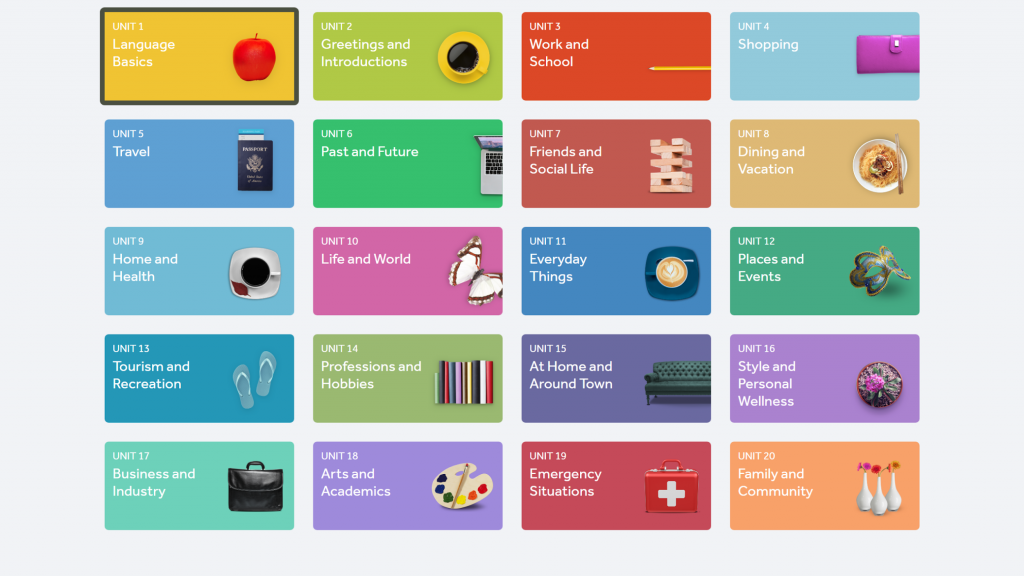
There are four units per level, so this could ultimately mean 12 very distinct (or more if you feel like repeating a lesson) private or very small group lessons included in the price. To me, this was the greatest justification of a higher price than the reasons I give below. You can hire teachers to get Skype lessons much cheaper elsewhere, but it would be hard to find people so integrated into such a complex system like this.

Despite some restrictions that I wasn’t a fan of due to simple disagreements in learning styles (I used to be a teacher; teachers are the worst students :) ) I did indeed find each spoken session to be incredibly helpful, varying a bit depending on if I was the only student or with others. This was clearly my favourite part of the whole application and what I got the most value out of.

Without this to work towards (as it was in previous versions) I would have given up on using the program due to frustrations in the learning interface, but having something meaningful to work towards kept me going.

Interesting philosophy of no use of your native language

It was explained to me that Rosetta Stone was founded by people who appreciated learning by immersion and had learned languages abroad in immersive environments.

They wanted to emulate this as closely as possible for people who can’t travel, while making it still affordable. Of course I have other recommendations if you can’t travel, but the base concept (even if there are aspects of it I disagree with) makes sense. I don’t particularly feel immersion is something you can package a generic version of, but they’ve done a good job of trying.

One interesting aspect is how they have no English at all in the program apart from the containing interface. They never present a translation of anything. It’s all represented in photos and untranslated audio and text. While I think there are major issues with this (discussed below), the idea of not using your native language is an interesting one that definitely holds a lot of potential.

I have to admit that I (as many learners) do typically learn a lot through English (i.e. your mother tongue), getting my vocabulary through flashcards (usually translation based in my case, but you can make them just in the target language), looking up words in bilingual dictionaries, reading grammar explanations also in English etc. I’m sure there is a danger of slowing me down and thinking via English at times, which is an issue this program successfully avoids. For people who are fans of “learn like a baby would” philosophies I think they would get a lot out of this program.

Rosetta Stone say that they aren’t necessarily promoting a “learn as a baby” philosophy because they get rid of the guesswork involved in trial-and-error approaches. But I find many similarities myself.

Such learning approaches have big advantages, but as those who read the blog know, I disagree with the concept and feel that we can take advantage the fact that we are adults and can have things explained to us in more complex ways than being presented with some images and audio. The devotion to learning in such a simple way (even though the research behind it is very complex) made me learn very slowly in Rosetta Stone. After days of using the program intensely, I felt I would have learned the same words and phrases dramatically quicker using other approaches.

Rosetta Stone reply to this saying that the goal is not “speed for its own sake”. They feel the technique they apply is better described as “certain” rather than slow, because their research over 30 years about when and how words should be introduced have proven to be very effective. I believe them that they have carried out this research, but I still disagree based on my experience.

I only made it half way through my set, but I can’t imagine how completing all 3 levels would get you out of what I would definitely call basic level. It’s a clever idea, but I don’t see it as a major improvement over alternatives.

Outside of the program, this native-only content is expanded to the audio. I copied the audio to my MP3 player and listened to it as I jogged in the morning, repeating all the phrases when requested. I tried something similar when I reviewed Pimsleur in great detail. Even though Pimsleur is entirely audio, and so you would think their audio would be superior, I actually prefer Rosetta Stone’s audio.

Apart from instructions (like repeat, listen etc., which are given in the target language in Pimsleur’s courses), everything is in the target language. It is based on what you would have gone through for that unit, so you should actually recognise everything and this is a great chance to try to work on your pronunciation and test yourself to see if you understand what’s going on.

Even though it’s an improvement on Pimsleur (whose audio is almost entirely English or repetitions), I still found it a bit tedious after a few sessions and think that actual native content such as a podcast would have been more helpful to recreate an immersive environment. But of course, it’s all part of the greater whole and philosophy of the program to only present you with words you should know already.
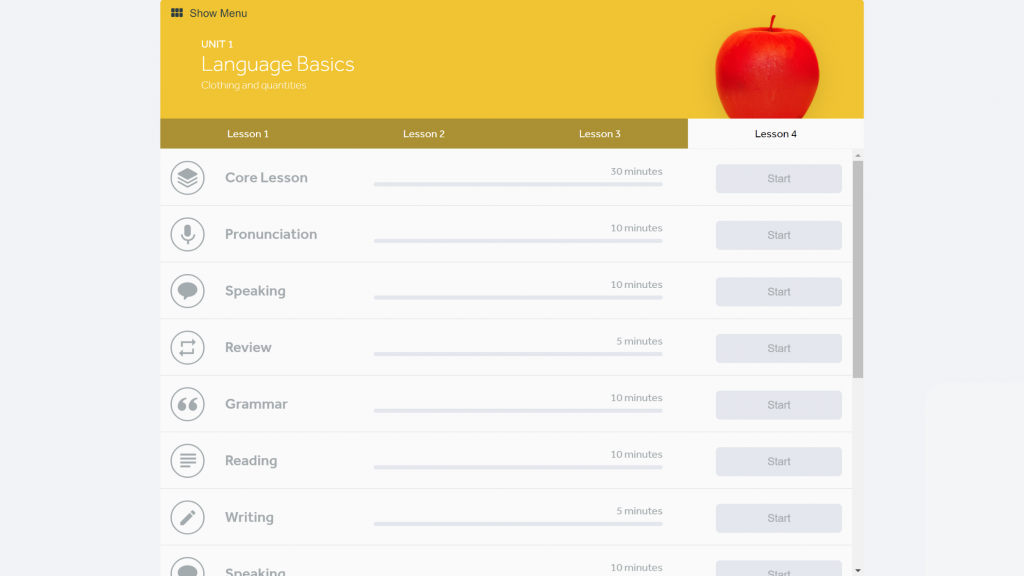
In this sense, the interconnectiveness of the entire set; actual lessons, audio, games, live classes etc. is very intricately designed to rely on what you’ve learned. You won’t be put under much stress in this program to see or hear things you haven’t come across before. This makes it an enjoyable learning environment, although hardly a realistic one in my view.

Krashen’s input hypothesis

Rosetta Stone reply to this saying that the pace and structure is based on the (Comprehensible) Input Hypothesis of Stephen Krashen, whose research has made huge and important contributions to linguistics in the 20th century.

While I have issues with how far otherwise interesting research is being taken as being the basis of your entire learning technique, I have to admit that RS applies that approach the most effectively that I’ve seen so far.

Over the long-term, purely recognisable input as a learning strategy is more enjoyable than the stressful situations you would encounter in immersive environments, but you learn quicker with that pressure and it’s simply more realistic to how the world will present you with situations and words that you aren’t prepared for yet. The input-hypothesis is an “ideal” learning environment, and is thus not suited to a non-ideal world in my view.

Of course, many people would like to get eased into a language through a system like Rosetta Stone, and then feel prepared to dive into conversations at the end. It sounds fantastic, only that I feel that after all 3 levels you would still not feel ready for the vast majority of conversations you are likely to have. You will have the struggle to speak no matter what.

If you compare it to easing yourself into cold water, I consider the amount you would learn in the whole system of 3 levels equivalent to dipping a toe in, rather than slowly easing your whole body or at least your legs in. The immersive/communictive approach I apply takes a preference of diving my entire body straight in and getting the unpleasant part over with quicker, since it’s going to happen anyway (presuming you actually plan on using your language with natives).

If you are a fan of Krashen’s research then you will love Rosetta Stone. I agree with a lot of what Krashen says, but think that most people take it too far.

Reasons for the price tag

If one typical small spoken group class would cost you $10-20 and 12+ are included in this, then the live lessons aspect of the program discussed above actually justifies over half of the price in my eyes (even though I would personally recommend you get private lessons tailored to your needs rather than based on a generic course). For the rest of the article I’ll be looking at why I didn’t get value out of the other “half”.

One great aspect of doing this review was that Rosetta Stone put me in touch with people high up in the company. We had a fascinating discussion where I was given a live tour of the software and explained intricate details of what goes on in the background.

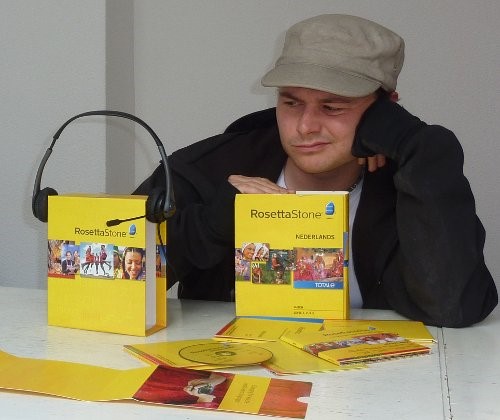
One of my first questions to them was about the price tag; why does it cost several hundred dollars when you ultimately receive what physically costs much less to produce (a USB microphone, one software CD per level for your computer and 4 audio CDs per level, packaging and an activation code).

Now from Rosetta Stone’s perspective, the price tag (changes often; was around $500 recently, but last time I checked is $379 for what I have) does indeed make sense. It’s the investment they‘ve made into it. And as I say above, I do feel the 12 50 minute sessions with a native must count for something in this.

But I did get other justifications, which I will discuss now and present my scepticism about them really helping to justify the price from the end user’s (not Rosetta Stone’s) perspective:

Research

Rosetta Stone have actually spent a fortune on linguistic research, consulting cognitive scientists, PhDs, neuroscientists and more. And these are incorporated into every single aspect of the software; from the positive reinforcement of harp sounds (that I promptly turned off; I felt it lost it’s impact entirely after several hours of constantly hearing it), to the meticulously planned photos (which I also had an issue with, described below).

As you all know, I am certainly no linguist (I studied and worked as an engineer initially). Linguists produce a body of fascinating and incredibly useful research that can help us understand how languages work. A small number of linguists also work specifically on second language acquisition, and to be totally honest, people with experience (or education) in this are who I would most like to be dominating research when language learning is being discussed.

With Rosetta Stone leading a team of people from such a varied and incredibly focused aspects of learning, brain functions, psychology etc., all focused on producing a great language learning system, it would be logical to presume that it would lead to the best system in the world. But I disagree here. I feel like the research is tailored more to how can we make a product that sells well and is scalable as a preference over how can we ensure people definitely learn this language as efficiently as possible.

As you can imagine, Rosetta Stone disagree with this. Their reply is “In our view, a program is truly effective only if it offers genuine language learning value to the widest possible diversity of learners”

However, this preference for scalability was my feeling as explained in various points below. So I’m afraid the research they invested in is not something I hold that highly.

Speech recognition

Another reason to justify the higher price is how much research has gone into developing their speech recognition from the ground up. Unlike speech recognition you’d come across for automated telephone calls, this was developed especially for non-natives speaking a foreign language and is all Rosetta Stone’s own research.

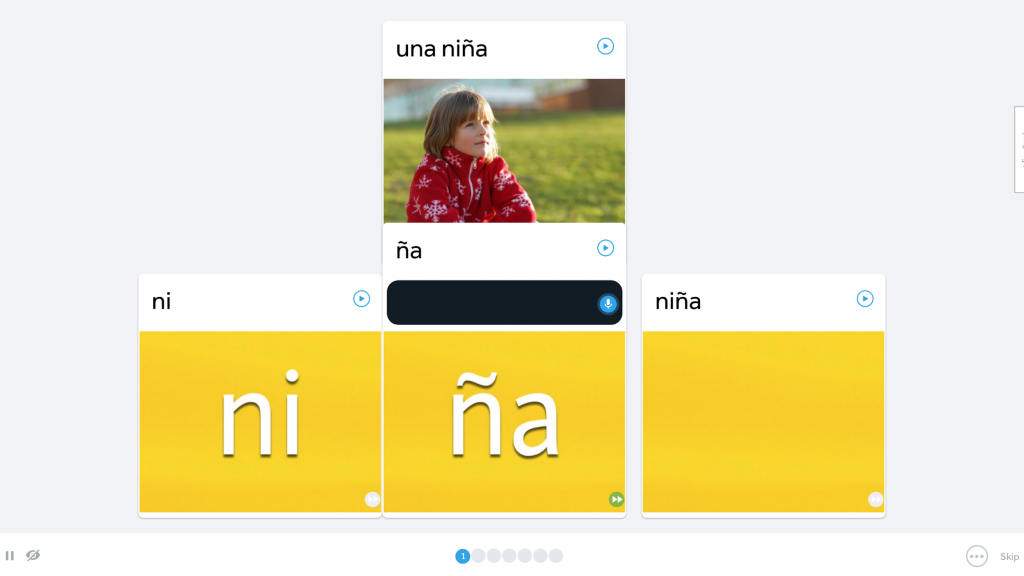
When you speak it analyses your recording and approves it or requests that you try again based on how you did. If you have particular trouble, you can open up the wave analyser and visually see the difference between the native’s speech when slown down and your own.

While I like the idea, since it gets you speaking to the program and gives you feedback, I found several problems with it including registering a sneeze as a correct answer or needing to repeat myself several times and not understanding what was different that I got right. This may be due to one of the technical issues with using my own microphone since the USB microphone wasn’t porting through my Linux-based virtual box. Rosetta Stone recommend that you use their headphone and do not support use of others, even though initially my headset didn’t give me problems, and they say you can use others if you wish.

It may also be due to the variable sensitivity; by default 3 out of 10. You would have to play with this when using the program to find a level that suits how good your pronunciation is, so that you aren’t rejected too much while also being corrected when wrong.

In this image you’ll see a slot on the right to analyse the tones for a tonal language like Chinese. As you can imagine it’s just a waste of space and deactivated for European languages.

One surprise I saw was how bad the examples used to train my pronunciation were. For example, “Baby” was used, and it was split into two syllables with the ‘a’ pronounced rhyming with may and emphasised as important. Baby is a loan word from English and Dutch does not pronounce ‘a’ this way normally. This was very misleading, as this part of the program was supposedly teaching me Dutch phonetics. It’s clearly only there as a remnant of words copied and pasted to all versions as discussed below.

Luckily the reading exercises are native content and the pronunciation you will learn from this is more useful. You can also get a more detailed pronunciation guide for the alphabet within the help menu of the program.

Games & other features

As well as the core course, there are other features of the program, such as a review, very basic writing test, grammar lesson (contextual of course; some grammar points are very difficult to explain with nothing but examples and photos!) and text reading.

I did like the text reading as it was like a mini-podcast with a native speaking more consistently than the rest of the program, and got you used to reading while listening at the same time to associate spellings with sounds.

The games were enjoyable guessing games and bingo with core vocabulary. Not my cup of tea, but certainly useful for many people.

Then there were multiplayer games that you can play live with/against another learner or with someone learning your language, while you learn theirs.

This sounds like a great idea until you stop and think about it for a second. How many Dutch people do you think have bought Rosetta Stone (especially considering version 4 is only available in the states and some time soon in the UK), and are learning English? Nobody in this country that I talked to has ever heard of Rosetta Stone, nor would they get much use out of it because all lessons are too basic for what most Adults’ level of English would be.

So basically, I would not have anyone to play Duo with in this language combination! I really don’t think this part of the program was thought about logically at all.

Photos

It wasn’t mentioned as a major reason for the price, but I suspect that taking professional photos, hiring models, and finding the right places and lighting etc. can be a huge expense. It was explained to me that while taking the photos, very precise care is taken to make sure that everything is perfectly right; right down to which direction the model is looking as they are performing the action, as this can dramatically alter what is interpreted.

This is shown as the photos are indeed very well done, and you do get a good feeling for the action they are performed in a natural way. Their research for precisely how to represent a word without using your mother tongue in just images is an interesting way to present it and the foundation of the way the software works. In most cases it’s pretty clear what is going on; although I did have one or two cases where the photos simply weren’t helping and I had to go find a dictionary to figure out what the word meant.

I would consider myself at least a mildly “visual” learner (whether such a label has any merit or not is up for debate), but I can’t say that four (or more) images is a great way to present every concept in the world.

Rosetta Stone reply to this saying that they aren’t attempting that, but that it has been based on advice from cognitive psychologists about how the brain likes to learn. Once again, this stems from my frustration in how the preference is to get people from so many fields on-board, who don’t have experience specifically in language learning. I don’t doubt that images are fantastic learning tools, but they are not suited to language learning when used in this way in my opinion.

Learning a language by clicking your mouse on multiple choice options is not even remotely emulating the immersion learning environment; without the spoken lessons that lean on them the usefulness of these clicking lessons would disappear entirely in my view.

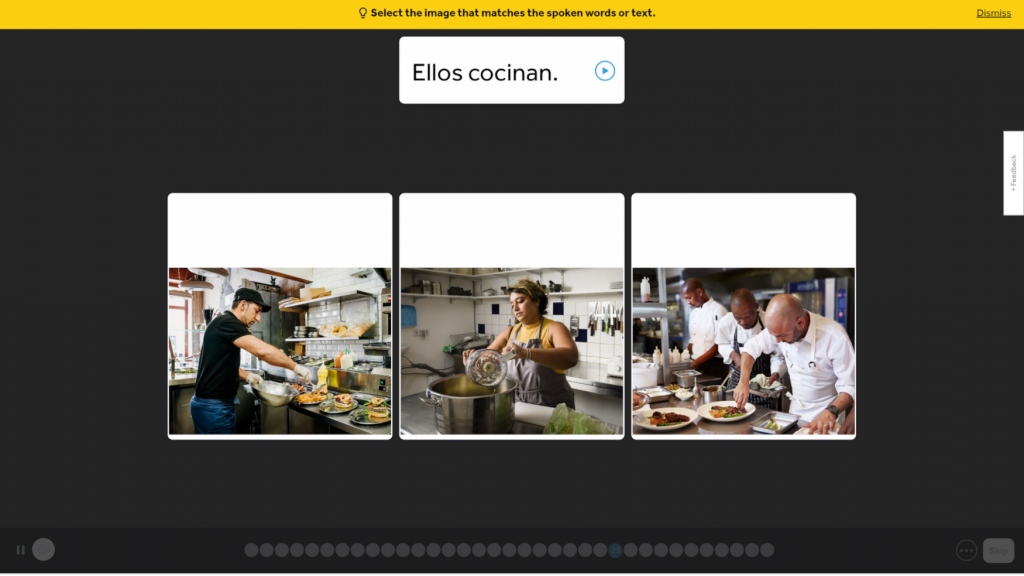
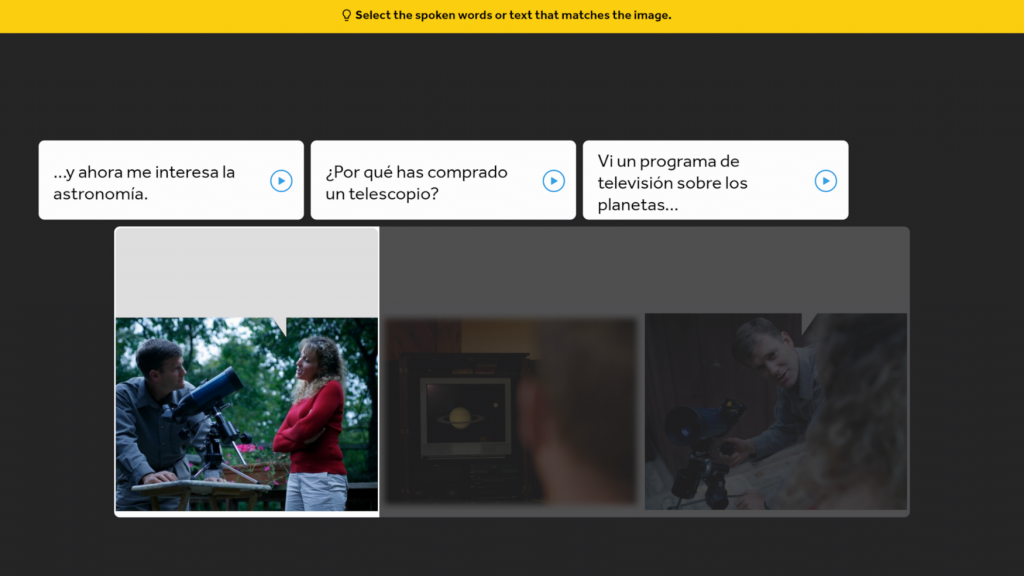
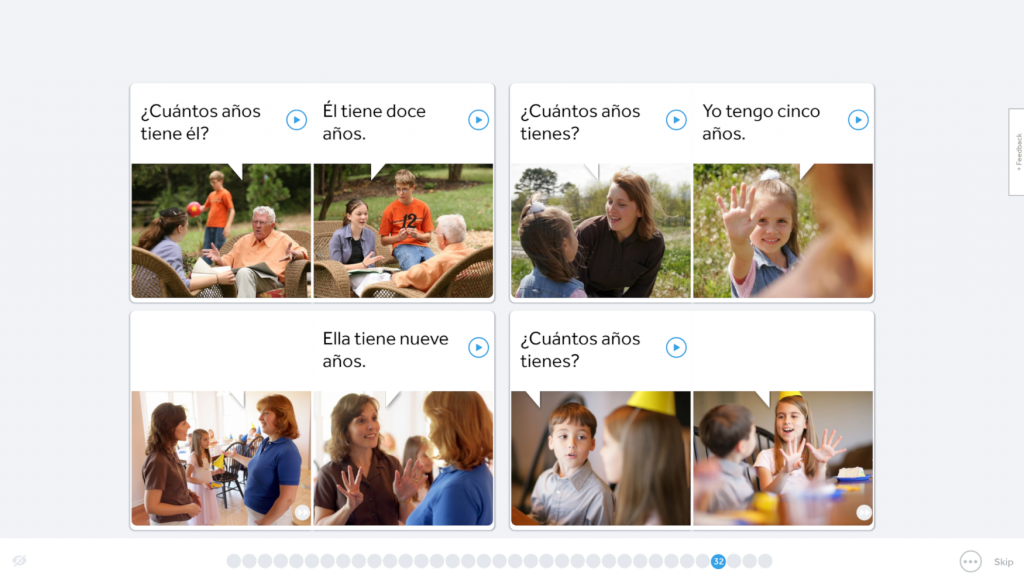
There are many ways the software presents images to you. Sometimes it simply asks you to repeat phrases, sometimes it explains one photo and gives a similar one with slightly different context you have to guess. However the vast majority of your work in lessons is based on multiple choice (usually just 2-4 options) and process of elimination.

You are given a phrase or word and you have to click the right photo. I find it hard to express fully how unnatural this feels to me for language learning, but apparently RS’s linguists disagree; once again I feel that neuroscientists etc. may be studying learning in general but out of context. This photo-centric presentation is a fundamental aspect of the learning system I can never agree on.

A similar system was copied from Rosetta Stone by some websites, and it’s even less effective there.

But forgetting the way the system works for a moment, I had two major issues with the photos themselves:

1. Some of them were badly photoshopped.

This surprised me quite a lot. The vast majority are real, and some require some editing (such as to show a clock in the corner or a number somewhere to suggest someone’s age, or a flag to suggest a country), which is fair enough.

But some were terrible jobs of plonking people in front of places like Rome’s Colosseum. I don’t even do photo editing, and I can tell they are photoshopped. The girl in Rome here was obviously shot in professional artificial lighting, not on a sunny day in Rome. And the contrast is terrible in the Moscow shot compared to the model. Surely they could have hired someone to change the lighting and contrast to make it more realistic, or taken this into account when shooting in front of the green screen? Or… you know, actually have someone really there?

Rosetta Stone reply to this saying that they don’t endeavour to pass these off as authentic, and that the focus is on the language value of the image, and they are used with a wink and a nod so to speak.

In some cases they were abroad, so I don’t know why they photoshopped in others. But for a system based on photos and which prides itself on how professional those photos are, making them up is just lazy. Apparently how annoyed some users may be at this was overlooked in all that research. Maybe I’m alone in this and nobody else using the system would get frustrated by these images?

2. Cheesy political correctness instead of cultural relevance

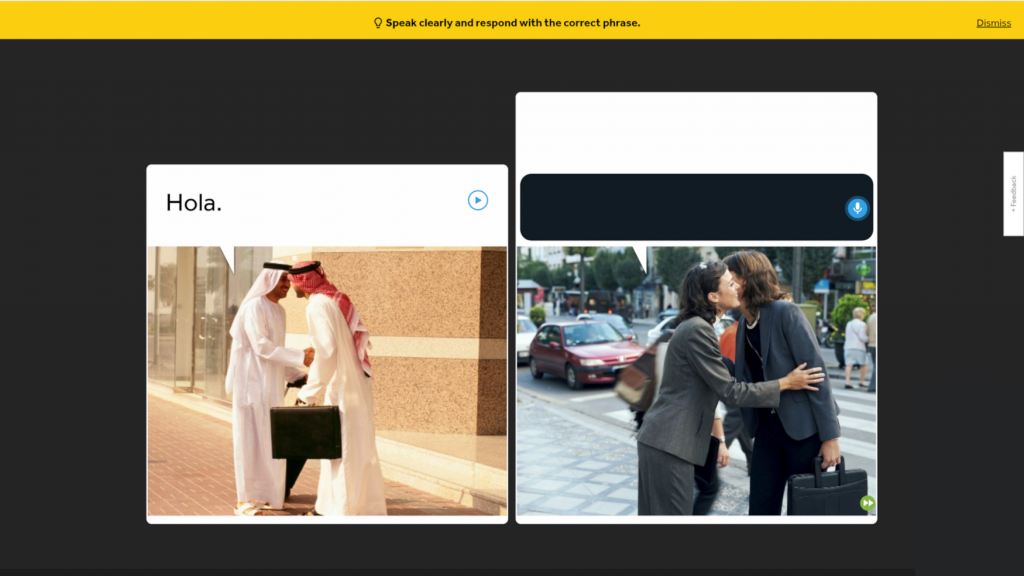
I’m all for political correctness. I love that Star Trek had a black, female and even a bald captain to star in their shows. Presenting a varied cultural set of people in photos is great if you are teaching children to have open minds about the world , especially in multicultural environments. But it’s distracting if you are learning a culturally relevant language.

For example, when learning the word “Newspaper”, the newspaper’s text in the image was printed in Arabic and I’m not learning Arabic right now. This doesn’t help me at all and is part of the copy-and-paste use of all images discussed below.

But even forgetting this for a moment, most culture presented in the photos screams U.S.A.

When learning about Dutch, I want to see photos relevant to the Netherlands and how Dutch people act (or Belgium/Belgians); their body language, their smiles etc. I do not want to see cheesy American poses. Even the culturally sensitive ones of Islamic families act like Americans just wearing different clothes.

In one image for example someone is presented a big jug of water in a restaurant. They don’t do that here in Amsterdam. I can’t imagine how many culturally irrelevant aspects of photos there are once you compare it to non-western cultures!

Every time I started using the program I felt like I was leaving the Netherlands and back in America. It’s hard for an American to appreciate how obvious this is in most of the photos. As a non-American who has lived in different countries I can say that this is doing nothing to help you prepare for any kind of immersion.

There’s a good reason they do this, which brings me to my biggest pet peeve of all with Rosetta Stone:

A copy-and-paste approach for drastically different languages

When I was getting the live video tour, I noticed that the content of the lesson (as well as the photos) was exactly the same in Swedish as it was in Dutch. I asked about this and it was confirmed that it’s the same in Chinese, Spanish, French, Russian or other very different languages.

When something is drastically different, they do take that into account. For example, one lesson showed me how to distinguish two Dutch words for “family” depending on if it’s immediate or broader. But this is more out of necessity since it would just be wrong to teach me that the same word counts for both as in English.

What Rosetta Stone have done is researched one way of presenting a language learning system and simply translated the content (audio and otherwise) to every single language. I was told that this is because a “completely customised language” (i.e. a unique course for each unique language) would increase costs. I was assured that the content is developed for each language separately, and that nothing is ever directly translated from one language to another, but I’ve looked at videos online of people’s Rosetta Stone, seen several slides of the Swedish version and I see precisely the same content that I came across in Dutch.

Even if “just” 80 or 90% of that template is the same, that’s far too much in my opinion.

The extent of how far this may negatively effect the content isn’t so clear, but I could feel some lessons as being just way too irrelevant for me learning Dutch.

An English speaker learning Dutch has obvious advantages over the same person learning Chinese, Arabic or Russian and to clump learning any language together as following the same generic vastly similar (even if not identical) content, photos and steps is madness. This holds no benefits at all to the end user and is nothing but a lazy shortcut to be able to scale a system to every language in the world.

While there are aspects of Rosetta Stone I do like, this really got on my nerves and it’s one of the many reasons I simply can’t recommend the system to people. The one-size-fits-all content you cover is everywhere (audio, games, courses, what guides live spoken lessons) and what the whole system rests upon.

Active learners always do better

Some people will get benefit out of Rosetta Stone. I can see how it would happen. I did indeed learn something from this program, including having my first ever conversation in Dutch, which gave me an enormous boost of confidence. Injecting this confidence is something that Rosetta Stone does very well but to be honest the time would have been much better spent on other tasks.

Talking about blue skies and red balls made little addition to the conversations I needed to have with people. This has always been an issue I’ve had with generic courses; they try to teach you everything and in doing so teach you almost nothing that you really need. I didn’t even see the word “please” until Level 2!

People feel that throwing money at the problem will solve it. You can actually learn a language entirely for free by finding learning material relevant to grammar and vocabulary online or in your local library, and then meeting up with natives in person (without needing to travel) or via language learning sites.

The problem is that doing so for free or inexpensively requires that the learner be active. Rosetta Stone attempts to spoon-feed the information to you so you do not need to plan anything at all. They retort this to say that the learner is quite active and needs to interact a lot with the program, which develops their skills to help make the language stick. I disagree; the system is indeed complex, but in such a way that almost too much is organised for you.

Relinquishing responsibility (apart from the time investment) before even beginning is hardly a good approach; active learners even with limited resources can do much more, and tailor what they learn to what they are interested in and what they talk about, rather than a generic system designed for the entire world and all languages.

The few people I talked to who had reached fluency using Rosetta Stone, when pressed said that they had actually used other systems along with it, which I would argue were helping them more than they think. Those promoting it have not demonstrated much progress or even completely misunderstood basic aspects of the language.

——————-

This has been a very long review (6000 words!!), because I wanted to present it in full detail, explain everything that I did get out of it, and explain why I can’t recommend it. I quoted Rosetta Stone’s own comments about my criticisms too because I wanted this to be balanced. Since the review is neither promotional, nor one endless rant, but focused on presenting as much information as possible, I feel it is perhaps unique online, at least for its depth!

If you’ve somehow made it this far, thanks for reading and if you have any comments or experiences with Rosetta Stone to share, or want to discuss particular parts of this review, please do leave a comment below!

***********************

Want more language learning tips and cool links delivered to your inbox, as well as two free chapters of the Language Hacking Guide? Join the Language Hacking League by entering your e-mail on the top-right of the site!


This article was written by

Comments: If you liked this post or have anything to say, please leave a comment! I love reading them :) You don’t even have to write in English! I will reply to all comments in any language listed on the right with the flags.
Just keep in mind that I’ll delete any comments that:
1. Are unnecessarily nasty and mean to me or any other commenter or otherwise totally inappropriate.
2. Are irrelevant to the particular post they follow, or leave a link to a site that is totally irrelevant or are clearly spam. If you have a general language learning question, please ask it in the forums.
3. Use a commenter name of a business or brand instead of a human being or a spammy temporary disposable e-mail service, or a clearly fake address.
But that’s not you, so don’t worry! Can’t wait to see what you have to write… don’t be shy!! :)


———————————–

  • http://www.fluentin3months.com/ Benny Lewis

    Your comment kind of makes sense, until the last bit. Why not just pay $20 for a good book based course and “use it like you paid 500″? I find the only true advantage of Rosetta Stone is that you are less motivated to fail because of the huge chunk of money you’ve spent and you’ll get out of the house to practice and study with other techniques too. That is a psychological technique independent of the content of the software.

  • http://www.fluentin3months.com/ Benny Lewis

    Your comment kind of makes sense, until the last bit. Why not just pay $20 for a good book based course and “use it like you paid 500″? I find the only true advantage of Rosetta Stone is that you are less motivated to fail because of the huge chunk of money you’ve spent and you’ll get out of the house to practice and study with other techniques too. That is a psychological technique independent of the content of the software.

  • http://www.fluentin3months.com/ Benny Lewis

    Your comment kind of makes sense, until the last bit. Why not just pay $20 for a good book based course and “use it like you paid 500″? I find the only true advantage of Rosetta Stone is that you are less motivated to fail because of the huge chunk of money you’ve spent and you’ll get out of the house to practice and study with other techniques too. That is a psychological technique independent of the content of the software.

  • http://www.fluentin3months.com/ Benny Lewis

    Your comment kind of makes sense, until the last bit. Why not just pay $20 for a good book based course and “use it like you paid 500″? I find the only true advantage of Rosetta Stone is that you are less motivated to fail because of the huge chunk of money you’ve spent and you’ll get out of the house to practice and study with other techniques too. That is a psychological technique independent of the content of the software.

  • http://www.fluentin3months.com/ Benny Lewis

    My feedback is to use Anki instead – as far as flashcard apps go it can’t be beat. Others who have used byki agree.

  • Matt Alexander

    Thanks for doing this. I enjoyed learning about the various language-learning theories you glossed, and it was very valuable that you helped me understand the theoretical underpinnings of Rosetta Stone.

    I was just about to pull the trigger on Rosetta Stone (Spanish). My daughter is learning Spanish in a dual language program in public school, and the rest of us want to learn Spanish to keep up with her. But after reading this, I’m not comfortable delegating responsibility for our language learning, or taking the “easy way” instead of a more true-to-life immersion approach.

    I’m reading your Language Hacking Guide next.

  • Anonymous

    I suppose I’m late to comment on this, but your review which strives to be fair and in-depth falls apart right here:

    “I only made it half way through my set, but I can’t imagine how completing all 3 levels would get you out of what I would definitely call basic level. It’s a clever idea, but I don’t see it as a major improvement over alternatives.”

    You don’t really know where you’d be at the end of all 3 levels. (Isn’t it 5 for some languages anyway?) You just assumed where you would be at the end. I don’t think it’s crazy to expect a self-proclaimed detailed and honest review of a course to be written by someone who has…actually completed the course they’re reviewing.

    • http://www.fluentin3months.com/ Benny Lewis

      Please read the review carefully. I wanted to finish the course but technical problems with faulty programming meant that I had no choice but to stop. I would have really liked to have discuss how poorly designed the software is, to force me to not be able to use the one thing I actually liked about the system (the private spoken lessons) with a functioning microphone half of the time, but since I was on a Virtual Box that technically isn’t supported, I didn’t go into that.

      In my opinion, the issues I had have nothing to do with the Virtual Box. I’m confident of this, but not 100% sure so I decided not to discuss them.

      And as I said, I didn’t learn how to say PLEASE until level 2. It’s pretty easy to extrapolate how much further I was going to get. Level 1 and 2 were exactly the same with slightly different lessons. There was no jump in new use of the interface.

      For me to complete the course I would have had to accept that I couldn’t continue with my live video lessons, and this was unacceptable as its the only part of the course worth investing time in.

      • Anonymous

        I still think you could have found a way to make it work (bug their technical support until you can get it done) for the sake of a complete review about a complete experience. And then certainly complain as much sa necessary in your review about what you had to go through to get it working, but I still think you should have done it.

        “And as I said, I didn’t learn how to say PLEASE until level 2. It’s
        pretty easy to extrapolate how much further I was going to get. Level 1
        and 2 were exactly the same with slightly different lessons. There was
        no jump in new use of the interface.”

        I still disagree with this in this context. It’s possible that you’re “probably right”, but making an honest and detailed review should still requires believing the possibility that you might not be right. Maybe the pedagogy doesn’t teach certain things early on because the order of material is designed in a certain way, and they expect you to eventually complete it. (A real example of this is Heisig’s Remembering The Kanji, where he doesn’t teach common characters early on, based on the idea that you can learn a couple thousand much faster if you use his order, rather than struggling more to learn only the two hundred that happen to be very useful).

        Not saying this is necessarily the case, just saying that it’s not fair to discount the possibility.

        • http://www.fluentin3months.com/ Benny Lewis

          I did bug their technical support. After weeks of to-and-fro I had no choice but to stop. You can think what you like, but I’m very confident that level 3 wouldn’t have had huge surprises to turn my opinion around. I put a lot of hours into Rosetta Stone so this is a very valid and serious review.

          I really wanted to discuss the buggy software and unsatisfactory technical support, but the technicality of me using a Virtual Box meant that I couldn’t.

          I did some research to see if there were major alterations in level three and this is not the case. You can’t compare it to Remembering the Kanji as the change is very much apparent from what I hear.

  • MsMay

    This was an interesting review and I know it was well thought out but unlike others im not so easily and instantly impressed. I found it to be overly wordy, overly long, and a bit dull in many aspects. I also enjoy reviewing and ive never been a fan of overly long, dull reviews that could easily be tightened up a bit.
    I completely agree with the part about the photos being recycled. I was wondering why they were using photos that were clearly of japanese, and arabic when I am learning Spanish. As far as it not being a good enough program and being an active learner. Not all of us have that option. I am disabled and so are many others and I cannot get out of the house very often. I also don’t have any extra cash to hire tutors or attend any classes so a boxed program like this is just right for me. I also think there is nothing wrong at all learning from a boxed program if you are beginner and just getting started in a certain language. After im done with it I may or may not look for other ways of improving my knowlege of spanish. Not everyone has to be overly serious about learning the language they want to learn. Some of us just want to enjoy ourselves and have fun learning the basics and there is nothing wrong with that at all. 
    Back to the photos section. I also, would have thought it would have been much better to see all spanish photos while learning the spanish language. And while I like the learning style I had some confusion as to two photos. In the early section I was sure I understand what the spanish phrases for swimming were but in later lessons they showed more photos that depicted swimming and I got confused as to which one really meant swimming or if both of them did. And I noticed someone saying ”oh my friends had terrible spanish accents  and only used rosetta stones so i didin’t think their opinions really mattered at all” and I have to completely disagree with that statement, I think the average person who is just learning a language is not supposed to have a picture perfect accent, and there opinion is what matters the most because the program is made for the beginner, it is not made for those who are already fluent in the language.

    • http://www.fluentin3months.com/ Benny Lewis

      That could have been an interesting comment and I know it was well thought out, but I found it to be overly wordy and terribly repetitive (saying “overly long, dull” so quickly in succession).
      Breaking your own rules much? :)
      The only useful part of the program is the video call – if you can’t leave the house then use many of the free language exchange sites to Skype people.

  • Amanda Allen

    This is definitely informative and makes me rethink making this purchase. I’m looking into learning Spanish for work (insurance) and debating on what is the most effective. I took classes in high school but never got a good grip on the language. Something that isn’t super time consuming would be best but there are just so many products out there…

  • http://www.fluentin3months.com/ Benny Lewis

    As I’ve said before, nobody I’ve talked to has ever successfully learned a language with Rosetta Stone unless they have used a large amount of other materials. At that stage it’s impossible to say if RS was any use because the person was doing so much with other means.

    The fact that you have used so many materials kind of proves my point. I’m sure your Hebrew is great, but it’s because you are living in Israel, have friends, attend a school etc., not because of the yellow box.

  • Rda734

    Hi,

    I had RS Chinese and loved the program.
    Problem is not the software but their Customer Service. The CS was so atrocious that I sent RS back to them and will never deal with them ever again.

    You might want to try the CS, you’ll see for yourself.

    • http://www.fluentin3months.com/ Benny Lewis

      I know all about it. I had some serious technical problems that I didn’t mention in the blog post because “technically” my system wasn’t fully supported. Expecting someone on a global corporations technical support to understand the basics of how the 3rd biggest operating system for computers in the world works was asking way too much.

  • http://www.fluentin3months.com/ Benny Lewis

    Best software in the world is HB 2.0: http://fi3m.com/hb

  • Jmickel

    I agree with most of Benny’s basic philosophy of language learning, but there is something else to consider: some people will not study, make flash cards, etc but still want to learn. A lot of your methods are quite time consuming. I learned Spanish and Arabic as a student and through immersion. Now that I hBr a demanding day job, I’ve found Pimsleur to be a great

  • Jmickel

    …sorry technical issues. Anyway, an invaluable way to get started acquiring vocabulary and familiarity with sound and syntax. I can just press play in my pimsleur tapes or click through Rosetta and I’m learning something that will be a great springboard for immersive learning when I am in Switzerland 3 months from now.

  • kirt ford

    yes the pictures confuse you at first because they show pictures instead of words but you can go on a translator like the one I go on such as google translate to see what the word are sentence mean rosetta stone work but you have to go on a translation in order to know the words and sentences thats the problem with it but it does work an they do have a rosetta stone chat site were you can talk to people of all different languages an interact with then with texts are webcam chat.

    • Alpage48

      I had not thought of using the translator because the Mandarin Chinese is presented in Pinyin rather than Simplified Chinese, however, I tried it this morning and discovered that Google Translate can handle that.

      A word of caution though.  My (step) daughter, who is Chinese, tells me that Google Translate is not always accurate, so it does pay to check with some other programs as well.

  • Missmt96

    I agree with the pictures not always being clear on RS and I find myself confused. Also how often am I going to need to say “The horse jumps”?

  • http://www.fluentin3months.com/ Benny Lewis

    Finding people who speak the language in your area or via Skype is by far the cheapest. Other than that go to your local library and get out any course on the language, or buy a book for $10-20. The content is almost always the same, just with prettier presentation for the more expensive ones.

    None of these courses that cost hundreds are necessary.

  • http://www.fluentin3months.com/ Benny Lewis

    The fact that someone “took the time” to read my article does not make them exempt from receiving my honest reply if they leave one.

  • Holly S.

    My personal breaking point with R.S. was after I received a notice (less than three months after buying TOTALe) informing me that I needed to pay an additional fee to maintain the product’s new services. These included tutoring sessions, interactive games- basically all of the components improved from older versions.

    Upon surveying the box, I found the whole deal written in 4-pt. font. It warned that “certain components of the Rosetta Stone product” might expire after an (unspecified) period of time. This disclaimer hardly communicates that two-thirds of R.S.’s advertised advantages over other language-learning products (i.e. components based on internet access and a theoretical immersion experience) will expire shortly after the date of purchase.

    Needless to say, I didn’t pay the additional cost… and thankfully, I’m still in high school so my parents paid a portion of the original price, as it was an “educational venture.” ;)

    • http://www.fluentin3months.com/ Benny Lewis

      Wow – I thought access to lessons was free for life! This is terrible!

  • http://www.facebook.com/people/Genilton-Barbosa/100000198704407 Genilton Barbosa

    Great post Benny. I’m from Brazil and I’ve studied English and Spanish and now, I’m begining with French language using various online materials, books, podcasts, skype and so on.  I completely agree that speaking is essential.

    When I go to online learning sites and realize that they use same structure, images and dialogs to every language they teach, that’s very frustrating to me.

    Aaron… If you want an exchange partner, we can talk via Skype, MSN and so on. I’m interested in Spanish, English and French. I can help you with Portuguese.

    Genilton Barbosa
    Brazil

  • http://www.fluentin3months.com/ Benny Lewis

    I suppose “you’re an extremist” is another “modest claim” and certainly not lashing out in any way? I really can’t stand hypocrisy.

    I must do no such thing “as the writer of a blog”. What a ludicrous suggestion! I am sharing my thoughts here in an honest and non-watered down way. If this offends you, then you will stop enjoying this blog eventually anyway.

    What I said to Aaron stands. His comment suggests a woe-is-me attitude.

  • http://www.reelmaniacs.com/ Brad

    I knew Rosetta stone wasn’t going to help me become fluent simply by using the
    program when I spent a week mastering Italian Unit 1, only to discover the Unit 1 “milestone” wanted me to say phrases I hadn’t heard in any prior lesson! Unit 1 built up basic foundations of boy, girl, man, woman, colors, and counting up to six. However, there’s one section in the milestone where a woman is holding a brown paper bag, and it wanted me to say “Voi che cosa avete?” Yet, the program never said all those words together in any prior lesson. I never heard the word “avete” in any lesson in unit 1. It never taught me how to interact with any human outside of “Buon Giorno!” and “Arrivederci!” in prior exercises. How was I supposed to have any clue what to say?

    I was completely lost, and the confidence I built up in the hours and hours spent practicing before was gone.

    I haven’t spoken one word of Italian before I started, so I figured I had been doing quite well because I never scored below 90 on the tests. Yet, they don’t help at all with syntax. What’s the difference with colors? How do I use it properly? Why is an object like a ball rossa, the singular color rosso, and flowers rossi? The only reason I passed the test was rote memorization of the pictures. Why is a picture of an apple “questa è una mela” in one photo and then an egg is “questa e un uovo” in another? It doesn’t help at all in interacting with a real human being or teaching correct grammar usage. If I went to Italy using this, I’d sound like a caveman. “Can we go to the museum?” will come out as “Us will gone to
    picture place?”

    Completely disappointed.

    • http://nko.si/ Nkosi

      Leo, don’t give up on Rosetta Stone just yet. I do about 4 – 10 lessons a day with Rosetta Stone, but this supplements my own research into Italian grammar and real life text conversations with my Italian friends. I’m currently trying to get someone to Skype with on a regular basis in Italian. I think that will be the turning point for me. Currently I can make small talk in Italian, and I credit most of my progress with sticking with Rosetta Stone at least for 4 lessons a day for the past 2 months.

  • http://www.fluentin3months.com/ Benny Lewis

    I would highly recommend she looks for online exchanges, which are totally free. Lots of people want to improve their Spanish. She can help them and get English practice and lessons without spending a cent. ;)

  • http://nko.si/ Nkosi

    Thanks for your update. I’m just about finished with unit 1 in Italian and I’m already creating grammatically correct sentences on my own. Hopefully at the end of unit 3, I will be able to have a better grasp on the grammar. I’m really amazed with my vocabulary though.

  • Bsort13

    I bought RS and essentially agree with what is stated above. The thing that continues to piss me off is that for the money spent, we should expect the software to operate at a consistent level. I have an Imac and when I set up both me and my wife-she has a different log in-we began to have trouble with the software. The main issue is that with 2 users, the software does not know who to recognize, even though you have logged into the app. So, essentially we have to reboot the machine for the speech recognition to work.

    When I called RS support on this, they acknowledged this and several other issues I brought up and just said that they were “known issues”! They walked me through a correction that only works once and then if you want the app to perform as expected, you either do it again or reboot. I don’t think it is worth the effort for the price and would not buy it again!

    Bill Sortino

  • The Brown Sugar Life

    Great Review….I guess that impulse buy is on hold for now

  • Asimov4

    Merci beaucoup pour cet article. Mon professeur me l’a donné comme lecture obligatoire pour un cours de programmation d’applications Android d’apprentissage de langues étrangères à l’Université de Washington (Seattle).

    C’est bien plus facile à lire que les documents de “Recherche” ;)

  • Jolenecraw

    What program do you suggest to learn italian? It is my dream to learn it! I took 4 years in high school but unfortunately that was awhile ago:/ would love to learn it again.

  • Permittivity

    I think you just saved me a few hundred bucks.  Thank you.  I’ll head over to the library and pick up some stuff on Spanish and become an active learner.

  • Fritz Brune

    Very informative comments on Rosetta Stone.  I learned a lot.  I just watched your TED  presentation and heard many of the statements I used to make as a high school language teacher…especially the one concerning the year 1066!  Wishing you continued success learning Chinese.  PS:  I believe you had a chance to meet my son Michael, who is in Shanghai to work on learning Chinese.  I’m sure the tips you mentioned in you blog will be help for him.

    Fritz Brune

  • http://www.facebook.com/hugo.rabson Hugo M M Rabson

    I’m new to this site, but I’m thrilled to have found it. It’s full of informative blog posts and intelligent comments.

  • http://www.facebook.com/people/Leena-Klama/100002233795195 Leena Klama

    Download EVERY ROSETTA STONE SOFTWARE FOR FREE!

    http://WWW..ONECLICKSOFTWARES.COM

  • http://www.facebook.com/michaelreinhart Michael Reinhart

    Fantastic article.

  • Professorpeterlane

    I actually find Rosetta Stone works a great deal better than the French classes I took in school and faster than library research and the like. I remember far more of what I learn for one thing. Now every system has flaws so using more than one thing is always recommended  but I’d say it’s a great way to learn the basics quickly.