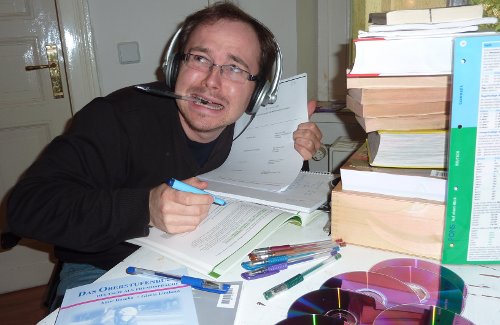
This post has been a long time coming.
Teachers and linguists are going to hate me for this, but it has to be said:
You can never speak a language by just studying it, no matter how much you study
Yes, you read that right. Studying is the wrong thing to do if you want to speak a language. I’m totally serious.
Last night I ran into some English speakers and heard the same thing I’ve heard thousands of times about other languages: they have been studying German for years and don’t speak it yet, even though they now live in Berlin.
Every day, I get dozens of e-mails from aspiring language hackers sharing their tales of woe with me; they’ve spent a small fortune on workbooks, CD audio courses etc. and have spent probably thousands of hours locked up in their rooms studying tables of rules and vocabulary lists. And they still can’t say anything.
Most people think the reason that this happens is because the material/teacher isn’t good enough. Or perhaps the language really is impossible and it’s the “hardest one in the world”.
I get asked all the time what my study method is, and precisely what books I buy. If our study materials were better then surely we’d finally speak!?
No.
There is only one thing study is good for
The purpose of this post isn’t to tell the world to stop studying. However, you have to realise that studying a language has a very specific purpose and if you are not aware of this then you may end up stuck in the vicious circle of never speaking: Studying will never help you speak a language, but (as long as you do it right) studying will help you speak a language better.
Most people don’t see the difference here. That one crucial word changes absolutely everything you need to take into consideration.
If you already speak but your conjugations aren’t great or you need to quickly increase your store of vocabulary about a specific topic, then by all means study. Need to pass a test in school? Sure, study for it. When the goal is to pass a test or improve your grasp on something specific, then study is the way to go.
But if you don’t speak the language confidently right now, then it’s time someone broke this news to you: studying is not the way to get this confidence!
But I’m almost ready!
When you study, you acquire vocabulary, you improve your grammar and you do exercises. Logically enough, your level improves. With time, your potential increases and you can understand more and you can theoretically join in on a wider scope of conversations. “One day”, when you’re ready, you can finally start speaking confidently. Not today though – maybe you just need to study a little bit more.
Theoretically & Maybe.
Based on my experience and accounts from thousands of learners I’ve met who need their language in the real world (not tests), “theoretically and maybe” translate to never. The academic system seems to have drilled into us that studying is the way to speak a language. Studying helps you improve (and to pass a test you do indeed need to know your grammar/vocab better… because that’s what the test is usually about) but it is an artificial means of acquiring or improving the language. Some artificial ways are quite useful, but they are still artificial.
When you look at a language the same way you look at geography or history or other subjects in school that can be tested, then you simply don’t know what a language actually is.
Stop looking at conversations with human beings as a test that you have to pass (so, every time you make a mistake you get a big red X and if you make a certain amount of them, then you fail). It doesn’t work like that!!
A language is a means of communication. It’s not a table of grammar rules in some dusty old book, or a piece of paper that you have to spread ink across in the right way for your teacher to be happy. German isn’t a rough sounding collection of Datives and Accusatives, it’s families sharing what they did that day. Czech isn’t a frustrating collection of consonant clusters, it’s young couples flirting with one another and someone buying his morning bread.
These are not things that you can put under a microscope. They are people living their lives and sharing experiences with one another. That is what a language is for. When you are locked away in your room you are avoiding this contact and that’s why so many people never speak. They still think about everything they don’t know and see the world that speaks their target language as one big test that they are doomed to fail.
How do you learn to speak then?
So, if studying isn’t how you learn to speak a language, then what is? I’ll tell you, and it’s going to blow your mind.
Are you ready?
Are you sitting down? Brace yourself!
You have to speak it! Yes, I know – it sounds absolutely crazy, doesn’t it! To speak a language you have to actually speak it.
It will be hard at first – you won’t know how to say things, it will be embarrassing, you’ll hesitate a lot and feel frustrated that you can’t say things precisely the way you want to. This will happen even if you study for decades. Until you actually use the language in its natural context (or at least in a course that gets you to speak to people) you will always have this barrier to get through. You simply have to break through it. If you practise often enough and enthusiastically enough you will get to the other side quite quickly. You can do this in person if there are natives or other learners close by, or over the Internet with millions of natives.
However, you can’t study to get this confidence. Confidence isn’t hidden somewhere on page 182, it’s getting into an actual conversation and proving to yourself (Obama style) yes you can.
Too many people study to gain confidence – this is an oblique way of going about it. You have to simply get used to speaking the language. Know how it feels to have the words come out of you rather than in an artificial test in which you have several minutes to think about things.
Last night with the English speakers I had the almost magic ability to turn them into German speakers with nothing more than a 5 minute pep-talk to boost their confidence and give them some language hacks. I didn’t teach them any actual German or tell them to study in a particular way. They had the potential to speak the entire time, no matter what their level was.
You haven’t learned enough to say anything yet? Hogwash! In many European languages you have thousands of words before you even start. In all languages you can study for a couple of hours (rather than years) to get basic phrases and then use them. Use what you know and go from there. Then you will see what you do need to work on (usually it will be something very specific and relevant to your situation rather than “chapters 1 to 7″), and then very specific study will help you improve how you are speaking so you will be able to express yourself a little better. But you already have the ability to say something right now.
There are a LOT of ways you can speak a language in the first weeks even if you didn’t study it much yet. So many ways that I had to write 30,000 words to describe them.
So what do you think? Picking on the academic system is such an easy target because it does such a miserable job in so many places and wastes the time of millions of people when it comes to language conversing ability. There are exceptions, and there are great courses to take, but that is usually because they have students converse in as natural a way as possible. Once the focus changes from studying to actually using the language to communicate with people then the road to speaking well, and doing it quickly, is opened up.
Don’t have this attitude of Leave me alone! Can’t you see I’m learning your language?
A language is a social tool and being locked up in your room studying it is, frankly, antisocial. You can’t avoid studying to improve your language skills, but if you want to speak then stop studying and just speak already!!
————
Of course, I wrote in depth about how I learn to speak languages with as little study as possible in the Language Hacking Guide. If you are a blogger check out information about becoming an affiliate.
I’m sure you can all understand how passionate I am to get this message out there – speaking a language does not have to be a chore! When I hear so many people complain about grammar I feel like they are looking at their language wrong and focusing on the wrong things. Stop complaining about it and just start speaking! You’ll make mistakes, but you will get over the barrier and start on the path to fluency
Looking forward to your comments! Feel free to call me crazy (as always…), but offensive or irrelevant comments will be eaten up by the Smoke Monster from Lost.
Similar Posts:
- Taking CEFRL tests for quality European language certificates with no classes
- Shocking truth about passive listening
- Mini-goals are the path to achieving fluency
- Just 2 weeks learning Esperanto can get you months ahead in your target language
- Non-verbal skills: essential but ignored aspects of foreign language communication


Subscribe by RSS
Looking for what in the bookstore?
If you mean my Language Hacking Guide, you can just download it right now
I won't be publishing it for at least a year, and only if sales go really well in the mean time.
Best of luck with your method
In the end one of the only advantage of learning in some courses is talking with those also taking the course – the HUMAN aspect – rather than the course material itself
Glad you were successful with Japanese and got over that awkward stage!
Hi I've just downloaded your book – you're an inspiration learning these languages so well!
HOWEVER I disagree about what you say above – I've been teaching English for over 10 years and I can assure you that today's major certificates and diplomas from Cambridge encourage teachers to organise lessons that get real results. ALL the teachers I know encourage real world speaking in their classes, along with a focus on what they need personally (eg emailing for work).
If you look at the latest coursebooks, some of them are quite forward-thinking when it comes to promoting conversational English. Yep, 'just speak speak speak' is important – but you also need language input. For some folk, a book helps (of course for others it can be a massive dreary hindrance).
Yep, there's still a little too much 'traditional teaching' or learning out there – but this is changing.
Despite what I've just said, I really do admire you for what you've done, and hope your book will have some tips for me on how to improve my Czech! I also agree that it's really improve to delay til tomorrow what you can do today – and also that each person's confidence and 'inner game' is really important.
Best wishes
David
Thanks David – glad you are enjoying the Guide
I have to say, no matter how accurate the coursebooks are, they are useless if not actually applied. Knowing all the information doesn't mean the student can actually use it.
If teachers from Cambridge get results then I imagine it's because they get the students to actually speak. Self-study or academic courses that encourage no interaction are what I am attacking in this post, not efficiently run courses that lead to actual conversation within the courses. If they do, then there is no disagreement – they combine conversation with studies. As I said in the post, courses that encourage speaking are great, and studying will help the student make progress… as long as they are speaking too
Thanks for your comment!
Many years ago when I was studying French at high school a new student came who was fluent in French because her family lived in a French speaking African country. It was then I realised what we were doing was not really related to a proficency in the language because my nerdy friends and I (who could always remember to make sure our adjectives were the right gender etc) regularly got higher marks than her.
hahahahahaha!
This is such bullshit! I've learned six languages using study and been to the countries where they speak them. It's taken me twelve years but I know speak Spanish, Italian, French, German, Portuguese, and Dutch. I went on a kind of Grand Tour last year. I went to Spain, Italy, Switzerland, the Netherlands, France, Portugal and Germany. And it seems that they thought I spoke perfectly.
Not sure what you are getting at, but your comment proves the worth of this post perfectly.
Exams are made for people good at exams. Because of that even natives can't do as well as people who spend their time learning tables. If the point of learning a language is nothing more than to pass an exam, then all you have to do is study.
But of course that student would have likely had spoken French at some level and been way better off than the rest of you in a natural conversation that didn't involve talking about subjunctives etc.
Just because you can explain the correct adjective endings doesn't mean you can talk about where you'll go to party this weekend…
Most people don't worry about speaking a large number of languages, they are quite happy with just one to start with. You seem to be ignoring crucial information. Right now, I too could study my way to fluency if I wanted (although I don't, because it's boring and antisocial).
But the point is, you would have gotten over the inability to converse in one language and the frustration of that and THEN been able to take on other languages easier. This barrier has to be gotten over and once you do it one time then it's way easier after that if you take on other languages.
If you honestly believe what they said about you speaking “perfectly”, you're deluded. Mastering a language takes a lot more than what you see it taking.
You met nice people who complimented your level. I'm sure you were speaking well and getting your point across. If you enjoy studying a language, keep it up. But your comments do nothing to disprove what I said here for people taking on their first foreign language.
Thanks for the link Anth
Hope you are enjoying your copy of the Guide
I was lucky to have a good French teacher in high school. For the first two years the classes were almost entirely speaking. It wasn't until our third year that we got a textbook. He thinks that input is essential to being able to speak, but he says that you get that input from hearing the language rather than reading through a textbook.
After taking his class real conversations were easy to get used to because I already knew how to speak. My spelling is terrible though, but I've never been in a situation where I need to spell French correctly.
I think you've gone a step too far.
Studying will help you speak a language. “Help”.
Studying will not make you speak a language.
The “speak” vs “speak better” distinction is a red herring.
A lot of language study falls into the category of “reception learning” as defined by Ausubel. “Reception learning” is learning by having the material explained to you, as opposed to “rote learning” which is just memorising facts (or words, phrases and sentences, in the case of language learning) and “discovery learning” which is working everything out for yourself.
But “telling is not teaching”, as I always say, so why am I in favour of reception learning? Reception learning theory agrees with this and says that we only genuinely learn through use, application and manipulation of the new knowledge. Discovery learning theory claims that the discovery process is part of the learning process, but reception learning claims that we don't actually start the learning until we have the facts in our possession, so the discovery period is little more than wasted time.
So I believe that study is of immense help in learning a language because it puts the mechanics of the language into your hands to use.
But of course, you have to get out and use it to learn it as you say, and reception theory says the same.
The “not ready yet” thing is self-perpetuating, as you say.
As I read through the article, it seemed to me you agree with this, but by being so strong in your title and opening paragraphs, you risk misleading the reader.
I'm currently taking Japanese in college, aiming for a degree in the language. I've managed to get straight A's in the class but still cannot speak very well. Read and write? Sure. I have a very limited vocabulary since it's not very important to my teacher but this summer I'm taking a conversation class. I speak with my friends in Japanese and can explain myself very basically in Japanese but for some reason in class I cannot do it. I have learned languages before (French, Spanish and German) but don't recall a lot in any of the three or I somehow combine them… I was lucky to have been able to live in two of the three countries in Europe those languages are spoken so I had no choice but to learn them! I was an exchange student in France for 6 months and became fluent enough that when I returned to the USA, I was technically in French 3 but doing French 6/7 work (which was considered fluent since there was no English in the book at all). I lived in Germany for 4 years and can still remember when I arrived there how foreign the language looked. I look at it now and can figure out (usually) what people are saying. Spanish I get to use at work as I have several co-workers who are native speakers and boy have I said some embarrasing things… apparently in Spanish, saying caliente means you want to have sex! I now know not to say that…
Anyways, this has been a very long comment (sorry!), but I wanted to let you know you've helped me get over the fear of speaking and even though I forget a lot of the time what I want to say, I'm speaking Spanish fluently (ish) at work, speaking French fluently to two of my co-workers who are native and attempting to speak Japanese to anyone who will listen. So thanks for posting all the things you have!
Your post reinforces a sociocultural framework for language learning, which emphasizes the supreme importance of CONTEXT, and that language cannot be separated from context, and when it is, is rendered meanngless…..over the cognitive framework that argues that language learning is primarily a function of the mind, and happens in predictable patterns.
What I dig about you is your ability to relay valuable language information, while at the same time providing a shit ton of motivation, where your passion comes through. On top of that, you're hilarious.
Well done!
I am a foreign language teacher and I don't hate you for this post. I agree. Studying the language (worksheets, conjugation charts, etc.) has its place, but we should be giving students opportunities to actually SPEAK in the target language on a daily basis. Give students phrases on the very first day of school so that they can start speaking on day one! Many teachers (particularly in the U.S.) are criticized for using total immersion and pressuring their students into actually speaking in the target language every day…but it's the only way they're actually going to acquire the language!! The teachers that are going to hate you are the ones who are simply too afraid to challenge their students or just don't care if their students acquire the language.
Hey, Benny, it's great you'tr interested in Russian! But I personally would suggest you consider studying Russian in the Russian speaking part of Ukrainian, because I find the accent of Moscow ridiculous – a bizzare combination of harshness and stereotypical gayness; and it's not even the standard pronunciation! I suggest you do accent comparison between different Russian-speaking areas before you decide to move anywhere to study Russian.
You're right in that learning to play an instrument is quite similar to learning a language. But the similarity goes even further:
I know of many people that once learned an instrument, went to lessons for years and still can't play much more than one or two favorite pieces. This is studying music.
Others learn a few chords and then go out and play together with their friends. This is conversation.
I don't want to say that the years of piano lessons I had were useless, there certainly is much to it, like technique (grammar), but only because I soon started playing with others, now I speak the piano language. And the guitar language I learned a little later without any teacher's advice. There are certainly some that speak it more fluently, but I get into a conversation with my band easily, even on songs I don't know yet
I'm not sure which teachers and linguists you have met, but I agree with Corcaighist completely. I wouldn't be able to find ONE professor or TA in the whole modern languages department where I work that would disagree about the importance of speaking. NONE of them stress studying as more important than actually speaking the language. Every single one of them (and our department) stresses the importance of speaking in the classroom and try to use a student-centered approach, which allows the students to utilize everything. This situation was exactly the same during my undergraduate studies, my graduate studies, and my time studying abroad.
I don't understand why “polyglots” with these “learn X languages in X amount of time” claims always attempt to attack academia and try to paint it as a group of people merely trying to force their students to study and never use what they have learned. It's completely absurd. I think it's an easy target and ridiculous to lay all blame on professors and claim that they are constantly unsuccessful in assisting a student in acquiring the ability to converse in the target language. Having learned a language through both speaking and “studying”, and having taught courses in which immersion and conversation are very stressed, I find it preposterous to ignore the faults of some of the students themselves.
Keep in mind that most introductory language courses are filled with students who have little to no desire to learn the language. Many of them are forced to take the course due to general education requirements and simply need to pass the courses. We always asked our students why they were taking our courses, and 90% of them generally said that. Of course that does not mean that I, or others, will simply just lackadaisically go about teaching since they don't want to learn. A teacher can create an atmosphere where speaking is encouraged and only the target language is used, but they cannot force students to speak…no matter how many times you tell them that it's ok to make mistakes…everyone makes mistakes. I even correct my own mistakes in front of my students to show that that even I, as the teacher, can make mistakes. Those students who do make an effort to participate are the ones who are generally the most successful in both learning and speaking. Teaching and modern language associations also highly promote research that stresses the importance of teaching and utilizing the language, even if mistakes are made.
I agree with most of what you said. I simply disagree with this need to paint academia as “failing”, “useless”, “never focused on utilizing”, etc.
“If you honestly believe what they said about you speaking “perfectly”, you're deluded. Mastering a language takes a lot more than what you see it taking. “
And how exactly is he deluded? It is very much possible that he simply met people who thought it was nice that he spoke their language, so they wanted to compliment him. It is also possible that he was good enough in at least one of the languages to have someone seriously mean he spoke “perfectly”. I know people who taught themselves languages with textbooks, videos, movies, etc and have near perfect pronunciation and grammar when it comes to conversational situations. I know a girl like that who taught herself German. Neither my boyfriend nor I can hear an accent or a mistake unless we wait a long time. She does in fact speak “perfectly” in conversational situations.
Chad, teachers never say “don't speak”, but those in schools etc. focus entirely on the content of the language rather than it's social implications. Focusing on studying and dull exercises is as good as actively avoiding conversations as far as I'm concerned. Perhaps other (more expensive) courses are different, but this has been my experience, and many many people share my experiences.
If the course you give is different and focuses on conversation as the priority over tables of grammar and standardised exercises that aren't relevant to the learner, then that's great, but that would be an exception rather than the norm.
Thanks Traci – it's always nice to read comments like yours that help me see I am helping people
And I know many, many people who share my experiences as well. You cannot simply portray your experiences as some sort of fact and basis for attacking academia as you have.
You do realize that your whole approach focuses solely on conversational skills? The purpose of a classroom is not to only teach conversational skills. You need to focus on writing and reading skills as well. You may be of the opinion that many of the exercises are dull and irrelevant, but I personally find that opinion to be complete BS and truly uninformed.
Teaching and promoting conversational skills is very important, however, doing so at the expense of the other skills is doing the students a disservice. You seem to incorrectly assume that each person learns in a similar way. You do realize that there are different ways of learning? Not all students can simply pick up the correct grammar through speaking. I know students I studied abroad with who spoke German every day and yet rarely improved in their grammar. Sure they were able to get their point across in simplistic situations, but they sometimes spoke in broken sentences, and failed to even make the verb and subject agree. Perfect grammar is not something somoene should obsess over…they will never speak it PERFECTLY. However, the importance of learning the grammar and structure of the language in a classroom is not something that one can ignore. A good teacher will utilize both conversational activities and those grammar tables that you seem to find so tedious to assist their students in grasping the language.
I agree with a lot of both Chad and Benny say here. Reflecting on my own school experience, no one really wanted to learn Spanish. But it can be so chicken and egg as well. Did they not want to learn because it was taught so badly? Or was it taught badly because the course had to cater to those who didn't want to learn? In any language class, junior high, high school and in college, regardless of who taught the class, we studied straight from a text book. It was commonly said that you couldn't even begin to think of having a conversation until maybe your fourth year. It would take that long to learn all the grammar.
I remember one time, a friend and I had a sort of pidgin conversation with what we knew from Spanish. This was after two years maybe? Two years, and we could barely put together sentences.
In my early twenties, I moved to Prague as a part of that now infamous ex-pat scene. I made a huge effort to learn Czech, and spent a lot of time studying. I worked very hard at it and reached a certain level after one year that I felt good about, at least for having made the effort. But I can't deny that there were some Americans I knew who didn't try so hard, but who were at the same time quite cocky from my vantage point, who'd jump right in and just talk, very badly, but their comprehension was much higher than mine, in certain social settings, at a certain point. There's a give and take; we were all beginners. I was about to say “hack”, but that's taken on a new meaning now.
But after a year there, I felt like I was starting to really get it, and my cocky American friends were quite adept at ordering beers. But they “believed” they were quite good.
Slightly off topic, I just want to point out that at least (a lot of) Americans tried. I can't say as much for (several of the) ex-pats from other countries. Maybe we were all embarassed about the stereotypes against monolingual Americans, but I met quite a few polyglots from France, Germany, Holland and so on who just couldn't be bothered with Czech, claiming it was impossible.
I think Benny's headings are intended to be provocative, because while he says studying will never help you, he does spend time studying the language. It must help, or he wouldn't be doing it. But I think he's trying to take jabs at people who say that to learn a language you don't have to speak it, which is also an intentionally provocative point of view, because when pressed, these same people will say, Yes, of course, conversation is important.
Can we be real for a second? Aren't we all passionate about learning languages? I know I love arguing about it. Don't we all? Isn't that what this is all about? Nothing wrong with it. It keeps me going!
I come to this discussion from a slightly different perspective.
As someone who best learns languages the way you do, I obviously agree with your method. But as someone who is now about to begin teaching English to a group of students who live in a city where very few people speak the target language, I face other obstacles.
We're setting up our classroom as an English only space, and the goal of the classroom — from the student's perspective — is not to learn English, but another subject altogether. At the end of the quatrimestre (funny how it turns out to also be three months), we have to prove improved English facility.
So we're using an immersion model while being tested by the old study grammar model.
Should be interesting to see how it turns out.
Completely agree with you. I decided to take two years learning Mandarin in Beijing rather than going to an expensive academy in my hometown; being there I was able to connect and talk to locals all day, every day! I also went to university there to learn, but the only way to put all those expressions and new vocab I learnt in class to use was to go out there and talk my head off with any willing stranger/cab driver. I think locals in general are happy (or atleast find it interesting) that foreigners are making such an effort with their language, that when I said anything wrong they just corrected me and let out a little chuckle, but no ridicule (despite the fact that I may in fact have butchered their language).
Great post!
Brilliantly put, Benny.
And when you speak, people speak back. Pretty handy for learning a language.
Definitely some good points there, but saying that studying doesn't help you speak is gobbledygook that might be swallowed by someone learning their first foreign language, and might get you enough eyeballs and sales from people who are making no progress in their studies.
I've done it with three languages and there is no better way to it. Study, get the basics sorted, go out and talk/listen for a few weeks then hit the books again. Repeat.
I had respect for your blog but now it seems you're just saying stuff to get eyeballs and make money.
spot on-i realised this myself-my confidence explodes when i speak and it encourages me to study more-my beef is that books can't teach the real everyday speech(there are a few exceptions) but nothing beats learning from what ordinary people say!
This isn't something different from what linguistics usually say. They call it “exposure”. In order to use the language, you need to be exposed to. However, this doesn't often work in a foreign language class. The teacher sets the rule “No native language”, always “target language”, but later it is the teacher who uses it somehow.
The other thing you claim is called “language learning barrier”. Suggestopedia (a language teaching method) says when the barriers are on, the learning doesn't take place because the learner fells uncomfortable. For this reason, the teacher should set an environment where the learner could express himself clearly without fearing of making mistakes.
Another point is that Stephen Krashen (a famous linguist) claims there is an effective filter, which is close to the method's above mentioned claims more or less.
What I mean is, what you are saying isn't different, what is different is you have the ability to put it into practice, rather than lecture topic.
What if you don't have someone to talk to except like on text based chat? Does that still count as speaking (without the voice). Will it help you in a sense of speaking and not so much of just studying? The Language I am learning it's on the other side of the world. But planning to visit next year.
But as of right now I currently only have a way to speak is to myself and via text based applications. Would it hinder me?
thank you for posting this comment.
I'm Japanese and I've been studying English for over 10 years and I am now studying Nursing at uni in Australia. But I didn't have confidence with my English BEFORE I read this. And it has been my biggest concern, I couldn't say what I wanted to say.
I realised that I had been studying English with sitting at the desk all the time to get enough confidence to talk to people. Now I know that's all wrong.
Tommorrow, my new tutorials are starting. My mission is to find somebody to talk!!
Thanks Benny!!
i have to say hand on heart i completely disagree with you when you say that it should be used to help you improve as opposed to anything else. yes, obviously it will help you improve if you arent brilliant in a given aspect of the language, that goes without saying, but i;m living proof that studying a language can make you speak it without too much difficulty. last year i went to portugal to see my girlfriend and her family, who are all native portuguese. before going, i speant a month looking at vocab, learning it, reading how to pronounce the words correctly. i sat and memorised all the grammar rules and exceptions i could find and finally at the end of the month i flew out there. when i got out there i was able to speak clearly and concisely by applying the rules of grammar to the vocab i had learnt. naturally i wasnt able to speak like a native and it was obvious i wasnt one, but i was still able to communicate without a problem and and make myself completel understood by everyone i came into contact with, and all this was without ever having heard a word of the language spoken by a native. today, after having spent the past year speaking nothin but portuguese with my girlfriend i am now completely fluent with a good accent. there are very few things that i am unsure how to say in the language, and as much as it will never be as good as my native obviously, i recon that with time then it will come pretty close if it continues the way its goin
i have read alot of your posts and think they are very good, but have to admit that you do generalise alot, and forget that like rules of language, there are exceptions to the rules to with people and the ways they study and learn.