


Japanese History: The Beginner’s Guide

Full disclosure: This post contains affiliate links. ?
Japanese history stretches from Palaeolithic communities and some of the world’s earliest pottery to court culture, warrior governments, empire, war and post-war democracy. This guide gives you the main sequence without treating legends as documented events or reducing the country’s past to samurai and shōgun.
The period dates below are a map, not a set of hard borders. Archaeologists and historians use slightly different dates, and political, cultural and social changes rarely happen everywhere at once.
Editor's note: Before we get started, if you’re looking for an online Japanese course, here’s the course we recommend: Japanese Uncovered – Learn Japanese Through the Power of Story, a course with a fascinating new method by Olly Richards. You can try it for free for 7 days!
Table of contents
- How to Say “History” in Japanese: 歴史, rekishi
- Japanese History: An Overview
- Japanese History Timeline
- Ancient Japan
- Asuka, Nara, and Heian Periods
- Feudal Japan: Shogunates and Daimyō
- Early Modern and Modern Japan: Edo and Meiji
- Japanese American History
- Japanese Brazilian History
- Japanese Language History
- Japanese History for Kids: Resources
- Japanese History Books to Learn More
- Japanese History in Modern Culture
- Where to Go Next
How to Say “History” in Japanese: 歴史, rekishi
“History” is 歴史 (rekishi). Japanese history is 日本史, normally read nihonshi, while world history is 世界史 (sekaishi). The National Diet Library record for the Iwanami Nihonshi Jiten gives the reading にほんし for 日本史.
- 時代 (jidai): a historical period or era, as in 江戸時代 (Edo jidai)
- 年代 (nendai): a period, date range or decade, depending on context
- 紀元前 (kigenzen): BCE
- 西暦 (seireki): the Common Era or Western calendar
日本 can be read Nihon or Nippon, but this does not make Nippon a generally “more honourable” version. Learn the reading used in each fixed name and compound rather than trying to apply one political rule to both.
Japanese History: An Overview
A useful first pass has five broad stages: prehistoric Japan; the formation of court government; rule by warrior governments; the centralised early-modern Tokugawa state; and modern Japan from the Meiji Restoration onwards. The Columbia University Japan timeline and the Metropolitan Museum’s regional chronologies are good companions because they put political changes beside religion, literature and art.
For a language learner, the dates will stick better if you connect each period to one Japanese term and one surviving object or text. Try this four-part routine:
- Read one short period overview in English. Write down the event that begins or ends the period, while remembering that the boundary is approximate.
- Learn three Japanese keywords. For the Edo period, that might be 幕府 (bakufu, warrior government), 大名 (daimyō, domain lord) and 浮世絵 (ukiyo-e, pictures of the floating world).
- Open one museum object or primary source. Describe what you can see before reading the curator’s explanation.
- Check a drama, game or manga against the source. Historical fiction can give you names and settings, but it is not evidence for what happened.
Japanese History Timeline
This is a compact working chronology. Earlier dates, especially the transition between Jōmon and Yayoi cultures, vary between sources and regions.
| Period | Approximate dates | Useful anchor |
|---|---|---|
| Palaeolithic | before c. 14,000 BCE | Mobile communities lived in the archipelago before pottery. |
| Jōmon | c. 14,000–c. 300 BCE | Cord-marked pottery, hunting, fishing, gathering and settled communities. |
| Yayoi and Kofun | c. 300 BCE–538 CE | Wet-rice agriculture, metalworking, regional polities and large elite tombs. |
| Asuka and Nara | 538–794 | Buddhism, court institutions and the first surviving official histories. |
| Heian | 794–1185 | Kyoto court culture and the growing power of provincial warriors. |
| Kamakura | 1185–1333 | The first durable warrior government at Kamakura. |
| Muromachi and civil war | 1336–1573 | Ashikaga rule, regional daimyō and prolonged conflict. |
| Azuchi–Momoyama | 1573–1603 | Political reunification under Nobunaga, Hideyoshi and Ieyasu. |
| Edo or Tokugawa | 1603–1868 | Tokugawa rule, urban growth, controlled foreign relations and a thriving print culture. |
| Meiji | 1868–1912 | Centralisation, industrialisation, constitutional government and imperial expansion. |
| Taishō | 1912–1926 | Party politics expanded alongside social and imperial tensions. |
| Shōwa | 1926–1989 | Militarism and war, followed by occupation, reconstruction and rapid economic growth. |
| Heisei | 1989–2019 | The asset bubble collapsed; Japan faced demographic change and the 2011 triple disaster. |
| Reiwa | 2019–present | The era of Emperor Naruhito. |
Ancient Japan
People lived in the Japanese archipelago long before written records. The Tokyo National Museum’s archaeology guide describes permanent Jōmon settlements and pottery used for cooking, storage, ceremonies and burials. Very early pottery from Japan is among the oldest known, but that does not make one vessel or site the uncontested “oldest in the world”.
During the Yayoi period, wet-rice farming and metal technologies spread through much of the archipelago. In the Kofun period, enormous keyhole-shaped tombs show the growth of powerful regional elites and the Yamato court. These developments did not erase the archipelago’s diversity; the histories of Hokkaido, the Ryukyus and other regions do not fit neatly into a court-centred timeline.
Traditional chronicles date the accession of Emperor Jimmu to 660 BCE, but that belongs to foundation mythology, not a securely documented reign. The Kojiki was compiled in 712, and the Nihon Shoki, completed in 720, begins with a mythical age before moving into historical material. They are vital sources, but historians do not read every episode as a literal contemporary record.
For a separate introduction to the Indigenous people and language of northern Japan, see our guide to the Ainu language.
Asuka, Nara, and Heian Periods
From the sixth century, Buddhism and new forms of writing, law, administration and art reached Japan through sustained contact with the Korean peninsula and China. The court built capitals at Nara and then Heian-kyō, now Kyoto. The Kojiki, Nihon Shoki and poetry collection Man’yōshū are central texts from this state-building period.
In the Heian period, the court developed a distinctive literary and artistic culture. Kana grew from ways of using Chinese characters for Japanese sounds; it was not simply a script invented because women were forbidden to learn kanji. Court women used kana to produce works including The Tale of Genji and The Pillow Book, while men also used kana alongside literary Chinese.
Political power became more dispersed as aristocratic houses, religious institutions and provincial landholders gained influence. Warrior families including the Taira and Minamoto became decisive in court conflicts, and the Genpei War of 1180–85 ended with Minamoto victory.
Tea had reached Japan earlier, but the practices now associated with chanoyu, the Japanese tea gathering, developed over centuries. Zen institutions and warrior elites shaped it especially during the medieval and sixteenth-century periods, so it is misleading to place the finished tea ceremony in Heian Japan.
Feudal Japan: Shogunates and Daimyō
Minamoto no Yoritomo established a durable warrior government at Kamakura after defeating the Taira, and he received the title sei-i taishōgun in 1192. He was not the first person in Japanese history ever to hold a shōgun title. The important change was the new bakufu, in which the imperial court continued while warrior institutions exercised governing power.
The Mongol-led invasions of 1274 and 1281 were repelled through Japanese fighting and fortifications as well as storms that damaged the invading fleets. The cost of defence weakened the Kamakura government because there was little captured land with which to reward warriors. The Metropolitan Museum chronology for 1000–1400 is a useful corrective to the familiar story that typhoons alone decided both campaigns.
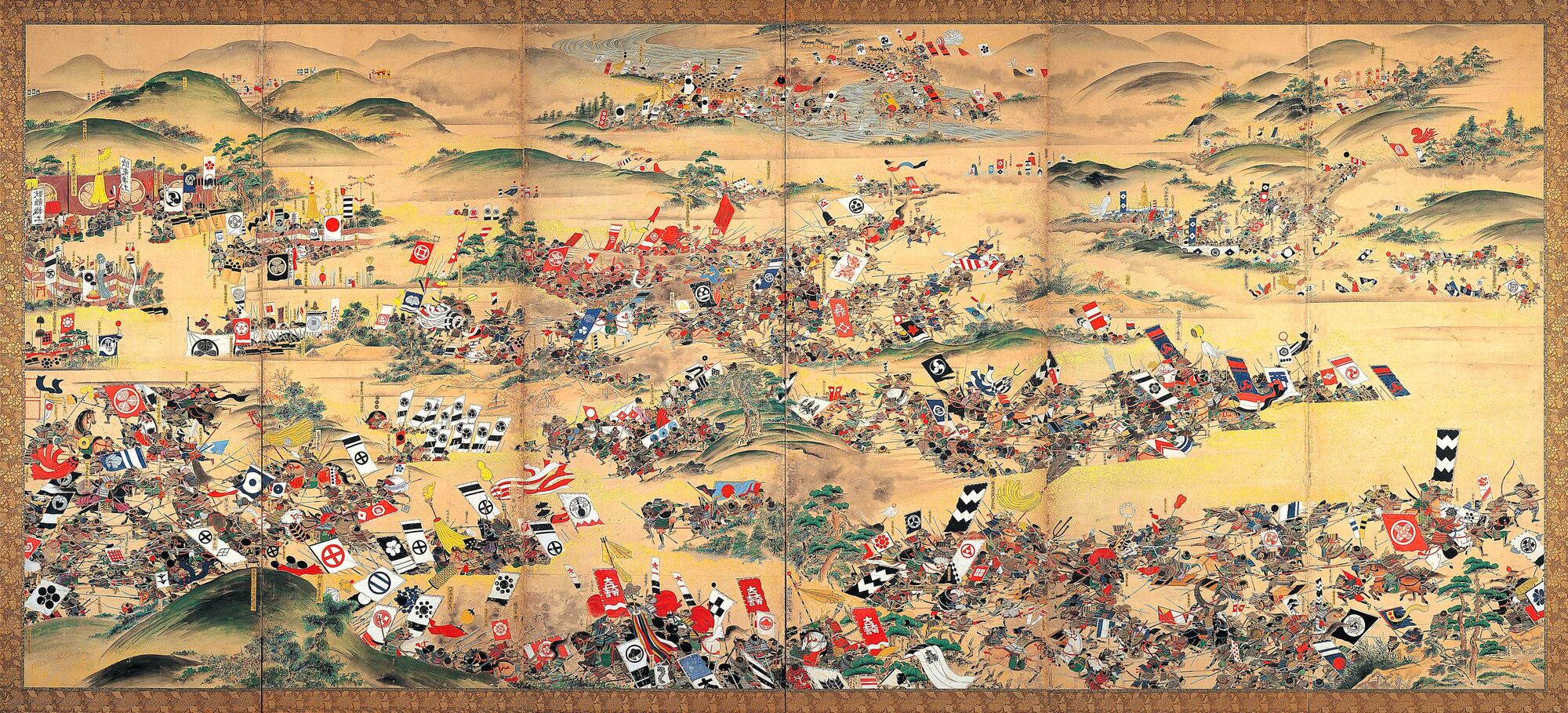
The Ashikaga shogunate followed in the fourteenth century, but regional daimyō became increasingly independent. The Ōnin War and the Sengoku period brought prolonged conflict before Oda Nobunaga, Toyotomi Hideyoshi and Tokugawa Ieyasu reunified most of the country. Popular images of ninja as a standard class of masked professional assassins come largely from later theatre, fiction and modern entertainment; historical espionage and irregular warfare were less tidy.
Early Modern and Modern Japan: Edo and Meiji
Tokugawa Ieyasu’s victory at Sekigahara in 1600 helped establish the Tokugawa shogunate in 1603. The Edo period brought long internal peace, urban growth, expanding literacy and commercial culture. Kabuki, ukiyo-e, haiku and popular publishing flourished alongside older court, Buddhist and regional traditions.
Japan was not completely sealed off. The shogunate tightly controlled foreign relations, but Chinese and Dutch merchants traded at Nagasaki, the Tsushima domain managed relations with Korea, Satsuma dealt with the Ryukyu Kingdom, and Matsumae traded with Ainu communities. Christianity was suppressed, yet the old label “isolation” hides these continuing networks.
Commodore Matthew Perry’s US squadron arrived in 1853 and returned in 1854. Treaties opened ports and granted foreign powers unequal privileges, intensifying a domestic political crisis. The Tokugawa government fell in 1867–68, and the new Meiji government abolished the domains, built national institutions, industrialised and adopted a constitution.
Modernisation and empire developed together. Japan acquired Taiwan after the First Sino-Japanese War, made Korea a protectorate and annexed it in 1910, and expanded its position in southern Manchuria after the Russo-Japanese War. The Nanjing Massacre did not belong to the Meiji wars: it began in 1937, during the Shōwa period and the Second Sino-Japanese War.
Shōwa and Heisei Japan
The early Shōwa period saw military expansion into Manchuria in 1931, full-scale war with China from 1937, and attacks across the Pacific and Southeast Asia from December 1941. Japanese forces committed mass atrocities, including the Nanjing Massacre and systems of forced labour and sexual slavery. The US Holocaust Memorial Museum’s Pacific War overview places these events in the wider history of Japanese imperial expansion.
The United States dropped atomic bombs on Hiroshima on 6 August 1945 and Nagasaki on 9 August. Exact death totals cannot be known; Hiroshima Prefecture estimates about 140,000 deaths by the end of 1945, with an uncertainty of about 10,000, while Nagasaki City records an estimate of 73,884 deaths by the end of that year. Japan announced its acceptance of surrender on 15 August and signed the formal instrument on 2 September.
The Allied occupation lasted until 1952. The Constitution of Japan came into force in 1947, established popular sovereignty and defined the emperor as “the symbol of the State and of the unity of the people”. Post-war reconstruction was followed by decades of rapid economic growth.
The Heisei period began in 1989. Its first years included the collapse of the asset-price bubble and a long period of weak growth. On 11 March 2011, a magnitude 9.0 earthquake and tsunami caused widespread loss of life and triggered the Fukushima Daiichi nuclear accident, as documented in the IAEA’s accident report. Treat the earthquake, tsunami and nuclear accident as connected but distinct events when you read about their effects.
Present Day: The Reiwa Period
Emperor Akihito abdicated in 2019 and Emperor Naruhito’s accession began the Reiwa period. The era has included the COVID-19 pandemic, the postponed Tokyo 2020 Olympics held in 2021, and continuing demographic pressure. Japan’s preliminary 2025 census counted 123.05 million people, down 2.5% from 2020, according to the Statistics Bureau of Japan.
Japanese American History
Large-scale Japanese migration to Hawaiʻi and the continental United States grew in the late nineteenth and early twentieth centuries. First-generation migrants are called Issei; their US-born children are Nisei. Anti-Asian laws restricted land ownership, citizenship and migration, and the Immigration Act of 1924 largely ended immigration from Japan until the system changed after World War II.
After Japan attacked Pearl Harbor, President Franklin D. Roosevelt signed Executive Order 9066. It led to the forced removal and incarceration, without trial, of more than 120,000 people of Japanese descent from the western United States and Hawaiʻi; about two-thirds were US-born citizens. The order did not itself name a one-sixteenth ancestry threshold, and conditions varied across the many detention, assembly and incarceration sites.
The US National Park Service history documents the incarceration sites and terminology. The Civil Liberties Act of 1988 issued a formal apology and authorised redress payments to surviving eligible incarcerees.
Japanese Brazilian History
The first official group of Japanese migrants to Brazil arrived at Santos aboard the Kasato Maru on 18 June 1908. The ship carried 781 people, many recruited for agricultural work. The Japanese Overseas Migration Museum traces the wider movement of Japanese workers and families to Hawaiʻi, North America and Latin America.
Early migrants often faced hard conditions as contract labourers on coffee plantations. Immigration later expanded beyond agriculture, stopped during World War II and resumed after the war. Wartime Brazil broke relations with Japan, restricted Japanese-language education and subjected Japanese communities to discrimination and surveillance. The Historical Museum of Japanese Immigration in Brazil preserves records of this wider community history.
Brazil now has the world’s largest community of Japanese descendants outside Japan. A 2024 Japan–Brazil joint statement estimated about 2.7 million people, so the older picture of a community made up mainly of recent migrants no longer fits.
Japanese Language History
Japanese is part of the Japonic language family alongside the Ryukyuan languages; calling it a language isolate erases that established relationship. Research on Proto-Japonic and language dispersal continues, and proposed deeper links with Korean or other families are not settled facts.
Writing arrived through contact with literate cultures on the Korean peninsula and in China. Early Japanese texts used Chinese characters in several ways: for Chinese-style writing, for Japanese meanings and for Japanese sounds. Hiragana and katakana developed from these practices, and modern Japanese combines kanji with both kana systems.
Spoken standards also changed. The modern standard is based largely on educated Tokyo speech, but regional varieties remain important, and Ryukyuan languages are not simply colourful accents of standard Japanese. History helps explain why a word may have a native Japanese reading, a Sino-Japanese reading or a later loanword form.
Japanese History for Kids: Resources
For children, start with a short country overview, then choose one object or period rather than trying to memorise the full table.
- National Geographic Kids: Japan gives a brief introduction to geography, wildlife, people and history.
- Columbia University’s elementary Japan resources collect age-appropriate material on Jōmon culture, shōgun, art and daily life.
- Tokyo National Museum education connects families and schools with objects from Japan’s cultural history.
- Our Japanese resources for kids helps add age-appropriate language practice once a child has chosen a historical topic.
Ask a child to pick one object, describe what it was made from and place it on the timeline. That small source-based task is more useful than a cartoon that mixes several centuries without saying so.
Japanese History Books to Learn More
Choose a book for the period or question you care about. These cover different scopes rather than competing to be one definitive account:
- A History of Japan: From Stone Age to Superpower by Kenneth G. Henshall is a compact chronological survey.
- A Modern History of Japan: From Tokugawa Times to the Present by Andrew Gordon starts with the Tokugawa order and follows Japan’s political and social transformation.
- The Making of Modern Japan by Marius B. Jansen is a detailed study of the Tokugawa-to-Meiji transition.
- Embracing Defeat by John W. Dower focuses on defeat, occupation and the remaking of post-war Japan.
- Japan at War: An Oral History by Haruko Taya Cook and Theodore F. Cook brings together memories from people with very different wartime experiences.
- Pure Invention by Matt Alt follows modern Japanese commercial culture and its international influence.
If your main goal is reading practice, pair a history book in English with our list of Japanese books for language learners. Keep fiction and historical evidence in separate columns in your notes.
Japanese History in Modern Culture
Historical settings turn up constantly in games, television, manga and film, but a familiar name does not guarantee a faithful account. Rurouni Kenshin, for example, uses the early Meiji transition as its setting; In This Corner of the World follows civilian life in and around wartime Hiroshima. Each can prompt good questions, but neither replaces a history source.
Our post on Japanese culture gives more context for traditions and daily life. The @languagehacking post below shows how Japanese folklore continues to surface in anime, manga and films.
Where to Go Next
Pick one period from the timeline, learn its three Japanese keywords and open one museum source. Once you can explain what changed, who held power and what evidence survives, move to the periods immediately before and after it. That gives you a connected history instead of a pile of isolated dates.
These guides continue into Japanese language and culture:

Social