


35 Ways To Say I Love You In Vietnamese

Full disclosure: This post contains affiliate links. ?
There is no single Vietnamese phrase that works for every English “I love you”. The verb matters, but the words you choose for “I” and “you” matter just as much.
Vietnamese speakers often use kinship terms such as anh, chị and em as person words. Your choice reflects your relationship, relative age and the way the two of you normally address each other.
That means a phrase for your partner will differ from one for your parents or grandparents. I’ll show you the useful patterns, explain what each one implies and flag the phrases you should only use in an established relationship.
A note from the Fluent in 3 Months team before we get started: You can chat away with a native speaker for at least 15 minutes with the “Fluent in 3 Months” method. All it takes is 90 days. Tap this link to find out more.
Table of contents
- How Do You Say “I Love You” in Vietnamese?
- How Do You Say “Love” in Vietnamese?
- Choose the Right Vietnamese Pronouns
- “I Love You” in Specific Situations
- Dating and Marriage Vocabulary in Vietnamese
- Romantic Vietnamese Phrases
- “I Like You” in Vietnamese
- Love and Vietnamese Culture
- Choose One Phrase and Use It
How Do You Say “I Love You” in Vietnamese?
For many couples, the familiar answer is Anh yêu em or Em yêu anh. Both mean “I love you”, but the person words reverse with the speaker.
- Anh yêu em: “I love you”, said by the partner using anh for himself to the partner addressed as em.
- Em yêu anh: “I love you”, said by the partner using em for themself to the partner addressed as anh.
In a conventional heterosexual couple, anh often refers to the male partner and em to the female partner, even when the age difference is tiny. Other couples use different pairs, names or pet names. Follow the terms your partner actually uses rather than assigning one from a phrasebook.
Pronunciation tip: Vietnamese spelling carries meaning. Type every diacritic, and do not treat the tone marks as decoration. Yêu and thương have the unmarked level tone, while words such as bạn, mình and chị carry different marked tones. Listen to the variety spoken by the person you want to talk to and copy a full phrase, not isolated English-style syllables. Michigan State University’s Vietnamese tone guide has audio and explains all six tone categories.
For more structured audio practice, have a look at our VietnamesePod101 review.
How Do You Say “Love” in Vietnamese?
Two important Vietnamese verbs can correspond to English “love”:
- Yêu can express romantic love, although it also appears in other kinds of loving relationships.
- Thương conveys affection, care or tenderness. You will hear it with partners, relatives, close friends and other people someone cares deeply about.
- Yêu thương combines the two and can mean “to love and care for”.
These meanings overlap. Yêu is not only a feeling, and thương is not only an action. The natural choice depends on the relationship, household and region, so ask a trusted speaker which one sounds right in your situation.

Choose the Right Vietnamese Pronouns
Vietnamese person words work in pairs. One person might call themself em and address the other as anh or chị; the other person reverses that pair. The same kinship terms can also refer to literal relatives.
- Tôi: “I/me”; neutral or relatively formal in many settings, though it can sound distant in an intimate relationship.
- Bạn: “you” for a peer in some contexts; it also means “friend”. It is not a universal casual “you”.
- Mình: “I”, “we” or “oneself”, depending on context; it can sound warm or intimate.
- Anh / chị / em: older male, older female and younger person of the same generation, as well as common relationship terms.
- Con: a child speaking to a parent or someone of a parent’s generation.
- Cháu: a grandchild, niece or nephew; also a younger person addressing someone of an older generation.
- Bố, ba, cha: father terms; mẹ, má: mother terms. Choice varies by family and region.
- Ông / bà: grandfather/grandmother or an older man/woman.
- Bác, chú, cậu and cô, dì: several distinct uncle/aunt terms. Their use depends on family side, relative age, gender and region; they are not interchangeable translations.
This system has more nuance than any short list can hold. Research on Vietnamese kinship terms shows how relationship and context shape person reference, while Michigan State’s family-address guide gives more detail on specific relatives.
When I first wrote this article, I’d been living in Vietnam for more than five years and had made plenty of pronoun mistakes along the way. My best advice is simple: listen for the pair the other person establishes, and ask if you are unsure. Names are also useful when a fixed English-style pronoun would force an awkward choice.
Kinship terms also extend beyond literal family. I use chị for both my slightly older sister-in-law and my landlord. I call my landlord’s mother Bà Nhi, just as I would address a woman of my grandmother’s generation. Social relationships shape the terms, so not every interaction follows one family-wide rule.
“I Love You” in Specific Situations
Adapt these patterns to the pronoun pair you use. The same verb can sound different with a different pronoun pair.
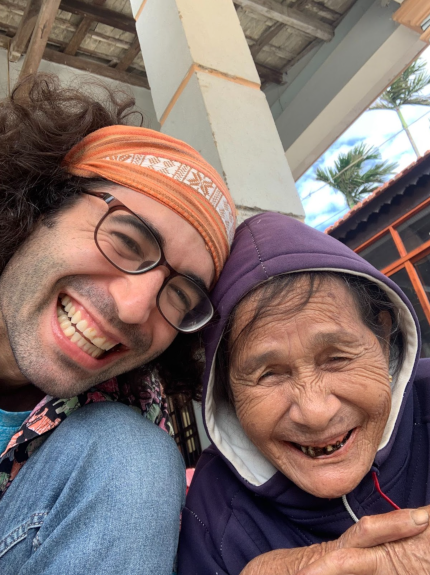
- Anh yêu em: “I love you”, using the anh–em relationship pair. My wife is two months older than me, but I still call her em; that is the convention we use together.
- Em yêu anh: the reverse of that pair.
- Con yêu mẹ or Con yêu má: “I love you, Mum.” Má is especially associated with southern speech.
- Con yêu bố or Con yêu ba: “I love you, Dad.” Bố is common in the north and ba in the south, with family variation.
- Con thương bố mẹ or Con thương ba má: “I love/care deeply for you, Mum and Dad.”
- Cháu thương bà / Cháu thương ông: “I love you, Grandma/Grandad”, using a common grandchild–grandparent pair. Some families use con instead.
- Em thương chị: “I love/care about you”, said by the younger person to an older female or older sister.
- Con thương cả nhà: “I love the whole family”, said as con to the family group.
- Tao thương mày: an intimate or rough “I love you” between people who already use tao–mày reciprocally. Outside that relationship, this pair can sound insulting or aggressive. Do not test it on a stranger.
Vietnamese is often described in three broad regional groups: Northern, Central and Southern. There is plenty of variation inside each group, in both pronunciation and vocabulary. If you have one person or community in mind, learn from their variety. The existing pronouns in three dialects lesson gives you a useful listening comparison.

Dating and Marriage Vocabulary in Vietnamese
- Vợ: wife
- Chồng: husband
- Bạn gái: girlfriend
- Bạn trai: boyfriend
- Người yêu: boyfriend, girlfriend or romantic partner
- Người thương: a loved one or beloved
- Anh yêu / em yêu: darling or my love, addressed to the partner using anh or em
Romantic Vietnamese Phrases
Once you have the right relationship pair, you can say more than the basic phrase:
- Anh yêu em nhiều lắm: “I love you very much.”
- Anh thật sự yêu em: “I truly/really love you.”
- Anh yêu em say đắm: “I love you passionately.” This sounds more literary than everyday conversation.
- Anh nhớ em: “I miss you”, from anh to em.
- Em nhớ anh: “I miss you”, with the pair reversed.
- Em đẹp lắm: “You’re very beautiful.”
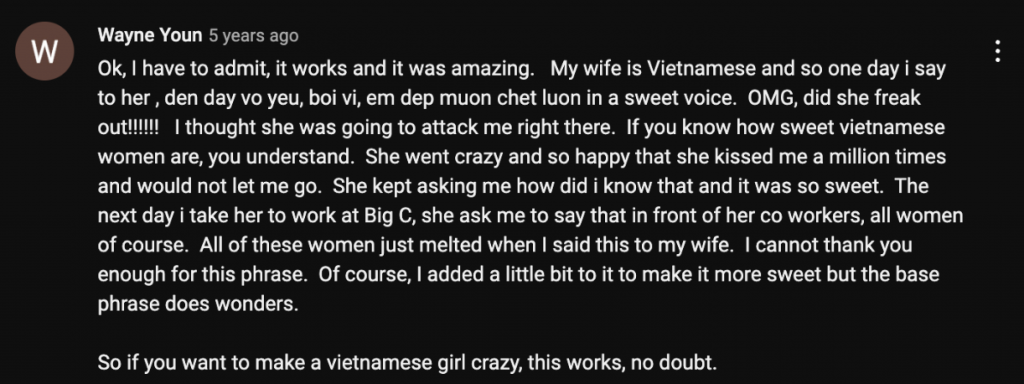
- Em đẹp muốn chết luôn: a playful, dramatic “You’re so beautiful I could die.” It is deliberate hyperbole, not a literal wish.
- Anh yêu ơi! / Em yêu ơi!: “Darling!” or “My love!”, when calling to the partner you address as anh or em.
- Vợ ơi! / Chồng ơi!: an affectionate “Darling!” between spouses; literally, you are calling “Wife!” or “Husband!”
Em đẹp muốn chết luôn is best kept for a playful relationship where that level of drama will land well. I made a YouTube video about the line in 2015, and one viewer later told me it had worked for him. That is a fun story, but it does not guarantee that the phrase will work for anyone else. A clever phrase still needs timing, warmth and mutual interest.
“I Like You” in Vietnamese
If “love” feels too strong, thích means “to like”. Quý and mến are closer to valuing, esteeming or feeling fond of someone.
- Anh thích em: “I like you”, using the anh–em pair. In the right context, it can reveal romantic interest.
- Tớ thích cậu: “I like you”, an informal peer-to-peer form associated especially with northern speech.
- Tôi mến bạn: “I’m fond of you” or “I hold you in affection.” The tôi–bạn pair can sound neutral or distant in some relationships.
- Tao quý mày: “I value you/I’m fond of you”, only within an established relationship that already uses the intimate tao–mày pair.
- Trời ơi, thích quá!: “Oh wow, I like it so much!”
- Bạn có thích không?: “Do you like it?” using bạn for the listener.
- Anh không thích chơi nữa: “I don’t want to play any more” or “I don’t like playing any more”, depending on context.
- Em có thích món này không?: “Do you like this dish?” addressed to em.
- Mình thích uống cà phê: “I like drinking coffee” or “We like drinking coffee”; context tells you which meaning mình has.

Love and Vietnamese Culture
Be wary of any rule that says Vietnamese people do or do not express love in one particular way. Families, generations, regions and individuals differ. Words can matter deeply, but affection can also appear through food, practical help, time and everyday care.
As an American, I grew up saying “I love you” to relatives several times a day, and I say it easily to close friends. My wife’s family expressed affection differently. On my early visits, I noticed fewer hugs and fewer direct declarations than I was used to. That describes one family’s experience and does not apply to everyone in Vietnam.
I still like being open about affection, but I have learnt to pay attention to what makes the other person comfortable. Treat a loving phrase as an invitation. It never obliges anyone to say it back. If you are unsure, ask your partner or relative which wording and person terms feel natural.

Choose One Phrase and Use It
Start with the relationship, then choose the phrase. If your partner uses anh–em, practise Anh yêu em or Em yêu anh as one complete sound pattern. For parents, learn the exact terms used in their family rather than assuming bố mẹ or ba má.
My wife and I have made a habit of saying con yêu bố mẹ when we speak to her parents. It was not their usual style at first, but over time they began saying it back. That little change worked because it became part of our relationship over time.
Try one phrase with someone you trust, then ask how it sounds. That short conversation will teach you more about Vietnamese pronouns, tone and affection than memorising a long list on your own.
Cảm ơn bạn đã đọc. Chúc bạn học tốt! (“Thank you for reading. Happy learning!”)

Social