


Master the Spanish Alphabet (With In-Depth Pronunciation Guide)

Full disclosure: This post contains affiliate links. ?
If you’re studying Spanish, you’re in luck: Spanish uses the Latin script and shares most of its letters with English.
Spanish spelling has a relatively regular relationship with pronunciation, but it is not an exact one-to-one system: some letters represent different sounds in different contexts, and some sounds have more than one spelling. This still makes Spanish spelling more predictable than English in many cases.
If you want a clear structure for putting your Spanish into practice, take a look at the Fluent in 3 Months Bootcamp. It’s a 90-day programme with weekly coaching calls, a private community and a focus on speaking from day one.
Table of contents
- The Spanish Alphabet
- How to Spell Words in Spanish
- Spanish Vowels
- Spanish Consonants
- How to Pronounce Spanish C
- How to Pronounce Spanish G
- How to Pronounce Spanish H
- How to Pronounce J in Spanish
- How to Pronounce Spanish Ll and Consonant Y
- How to Pronounce Spanish Ñ
- How to Pronounce Spanish Q
- How to Pronounce Spanish R
- How to Pronounce Spanish X
- How to Pronounce Spanish V
- How to Pronounce Spanish Z
- Spanish Accent Marks and the Diéresis
- How to Keep Learning Spanish
The Spanish Alphabet
In Spanish, the alphabet is called el alfabeto or el abecedario, and each letter is una letra. The Spanish alphabet has 27 letters, only one more than English.
Learning their names helps you spell out your name, email address and other details. It also gives you a map for the pronunciation patterns later in this guide.
What about ch and ll? They were traditionally treated as separate letters, so you may still see them in older alphabet charts and dictionaries. Since 1994, academic dictionaries have sorted them under C and L, and the 2010 Spanish orthography formally excluded them from the alphabet. Today, they’re classed as digraphs: two-letter combinations that represent a sound. They don’t add to the 27-letter total.
Spanish Letter Names and Examples
- a (a): avión (“plane”)
- b (be, be alta, be grande, be larga): barco (“boat”)
- c (ce): casa (“house”)
- d (de): dedo (“finger”)
- e (e): elefante (“elephant”)
- f (efe): familia (“family”)
- g (ge): gato (“cat”)
- h (hache): hola (“hello”)
- i (i, i latina): isla (“island”)
- j (jota): jugar (“to play”)
- k (ka): kiwi (“kiwi”)
- l (ele): libro (“book”)
- m (eme): mano (“hand”)
- n (ene): nube (“cloud”)
- ñ (eñe): niño (“boy”)
- o (o): ojo (“eye”)
- p (pe): perro (“dog”)
- q (cu): queso (“cheese”)
- r (erre): reloj (“clock”)
- s (ese): sol (“sun”)
- t (te): tigre (“tiger”)
- u (u): uva (“grape”)
- v (uve, ve, ve baja, ve chica, ve corta, ve pequeña): ventana (“window”)
- w (uve doble, doble uve, ve doble, doble ve, doble u): wifi (“wifi”)
- x (equis): examen (“exam”)
- y (ye, i griega): yo (“I”)
- z (zeta): zapato (“shoe”)
Letter names are feminine in Spanish, so you’ll hear la be, la hache and una erre. Uppercase is mayúscula and lowercase is minúscula: A mayúscula and a minúscula, for example.
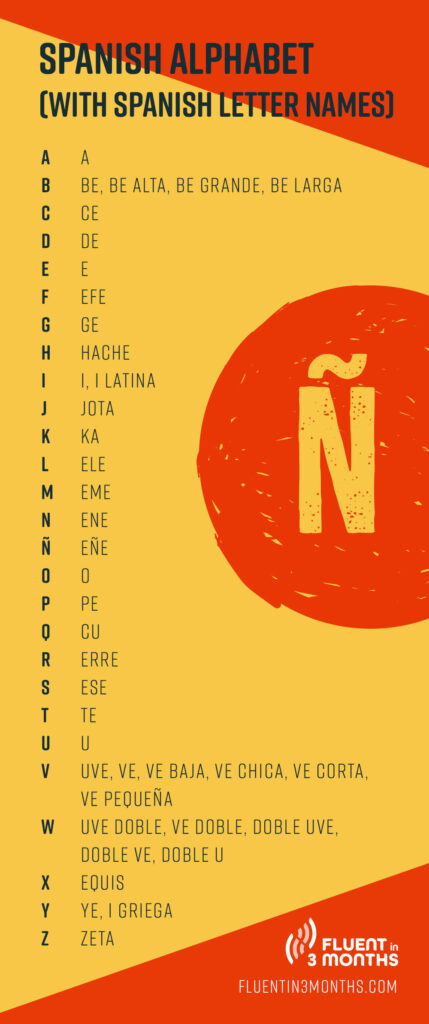
You may be surprised that some letters have multiple names. I’ll explain B and V later, but let me cover a couple of others now:
- W: The recommended name is uve doble, also used in Spain. Across Latin America you’ll also hear doble uve, ve doble, doble ve and, especially in Mexico and parts of Central America and the Caribbean, doble u.
- Y: Both ye and i griega (“Greek I”) are used. The second name distinguishes it from I, which can be called i latina (“Latin I”).
To help the letter names stick, listen to this Spanish alphabet song from Sesame Street:
You’ll notice a lot of similarities and also a lot of differences with the English alphabet. Let me explain some of the most important aspects to pay attention to.
How to Spell Words in Spanish
Knowing the letter names comes in handy when you’re giving your name or email address over the phone. To spell guitarra (“guitar”), for example, you can say ge, u, i, te, a, doble erre, a.
If a letter is hard to hear, add de and a familiar example word: ge de gato (“G as in gato”). You can use doble for a repeated letter, as in doble erre.
Spanish Vowels
Spanish has five vowel phonemes, written /a/, /e/, /i/, /o/ and /u/ in the International Phonetic Alphabet. They’re more stable than English vowels, although you’ll still hear normal regional and individual variation.
- A represents /a/. An example is manzana (“apple”).
- E represents /e/. An example is elefante (“elephant”).
- I represents /i/, roughly like the “ee” in “see”. An example is isla (“island”). Y also represents a vowel sound in the conjunction y (“and”), while word-final Y often forms a diphthong, as in soy (“I am”).
- O represents /o/. An example is hola (“hello”).
- U represents /u/, roughly like the “oo” in “food”. An example is usar (“to use”). It is silent in gu before E or I, as in guerra, and in qu before E or I, as in queso. In güe and güi, a diéresis shows that U is pronounced, as in vergüenza (“embarrassment”).
Easy, right?
Spanish Consonants
There’s more variation among Spanish consonants, but the spelling still gives you useful clues about how to pronounce them.
Some consonants, such as F, K, L, M, N and P, have close English equivalents. Others change with their position, the neighbouring vowel or the speaker’s dialect. Spanish /p/, /t/ and /k/ also tend to have less of a puff of air than their English counterparts, while Spanish /t/ and /d/ are normally made with the tongue at the teeth.
K and W are less common and often appear in loanwords and names, such as karate, kiwi and web. They’re still worth learning because their pronunciation can reflect the word’s origin.
Now let me explain some differences between English and Spanish pronunciations for some of these consonants.
How to Pronounce Spanish C
Before A, O, U or most consonants, C represents /k/, as in carro (“car”). Before E or I, its pronunciation depends on the speaker’s dialect. CH is a separate digraph with its own sound.
In much of Spain, C before E or I sounds like the voiceless “th” in English “thing”. In Latin America, the Canary Islands and much of Andalusia, it sounds like S. So ciudad (“city”) begins with either sound, depending on the accent.
How to Pronounce Spanish G
Before A, O or U, G represents /g/, as in gato (“cat”). Before E or I, it represents the same voiceless fricative as Spanish J, as in general. Depending on the dialect, that can be a velar [x] or a weaker [h]-like sound.
To keep the /g/ sound before E or I, Spanish writes gu, with a silent U, as in guerra (“war”). If the U should be pronounced too, it takes a diéresis, as in pingüino (“penguin”).
How to Pronounce Spanish H
In standard Spanish, H is normally silent. That’s why hola (“hello”) in Spanish sounds like “ola”. You may hear an aspirated H in some loanwords, names and regional speech. Ch is a separate digraph with its own sound, as in chico (“boy”).
How to Pronounce J in Spanish
Spanish J represents a voiceless fricative, often velar [x] and realized more like English H in some regions. Thus jugar (“to play”) begins with this fricative, not the English J sound /dʒ/.
In much of Spain, this fricative is commonly produced farther back in the mouth and may sound stronger than English H. Its exact realization varies by region and speaker.
How to Pronounce Spanish Ll and Consonant Y
Ll is a digraph, not a consonant cluster or a separate alphabet letter. Speakers who distinguish Ll from Y pronounce it as a palatal lateral /ʎ/, while most of the Spanish-speaking world is yeísta and uses the same consonant sound for Ll and Y.
A rough starting point for the common yeísta sound is English Y in “yes”, so lluvia (“rain”) may sound roughly like “yuvia”. The exact sound varies by position and accent.
In Argentina and Uruguay, you’ll often hear [ʒ], like the consonant in English “measure”, or [ʃ], like “sh” in “ship”. In those accents, lluvia and ya may begin with one of these sounds.
How to Pronounce Spanish Ñ
Ñ is the one Spanish letter that isn’t part of the English alphabet. The small mark above it is called a tilde or virgulilla.
Ñ represents the palatal nasal /ɲ/, roughly like the “ny” sound in “canyon”. You’ve probably already met it in piña colada.
How to Pronounce Spanish Q
In standard Spanish spelling, Q appears in the digraph qu before E or I. The U is silent, and the pair represents /k/, as in queso (“cheese”) and quiero (“I want”).
How to Pronounce Spanish R
R is probably one of the letters English speakers find most difficult because Spanish contrasts a single tap with a multiple trill. Which sound occurs depends on the R’s position and spelling.
Between vowels or at the end of a word, a single R is usually a quick tap. Examples include pero (“but”) and quiero (“I want”). Some speakers compare it to the quick “tt” in an American pronunciation of “butter”.
At the beginning of a word, between vowels as RR, or after L, N or S, you use the longer trill. The digraph RR is called erre doble or doble erre. Examples include rumba (“rumba”), correr (“to run”) and the first R in alrededor (“around”).
Don’t worry – it took me about a year of learning Spanish to finally be able to roll my R’s! Sometimes it’s just a matter of time and practice. We also have an article all about how to roll your R’s for extra help!
How to Pronounce Spanish X
X has several possible pronunciations. Between vowels or at the end of a word, it usually represents /ks/, as in examen (“exam”). Before a consonant, you may hear /ks/ or a simpler /s/, depending on the region and speaking style. At the start of words such as xenofobia (“xenophobia”), it represents /s/.
Some names keep historical or Indigenous values of X. In México and Oaxaca, it represents the same sound as Spanish J. In other Mexican and Central American names, X can represent /ʃ/, /ks/ or /s/, so it’s best to check the local pronunciation.
How to Pronounce Spanish V
B and V represent the same /b/ phoneme in Spanish. There isn’t a separate English-style V sound, so baca and vaca are pronounced alike.
B is called be, with regional names such as be alta, be grande and be larga. V is uve or, regionally, ve, ve baja, ve chica, ve pequeña or ve corta. These extra words help distinguish the two letters when you’re spelling aloud.
After a pause or a nasal consonant, the phoneme is normally a stop [b]. In many other positions it’s an approximant [β], made without fully closing the lips. This variation applies whether the sound is spelled B or V.
How to Pronounce Spanish Z
Z follows the same regional pattern as C before E or I. In much of Spain it sounds like the voiceless “th” in “thing”; in Latin America, the Canary Islands and much of Andalusia it sounds like S. An example is paz (“peace”).
Spanish Accent Marks and the Diéresis
Spanish uses the acute accent, called a tilde or acento gráfico, on vowels: á, é, í, ó and ú. When you see one, it marks the stressed syllable. That’s why the stress falls at the start of águila (“eagle”) and at the end of jamón (“ham”).
The accent can change stress and meaning, as in bailo (“I dance”) and bailó (“he or she danced”). A diacritic accent can also distinguish words such as tú (“you”) and tu (“your”), or sí (“yes”) and si (“if”). Those pairs don’t gain an extra syllable or dramatic emphasis.
The two dots in Ü are a diéresis. In the combinations güe and güi, they tell you to pronounce the U. Compare guerra, where the U is silent, with pingüino (“penguin”), where you hear it.
For the full stress rules and more examples, see our complete guide to Spanish accent marks.
How to Keep Learning Spanish
Now you know the letter names and the main pronunciation patterns, put them to work. Spell your name aloud, read a short Spanish paragraph and circle the letters whose sounds change with context. Then build your vocabulary and grammar around words you can already sound out. ¡Buena suerte!

Social