


How to Say “Cheers” in Japanese: Kanpai and Toast Etiquette

Full disclosure: This post contains affiliate links. ?
If you want to raise a glass in Japanese, the one word you need is kanpai (乾杯).
You can use it with beer, sake, tea, or a soft drink. The useful part is knowing when to say it, what the other expressions around a toast mean, and which “rules” depend on the group you are with.
I lived in Japan for several years and speak Japanese fluently. I have heard kanpai at relaxed dinners with friends, university gatherings, and more formal events. The details change with the setting, but the word itself stays the same.
In the romanisation below, a macron marks a long vowel: ō lasts longer than o, and ū lasts longer than u.
Table of contents
Japanese Expressions Around a Toast
Kanpai is the standard toast. You may hear the other expressions in the same speech or gathering, but they do different jobs.
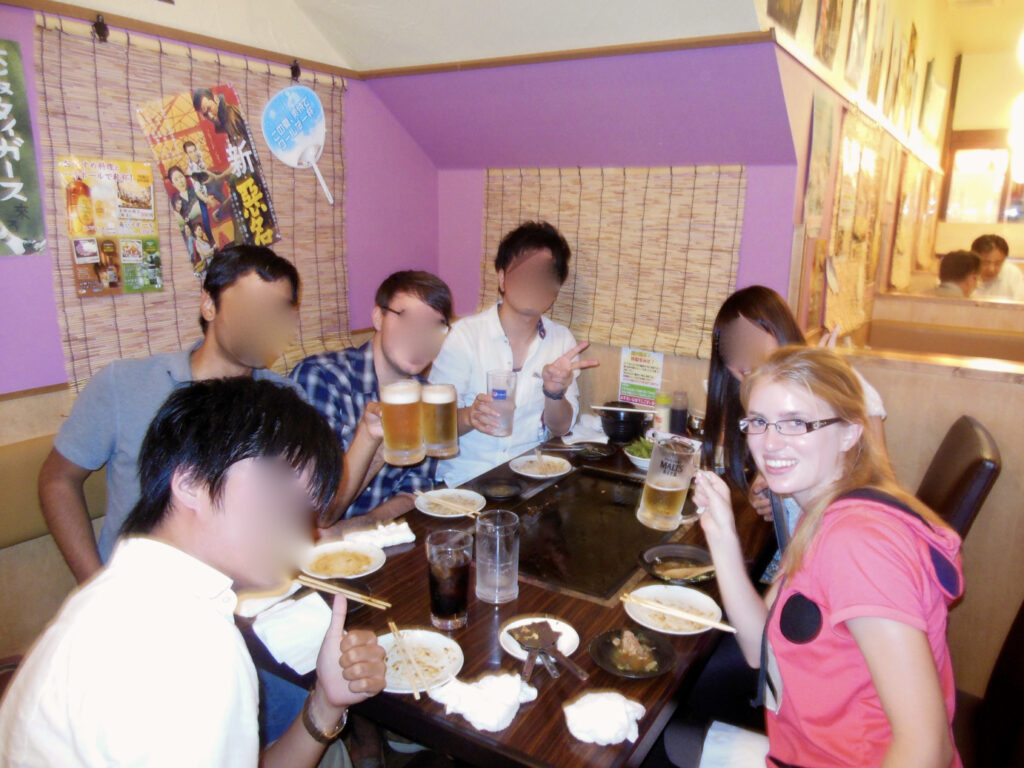
Here’s me with some university friends out for a drink in Japan, back in the day!
Kanpai (乾杯): The Standard “Cheers”
- Japanese: 乾杯
- Romanisation: kanpai
- Meaning: “Cheers!” or “A toast!”
- Register: Neutral and suitable for casual or formal toasts
The characters suggest emptying or drying the cup, and Japanese dictionaries include “drink the cup dry” in the word’s history. That does not mean you need to finish your drink today. The Japan Foundation’s guide says to take a sip after the toast and drink at your own pace after that.
If you are leading the toast, this polite sentence is useful:
じゃあ、乾杯しましょう。
Jā, kanpai shimashō.
“Well then, let’s toast.”
Shimashō is the polite “let’s” form of suru (する, “to do”). In a more formal speech, you may hear soredewa (それでは, “well then”) instead of the conversational jā (じゃあ).
Otsukaresama Desu (お疲れさまです): A Work Greeting
- Japanese: お疲れさまです
- Romanisation: otsukaresama desu
- Contextual meaning: “Thanks for your work” or “Good work today”
- Register: Polite workplace expression
This is not another translation of “cheers.” Coworkers use it to acknowledge one another’s effort, so it can come just before a work-party toast: Minasan, otsukaresama deshita. Kanpai! (みなさん、お疲れさまでした。乾杯!, “Everyone, thanks for your work. Cheers!”).
Otsukaresama deshita (お疲れさまでした) looks back on work or an event that has finished. Otsukaresama (お疲れさま) is less formal, but relationships and workplace culture matter. Listen to what your colleagues use before shortening it.
Omedetō Gozaimasu (おめでとうございます): “Congratulations”
- Japanese: おめでとうございます
- Romanisation: omedetō gozaimasu
- Meaning: “Congratulations!”
- Register: Polite; omedetō is the casual form
Use this for happy news such as a birthday, wedding, new baby, or exam result. It can introduce the reason for a toast, but the toast itself is still kanpai.
ご結婚おめでとうございます。乾杯!
Gokekkon omedetō gozaimasu. Kanpai!
“Congratulations on your marriage. Cheers!”
Banzai (万歳): A Cheer, Not a Toast
- Japanese: 万歳 (also written バンザイ)
- Romanisation: banzai
- Meaning: “Hurray!”; literally, “ten thousand years”
- Register: Public or emphatic cheer, not the normal word at the table
People may shout banzai to celebrate good news, sometimes three times with both hands raised. It has also appeared in imperial and military history, but that is not its only modern association. For an ordinary toast with drinks, use kanpai.
Toast and Drinking Etiquette in Japan
A casual meal among friends may be very relaxed. A wedding, business dinner, or organised enkai (宴会, banquet) can have a host, a speech, and a clear opening toast. The details vary, but these habits are a useful starting point:
- Pause before the first sip. At an organised gathering, people commonly wait until the opening kanpai. If you are unsure, follow the host.
- Choose the drink that suits you. Some groups order beer for a quick first round, but it is not an obligation. Tea, juice, and alcohol-free beer can join the same toast.
- Offer to pour in a formal setting. Pouring for other people, especially a guest or senior colleague, can be courteous. Receiving the bottle and pouring for yourself is normal in many casual situations.
- Do not treat a refill as a command. You do not have to finish a drink. If you do not want more, say mō daijōbu desu (もう大丈夫です, “I’m fine now / no more for me, thanks”) and leave some in the glass.
- Keep the glass gesture simple. Raising the glass is enough. Clinking is common in relaxed groups, but at a formal event you can follow the people around you.
You may hear advice never to toast with water. Treat that as a custom some people observe, not a national law. A non-alcoholic drink is a better choice than drinking alcohol you do not want.
What You Can Toast With
Kanpai names the toast, not the drink. Japan has a wide range of alcoholic and non-alcoholic options, and menus vary by venue and region.
Popular Alcoholic Drinks in Japan
Nihonshu (日本酒)
Nihonshu is the rice-based drink usually called “sake” in English. In Japanese, sake or osake (酒 / お酒) can also mean alcoholic drink more generally. You may also see the legal category seishu (清酒) on labels.
It may be served chilled, at room temperature, or warmed, in cups or wine glasses as well as small ceramic vessels. Sip it at the pace that suits the drink and the occasion.
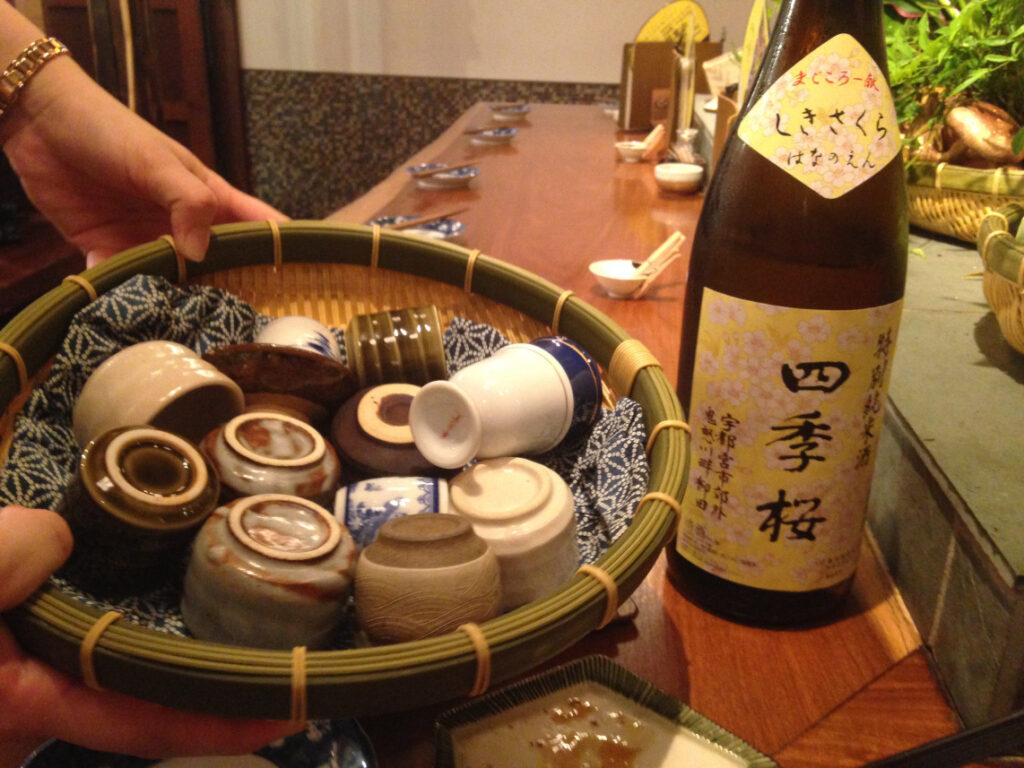
This restaurant let us choose a small cup for the sake.
Beer (ビール)
Beer is bīru (ビール). Large Japanese brands include Asahi, Kirin, Sapporo, and Suntory, alongside regional and craft breweries. Beer is a common first-round choice at group dinners, but you can order something else.
Shōchū (焼酎)
Shōchū is a distilled spirit. Depending on the style, it may be made from barley, sweet potato, rice, buckwheat, brown sugar, or another approved ingredient. It can be served neat, on ice, with hot or cold water, or in mixed drinks. Calling it “Japanese vodka” hides those differences.
Umeshu (梅酒)
Umeshu is made by steeping ume fruit in alcohol and adjusting the sweetness. “Plum wine” is the familiar English label, though ume is its own fruit and the drink is usually a liqueur rather than a fermented fruit wine. It may be served on ice, with water, or with soda.
Whisky (ウイスキー)
Whisky is uisukī (ウイスキー). A haibōru (ハイボール) is whisky with soda, often served over ice. You can also order whisky neat, on the rocks, or with water.
Popular Non-Alcoholic Drinks in Japan
Ask for non-arukōru (ノンアルコール, “non-alcoholic”) or sofuto dorinku (ソフトドリンク, “soft drink”) options. Check the label if you need to avoid alcohol completely, especially with traditional drinks.
Amazake (甘酒)
Despite the 酒 character, amazake is often alcohol-free or contains less than 1% alcohol. Kōji amazake (麹甘酒), made from rice and rice kōji, is non-alcoholic. Sakekasu amazake (酒粕甘酒), made with sake lees, can retain a small amount, so check the product if that matters to you.
Oolong Tea (ウーロン茶)
Oolong tea is ūroncha (ウーロン茶). It is a standard alcohol-free option on many izakaya and karaoke menus.
Calpis (カルピス)
Calpis, pronounced Karupisu (カルピス) in Japanese, is a sweet, tangy cultured-milk drink. Restaurants may serve it still or mixed with soda.
Mocktails and Alcohol-Free Beer
Many menus offer alcohol-free beer and cocktails. Useful labels include non-arukōru bīru (ノンアルコールビール) and mokuteru (モクテル, “mocktail”). Availability depends on the venue.
Japan’s Drinking Laws: The Essentials
You must be 20 or older to drink alcohol in Japan. The age stayed at 20 when Japan lowered the general age of adulthood to 18.
Drinking and Driving in Japan
Do not drive after drinking. The shuki-obi unten (酒気帯び運転, “driving with alcohol present”) offence applies at 0.15 mg or more per litre of breath, but Japan’s National Police Agency says driving with alcohol is prohibited even below that threshold. Penalties can also apply to people who provide a vehicle or alcohol to someone they know will drive, and to passengers who request a ride.
Bicycles count too: riding after drinking is prohibited, and serious violations can enter the criminal process. Use public transport or a taxi. If you need to get both yourself and your car home, an unten daikō (運転代行) service sends drivers to take you and the car.
Public Drinking in Japan
Japan does not have one nationwide rule banning every open container outdoors. That does not make every street, park, train, or event fair game. Local ordinances, venue rules, and transport policies can restrict alcohol.
For example, designated public spaces around Shibuya Station ban drinking from 18:00 to 05:00 every day. Official visitor guidance also asks travellers to avoid drinking on streets and outside convenience stores. Check signs, follow event rules, and keep alcohol to a place where it is clearly welcome.
If you need to ask, try:
ここでお酒を飲んでもいいですか?
Koko de osake o nonde mo ii desu ka?
“Is it okay to drink alcohol here?”
The pattern verb-te mo ii desu ka (〜てもいいですか) asks permission: “Is it okay if I…?”
Nomihōdai (飲み放題): All-You-Can-Drink Plans
Nomihōdai combines nomi (飲み, the verb stem of “drink”) with hōdai (放題, “as much as you like”). It is a fixed-price, time-limited drinks plan offered by some izakaya, restaurants, and karaoke venues.
A plan often lasts around one or two hours and covers a designated menu, not every bottle in the building. The venue may set a last-order time, require everyone in the group to choose the same plan, or limit how many drinks can be ordered at once. Read the terms rather than assuming.
Tabehōdai (食べ放題) is the matching “all-you-can-eat” term. Some venues combine the two.
A fixed price is not a target. Pace yourself, eat, drink water, and stop when you have had enough. To be honest, I’ve gotten more badly drunk in Japan than anywhere else in my life thanks to these plans. That experience is a reason to be cautious, not a challenge to repeat it.
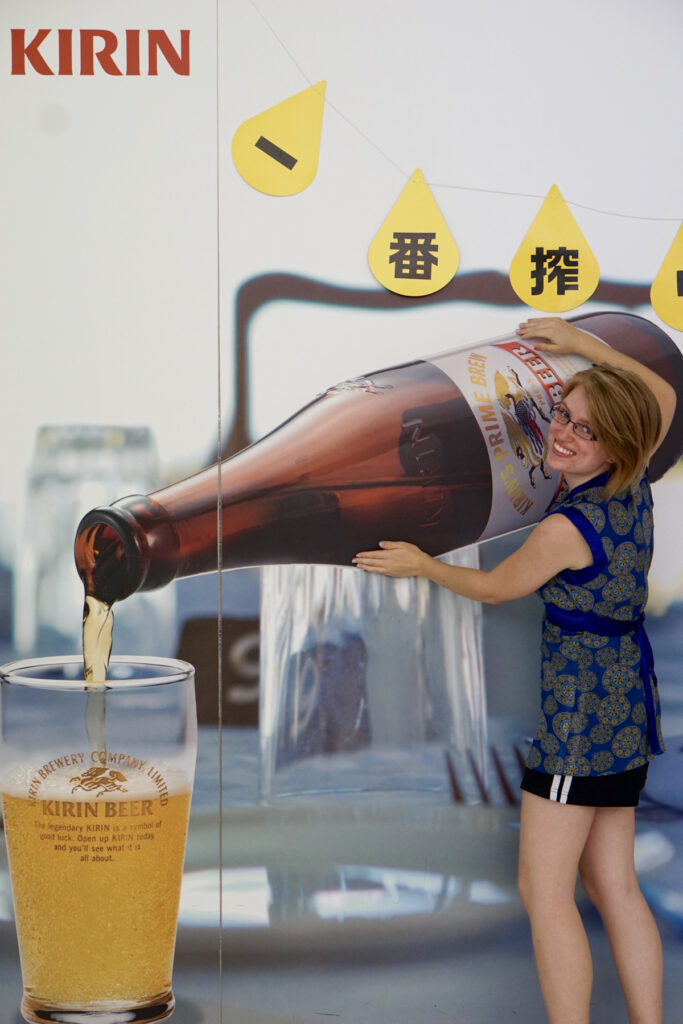
Kirin bottles do not usually come this big!
Your Next Japanese Phrase
For the toast itself, keep it easy: raise your drink, say kanpai, and follow the room. You don’t need alcohol or a long speech.
Want a few more expressions for the conversation around it? This video teaches 25 useful Japanese words and phrases for beginners:
For a larger audio course, see our JapanesePod101 review to decide whether its lessons fit the way you study.
Then try the phrase in a real moment: Jā, kanpai shimashō! (じゃあ、乾杯しましょう!, “Well then, let’s toast!”)

Social