



FinnishPod101 Review: Can It Crack One of Europe’s Hardest Languages?

Full disclosure: This post contains affiliate links. ?
What is FinnishPod101?
FinnishPod101 is part of the Innovative Language family, built to get you understanding and speaking Finnish from the very first lesson. Audio and video lessons taught by native speakers are its main feature.
- what it’s for:
- First contact with Finnish, listening practice, vocabulary, pronunciation (the vowel and consonant length), and phrases and conversation material
- languages:
- Finnish
- level:
- Absolute Beginner to Advanced
+ PROS
- Loads of native-speaker audio, exactly what Finnish’s vowel and consonant length needs
- A dedicated pronunciation pathway plus a voice recorder that compares you with a native speaker
- Genuinely deep beginner content, with a CEFR-aligned Level 1 pathway
- A 25-lesson slang pathway that tackles everyday spoken Finnish
- Phonetic spelling means listening practice converts straight into reading and writing
- Genuinely affordable, with a free tier and a 60-day guarantee
- CONS
- Lessons lean formal, so everyday spoken Finnish only arrives at Intermediate
- Grammar isn’t drilled in sequence, so the 15 cases need a companion resource
- Upper Intermediate content is noticeably thinner
- Pathways can feel like parallel options rather than one clear route
- The mobile app doesn’t have all the best features
Quick Fire Review
A brilliant audio-and-vocabulary engine for Finnish that trains your ear for its make-or-break vowel and consonant length; pair it with a grammar resource for the 15 cases. 4.3/5.
Finnish has a fearsome reputation among language learners, and for once the reputation points at the right things. The sounds themselves carry meaning in a way English ears simply aren’t trained for: tuli, tuuli and tulli are three different words (fire, wind and customs), and the only thing separating them is how long you hold a vowel or a consonant. Then the grammar arrives: 15 cases, words built by stacking ending after ending onto one stem, vowel harmony deciding which endings you’re even allowed to attach, and consonants that mutate between forms of the same word. The US Foreign Service Institute files Finnish under Category IV, at roughly 1,100 classroom hours to professional working proficiency, and a big part of that is that Finnish is a Uralic language, unrelated to English or to the French, German and Spanish most of us met at school. There are no cognate freebies to coast on. For perspective, though, that’s still only around half the hours the same institute budgets for Japanese or Mandarin, so Finnish is hard without being in the very hardest bracket.
And Finnish is generous in ways most European languages aren’t, which learners don’t hear often enough. The spelling is exactly as it sounds, with no silent letters and no irregular spellings to memorise. There’s no grammatical gender. There are no articles. There isn’t even a true future tense; the present tense plus context does the job. So the difficulty is concentrated in a few very specific places, and that’s exactly the kind of language where your choice of course matters most.
I’ve reviewed the Innovative Language “101” family across more than a dozen languages now, including TurkishClass101 (Turkish being Finnish’s fellow agglutinative, vowel-harmony language) and JapanesePod101, and most of the Fluent in 3 Months team have leaned on these courses for their own language projects. So the question I want to answer here is a specific one: does FinnishPod101 handle the things that genuinely make Finnish hard?
What Makes Finnish So Different
Before we get to the platform, let’s lay out what a Finnish learner is actually up against. These six challenges are the yardstick I’ll measure FinnishPod101 against.
1. Vowel and consonant length change the meaning. This is the big one, and it’s a listening problem before it’s anything else. In English, holding a sound longer adds emphasis; in Finnish it creates a different word. Tuli is fire, tuuli is wind, tulli is customs. Tapa is a habit; tappaa is to kill, which is quite a gap to fall into by rushing a consonant. Your ear has to be trained to catch distinctions it has spent a lifetime ignoring, and the standard advice is to exaggerate the long sounds at first, because every learner’s instinct is to underplay them.
2. Fifteen grammatical cases. This is the wall learners talk about most. English has essentially nothing left of a case system, so there’s nothing to map Finnish’s fifteen onto; the work that English does with little words like “in”, “on”, “from” and “of” gets done by changing the noun itself.
3. Agglutination. Finnish builds words by stacking endings onto a stem. Cases, possessive suffixes and small clitic particles all pile onto the same root, so a single Finnish word regularly carries what English needs a short phrase for. Reading a long Finnish word is less like recognising a unit and more like unpacking one.
4. Vowel harmony. Finnish vowels split into front and back sets, and a suffix’s vowels have to match the stem they attach to. It sounds abstract until you realise it governs almost every ending you’ll ever add.
5. Consonant gradation. Stems change shape between grammatical forms of the same word: katu (street) becomes kadun (of the street). So you’re not just learning endings, you’re learning how the word itself shifts underneath them. It’s a process pretty much unique to Finnish and its close relatives.
6. Spoken Finnish and written Finnish genuinely diverge. Finnish has a formal written register (kirjakieli) and an everyday spoken one (puhekieli), and the gap between them is wider than in most European languages. Textbook Finnish and the Finnish that Finns actually speak to each other can differ noticeably. Keep this one in mind, because I’ll come back to it.
Getting Started with FinnishPod101
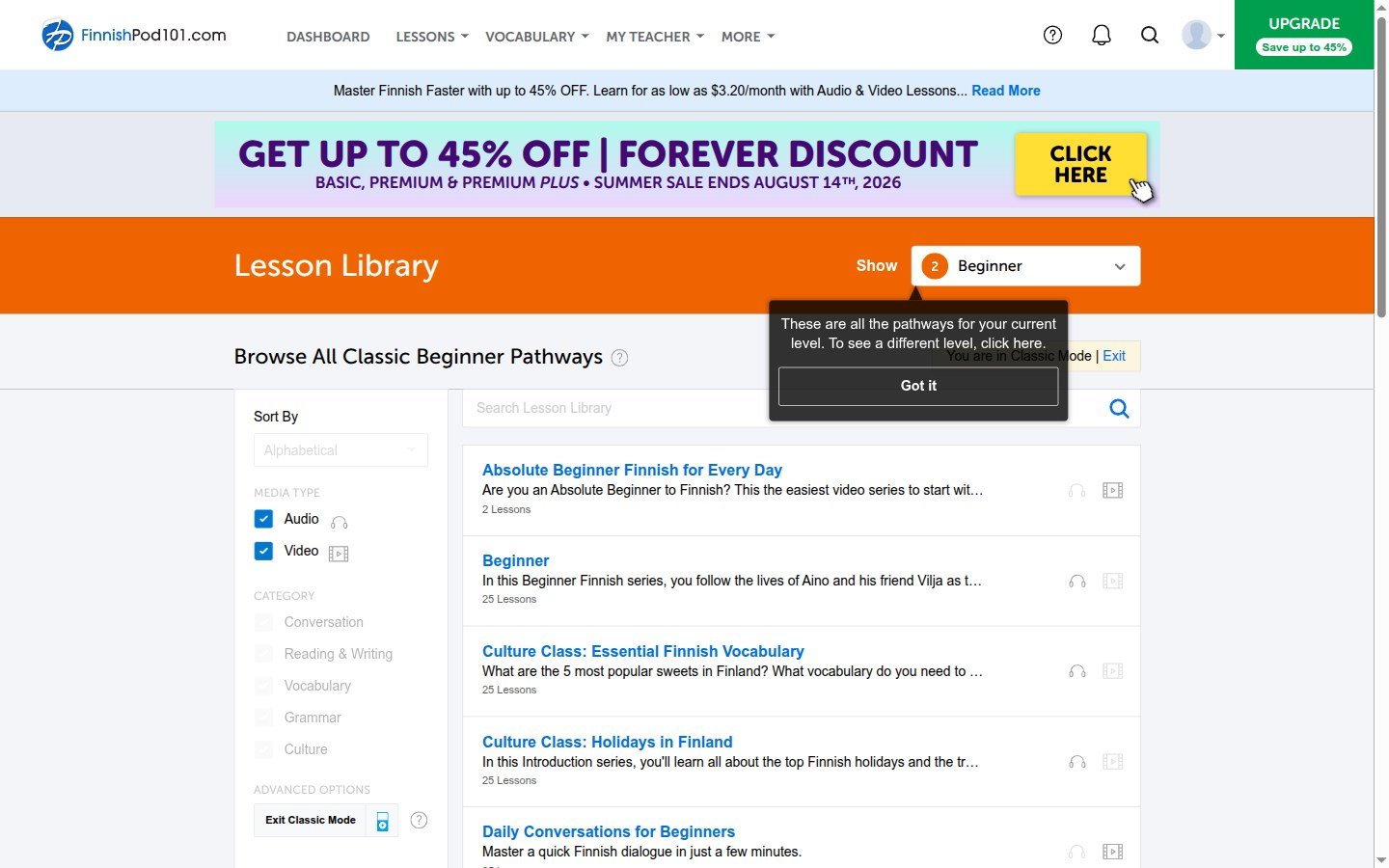
Like the rest of the 101 family, FinnishPod101 is built around short audio and video lessons taught by native speakers, organised into level-based pathways from Absolute Beginner up to Advanced.
Signing up is painless: a free lifetime account with just an email address, no card needed, and you pick your level. New accounts also get a 7-day Premium trial, so you can test the paid tools before spending anything.
The Absolute Beginner tier is genuinely deep, with roughly 27 pathways to work through. The flagship is “Level 1 Finnish”, a 34-lesson track with 25 assessments, around five hours of core material aligned to CEFR A1, and around it sit “3-Minute Finnish”, a 50-lesson Survival Phrases series, a 40-lesson Extensive Reading track and a long tail of short task-based “Can Do” pathways. For a language with as few quality resources as Finnish, that’s a brilliant amount of structured beginner material in one place.

How It Handles the Pronunciation
This is the section that matters most for Finnish, because the tuli/tuuli/tulli problem is an ear-training problem, and ear training is exactly what an audio-first course should be good at.
FinnishPod101 has a dedicated five-lesson pronunciation pathway at Absolute Beginner level: the consonants, the vowels (including the two major Finnish diphthongs), a lesson on stress, one on Finnish accents, and one on common pronunciation mistakes. I’ll be straight with you on one detail: none of the five lesson titles names vowel or consonant length as its own topic. Length is the single most-cited mistake Finnish learners make, so the “Common Finnish Pronunciation Mistakes” lesson is its natural home, but I can’t confirm from the outside exactly how explicitly it’s drilled there.
What I can say is that the format itself is the right medicine. Every lesson is built on native-speaker recordings, the paid tiers add slowed-down line-by-line playback, and Premium includes a voice-recorder tool that plays your attempt back against the native speaker’s. That’s precisely the loop you need to stop hearing tuuli and tuli as the same word, and it’s a loop a textbook physically cannot give you.
There’s also a lovely payoff waiting once your ear comes along: because Finnish spelling matches the sound exactly, every hour of listening practice converts straight into reading and writing. Hear the double vowel and you already know how to spell it. Loads of languages make you fight the spelling and the sound separately; Finnish only asks you to win the sound.
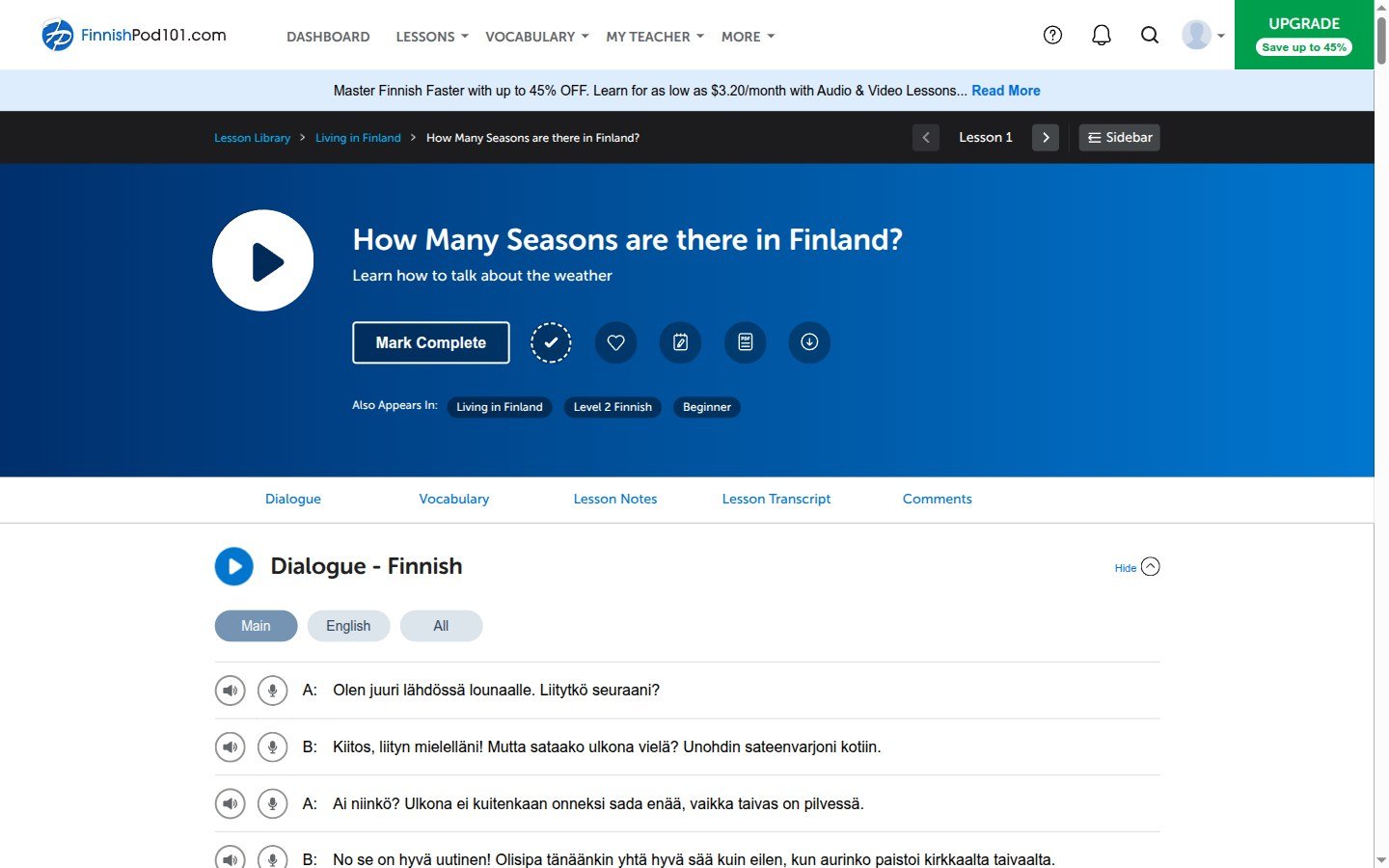
Inside a FinnishPod101 Lesson
A typical lesson is short (most run 3 to 15 minutes) and follows a consistent shape: a native dialogue, a line-by-line breakdown, vocabulary with natural-then-slow pronunciation, a grammar point and a cultural note. You get the audio, the full scripted dialogue, a vocab list and downloadable lesson notes as a PDF.
For the grammar, the course builds up the case system lesson by lesson rather than dumping all fifteen cases on you at once, which is the right call for an absolute beginner; nobody should meet the full table in week one. Premium members also get a Grammar Bank, a searchable database of grammar explanations to fall back on when a lesson’s ending doesn’t make sense.
The honest caveat is the same one I give for the whole 101 family, and it bites harder in Finnish than almost anywhere else: grammar is taught as it comes up in dialogues, not as a deliberate, sequenced syllabus. You’ll hear correct case forms hundreds of times, which quietly builds your instinct, but fifteen cases plus consonant gradation is loads of system to absorb by exposure alone. Plan on pairing FinnishPod101 with a dedicated grammar resource once you’re past the basics. That’s not a knock on the course; it’s just what the course is.
The Study Tools
On a Premium plan, the lessons come wrapped in a solid set of study tools:
- Spaced-repetition flashcards and a personal word bank, so words you save from a lesson come back for review right when you’d otherwise forget them.
- The Grammar Bank, which earns its keep in a 15-case language.
- Multiple-choice assessments to check a section has actually gone in.
- The voice-recorder pronunciation tool, the standout feature for Finnish’s length distinctions.
- 2,000 core words and phrases as a ready-made vocabulary backbone.

The Mobile App
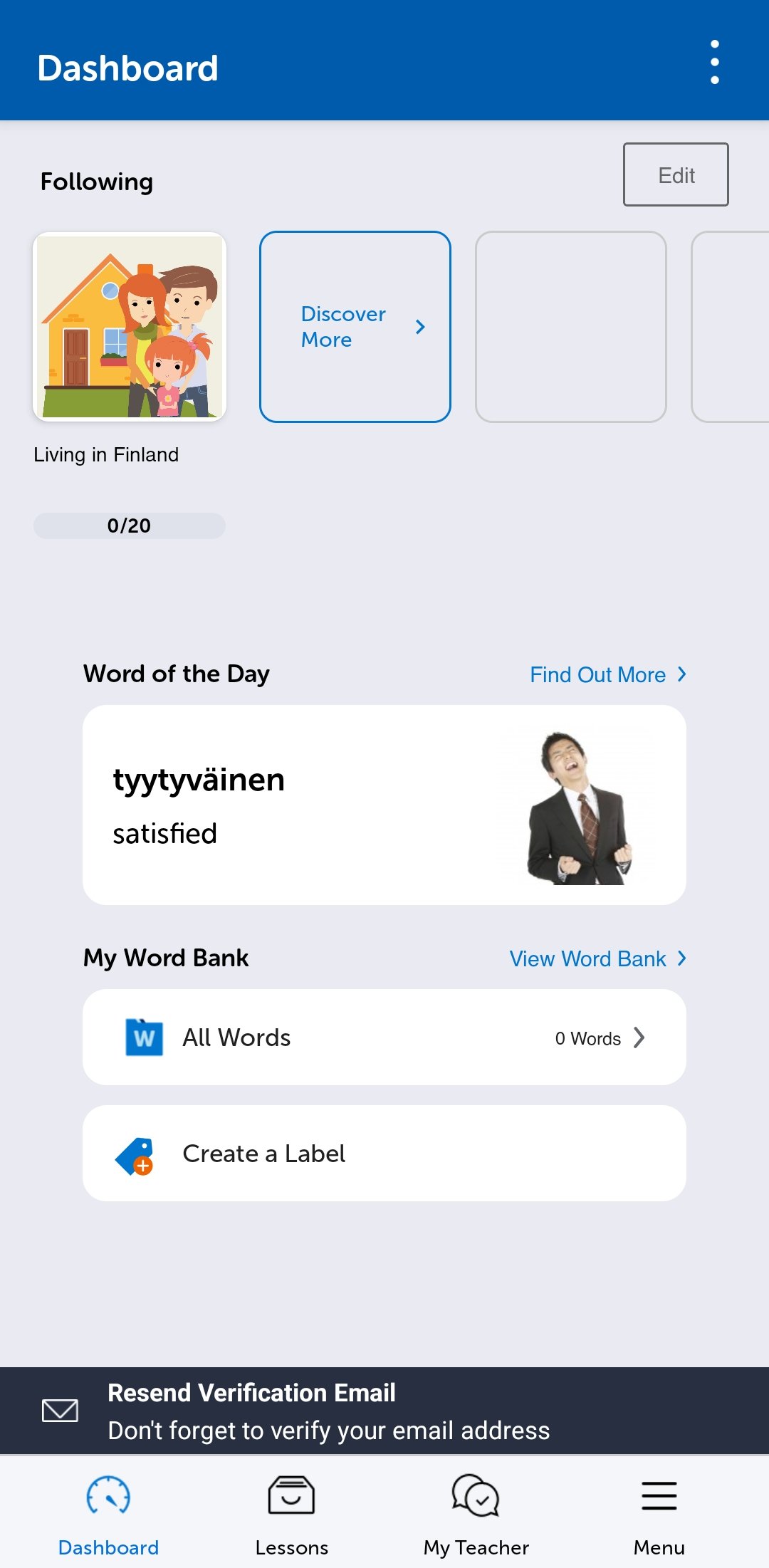
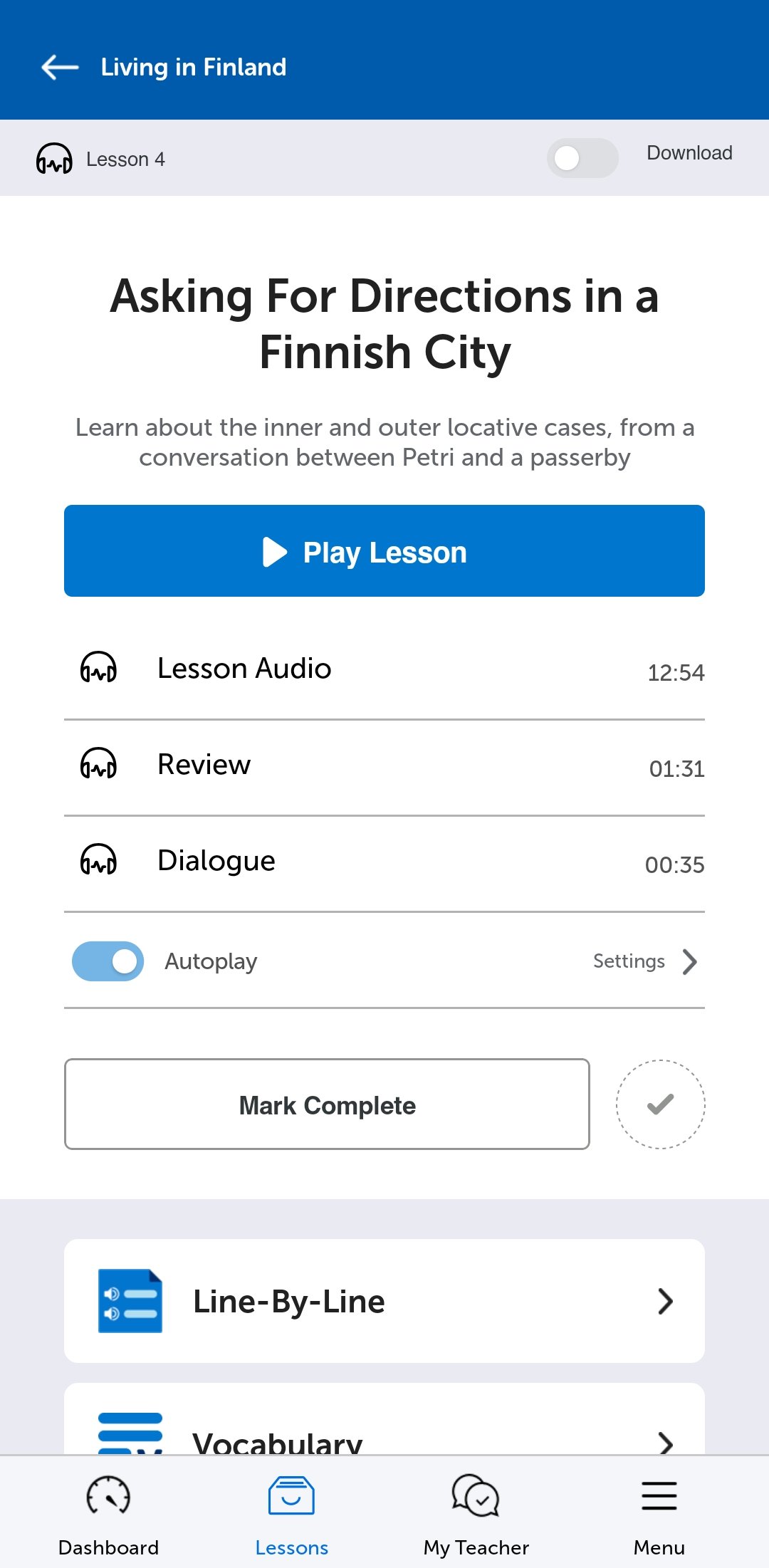
FinnishPod101 runs on the shared Innovative Language Learning app (you choose Finnish after installing), and it’s genuinely well liked: 4.7 out of 5 on the iOS App Store across tens of thousands of ratings, and 4.4 out of 5 on Google Play. It syncs with your account, so a lesson finished on your laptop shows as done on your phone, and you can download lessons for offline listening, which suits Finnish’s podcast-style format perfectly.
The usual family caveat applies: the app is lighter than the website, and some of the best study tools (the flashcards get named specifically by reviewers) live more comfortably in the browser. The workaround is the same one I use everywhere: open the site in your phone’s browser when you want the full toolkit.
What Other Finnish Learners Say
I dug through a stack of independent reviews to test my own read against other people’s, and a few clear patterns came up.
The praise is consistent. Learners rate the practical, culturally grounded lesson content and the way each lesson mixes vocabulary, grammar and pronunciation rather than isolating them. The voice recorder, the flashcards and the dialogue-plus-transcript lesson structure all land well. And more than one reviewer makes a point that matters for this language in particular: FinnishPod101 is one of the very few structured, on-the-go options for learning Finnish at all. The competition isn’t crowded.
The criticism deserves an honest airing, and the biggest piece of it goes straight back to challenge number six. One reviewer put it bluntly: the lessons are “too formal for a natural conversation”. That matches the kirjakieli lean I’d expect from a course built on scripted dialogues; you’ll come out sounding correct and slightly bookish rather than casually Finnish. The course does address it, partially: there’s a dedicated “Must-Know Finnish Slang Words & Phrases” pathway, 25 lessons of real spoken-register Finnish, sitting at Intermediate level. So everyday puhekieli is genuinely in there, but it arrives as a destination rather than being woven through from lesson one, and you should know that going in.
Beyond that, reviewers flag that the pathway library can feel like loads of parallel options rather than one clear track (the curated “Level 1 Finnish” pathway mostly solves this for beginners), that the content thins out noticeably at Upper Intermediate, and that interactive feedback is limited compared with app-first rivals; below the top tier, most practice is self-checked. On the depth point, the picture at the very top is actually better than I expected, with two 65-lesson collections at Advanced level, but the upper material feels less curated than the beginner tiers.
Pricing and Plans
FinnishPod101 runs the same four-tier structure as the rest of the family:
| Plan | Roughly… | What you get |
|---|---|---|
| Free | Free forever | The first lessons of every series, Word of the Day, vocab lists, the app, plus a 7-day Premium trial |
| Basic | ~$4/mo | Everything free + access to all lessons and the in-depth PDF lesson notes |
| Premium | ~$5–10/mo | Everything in Basic + line-by-line audio, flashcards, word bank, the Grammar Bank, assessments, the voice-recorder tool and the 2,000 core words |
| Premium PLUS | ~$13–23/mo | Everything in Premium + your own teacher, hand-graded assessments and a personalised study plan |
A few honest notes on the numbers. The headline per-month figures are anchored to the longest (24-month) plan, so the real price depends on the billing period you pick; check the checkout before you commit. Innovative also runs a near-permanent discount (often around 45% off list), so you should rarely pay the full price. And there’s a 60-day money-back guarantee, which takes the risk out of trying Premium properly.
For most people, Premium is the sweet spot: that’s the tier with the flashcards, the Grammar Bank and the voice recorder, which are the three tools that map onto Finnish’s actual difficulties.
Pros and Cons
Pros
- Loads of native-speaker audio with line-by-line playback, exactly what Finnish’s vowel and consonant length demands.
- A dedicated five-lesson pronunciation pathway plus a voice recorder that plays you back against a native speaker.
- Genuinely deep beginner content, with a CEFR-aligned Level 1 pathway and several 25 to 70 lesson tracks, in a language where good resources are scarce.
- A real 25-lesson slang pathway that tackles everyday spoken Finnish head-on.
- Phonetic spelling means your listening work pays double, converting straight into reading and writing.
- Genuinely affordable, with a usable free tier and a 60-day guarantee.
Cons
- The lessons lean formal, so natural spoken Finnish (puhekieli) only properly arrives with the Intermediate slang pathway.
- Grammar is taught incidentally, so the 15 cases and consonant gradation need a companion resource.
- Upper Intermediate content is noticeably thinner than the beginner tiers.
- The pathway library can feel like parallel options rather than one clear route, once you leave the curated beginner track.
- The app is lighter than the website, with some study tools missing.
Who FinnishPod101 Is (and Isn’t) For
It’s a brilliant fit if you are starting Finnish from zero and want a structured, audio-first route through the beginner and intermediate stages; if you learn well by ear and want Finnish in your headphones on a commute; or if you want your pronunciation taken seriously from day one, which for Finnish it absolutely should be.
It’s less ideal if you’re already at a solid intermediate level and hunting for advanced structure, or if you want one resource to systematically drill the case system. In those cases, use FinnishPod101 as your listening and vocabulary engine and pair it with a dedicated grammar book or a tutor for the cases.
The Verdict
FinnishPod101 gets the most important thing right: it matches its format to what actually makes Finnish hard. Finnish’s headline difficulty is an ear problem, and an audio-first course with native recordings, line-by-line playback and a voice recorder is the right shape of tool for it. The beginner material is deep and well organised, the slang pathway shows the course knows the puhekieli gap exists, and the whole thing costs less per month than a single tutoring session. It won’t carry you through the 15 cases on its own, the spoken-register content should start earlier than Intermediate, and the upper levels are thinner, which is why I’m scoring it a notch below the family’s flagship courses.
My rating: 4.3 out of 5.
If you want to give it a go, you can start with FinnishPod101 here. That link also carries our reader discount (Innovative’s near-permanent deal gets applied for you at checkout), so you won’t be paying full list price. Set up a free account, listen to tuli and tuuli until they stop being the same word, and see if learning Finnish by ear clicks for you.

Social