


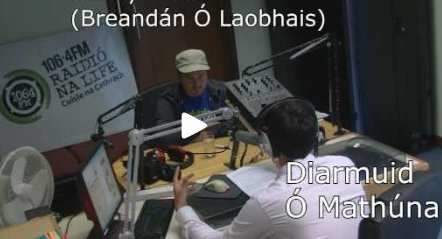
Interview in Irish: My 2012 Raidió na Life Conversation

Full disclosure: This post contains affiliate links. ?
This interview was recorded in 2012 and is kept as part of the blog’s mission archive.
The video is my Irish-language interview with Diarmuid Ó Mathúna from Raidió na Life. YouTube’s public record still identifies it as “Gaeilge: interview in Irish about learning the language, with a native speaker (subtitled)”. Caption availability can change, so use the subtitle menu only if the English track is offered.
While my level in Irish was still far from what I considered fluent, being interviewed on the radio in the language was one of my major goals that summer, and I was proud to do it.
A note from the Fluent in 3 Months team before we get started: You can chat away with a native speaker for at least 15 minutes with the “Fluent in 3 Months” method. All it takes is 90 days. Tap this link to find out more.
My unfortunate wasted education in the Irish language
The level you hear me use here is after two months total of time spent either immersed in or studying Irish as an adult. These two months were broken up into various visits to the Gaeltacht or the weeks just before going and studying for it, over the space of five years, where I'd always be focused on some other language outside of those two months.
I've said before that I had spent five years learning German in school and not been able to even order a train ticket after all that. What's worse than this though is that I had spent ten years “learning” Irish in school, and to be honest I found most of this a complete and utter waste of time because it was far too academic or with subject matter I found boring/irrelevant. Irish was without a doubt the worst of all of my subjects in school because of this.
This article uses Irish; Gaeilge is the Irish-language name. Gaelic also appears in English in some contexts, so the label alone should not be used as a test of somebody’s connection to the language. Here is more background on Irish.
My teachers were certainly eager to help us, and tried their best to make it more fun, but the material and the system it was presented in was just far too inefficient. Ridiculously so;
After all that time, I honestly couldn't form the most basic sentences, and could do no more than blurt out a few dozen words or five or six phrases, such as An bhfuil cead agam dul go dtí an leithreas? (“May I go to the toilet?”). That was much less than I wanted after years of school.
This is a sorry state of affairs, and unfortunately it represents the situation for many adults in Ireland, not because “the language is hard”, but because it was taught to make it hard, and to extinguish any chance of pride or interest in using the language outside of school. In fact, there is a sense of resentment with the language for many Irish people, because of the way it was forced on them in school in such a dull manner.
It was even worse for me, because I personally dropped down to the Lower (Ordinary) level for my university entrance exam, passing it more on good exam strategies than any kind of language skills. For example, I would look at words in the question and copied the sentence containing those words from the text being examined (conveniently with paragraph indications to help); I might as well have sat an exam of similar standards in Swahili, after spending a few minutes to recognise just the question words.
Many people who didn't do well in the system, would have still been better off than me and could at least have a basic conversation if they had to, or perhaps know a few hundred words, thanks to having done the more challenging Higher Level exam. (Although, having done the higher level myself in German, you won't hear me sing its praises much either 🙂 )
Luckily there's hope!
Luckily, things have changed dramatically in recent years.
Nowadays, we have TV with lots of fun programs in Irish, including a soap opera and plenty of children's shows, that you can watch online. In fact there are tonnes of online resources for learning and practising Irish.
Also, the Irish education system which had done such a terrible job over the decades has started to catch on, and now primary school Irish is made much more interactive, fun and relevant, and about using the language more naturally. I'm told that secondary school Irish is still too academic in comparison (for the purposes of adding structure/literature to the language), but at least up to then it seems like there is more potential to inspire real use of the language, which there wasn't for me.
But what about those of us who went through a decade or more of the previous set up, which ultimately leaves you actually disliking the language?
I'm hoping that by showing that if this lower level Irish student, can sit a radio interview entirely in the language, perhaps a few other Irish adults will join me in diving back in and using the language as it was truly meant; as a means of communication!
As you can hear, I hesitate a little and do make a couple of wee mistakes, but lack of perfectionism, and embracing making mistakes and focusing on saying something, is what I owe for being able to actually communicate in Irish now.
How I got into Irish
What initially got me curious was coming across the Assimil Irlandais de poche book, while I was living in France. I was starting to realize that learning languages in general wasn't as hard as I had thought, and this fresh new presentation of the language got me interested. I had resolved to go to the Gaeltacht the following summer.
I signed up to Oideas Gael, the adult course in Donegal for three weeks straight. I started at the absolute bottom and was ashamed to see people from Russia, Africa, Japan, Italy and South America in levels above me speaking Irish way better than this Irish person. But rather than have that discourage me, it just reminded me that anyone really can do it.
You can see a video I made after that first immersion experience here. Slowly, but surely, I kept up with the speakfromday1 philosophy of genuinely using the language all the time. The course itself wasn't why I was there, but for the encouraging environment of other learners and a place where I could genuinely socialise daily in the language.
Thanks to those three weeks, I felt confident enough to record some videos in Youtube in Irish – although I'd be reading a script that I had native speakers correct for me. You can see all the videos I've made in Irish here.
Every second year or so I would set aside another week or two to go back, and push my level up a notch. I slowly climbed up the levels at Oideas Gael, and even spent a week in Connemara at a similar adult course while hitchhiking through Ireland and its various Gaeltacht regions.
Finally, in 2012 I set aside another couple of weeks and went back to Gleann Cholm Cille, where I signed up for Saibhreas na Gaeilge (“Richness of Irish”). I was the weakest speaker in the class, but I liked how much it pushed me. For reading practice, I used an Irish translation of my Language Hacking Guide.
After this experience I spent a couple of days in Gaoth Dobhair, the largest Irish-speaking region of the country, and finally made it to the Raidio na Life studio in Dublin to take them up on an interview offer they gave me some time ago when I wouldn't have felt ready for it.
Living through the language: who's with me?
Now, I can truly say that I've lived my life through Irish for most of those two months. I have friends I only ever talk in Irish to, I got my heart broken in Irish, I've had serious discussions in the language, and lots of fun ones in pubs (over an Orange Juice) and over the Internet.
I also sent text messages in Irish. The abbreviations people used were highly informal and changed with context, so I would not treat my 2012 examples as a current spelling guide.
At the time, I planned to keep returning to the Gaeltacht and meeting Irish speakers elsewhere. This interview was one milestone in that longer process, not proof that every adult learner will follow the same route or timetable.

Social