


How to Learn Russian – It’s Easier Than You Think!

Full disclosure: This post contains affiliate links. ?
Learning Russian has changed my life, and I believe it can change yours too – if you are open to it.
People come to Russian with different interests and feelings about Russia. You can learn the language without endorsing a government's actions.
Russian is also one of the most widely spoken languages in the world, with well over 200 million speakers across many countries, and it opens the door to one of the richest literary traditions on the planet. And yet, despite all this, there is often a lack of interest in wanting to understand Russia, its culture, its people, and its language.
And that's a shame.
I studied Russian for 4 years in college. I studied abroad there for a semester, worked a summer in Moscow, and have travelled there on several occasions as a tourist. At the time I originally wrote this article, my girlfriend of many years was Russian.

In this post, I’ll give you a few tips on how to learn Russian. Here’s what we’ll cover:
Table of contents
A note from the Fluent in 3 Months team before we get started: You can chat away in Russian for at least 15 minutes with the “Fluent in 3 Months” method. All it takes is 90 days. Tap this link to find out more.
Hacking The Language: How to Learn Russian and Why It Isn't As Hard As You Think
I'd be lying if I said Russian was easy.
After many years of studying and interacting with Russians, I still consider myself to be only conversational. Verbs of motion, verbal aspect, and completely unpredictable verb/preposition pairs will make your head spin.
Online lists of the “hardest languages” aren’t a reliable guide to your own experience. Your background, goals and practice matter, whether you choose Russian or languages such as Arabic, Chinese, Japanese, and Korean.
So let's focus on some of the bright sides of learning Russian.
Start With the Russian Alphabet
One of the first things that turn people off from a new language is having to learn a different set of characters or letters.
People vastly overestimate how difficult this really is. They see the backward “R” (я pronounced [ja]) and immediately want to turn the other way. If you want to get it out of the way properly, our guide to the Russian alphabet takes you through every letter.
Benny Lewis, founder of Fluent in 3 Months, has written extensively about why Chinese is not as difficult as it seems. He points out in particular that the number of characters in the language should not be seen as a huge obstacle.
If that's true for Chinese, which has thousands of characters, it should certainly be true for Russian, which has only 33 letters.
Remember: it may be Cyrillic, but it is still an alphabet. And alphabets are made up of letters, just like English. But what makes it even easier than English is that Russian spelling is more regular than English spelling, although a letter does not always represent one fixed sound. Ever try to say this poem in English aloud? Then you’ll appreciate having useful spelling patterns to work with!
Russian has some tricky sounds, and ordinary writing usually doesn't mark stress. Don't guess where the stress falls in a new word: check a dictionary or native-speaker recording.
Russian spelling gives you useful pronunciation clues, but you still need to learn word stress and sound changes such as vowel reduction.
You can make a good start on Cyrillic in a day. Similar-looking letters may trip you up at first, and reading smoothly takes practice. Revisit the alphabet with words and audio rather than expecting one session to settle it forever.
In fact, five uppercase Cyrillic letters are especially friendly to English readers because they have the same shapes and broadly similar basic sounds: А, К, М, О, Т.
And many of the other ones have the same pronunciation, they just look a little funny. For example г is “g” and ф is “f”.
All in all, the alphabet is a manageable first step. Pay particular attention to unfamiliar vowels and the difference between hard and soft consonants.
Additionally, I find the Cyrillic alphabet to be visually distinct. It still has that boxy look that English has where, at least to me, each letter looks relatively different from the other. I don't feel that as much with say, Arabic, which looks very curvy.
All of this will help expedite the memorisation phase.
Spot the Adaptations From English
Romance languages are not the only ones to have borrowed words from English. Russian has plenty of English loanwords as well; they can be harder to recognize at first because they are written in Cyrillic.
For example, Russian has its own word for doctor: врач (pronounced vrach). But you could just as easily say доктор (“doctor”), and that would be completely normal.
Additionally, Russian has many borrowed international verbs, including:
- парковать (parkovat) – “to park”
- адаптировать (adaptirovat) – “to adapt”
- импортировать (importirovat) – “to import”
These examples end in either -овать or -ировать; neither ending by itself proves that a verb came from English.
In fact, more and more English words are finding their way into Russian because of Western media as well as technology-based words. These seem to be adopted almost with a general agreement across various languages.
For example, компьютер (“computer”), микрочип (“microchip”), камера (“camera”, depending on the type) and телевизор (“television set”) may look familiar once you can read Cyrillic. Similar-looking international words don't necessarily come directly from English.
Work With the Immense Flexibility of Sentence Structure
One of the things I realised about English AFTER learning Russian was just how rigid the sentence structure is. There's a right way to say something.
For example, if you want to say that you are going to the park, you would probably say, I am going to the park. You wouldn't say, to the park, I go.
Unless you want to sound like Master Yoda.
Russian allows more word-order variation, though changing the order can change the emphasis and what sounds natural in context. I could express that idea in several ways, such as:
- Я иду в парк – “I am going to the park”
- В парк иду – “to the park I go” (without the subject)
- В парк я иду – “to the park I go” (with the subject)
Did you notice how in the second variant I left out the subject? In English, we almost always include the pronoun, and English verb endings often don't identify the subject. In “I go to the park” and “They go to the park”, the verb form is the same.
Russian verb endings often identify person and number, but Russian still regularly uses subject pronouns. A pronoun can be omitted when context makes the subject clear, but omission is not the general rule.
Learn the Many Russian Rules, But Face Few Exceptions
One of the aspects of Russian that appeals to me is its patterns. I was a Math major, so I like repeatable procedures and rules I can work with. There are plenty of exceptions too; the heading above is an encouragement, not a promise that you can avoid them.
This was one of my major turn-offs in high school when I was learning French.
In French, it helps to learn each noun with its gender. Word endings offer clues, but exceptions remain, and adjectives and possessives need to agree. Russian also has agreement rules; its noun endings often make the starting pattern easier to spot.
Here's a useful starting point for Russian:
A noun's ending often helps you predict whether it is masculine, feminine, or neuter (a third grammatical gender), but there are important exceptions.
Common patterns for noun gender in Russian, using the singular dictionary form:
- Look at the last letter of the word:
- If it ends in a consonant other than “ь”, including “й”, it is usually masculine.
- If it ends in “а” or “я”, it is usually feminine, with exceptions such as the male-person words below.
- If it ends in “о” or “е”, it is usually neuter, though borrowed words can be exceptions.
- If it ends in the soft sign “ь”, it may be masculine or feminine. These words are common, so learn each one's gender with the word.
The following list gives four masculine nouns whose -а or -я endings reflect words for male people, plus кофе, a separate masculine noun ending in -е.
- Папа – “daddy, papa” → masculine
- Дядя – “uncle” → masculine
- Дедушка – “grandfather” → masculine
- Мужчина – “man” → masculine
- Кофе – “coffee” → masculine in formal standard usage; dictionaries also record colloquial neuter usage
Gender agreement appears in Russian past-tense verb forms. Future-tense verbs instead mark person and number, while noun plural formation follows its own inflectional patterns.
Rules, rules, rules.
For nominative plurals, these are common Russian patterns. They aren't exhaustive: there are irregular forms, shifting stress and changes inside the stem too.
For masculine nouns:
- If the word ends in a consonant, add ы (unless that consonant is Г, К, Х, Ж, Ч, Ш or Щ, in which case add и, per the same spelling rule as below: парк becomes парки, not паркы).
- Replace й with и
- Replace ь with и
For feminine nouns:
- Replace я with и
- Replace ь with и
- Replace а with ы (unless previous consonant is Г, К, Х, Ж, Ч, Ш, Щ. Then replace it with и as per the spelling rules.)
For neuter nouns:
- Replace о with а
- Replace е with “я” (don't forget the spelling rules)
Examples:
- студент (“student”) – студенты (“students”)
- газета (“newspaper”) – газеты (“newspapers”)
- здание (“building”) – здания (“buildings”)
I find these patterns helpful, but I still learn unfamiliar plurals with their nouns. For example, друг (“friend”) becomes друзья (“friends”), rather than following the basic pattern above.
The problem with Russian is that it has six cases: nominative, genitive, dative, accusative, instrumental, and prepositional. If you've ever studied Latin, German, or another Slavic language, you're probably familiar with case systems.
And they kind of stink, and lead to tables like this:
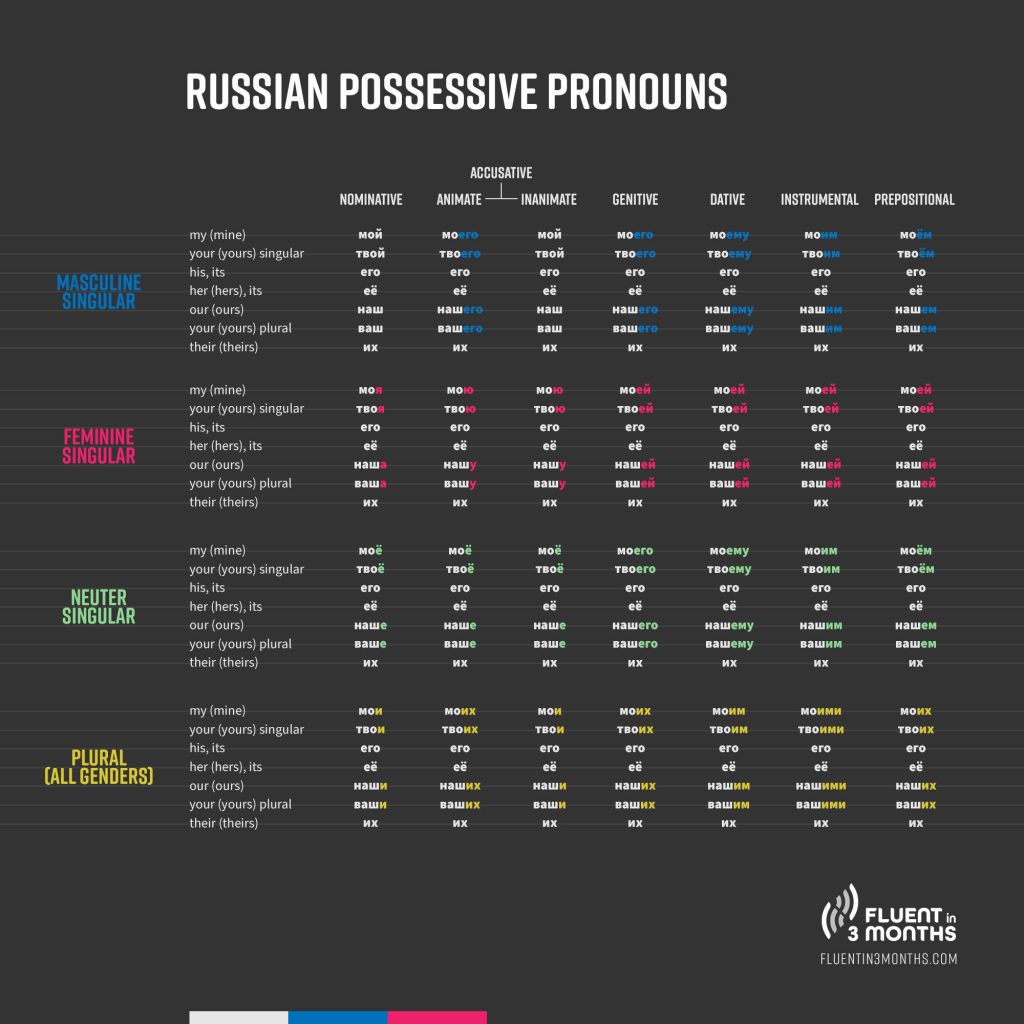
This is pretty nasty looking, I know. My argument isn't that it's easy, but that it's reliable.
It also helps us break down the sentence structure and see how words relate to each other. It's largely because of these case endings that we can organise the sentence in a bunch of different ways and still distinguish between the subject and objects.
Why Russian Should Be Your Next Language Of Choice
Knowing Russian lets you take part in conversations where English isn't shared.
People vary in how comfortable they feel travelling in another language.
That gives you a practical reason to learn: you can meet someone in their language instead of expecting them to use yours.
For background, you can consult the list of countries by English speaking population linked here, but it combines figures from different years and methods. Don't treat an old percentage as a current measure of who will understand you.
French or Spanish may feel more familiar to an English-speaking beginner, but that needn't decide which language you learn.
Russian can help you connect with speakers in Russia and in communities around the world, including people who don't speak English.
That's a lot of people we can meet with one language.
Travel To Russia And The Eastern Bloc

Editorial travel note, checked 2 October 2026: the UK's Foreign, Commonwealth & Development Office advises against all travel to Russia. Check your own government's current advice. The experiences and attractions below are part of the author's earlier account, not a recommendation to travel now.
The original article used this comparison to encourage travel: Russia gets about half the tourists that Spain and Italy get, and only one-third of what France gets. Those undated ratios are retained as historical wording, not current tourism data or an explanation of why people choose a destination.
Travel decisions involve safety, entry rules, transport and consular support, not just the language barrier. Learning Russian doesn't require a trip to Russia.
These were some of the attractions that interested me when I first wrote this article:
- Travel on the Trans-Siberian Railway
- Visit Red Square and Saint Basil's Cathedral and other beautiful attractions in Moscow
- Watch The Nutcracker in a Russian theater
- Buy original Matryoshka dolls
I've gotten by with Russian in Poland and the Czech Republic. That's a personal experience, not a reason to assume Russian is welcome or understood throughout the former Eastern Bloc. Ask which language someone prefers, and learn local greetings too.
Expectations For Westerners Are Low
You don't need to wait until you're fluent to try a conversation. A few useful phrases give you a starting point, and a willing conversation partner can help you build from there.
How chatty someone is depends on the person and the situation, not just their nationality.
My Russian has been at all sorts of levels. When I was just starting out, I only knew a few words. Now I am proficient in everyday conversation, but I can tell you that never once did anyone turn their back on me because of my level in Russian.
Understand And Partake In Customs
It's easy to approach an unfamiliar culture with stereotypes. Learning the language gives you a chance to get to know individuals and hear how they describe their own lives.
Customs and traditions may be unfamiliar at first. You can ask about them and decide how you'd like to take part.
As Benny Lewis, Founder of Fluent in 3 Months, can attest to, the best way to understand a culture is through its language.
Had I not learned Russian I would have been excluded from the vast majority of these customs, and likely would have just sat on the sidelines.
Instead, I have been able to be active in these various traditions, like giving a meaningful toast at a reception or singing a song in a group. At the time, these seemed somewhat trivial, but I realise now how important they were in building the foundations of a relationship with strangers.
Abundant Resources and Interest
Russian may be a complex and intimidating language, but there are plenty of resources to help you on your way. The original article linked Russia's population of over 140 million and an estimate of 27 million living abroad. These figures count different populations; they aren't a current total of Russian speakers or potential language-exchange partners.
Look for people who actively want a language exchange, rather than assuming someone's interests or English level from their nationality.
Although I went to college for Applied Math, I probably spent the bulk of my time chatting with Russians. I connected with them on social search sites like Preply (our review is here) and Scrabbin.
I would study sites like RussianForFree.com. YouTube has a nice selection of videos with subtitles. I'm particularly fond of cartoons for beginners.
You can find more free resources to learn Russian in this post.
You Will Understand Your Own Language Better
Perhaps my most unexpected benefit from learning Russian is how much it has deepened my understanding of my own language.
I never really approached English from a linguistics perspective. As a result, I never really appreciated the various constructions that make English different.
When you start learning Russian, you really have to dive into the grammar and the rules. This opens up a number of parallels to English that I never knew before. For example, English sentences have an order that’s completely different from Russian sentences, and still convey the same meaning.
I would even say my French got better as well, just by learning Russian. Grammar finally started to make sense.
Start Learning Russian Now
Russian is a commitment. Even the most talented language learners will probably struggle for months or years before they really crack it. However, it brings with it a world of opportunities in terms of people to meet, places to go, and experiences to have.
If I have convinced you to take on the language, but you’re not sure where to start, give a look at Benny’s favourite resources to learn Russian!
Or, if you are Russian, давайте говорить по-русски (“let’s speak Russian”)!
If you’d rather learn with native-speaker audio than with grammar tables, sign up for RussianPod101, and our RussianPod101 review covers what you get for your money.
And when you want to put all of it to work in a real conversation, the Fluent in 3 Months Bootcamp gives you 90 days to reach a 15-minute conversation with a native speaker.
Original article by David Schneider, updated by the Fluent in 3 Months team.

Social