



RussianPod101 Review: Is It the Best Way to Learn Russian?

Full disclosure: This post contains affiliate links. ?
What is RussianPod101?
RussianPod101 is part of the Innovative Language family, built to get you understanding and speaking Russian from the very first lesson. Audio and video lessons taught by native speakers are its main feature.
- what it’s for:
- First contact with Russian, listening practice, vocabulary, the Cyrillic alphabet, phrases and conversation material
- languages:
- Russian
- level:
- Absolute Beginner to Advanced
+ PROS
- Teaches the Cyrillic alphabet properly from day one
- Loads of native-speaker audio for Russian’s tricky pronunciation
- A guided learning path, so there’s no guessing where to begin
- Brilliant lesson-notes PDFs and grammar explanations
- Excellent for building vocabulary, with a 2,000-word core
- Genuinely affordable, with a free tier and a 60-day guarantee
- CONS
- Light on speaking and writing practice (it’s an input course)
- Grammar isn’t drilled in sequence, so cases and aspect need a companion resource
- Upper-intermediate and advanced content is thinner
- Upsell banners and marketing emails
- The mobile app doesn’t have all the best features
Russian has a reputation for being brutally hard, and that reputation is only half-deserved. The US Foreign Service Institute rates it a Category III language: roughly 1,100 class hours to reach professional fluency, about double what it takes for Spanish or French, but still a clear rung below the “super-hard” four (Arabic, Chinese, Japanese and Korean). The truth is that Russian front-loads its difficulty. The alphabet you can crack in a weekend; the grammar is where you’ll spend your hours. So when you pick your main Russian resource, you want one that actually wrestles with the things that make Russian Russian, not a generic app that treats it like French in a different alphabet.
I’ve been reviewing the Innovative Language “101” courses for a while now (you might have seen my SpanishPod101 and JapanesePod101 reviews), and most of the Fluent in 3 Months team have leaned on these podcasts for their own language missions. RussianPod101 is the Russian member of that family.
So the real question for this review is whether RussianPod101 handles the bits of Russian that actually trip people up.
What Makes Russian So Different (and Where a Course Has to Earn Its Keep)
Before we get to the platform itself, let’s be clear about what you’re signing up to learn. These are the six things that make Russian so different from a Western European language, and they’re the yardstick I’ll measure RussianPod101 against.
1. The Cyrillic alphabet. Good news first: this is the easy hard part. Cyrillic is 33 letters, and most motivated learners can read it, slowly, after a weekend. The trap is the “false friends”: letters that look like Latin ones but sound nothing like them. В is a “v”, Н is an “n”, Р is an “r”, С is an “s”, У is an “oo”. So РЕСТОРАН looks like nonsense but is just restoran, restaurant. Any decent Russian course should get you reading real Cyrillic almost immediately, not hiding behind romanisation for months.
2. The six-case system. This is the real wall. In English, word order tells you who did what: “the dog bit the man” versus “the man bit the dog”. Russian instead changes the ending of the noun depending on its job in the sentence. There are six of these cases (nominative, genitive, accusative, dative, instrumental and prepositional), and the ending shifts again for gender and for singular versus plural, so a single noun can have a dozen forms. Worse, adjectives, pronouns and numbers all have to agree. English speakers find this genuinely alien, because we only have a scrap of it left (“I/me/my”).
3. Grammatical gender. Every Russian noun is masculine, feminine or neuter, and you usually can’t guess from meaning (a table is masculine, a lamp feminine, a window neuter). Gender decides which case endings the noun takes, and every adjective describing it has to match its gender, number and case. That’s how you end up with the same adjective wearing two dozen different endings.
4. Verb aspect. This is the most alien feature of all, because English has no equivalent. Almost every Russian verb comes as a pair: one imperfective (an ongoing, repeated or unfinished action) and one perfective (a single, completed action with a result). Читать is “to read” in general; прочитать is “to read it and finish”. You can’t dodge the choice, because aspect is baked into the verb form you pick, not bolted on afterwards. Learners wrestle with it long after the alphabet is a distant memory.
5. Verbs of motion. Russian splits “go” into a whole subsystem. There’s one verb for going somewhere in one direction right now (идти) and another for going habitually or there-and-back (ходить), and the same split runs through going by vehicle, flying, carrying and more. Then a stack of prefixes layers on “arrive”, “leave”, “pass through”, “enter”, and so on. That’s loads of moving parts for something English does with two letters.
6. Pronunciation that hides in plain sight. Three things catch people out. An unstressed О is pronounced like “a”, so Москва is “Mask-VA”, not “MOS-kva”. Most consonants come in hard and soft (palatalised) pairs that change meaning. And word stress is unpredictable, mobile (it shifts as the word changes form) and almost never marked in real Russian text, so you can read a word perfectly and still say it wrong. All of which means you need a course built on loads of native audio, not just text on a page.
Keep those six in mind. Here’s how RussianPod101 stacks up against them.
Getting Started with RussianPod101
Like the rest of the 101 family, RussianPod101 is built around audio and video lessons taught by native speakers, organised into level-based pathways: Absolute Beginner, Beginner, Intermediate, Upper Intermediate and Advanced.
Signing up is painless. You create a free lifetime account with just an email (no card needed) and pick your level. Not sure where you sit? Choose Absolute Beginner; you can move up later. New accounts also get a 7-day Premium trial, so you get a proper taste of the paid features before deciding anything.
Once you’re in, your dashboard hands you a learning path for your level, so you’re not left staring at a library of a thousand lessons wondering where to start. The flagship “Level 1 Russian” pathway runs to dozens of short lessons with built-in assessments and maps onto CEFR A1, and there’s a complementary “Can-Do Russian for Absolute Beginners” track focused on practical, task-based skills. That guided pathway is one of the platform’s real strengths.

Does It Teach Cyrillic Properly?
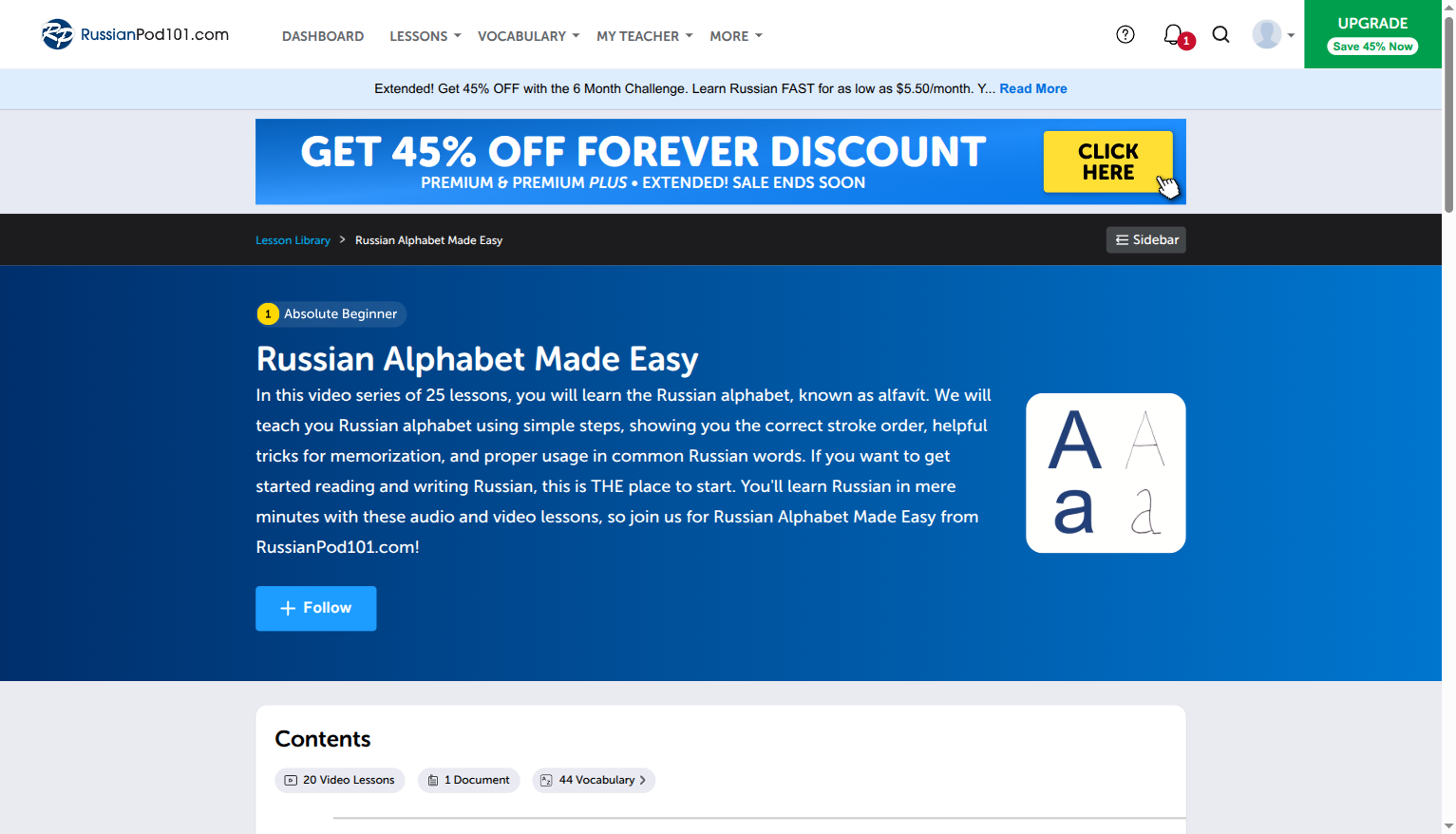
Yes, and this matters, because plenty of resources let learners lean on romanisation far too long. RussianPod101 has a dedicated alphabet series of short video lessons plus a printable practice worksheet, and it does something smart: it sorts all 33 letters by how familiar they are, into true friends (look and sound like English), false friends (look familiar, sound different), new friends and outright strangers. That false-friends grouping is exactly the right way to defuse Cyrillic’s main booby-trap. There’s also a free alphabet eBook and practice sheets to drill the handwriting.
The pronunciation side is where the audio format really pays off. Because every lesson is built on native-speaker recordings with slowed-down, line-by-line playback, you actually hear the vowel reduction and the soft consonants instead of trying to reverse-engineer them from spelling. And because stress isn’t reliably marked in written Russian, hearing every word said properly from day one matters more than you’d think. The one thing audio can’t fix on its own is stress memorisation, so you’ll still want to note the stressed syllable as you learn each new word.
Inside a RussianPod101 Lesson
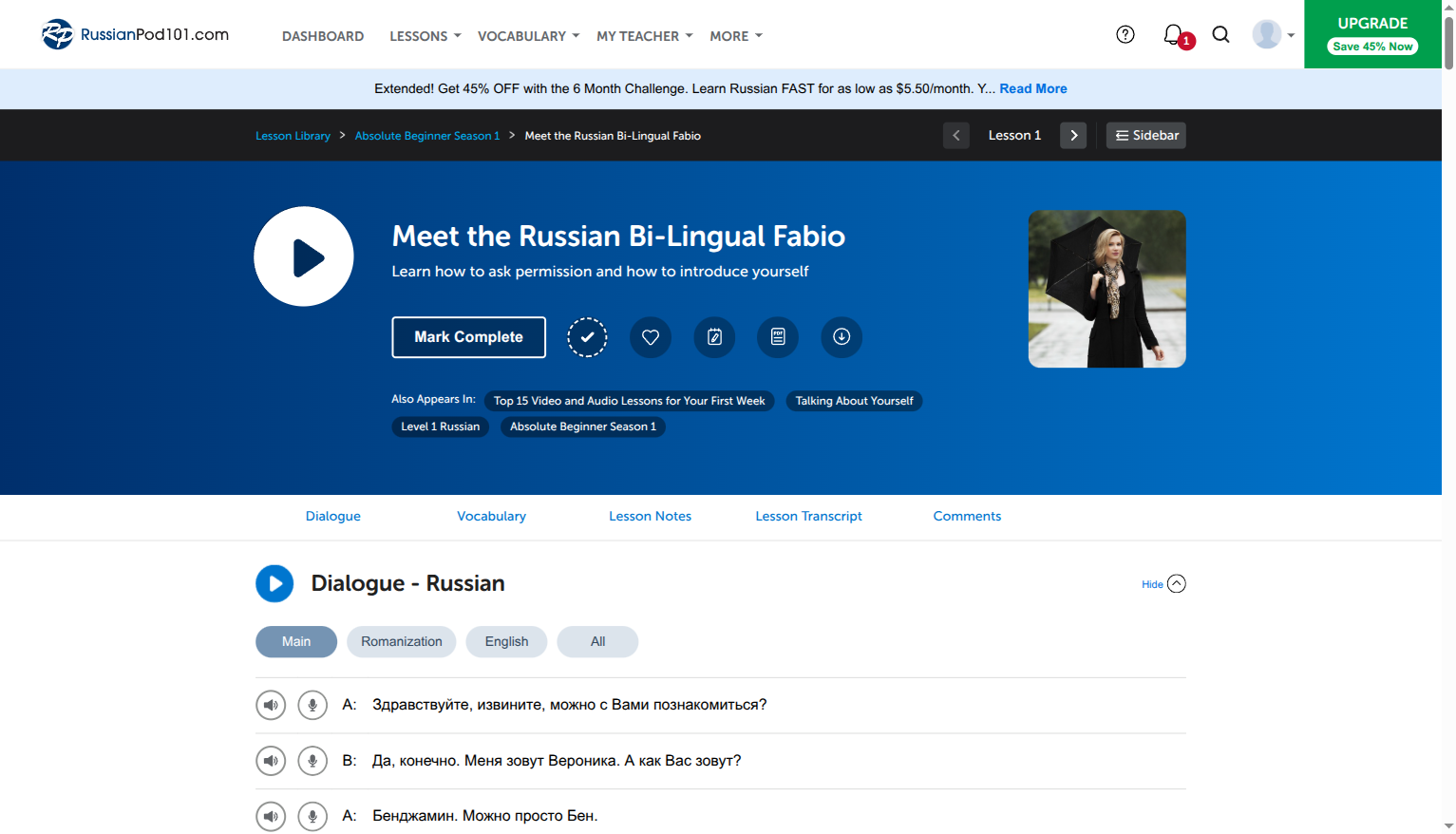
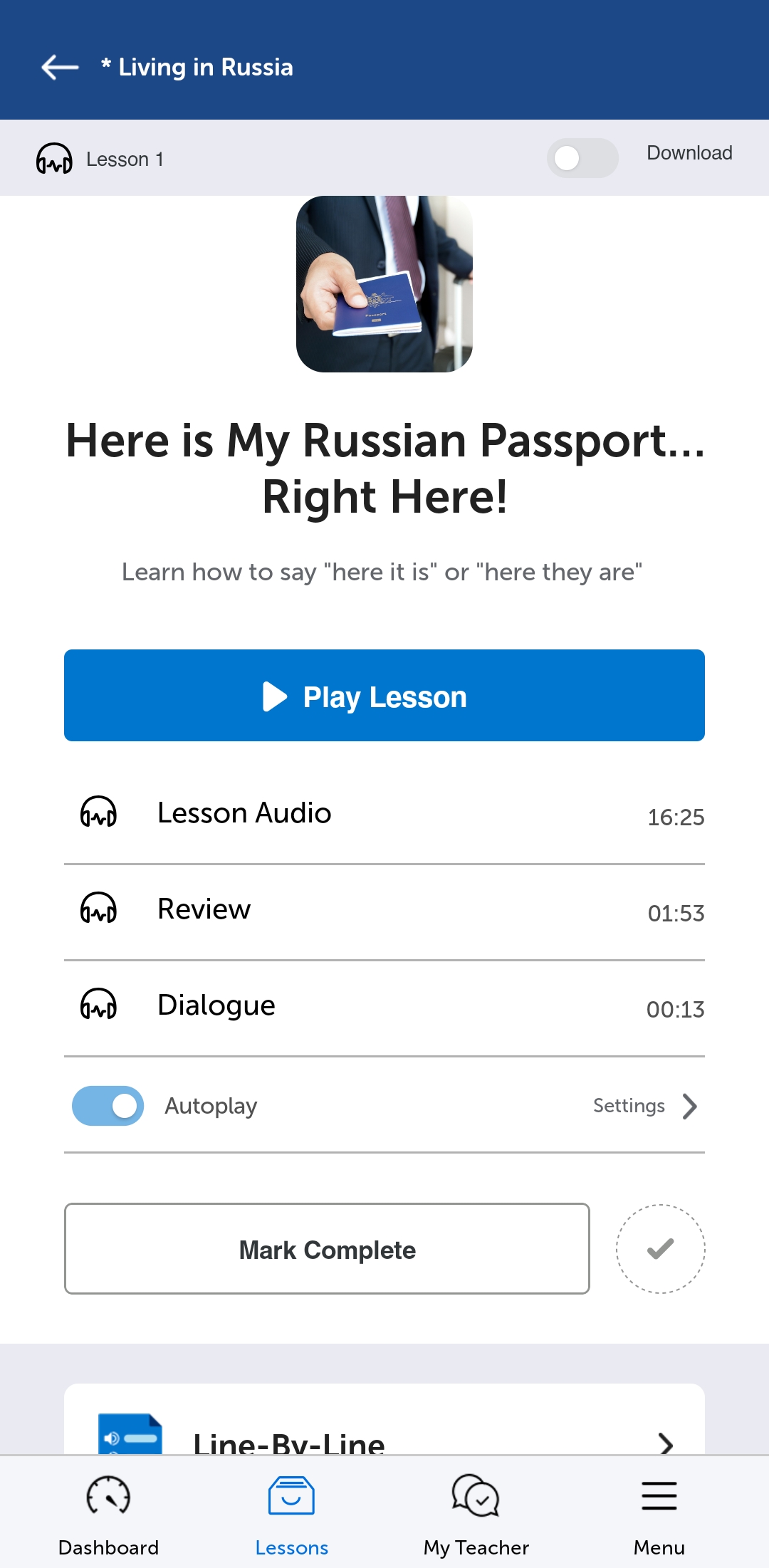
A typical lesson is short (most run around 3 to 15 minutes) and follows a consistent shape: a native dialogue, a slow line-by-line breakdown, vocabulary with natural-then-slow pronunciation, a grammar point, and a culture note. You get the audio, the full scripted dialogue, a vocab list, and downloadable lesson notes (a PDF) that dig into the grammar and cultural context. Those lesson-notes PDFs are consistently one of the most praised things about the whole platform; reviewers single them out as some of the best written lesson material going.
This format suits Russian’s quirks reasonably well, with one honest caveat. The dialogue-first approach is excellent for vocabulary and listening, and the lesson notes are where the cases, gender agreement and aspect get unpacked. What the format doesn’t do is drill those grammar points in a structured, escalating sequence, so the heavy lifting on cases and aspect is something you’ll do partly on your own. More on that below.
The Study Tools
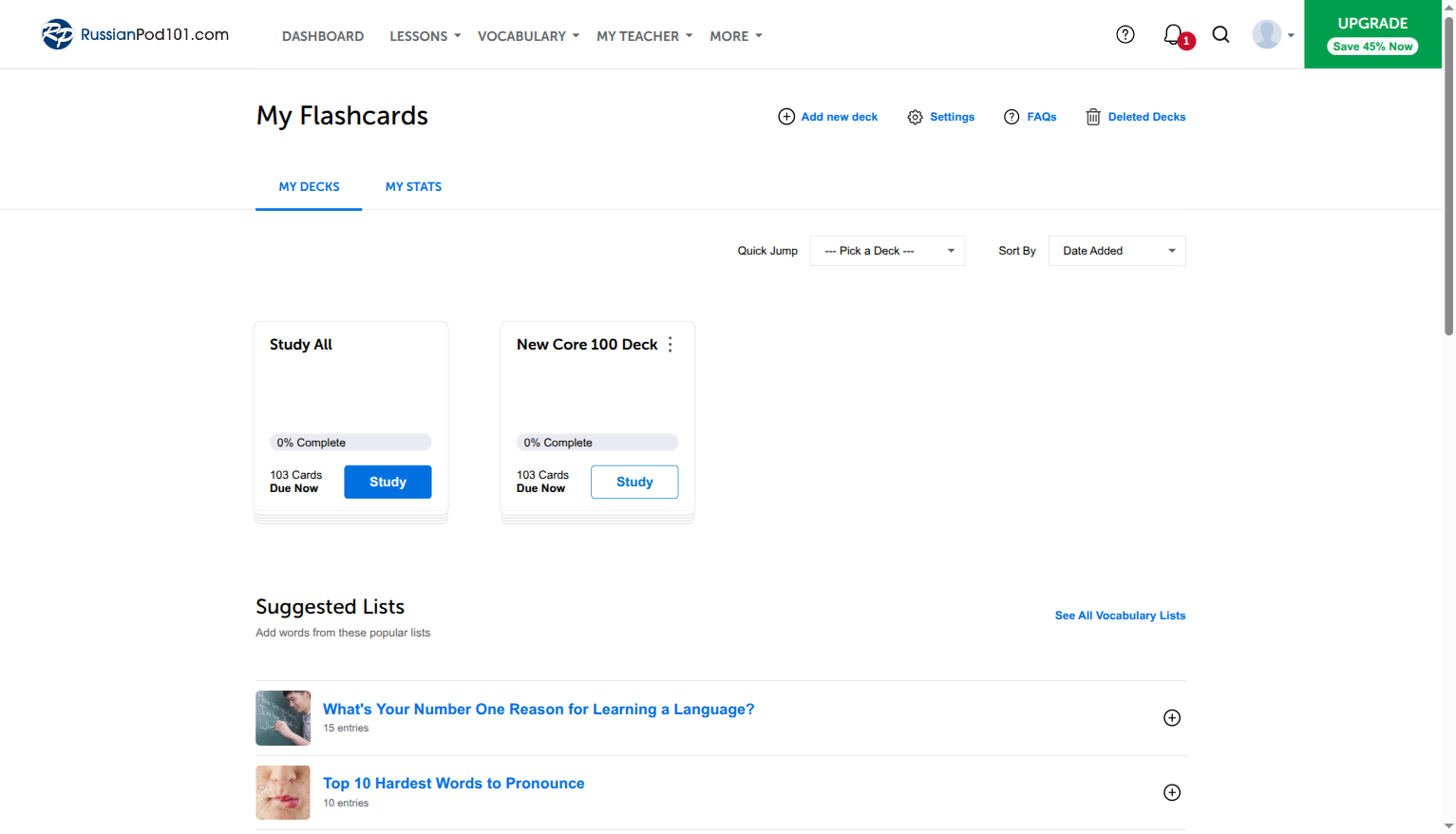
On a Premium plan, the lessons are wrapped in a solid set of study tools:
- Flashcards (spaced-repetition style) and a personal word bank, where you add words straight from any lesson, perfect for hammering home Russian vocabulary.
- A grammar bank that collects the grammar points in one place. Reviewers rate the actual explanations here highly; the limitation is that it works as a reference glossary rather than a guided curriculum.
- Multiple-choice assessments to check you’ve actually absorbed a section.
- A voice recorder on every lesson page that lets you record yourself and compare against the native audio, handy for those soft consonants and tricky stress patterns.
- 2,000 core words and phrases as a ready-made vocabulary backbone, with Cyrillic, romanisation and audio.
The Mobile App
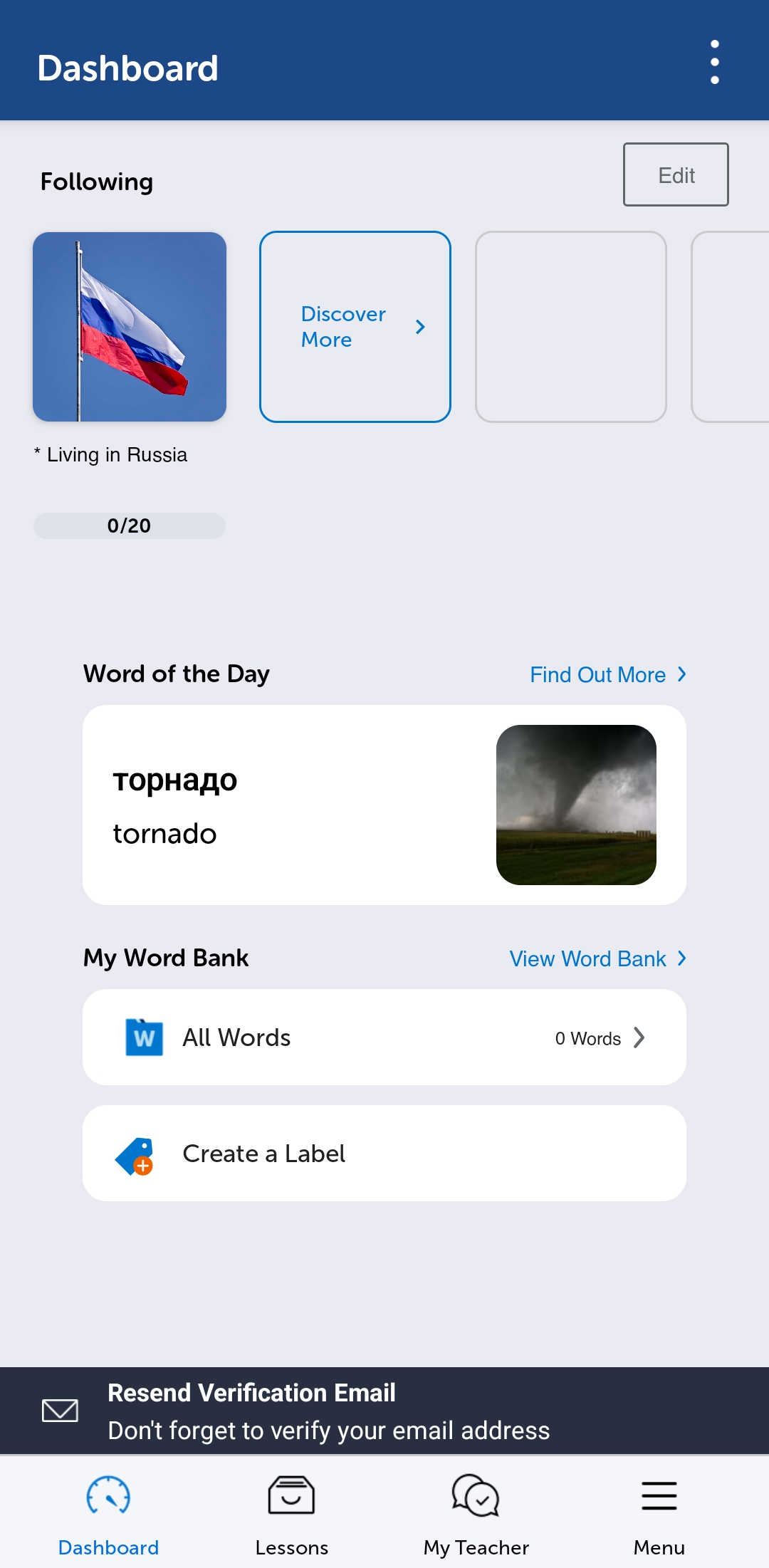
There’s an Innovative Language app (it’s the shared “101” app that covers every language in the family) and it syncs with your account, so lessons you finish on your laptop show as done on your phone. You can download audio for offline listening, which is exactly how loads of people use these courses: as a podcast for the commute.
The same caveat applies as on the other 101 courses: the app is a slightly lighter version of the website. Some of the best web features aren’t fully there, and following your structured study path can be fiddlier on mobile. The workaround is the same one I use elsewhere: pull the site up in your phone’s browser when you want the full experience.
What Other Russian Learners Say
I dug through a stack of reviews and Russian-learning forums to add to my own take. A few clear patterns came up.
The praise is consistent. The native audio and listening input are the headline: learners credit RussianPod101 with getting their ear in, to the point of following native speech and films. The PDF lesson notes and transcripts get glowing mentions, the grammar bank’s explanations are rated as genuinely good, and the short lesson format makes it an easy daily habit. As one long-term learner put it, the course “got me to this point where I can understand the gist of the speaker.”
The criticism is consistent too:
- It’s an input course, not an output one. You’ll listen and read a lot; you won’t be pushed to speak or write. The voice recorder helps with pronunciation, but it isn’t conversation practice. The standard fix is to pair it with a tutor on a platform like italki once you’ve got some vocabulary under your belt.
- The grammar isn’t sequenced. Cases and aspect are explained well in places, but scattered across lesson notes and the grammar bank rather than drilled in a structured progression. For a language where six cases touch nearly every sentence, most learners bolt on a dedicated grammar resource (a textbook like The New Penguin Russian Course, or a free reference like masterrussian.com) to fill that gap; our own guide to learning Russian rounds up more options.
- The upper levels thin out. There’s a wealth of beginner content and noticeably less once you reach upper-intermediate and advanced, so it’s strongest as a course to get you started and up to conversational footing.
- Expect upsell banners and a chatty inbox. Mildly annoying, easy to ignore.
None of that is a dealbreaker, but it does shape what RussianPod101 is best for: the audio-and-vocabulary engine of your Russian study, not your single do-everything resource.
Pricing and Plans
RussianPod101 runs the same four-tier structure as the rest of the family:
| Plan | Roughly… | What you get |
|---|---|---|
| Free | Free forever | First 3 lessons of every series, Survival Phrases, Word of the Day, 100+ vocab lists, the app, plus a 7-day Premium trial |
| Basic | ~$4/mo | Everything free + access to all lessons and in-depth lesson notes |
| Premium | ~$5–10/mo | Everything in Basic + flashcards, word bank, voice recorder, assessments, grammar bank, 2,000 core words |
| Premium PLUS | ~$13–23/mo | Everything in Premium + your own teacher, hand-graded assessments and personalised guidance |
A few notes on the pricing. The headline per-month figures are based on the longest (24-month) plan, so the actual price depends on the billing period you choose. Innovative also runs standing discounts most of the time, so you should rarely if ever pay full list price; the exact amount varies, so check the current price at checkout. And there’s a 60-day money-back guarantee, which takes the risk out of trying Premium.
For most people, Premium is the sweet spot: that’s the tier where the flashcards, voice recorder and full lesson features live. Premium PLUS only makes sense if you specifically want a teacher checking your work, and for that the live conversation practice can be worth it given that speaking is the one thing the core course doesn’t push.
Pros and Cons
Pros
- Teaches Cyrillic properly from day one with a dedicated alphabet series that smartly defuses the “false friends” trap.
- Huge amount of native audio, which is exactly what Russian’s unmarked stress and vowel reduction demand.
- A guided learning path so you’re never guessing what to study next.
- First-rate lesson-notes PDFs and grammar explanations.
- Excellent for vocabulary, with a 2,000-word core and an easy add-to-word-bank workflow.
- Affordable, with a usable free tier and a 60-day guarantee.
Cons
- Input-focused, with little built-in speaking or writing practice.
- Grammar isn’t sequenced, so cases and aspect need a dedicated companion resource.
- Upper-intermediate and advanced content is thinner than the beginner library.
- Upsell banners and marketing emails crop up.
- The app is a lighter version of the full website.
Who RussianPod101 Is (and Isn’t) For
It’s a brilliant fit if you’re an absolute beginner who wants a clear, guided path from Cyrillic upward; someone who learns well by ear and wants Russian in your headphones on the commute; or anyone who wants to build a big vocabulary and a real listening ear before tackling Russian’s grammar head-on.
It’s less ideal if you want a single resource that drills the case and aspect systems in a strict sequence, or one that forces you to speak from day one. In that case, use RussianPod101 for vocabulary and listening, bolt on a grammar book for the case system, and add a tutor for speaking practice.
The Verdict
RussianPod101 does the most important thing right: it takes Russian’s specific challenges seriously where it can. It gets you reading Cyrillic early and cleverly, it floods your ears with the native audio you need to crack Russian’s hidden stress and soft consonants, and it builds vocabulary brilliantly. It’s not a do-everything grammar course, and it won’t make you speak on its own, but as the audio-and-vocabulary core of your Russian study, paired with a grammar reference and eventually a tutor, it’s hard to beat for the price.
My rating: 4.5 out of 5.
If you want to give it a go, you can start with RussianPod101 here. Set up a free account, take it for a spin, and see if learning Russian by ear clicks for you. That link has our reader discount built in, so you’ll get money off automatically if you decide to go Premium.

Social