


Learning Russian for 2 Weeks: What Worked and What Didn’t

Full disclosure: This post contains affiliate links. ?
This is a historical guest update from Lauren, published in 2015. The first-person account below is hers, and the course names and progress totals describe what she used at the time rather than a current product recommendation.
Two weeks into a three-month Russian mission, Lauren took stock of what was helping, what was getting in her way and what she planned to change. Her long-term target was B1, but her immediate focus was the much smaller set of things she needed for simple conversations.
The useful part of this case study is not the speed or the deadline. It is the feedback loop: set a concrete speaking goal, try a method, notice the problem and adjust the next week.
A note from the Fluent in 3 Months team before we get started: You can chat away in Russian for at least 15 minutes with the “Fluent in 3 Months” method. All it takes is 90 days. Tap this link to find out more.
Crafting a Focused Strategy for Your Language Project
Having a high-stakes goal was intimidating. I wanted to reach B1 in three months, or come as close as I could, and at the start that felt enormous.
I got around that pressure by breaking the big goal into smaller missions. For my first month, I focused on A1: understanding and using familiar everyday expressions, introducing myself, asking and answering basic personal questions, and managing a simple exchange when the other person spoke clearly and helped.
That description gave me actions I could practise:
- use a small set of everyday expressions;
- introduce myself;
- ask a few simple questions; and
- understand and give short answers.
A1 is broader than a four-item checklist, and a formal assessment would test more than this. For planning my first conversations, though, these behaviours were concrete enough to guide the next two weeks.
My deadline was part of this particular experiment, not a promise about how quickly anyone else should reach a CEFR level. The transferable idea is to turn a broad level target into tasks you can observe in a real conversation.
Week 1: Diving Headfirst Into an Intensive Project
I was not sure how to prepare for online conversations with tutors, so Benny suggested that I start somewhere and use the experience to adjust my strategy.
I began with RussianPod101 audio lessons. I repeated useful lines, listened to their pronunciation and wrote down phrases I expected to need in a call. I skipped tourist and food topics for the moment because my first conversations were more likely to cover introductions and basic personal details.
I put the phrases into a text document and grouped them by purpose. My categories included greetings, introducing myself, asking for clarification and answering common questions. This gave me a reference during a call and made it easier to choose what to practise next.
The sheet was useful, but it was not meant to hold every phrase from every lesson. A shorter list of language I was likely to say soon was easier to review and use. I also needed to check each phrase in context rather than assume that one translation would fit every situation.
The Bingo Strategy for Practising New Phrases
During tutor calls, I played a private game of bingo with my phrase sheet. I chose a few expressions before the lesson and tried to use each one naturally. Ticking them off gave the conversation a purpose and stopped me relying only on the lines I already found comfortable.
The word naturally matters. Forcing a phrase into the wrong situation would only rehearse awkward language. If an expression did not fit, I saved it for another call or asked the tutor to help me build a suitable example.
After the lesson, I marked each item in one of three ways: used comfortably, used with help, or not used. For the next call, I could keep one phrase that needed work and add one or two new ones. This turned the sheet into a simple retrieval loop rather than an ever-growing archive.
Grouping related phrases also helped me notice patterns. Those patterns were useful questions to take to a tutor or grammar reference, but they were not rules on their own. Similar-looking Russian forms can behave differently, so I still needed checked examples.
Week 2: Moving From Personal Phonetics to Cyrillic
During the first week, I often wrote Russian phrases the way they sounded to me because typing Cyrillic was slow. Those personal phonetic spellings helped me capture a line quickly, but they also preserved my mishearings and made it harder to connect the sound with the real word.
Romanisation itself is not inherently wrong. Standard transliteration can show how Cyrillic letters map into Latin script, although it is not a complete pronunciation guide. My improvised English-like spellings were the problem because they had no consistent system.
I therefore started replacing those notes with Russian Cyrillic. I kept the audio with the written phrase when I could, marked the stressed syllable, and practised typing a few useful lines until the keyboard stopped slowing me down so much.
I also added an Assimil Russian coursebook because I wanted more reading and structured explanation alongside the audio lessons. Seeing sentences on the page helped me notice endings and word order that I had missed by ear.
Some of its grammatical terminology felt too technical for me at that point. Terms such as third-person plural and accusative case are precise, though, and Russian does conventionally teach six cases. What I needed was a clear example showing how the term changed the sentence, not a replacement label that hid the distinction.
Russian word order is relatively flexible, but it is not random. Case endings help show a word’s grammatical role, while order can change emphasis and what information feels new or already known. Written examples gave me a way to notice those choices and ask better questions.
What Was Working After Two Weeks, and What Was Not
Move into Cyrillic early, but keep sound attached to spelling.
My private phonetic notes had become a crutch because I saw my own spellings instead of the Russian words. Replacing them with checked Cyrillic was the right correction. Reading alone would not teach pronunciation, so I still needed audio and feedback from a Russian speaker.
Repeat a manageable first conversation.
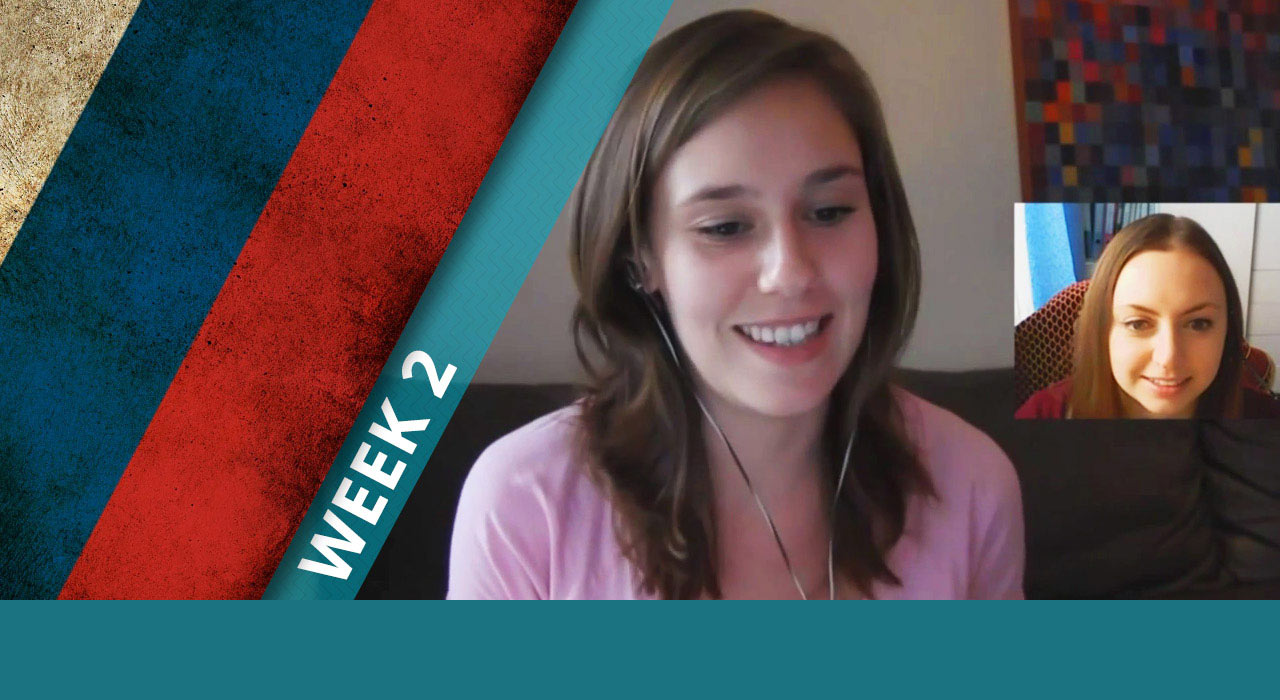
I was extremely nervous before my first online conversation in another language, but I enjoyed it once I had started. I booked introductory conversations with several tutors and repeated the same core topics: greetings, where we were from, what we did and why I was learning Russian.
I called this my “Groundhog Day” strategy. Repeating the situation reduced the planning load, while changing conversation partners stopped it becoming a memorised dialogue. The aim was to answer a real person, not recite a script.
Use supported and unsupported speaking for different jobs.
In some sessions I tried to stay in Russian and use the language I already had. In others I used English when necessary to ask about Russian, get a correction or understand homework. Both formats helped, but they trained different skills.
Combine methods when each one solves a real problem.
The audio course supported listening and imitation. The book supported Cyrillic, sentence analysis and written exercises. Tutor calls made me retrieve language under pressure. My phrase sheet connected the three.
I had begun to notice verb patterns and grammatical gender, but two weeks of exposure did not mean I had mastered “basic Russian grammar”. In Russian, present-tense verbs conjugate for person and number, past-tense forms mark gender in the singular, and nouns belong to grammatical genders. That gave me several specific areas to test rather than one vague claim of understanding grammar.
The broader lesson was to add a method because it addressed a gap. Using several tools without a reason could just scatter my attention.
Recap: What I Had Done After Two Weeks
These totals record my 2015 experiment. Course catalogues, lesson names and platforms may have changed since then:
- RussianPod101: completed “Newbie Season 1”, 11 of 25 “Top 25 Russian Questions” lessons and 19 of 26 “Absolute Beginner Season 1” lessons;
- Reading and Writing Russian Script: completed the book;
- Preply: completed five conversations on Skype;
- Assimil Russian: completed 13 of 100 lessons;
- Memrise: completed 75 of 543 words in the “Beginners Russian” deck I was using; and
- My phrase sheet: collected personally useful language from the other activities and brought selected phrases into tutor conversations.
The numbers show activity, not proficiency. The more useful evidence was what I could do: introduce myself, handle familiar questions, recognise more Cyrillic and notice which parts of a conversation still needed help.
If you want to adapt this experiment, pick one conversation you expect to have, prepare three to five checked phrases, use them with a tutor or language exchange partner, then review what you could say without help. Let that result choose the next lesson.

Social