


The French Alphabet: Letters, Pronunciation and Audio

Full disclosure: This post contains affiliate links. ?
The French alphabet has the same 26 letters as English. The shapes are familiar, but the letter names and the sounds they represent are often different.
This guide gives you audio for every letter, then shows you how French accents, ligatures, punctuation and keyboards work.
For a quick overview, watch native French speaker Alice pronounce the alphabet from A to Z:
Editor's note: Before we get started, if you’re looking for an online French course, here’s the course we recommend: French Uncovered – Learn French Through the Power of Story, a course with a fascinating new method by Olly Richards. You can try it for free for 7 days!
Table of contents
French Alphabet 101
Here are the 26 French letter names. The IPA in slashes gives the standard pronunciation; use the audio as your main guide.
- : /a/
- : /be/
- : /se/
- : /de/
- : /ə/
- : /ɛf/
- : /ʒe/
- : /aʃ/
- : /i/
- : /ʒi/
- : /ka/
- : /ɛl/
- : /ɛm/
- : /ɛn/
- : /o/
- : /pe/
- : /ky/
- : /ɛʁ/
- : /ɛs/
- : /te/
- : /y/
- : /ve/
- : /dubləve/, literally “double V”
- : /iks/
- : /iɡʁɛk/, literally “Greek I”
- : /zɛd/
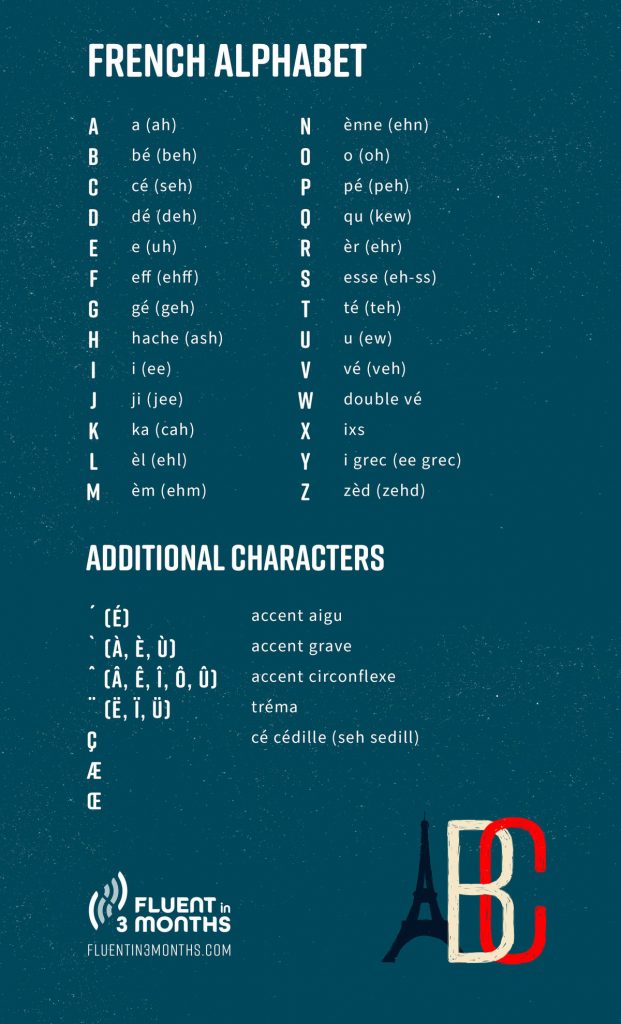
Letter names help you spell aloud, but they do not tell you every sound a letter makes inside a word. French spelling has regular patterns, but the relationship between letters and sounds is not one-to-one. Final consonants may be silent, vowels can combine, and the same letter can have more than one value.
French Letter Names and Spelling Sounds
French Consonants
G and J: Before e, i or y, g commonly represents /ʒ/, the sound in the middle of English “vision”. You can hear it in . The letter j usually represents the same sound, as in . Before a, o or u, g is usually /ɡ/, as in .
H: The letter h itself is not pronounced in modern French. However, dictionaries distinguish h muet from h aspiré. A word beginning with h muet allows elision and liaison, while h aspiré blocks them. Compare l’homme with le héros.
R: Standard French commonly uses a uvular sound /ʁ/, made with gentle airflow near the back of the mouth. Keep your tongue relaxed and listen closely to the audio for the letter R. There is no need to scrape or strain your throat.
One word can combine several of these differences. French has the same spelling and meaning as English “jury”, but its French pronunciation is quite different.
French Vowels
The French letter name U is /y/. To make it, hold your tongue as if you were saying “ee”, then round your lips without moving your tongue. In words, though, written u also appears in combinations such as ou and au, so do not assume that it always represents /y/.
French also has oral vowels, nasal vowels and common vowel combinations that do not map neatly onto English spelling. For a fuller sound-by-sound lesson, use our French pronunciation guide.
French Accents and Other Written Symbols
French uses four accent marks on vowels, plus the cedilla under c:
- l’accent aigu: é
- l’accent grave: à, è, ù
- l’accent circonflexe: â, ê, î, ô, û
- : ë, ï, ü, ÿ
- : ç
These marks are part of the correct spelling, not optional decoration. Our complete French accent-mark guide goes into more detail.
L’Accent Aigu
The acute accent appears only on e: é. In standard pronunciation it usually represents /e/, a steady vowel without the glide at the end of English “say”. Listen to and (“key”).
L’Accent Grave
The grave accent appears on à, è and ù. On è, it normally indicates /ɛ/. Compare with . On à and ù, it distinguishes words that otherwise look alike:
- a (“has”) and à (“at”, “to” or “in”)
- la (“the” or “her”) and là (“there”)
- ou (“or”) and (“where”)
The letter ù occurs chiefly in où and words or expressions built from it.
L’Accent Circonflexe
The circumflex can appear on all five vowels. It sometimes reflects an older spelling with a letter that later disappeared: compare French forêt with English “forest”, or hôpital with “hospital”. It can also distinguish words such as sur (“on”) and sûr (“sure”).
Its effect on pronunciation depends on the word and the speaker’s variety of French. The 1990 spelling rectifications made the circumflex optional on many instances of i and u, but kept it where it distinguishes meaning or marks certain verb forms. Traditional and rectified spellings both remain accepted.
Le Tréma
The tréma tells you that a vowel should be pronounced separately from a neighbouring vowel. You can see it in Noël, naïve, (“maize”) and (“ambiguity”).
The 1990 rectifications did not replace the tréma with a circumflex. In a small group of rectified spellings, they moved the tréma onto the vowel that is pronounced, so both traditional aiguë and rectified aigüe are accepted.
La Cédille
The cedilla changes c to ç, representing /s/. It is normally used before a, o or u, where an unmarked c would usually represent /k/. Examples include (“that”), (“disappointed”) and (“a glimpse”).
The Ligatures æ and œ
French also uses two joined letter forms, or ligatures: æ and œ. They are not extra alphabet letters.
Æ, called e dans l’a, is rare and occurs mainly in words or expressions of Latin origin, including and . The spelling is more common than et cætera.
, called e dans l’o, is more common. Its pronunciation depends on the word. Listen to , , , and . In careful spelling, keep the ligature in words that require it rather than replacing it with separate oe.
French Punctuation and Numbers
French punctuation spacing depends on the regional and publishing convention. In France, formal typography normally puts a non-breaking or thin space before a semicolon, colon, question mark or exclamation mark. Quebec convention commonly omits the space before the semicolon, question mark and exclamation mark. Your software may handle some of this automatically.
French typography uses spaces, not commas, to group long numbers: 23 000. A decimal comma replaces the English decimal point, so English 3.5 is French 3,5. Short four-digit numbers may appear with or without a grouping space, depending on context and style.
French Keyboards: How to Type the French Alphabet
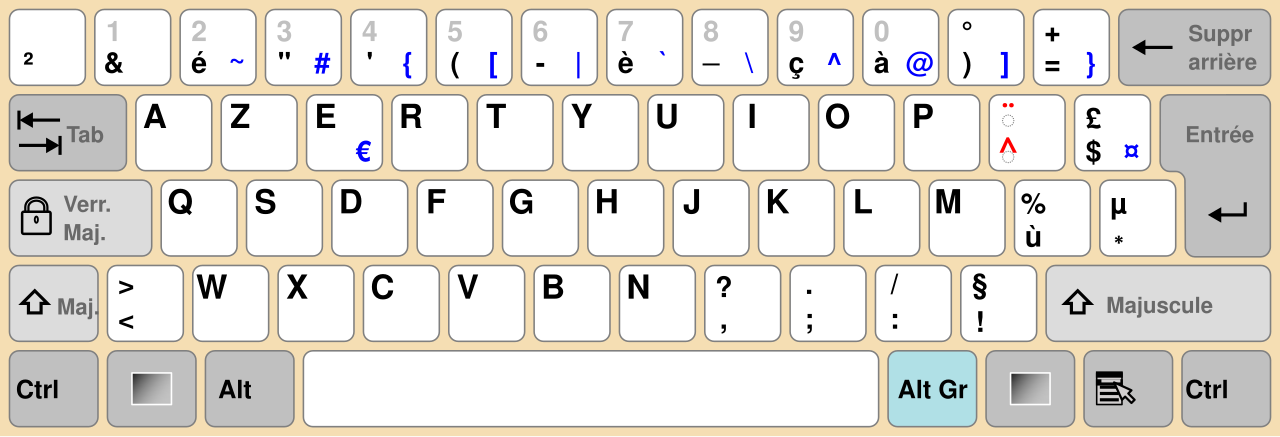
Many keyboards used in France follow a traditional AZERTY layout. The exact characters and shortcuts depend on your operating system and chosen keyboard layout. France also has the voluntary NF Z71-300 standard, which includes an enhanced AZERTY layout designed to make French and other Latin-script characters easier to type.
You do not need to buy a new keyboard. Add a French layout in your computer or phone settings, use your system’s accent shortcuts or long-press menu, or type with the free Lexilogos French keyboard and copy the result.
How to Practise the French Alphabet
Start by listening to the 26 letter names and spelling your own name aloud. Then practise short words, paying attention to the difference between a letter’s name and its sound inside the word.
- Listen to one letter.
- Repeat it without looking at the IPA.
- Record yourself and compare.
- Spell a familiar name or place.
For a dictation challenge, listen to the audio in our guide to colours in French and write each word before checking the spelling. Mistakes will show you which sound-and-letter patterns need another pass.
Original article by Akita Ropiquet, updated by the Fluent in 3 Months team.


Social