


Japanese N5 Kanji List: 100 Beginner Kanji to Study for the JLPT N5

Full disclosure: This post contains affiliate links. ?
読。書。聞。話。。。Do you know those kanji yet? They’re common beginner characters worth studying if you plan to take the JLPT N5.
JLPT stands for Japanese-Language Proficiency Test, which has five levels. N1 is the hardest and N5 is the easiest; the official N5 description focuses on understanding some basic written Japanese and short, slow conversations about everyday topics.
This guide gives you 100 common beginner kanji to study for N5, but it isn’t an official fixed syllabus or a guarantee of what will appear on your test.
Table of contents
The article below goes in-depth on the topic, if you want a quick overview here’s a video I made:
Editor's note: Before we get started, if you’re looking for an online Japanese course, here’s the course we recommend: Japanese Uncovered – Learn Japanese Through the Power of Story, a course with a fascinating new method by Olly Richards. You can try it for free for 7 days!
What to Expect on the JLPT N5 Test
Even though the JLPT N5 test is the most basic formal Japanese test, passing the test is still a big achievement.
To pass the JLPT N5, you need to read some typical expressions and sentences in hiragana, katakana and basic kanji, and understand short, slow conversations about everyday and classroom situations. The official guidance doesn’t publish a fixed vocabulary total, so figures such as 800 words are planning estimates rather than pass requirements.
I recommend starting with the Core 101 Japanese words and a structured beginner grammar course, then testing yourself with N5-style reading and listening questions.
My two favorite resources for studying grammar at this level are Genki I and JTest4U. Plus, you’ll need to be totally comfortable reading all the hiragana and katakana characters.
Why You Need to Know Kanji for the JLPT N5 Test
One of the most daunting tasks when starting to learn Japanese? Kanji.
The JLPT doesn’t publish a fixed list of 100 kanji that guarantees a pass. Treat the characters below as a practical study list covering common beginner themes such as numbers, time, people, places, verbs, adjectives and directions.
These kanji appear in plenty of beginner vocabulary, so you’ll meet them repeatedly. Learn each character inside a word rather than treating it as an isolated shape.
Radicals are recurring components used to index and analyse kanji. Some characters in this list can also appear inside more complex ones, but that doesn’t make the whole list a set of radicals or roots.
That being said, you can still come up with mnemonics to help you remember the kanji and their readings—and I highly recommend that you do, because it will help you immensely down the road.
Japanese N5 Kanji List: 100 Beginner Kanji to Study
Alright, so let’s start learning these kanji! I’ve broken them up into categories such as numbers, time, people and places. Kanji are easiest to learn when I associate them with related words.
In the lists below, you’ll see the kanji and the English meaning, followed by the onyomi and kunyomi readings.
Why the different readings? Kanji came from Chinese characters and were adapted into Japanese. On’yomi are readings derived from Chinese, while kun’yomi are native Japanese readings. Many kanji have several possible readings, and the right one depends on the word.
Don’t try to memorise every possible reading in isolation. Learn each kanji with a common word, which gives you a useful reading in context even though it won’t cover every use.
For that reason, I’ve included a beginner vocabulary example for each kanji.
Japanese Kanji for Numbers
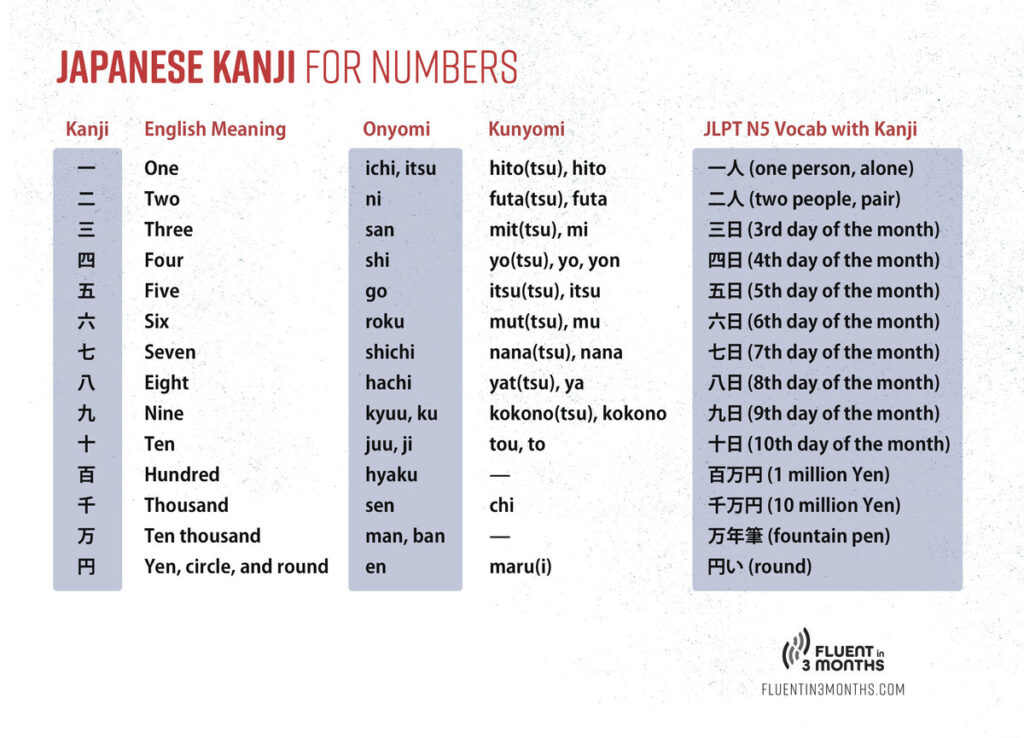
First, let’s look at numbers. The first three are very straightforward to remember: a single line (one), two lines (two), three lines (three). Easy.
The rest can be more difficult. You’ll often see Arabic numerals such as 1–10 in Japan, but the kanji forms still appear in words, dates and fixed expressions.
| Kanji | English Meaning | Onyomi | Kunyomi | Beginner Vocab with Kanji |
|---|---|---|---|---|
| 一 | One | ichi, itsu | hito(tsu), hito | 一人 (one person, alone) |
| 二 | Two | ni | futa(tsu), futa | 二人 (two people, pair) |
| 三 | Three | san | mit(tsu), mi | 三日 (3rd day of the month) |
| 四 | Four | shi | yot(tsu), yo, yon | 四日 (4th day of the month) |
| 五 | Five | go | itsu(tsu), itsu | 五日 (5th day of the month) |
| 六 | Six | roku | mut(tsu), mu | 六日 (6th day of the month) |
| 七 | Seven | shichi | nana(tsu), nana | 七日 (7th day of the month) |
| 八 | Eight | hachi | yat(tsu), ya | 八日 (8th day of the month) |
| 九 | Nine | kyuu, ku | kokono(tsu), kokono | 九日 (9th day of the month) |
| 十 | Ten | juu, jit- | tou, to | 十日 (10th day of the month) |
| 百 | Hundred | hyaku | — | 百万円 (1 million Yen) |
| 千 | Thousand | sen | chi | 千万円 (10 million Yen) |
| 万 | Ten thousand | man, ban | — | 万年筆 (fountain pen) |
| 円 | Yen, circle, and round | en | maru(i) | 円い (round) |
Pro tip: Be careful with 千: it looks almost identical to チ (katakana chi) and one of the readings is the same.
万年筆 means “fountain pen” and shows how 万 can appear inside a larger word. Learn it if it belongs in the vocabulary resource you’re using, but don’t treat any one word as guaranteed test content.
Japanese Kanji for Time
These kanji are often used together with numbers, so I’ve included them next. You’ll pair numbers up with kanji like 月 to create the months of the year, like 一月 (“January”).
Some of the kanji on this list have more uses than just time, such as 来る which is an irregular verb. But, 来 also reads as らい, meaning “future”. Combined with other time kanji you get: 来週 (“next week”), 来月 (“next month”), and 来年 (“next year”).
| Kanji | English Meaning | Onyomi | Kunyomi | Beginner Vocab with Kanji |
|---|---|---|---|---|
| 日 | Day, sun | nichi, jitsu | hi, ka | 明日 (tomorrow) |
| 週 | Week | shuu | — | 毎週 (every week) |
| 月 | Month, moon | getsu, gatsu | tsuki | 月曜日 (Monday) |
| 年 | Year | nen | toshi | 今年 (this year), 去年 (last year) |
| 時 | Time, hour | ji | toki | 時計 (clock, watch) |
| 間 | Time frame, span of time | kan, ken | aida | 時間 (time, hours) |
| 分 | Minute, part, to understand, to divide | bun, bu, fun | wa(karu) | 三十分 (thirty minutes), 自分 (oneself) |
| 午 | Noon | go | — | 午前 (morning, A.M.) |
| 前 | Before | zen | mae | 名前 (name) |
| 後 | After, later, behind | go, kou | ato | 午後 (afternoon, P.M.) |
| 今 | Now | kon, kin | ima | 今晩 (this evening), 今朝 (this morning) |
| 先 | Before, ahead, future | sen | saki | 先週 (last week), 先生 (teacher, master) |
| 来 | To come | rai | ku(ru) | 来月 (next month), 来る (to come) |
| 半 | Half, middle | han | naka(ba) | 半分 (half) |
| 毎 | Every, each | mai | — | 毎日(every day) |
| 何 | What, which, how many | ka | nan, nani | 何曜日 (what day of the week) |
Japanese Kanji for People & Things
This category includes many of the basic natural elements (very important in Japanese culture, so they pop up a lot), people, and body parts. Because these kanji are used in so many words, they’ve evolved the most over time and have a lot of readings.
I’ve included most of the top ones to know, but you’ll often find these have irregular readings, too.
Consider, for example, 母 and 父. When talking about your own mom and dad to others, you would read/say them as haha and chichi. But when talking to your parents, they would be kaa as in okaasan (お母さん) and tou as in otousan (お父さん). These kanji also change when used for grandparents, aunts, and uncles.
Just be on the lookout. You’ll have to memorize them on a word-by-word basis.
| Kanji | English Meaning | Onyomi | Kunyomi | Beginner Vocab with Kanji |
|---|---|---|---|---|
| 人 | Person | jin, nin | hito | 人々 (people) |
| 男 | Man, boy, male | dan, nan | otoko | 男の子 (boy) |
| 女 | Woman, girl, female | jo, nyo | onna, me | 女の子 (girl) |
| 子 | Child | shi, su | ko | 子供 (child) |
| 母 | Mother | bo | haha | 母 (mother) |
| 父 | Father | fu | chichi | 父 (father) |
| 友 | Friend | yuu | tomo | 友達 (friend) |
| 火 | Fire | ka | hi | 火曜日 (Tuesday) |
| 水 | Water | sui | mizu | 水曜日 (Wednesday) |
| 木 | Tree, wood | moku, boku | ki, ko | 木曜日 (Thursday) |
| 土 | Earth, ground | do, to | tsuchi | 土曜日 (Saturday) |
| 金 | Money, gold | kin, kon | kane | 金曜日 (Friday) |
| 本 | Book, source | hon | moto | 日本語 (Japanese) |
| 川 | River | sen | kawa | 川 (river) |
| 花 | Flower | ka | hana | 花火 (fireworks) |
| 気 | Spirit | ki, ke | — | 元気 (healthy, spirit, fine) |
| 生 | Life, to live, to be born, to grow | sei, shou | i(kiru), u(mareru), ha(yasu) | 生徒 (pupil) |
| 魚 | Fish | gyo | sakana | 魚 (fish) |
| 天 | Heaven | ten | ame, ama | 天気 (weather) |
| 空 | Sky, empty | kuu | sora, a(keru) | 空 (sky) |
| 山 | Mountain | san | yama | 山 (mountain) |
| 雨 | Rain | u | ame | 雨 (rain) |
| 電 | Electricity | den | — | 電気 (electricity) |
| 車 | Car, vehicle | sha | kuruma | 電車 (electric train) |
| 語 | Language, word, to chat | go | kata(ru) | 英語 (English) |
| 耳 | Ear | ji | mimi | 耳 (ear) |
| 手 | Hand | shu | te | 手紙 (letter) |
| 足 | Foot, to add | soku | ashi, ta(su) | 足 (foot) |
| 目 | Eye | moku | me | 目 (eye) |
| 口 | Mouth | kou, ku | kuchi | 出口 (exit) |
| 名 | Name | mei, myou | na | 名前 (name) |
Japanese Kanji for Places & Directions
It’s a good idea to memorize each reading really well for these common kanji.
店 is read as ten almost as often as mise. 外 is just as often read as gai as it is soto. But, they have patterns. 店 reads as ten when combined with other kanji, like 喫茶店. On its own, it’s mise. It’s the same with 外: gai describes something foreign or outside the norm of one’s own country or group. Soto is used to just say “outside.”
| Kanji | English Meaning | Onyomi | Kunyomi | Beginner Vocab with Kanji |
|---|---|---|---|---|
| 店 | Shop | ten | mise | 喫茶店 (coffee shop) |
| 駅 | Station | eki | — | 駅前 (in front of the station) |
| 道 | Street, path, way | dou | michi | 道具 (tool) |
| 社 | Shrine, society | sha | yashiro | 社長 (president of a company) |
| 国 | Country | koku | kuni | 外国人 (foreigner) |
| 外 | Outside | gai, ge | soto, hazu(reru), hoka | 外国 (foreign country) |
| 学 | School, learning | gaku | mana(bu) | 大学 (university) |
| 校 | School | kou | — | 学校 (school) |
| 上 | Up, above | shou, jou | ue, u, a(geru) | 上着 (jacket) |
| 下 | Down, below | ka, ge | ku(daru), shita | 靴下 (socks) |
| 中 | Middle, center, inner, between | chuu | naka | 日中 (during the day, midday) |
| 北 | North | hoku | kita | 北 (north) |
| 西 | West | sai, sei | nishi | 西 (west) |
| 東 | East | tou | higashi | 東京 (Tokyo) |
| 南 | South | nan | minami | 南 (south) |
| 右 | Right | yuu | migi | 右 (right) |
| 左 | Left | sa | hidari | 左 (left) |
Japanese Kanji for Verbs
These are among the most common verbs, besides する (suru, “to do”) which doesn’t use kanji. When used as verbs, you’ll almost always be using the kunyomi readings.
For each verb, focus first on the reading used in the example word rather than trying to rank every reading by importance.
N5 questions can test kanji readings and orthography, but the official test doesn’t publish a fixed word-by-word list. Use sample questions to get familiar with the format.
Readings become much easier to remember when you attach them to complete words such as 食品 (“food products”) and 会社 (“company”).
| Kanji | English Meaning | Onyomi | Kunyomi | Beginner Vocab with Kanji |
|---|---|---|---|---|
| 見 | To see, to be visible, to show | ken | mi(ru) | 見せる (to show) |
| 聞 | To hear, to listen, to ask | mon, bun | ki(ku) | 聞く (to listen, to hear) |
| 書 | To write | sho | ka(ku) | 辞書 (dictionary) |
| 読 | To read | doku | yo(mu) | 読む (to read) |
| 話 | To talk, conversation | wa | hanashi, hana(su) | 電話 (telephone) |
| 買 | To buy | bai | ka(u) | 買い物 (shopping) |
| 行 | To go, to carry out | kou | i(ku), okona(u) | 銀行 (bank) |
| 出 | To go out, to leave | shutsu | de(ru), da(su) | 出かける (to go out) |
| 入 | To enter, to put in | nyuu | hai(ru), i(reru) | 入口 (entrance) |
| 休 | To rest, break, holiday, vacation | kyuu | yasu(mu), yasu(mi) | 休む (to take a day off) |
| 食 | To eat, food | shoku | ta(beru) | 食堂 (dining room) |
| 飲 | To drink, a drink | in | no(mu) | 飲み物 (beverage) |
| 言 | To talk, word | gen, gon | i(u) | 言う (to say) |
| 立 | To stand | ritsu | ta(tsu) | 立つ (to stand) |
| 会 | To meet, society | kai, e | a(u) | 会社 (company) |
Japanese Kanji for Adjectives
Lastly, we have the most basic and common adjectives to describe things. You will most likely be quizzed on the kunyomi readings, as those are more commonly used as adjectives, while the onyomi readings combine with other kanji to give a more descriptive noun.
For example, 小 (little) + 学校 (school) means “elementary school.” You’ll definitely need to know them for later tests and vocab, but for N5 purposes your time would be better focused on reviewing the kunyomi readings.
| Kanji | English Meaning | Onyomi | Kunyomi | Beginner Vocab with Kanji |
|---|---|---|---|---|
| 多 | A lot, many | ta | oo(i) | 多い (many), 多分 (probably) |
| 少 | A little, few | shou | suko(shi), suku(nai) | 少ない (few) |
| 古 | Old | ko | furu(i) | 古い (old) |
| 新 | New | shin | atara(shii) | 新しい (new), 新聞 (newspaper) |
| 大 | Big, a lot | dai, tai | oo(kii) | 大きい (big), 大変 (dreadful, immense) |
| 小 | Little, small | shou | chii(sai), ko | 小さい (little) |
| 安 | Cheap, safety, peace | an | yasu(i) | 安い (cheap) |
| 高 | Expensive, high | kou | taka(i) | 高い (expensive) |
| 長 | Long, leader | chou | naga(i) | 長い (long), 部長 (manager) |
| 白 | White | haku, byaku | shiro, shiro(i) | 白い (white), 面白い (interesting) |
Japanese Kanji Practice: Ways to Memorise Kanji
Now that you’ve seen the study list, you can choose a memorisation method that you’ll use consistently.
Try a combination of mnemonic stories, reading practice and spaced repetition with the Anki app. James Heisig’s Remembering the Kanji is another mnemonic-based option, though you don’t need to use every method at once.
Heisig’s method organises characters around components and mnemonic stories. It still takes steady review, and some learners prefer to study each kanji through vocabulary instead.
Alongside that, I use the NihongoShark kanji deck in the Anki app, or you can create your own deck for the beginner kanji you’re studying. Add a mnemonic, a common word and the reading used in that word.
(Bonus points if you can tie how to read the kanji (or a word that uses it) into your mnemonic phrase.)
If you want to get more out of Anki, our Anki Power Up guide shows you how to set it up so the reviews actually stick instead of piling up.
I also suggest using Genki I, the beginner textbook I mentioned earlier.
It has a section in the back dedicated to learning kanji and reading practice that uses those kanji. It helps reinforce what you’re learning, at your level, without being incredibly tiresome.
As your kanji improves, vocabulary and reading become easier to organise. Keep working on listening and grammar too, since N5 tests all three areas rather than a kanji list in isolation.
Of course, there are other methods or apps you can use to learn kanji. But this is how I learned, and how many others have learned with success.
And once your kanji are coming along, keep building the rest of your Japanese with audio lessons like JapanesePod101, which is a fun way to train your listening while you drill.
A Final Word on Learning Japanese Kanji
Don’t let the JLPT N5 test intimidate you – you’ve got this! The best advice I have? Try to relax and keep calm. If you go in stressed and nervous, you may struggle to focus, especially with listening.
It may feel slow at first, but regular reviews will add up. Practise every day, revisit the words you miss and keep going until the test.
And most importantly, 皆さん、頑張って! (Good luck, everyone!)

Social