



13 Spanish-Language Movies to Add to Your Learning Watchlist

Full disclosure: This post contains affiliate links. ?
Spanish-language films are a satisfying way to spend more time with the language you are learning. They give you a reason to follow a story, hear different voices, and notice the words that keep coming back.
This guide was first published in 2021, when the films below were available on Netflix in at least one region. Streaming catalogues change frequently and vary by country, so treat it as a watchlist rather than a promise that every title is available on your Netflix today.
For a practical method once you have chosen a film, see our guide to learning languages by watching movies.
If you want a clear structure for putting your Spanish into practice, take a look at the Fluent in 3 Months Bootcamp. It’s a 90-day programme with weekly coaching calls, a private community and a focus on speaking from day one.
Spanish Films from Spain
Films from Spain can expose you to a range of regional voices, as well as Spanish, Catalan, and occasional Basque dialogue. Subtitles are a useful support, especially for a first viewing.
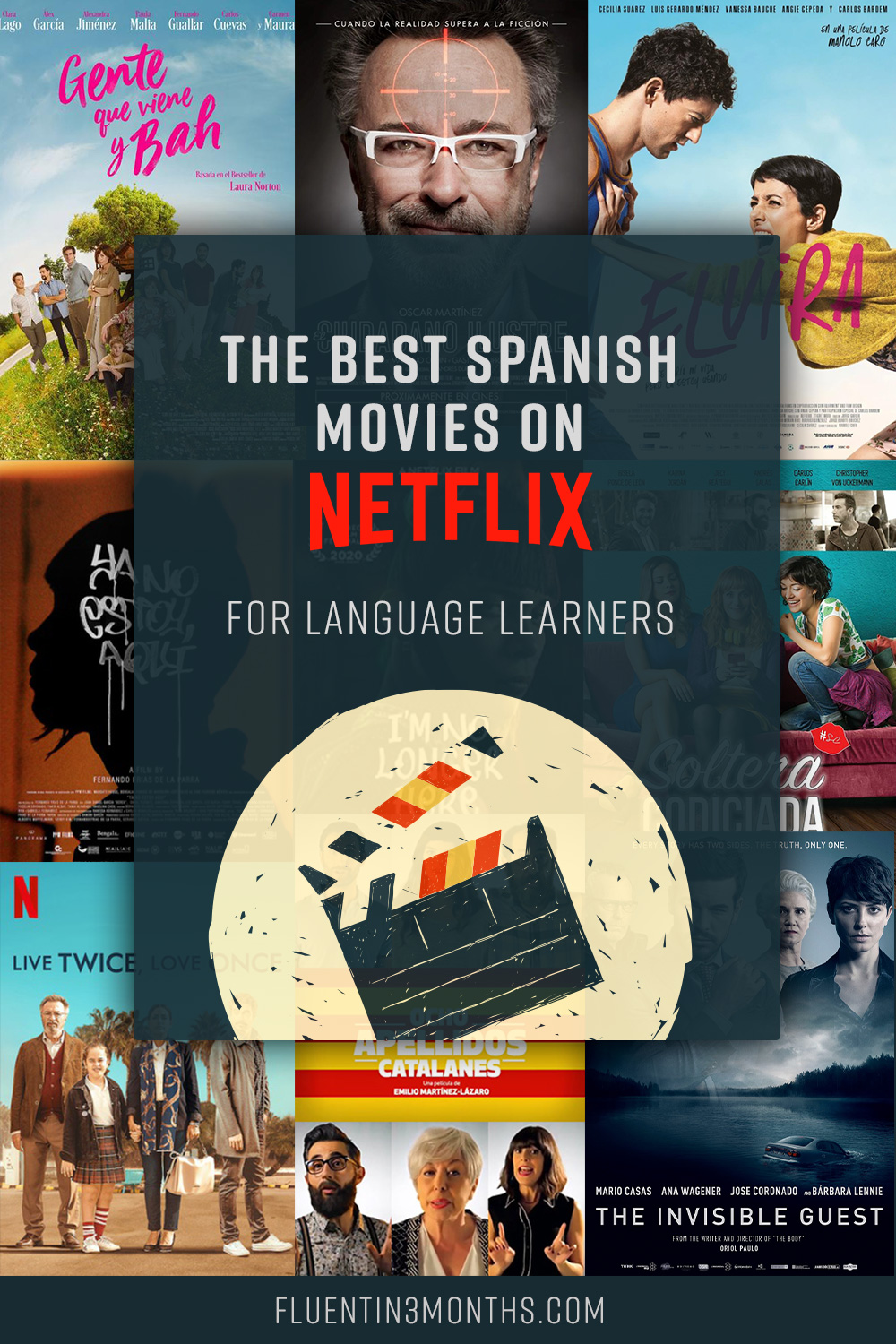
Gente que viene y bah (2019)
Patricia Font’s romantic comedy follows Bea as she returns home after a rough patch. It is a lighter choice for everyday conversation, family vocabulary, and informal Spanish from Spain. The title plays on gente que viene y va (“people who come and go”); bah is an interjection of dismissal.
Palmeras en la nieve (2015)
Fernando González Molina’s historical drama moves between Spain and Equatorial Guinea. It is a more demanding pick, both emotionally and linguistically; use it to hear Spanish from Spain and to explore a story connected to Spain’s colonial history in Equatorial Guinea.
Yucatán (2018)
Daniel Monzón’s comedy-adventure puts a lottery winner and two con artists on the same cruise. It is a lively option if you want to listen for shifts in accent and register rather than expect one single “standard” variety of Spanish.
Incerta glòria (2017)
Agustí Villaronga’s Civil War drama is primarily in Catalan, not a Spanish-learning film in the narrow sense. That is precisely why it belongs here: it is a reminder that Spain is multilingual. Choose it if you are curious about Catalan and can handle serious historical drama.
Vivir dos veces (2019)
María Ripoll’s family drama follows a retired professor trying to reconnect with someone from his past. The relationships make it a useful choice for family language, apologies, and everyday conversation, though its dementia storyline may be difficult for some viewers.
Contratiempo (2016)
Oriol Paulo’s tightly plotted thriller centres on a businessman constructing his defence before a trial. Watch it for suspense and for vocabulary around police interviews, evidence, and telling a story under pressure. The plot is worth protecting from spoilers.
Ocho apellidos catalanes (2015)
Emilio Martínez-Lázaro’s comedy uses exaggerated regional stereotypes around Basque, Andalusian, and Catalan identities. It can prompt useful cultural questions, but remember that the joke depends on caricature; it is not a guide to what people from those places are actually like.
Mexican and Latin American Films
Spanish is not one sound. Choosing films made in Mexico, Argentina, Peru, and elsewhere helps you get used to the variety you will meet in real life. If a particular region matters to you, start with films made there.
Se busca papá (2020, Mexico)
Javier Colinas’s family comedy follows a girl who wants to enter a BMX competition despite her mother’s objections. Its accessible story makes it a friendly starting point for Mexican Spanish and casual family conversation.
Ya no estoy aquí (2019, Mexico)
Fernando Frías’s drama follows Ulises, a young man from Monterrey’s Kolombia subculture. It is an excellent, challenging choice for Mexican Spanish, music, migration, and identity. Expect regional slang and a story that asks for close attention.
El ciudadano ilustre (2016, Argentina/Spain)
Gastón Duprat and Mariano Cohn’s dark comedy follows an Argentine writer returning to his hometown after receiving the Nobel Prize. It is a strong pick for Argentine Spanish, dry humour, and the gap between public image and private history.
Lo más sencillo es complicarlo todo (2018, Mexico)
René Bueno’s teen comedy follows a girl making a complicated plan to win over her crush. It is a lighter choice for school, friendship, and dating vocabulary in Mexican Spanish.
Elvira, te daría mi vida pero la estoy usando (2015, Mexico)
Manolo Caro’s comedy-drama follows Elvira after her husband disappears. It brings together family tensions, relationships, and contemporary Mexican Spanish. The title is a playful way to say “I would give you my life, but I am using it.”
Soltera codiciada (2018, Peru)
Bruno Ascenzo and Joanna Lombardi’s romantic comedy follows María Fe after a breakup and grew out of Peruvian writer María José Osorio’s blog. Choose it for modern Peruvian Spanish and the language of friends, work, and starting over.
Why Watch Spanish-language Films?
Films are not a replacement for speaking, but they can make your listening practice more regular and more enjoyable. They also provide context: gestures, relationships, humour, and the situation that gives a phrase its meaning.
How to Watch So You Actually Learn
- Pick a film you genuinely want to finish. Interest beats an “educational” choice you abandon.
- For your first viewing, use Spanish audio and subtitles in Spanish if you can follow them. Switch to subtitles in your strongest language when comprehension collapses; the point is to keep the story enjoyable.
- Do not pause for every unknown word. Save a small handful of useful phrases, then reuse them in a sentence or conversation.
- Rewatch a favourite scene without subtitles. Familiar context makes it easier to notice what your ears missed.
Want more ideas? Our movie-learning guide explains how to turn watching into active practice, and our guide to learning with telenovelas is another route into longer-form Spanish.
Pick One and Press Play
Check your local catalogue or another legal streaming service, choose one film, and make a small plan: watch twenty minutes, note three phrases, and use one of them this week. Consistent, enjoyable contact with Spanish adds up.

Social