


How I Learned Spanish and English Through Immersion

Full disclosure: This post contains affiliate links. ?
I was standing in the middle of the classroom, gaping for words as my palms turned clammy, while thirty foreign students of my age intently looked at me. I was so panicked that my brain had shut down, leaving only one scene on repeat in my mind: I was crying very hard, that day during my sixth grade year, when my father had made me sit an entire afternoon at my desk to learn the Spanish numbers from one to a hundred.
The teacher said something, but I couldn’t quite grasp it in my state of alarm. Not that I could have understood, anyway, since he was speaking in English. The only thing I was totally sure of is how furious I was that day during my sixth-grade year. It was Sunday, I only had top grades in language classes, and I was never going to need the Spanish numbers from one to a hundred in my life anyway. So why was Dad insisting so much?
At some point, my tongue unknotted, and I managed to say a few sentences to my already bored public: “My name is Alice. My favorite color is blue. I am thirteen years old.” The grandiose result of two years worth of high grades in middle school language classes.
By the way, I was the foreign student. The thirty others were locals. They spoke Spanish and English. I did not.
As I sank in my chair and wished I could disappear into a mousehole, I wondered how I was going to get through the year.
If you want a clear structure for putting your Spanish into practice, take a look at the Fluent in 3 Months Bootcamp. It’s a 90-day programme with weekly coaching calls, a private community and a focus on speaking from day one.
Prologue: The Experience Which Gives Me Some Credit
I am naturally bilingual, born to a French mother and an Italian father. I spent my entire childhood juggling between the two languages instinctively: French at school during the year, Italian during summer vacations at my grandparents’ house, and both at home. I completed my whole primary education in France, and I was halfway through middle school when my father sat me and my two siblings on the couch to give us the news that would 180 our lives: we were moving to the Dominican Republic.
First, the concept did not pass. Then, we metaphorically turned green.
Where was the Dominican Republic? What would this mean for our lives? Was he being serious serious?
A few months later, I was standing in the middle of a classroom of thirty Dominican students, failing to introduce myself.
While my parents had considered enrolling my siblings and I in a French-Spanish school, they had finally opted for a Spanish-English one. The objective was brilliant: we would end up speaking four languages.
What was a little less shiny was the way to the goal. How could we be expected to follow a regular academic curriculum while we couldn’t understand what was said around us?
The first two weeks were exhausting. I did not understand the lessons and I was left out of conversations during breaks. I got cross trying to express myself because I didn’t grasp the concepts and was too afraid of misusing the wrong words. I came back home and either cried or promptly fell asleep. Adaptation absorbed all of my energy.
The month after that, I made a small amount of progress. I was able to understand more of what I was being told, but only if the sentences were kept short and to the point. Reading was okay, as long as I had enough time to read each passage twice and look up words in the dictionary. Jokes, idioms, and figurative language were out of my reach, and it was painful to see everyone laughing at something and not knowing what they were honking about. Speaking was still a no-go except when I was forced to, but even then it was mortifying because I got mocked. Since homework was a little easier, I crammed grammar and writing sessions in my afternoon schedule.
After two months, I started using my Spanish and even drawing connections between my native languages and those I was learning. Reading got easier in Spanish, but not in English. It was still nearly impossible to say anything in English. I took too long to translate my French thoughts into English sentences, and people got bored of waiting, which made me nervous, even more conscious of my wording, and even slower. A vicious circle.
After three months, I was the best at written work in my class. All the extra study I was doing at home was paying off. My brain still had to work at a hundred miles an hour, but I was forming thoughts directly in Spanish instead of translating them from my native languages. I got better at conversations, but the trauma from the first two months had made me somewhat introverted, so I didn’t say much anyway, which is probably the reason why I struggled with pronunciation for long.
Six months went by and I was finally totally comfortable with doing somethings in Spanish. I started working more on my English, which wasn’t too bad, but since I was surrounded by a majority of Spanish-speaking people, I mostly left it aside. It took me two years to polish my English through reading, watching TV, listening to music, and, finally, conversing.
Despite feeling like I would not survive this new life, I made it through. Much better than I had thought I would in the rare moments when I give myself some credit. Truth is, I am very thankful for all the hard time I went through in high school. I am glad I left my cozy life in France. I am glad I passed for an idiot for most of my eighth grade, because I am now proudly quadrilingual, as fluent in English and Spanish as I am in French and Italian.
An Immersion-Based Language Learning Strategy
Looking back to the two years I had in this bilingual school is quite hard now. I’m pretty sure that my brain got so saturated that it decided to leave memories out or it would short-circuit, so moments come back in hazy flashbacks:
- The two hours long Math-in-English homework sessions during which I literally was decoding a new language;
- The stuttering while trying to speak;
- The sweating when interacting with a teacher, sure that I was missing out on 51% of what I was being told;
- My classmates’ sneering and mockery because I was “too slow” or pronounced words wrong;
- The stressful trips to the supermarket (because my usual interactions were school-based) where people talk even faster;
- The zoning-out in front of the TV shows.
There are many more of those moments. They felt like torture. But now that I am able to use my quadrilinguality as an asset for work (I am a reporter in both French and English and have done translation work in most of my language combinations) I realise that I had discovered an immersion-based learning strategy without naming it.
I had top grades in middle school language classes, which have turned out to be close to useless.
I have used language apps, but no single app covered every skill I wanted to develop. They worked better as one part of a broader routine.
I have taken language classes with particular teachers, but they didn’t help me to develop any lasting ability to communicate.
Two words sum up the strategy that worked for me: active immersion.
Take a Deep Breath and Dive
Immersion can feel hard and scary, but it creates frequent contact with the language. Its speed depends on your starting point, time, support and what you actually do with that contact.
The primary purpose of learning a new language is being able to use it to communicate, either passively (reading books, watching movies, understanding songs, etc.) or actively (having conversations, interacting through emails, etc.).
For that, you don’t need to only learn vocabulary, like most language classes and language apps try to convince you. Handling a language correctly revolves around a web of skills, which include:
- constructing complicated sentences;
- understanding double meanings, inside jokes, inappropriate use of words, etc.;
- pronouncing words correctly;
- knowing and using idioms;
- getting used to the language’s melody (the way accents work, or the right way to cut syllables out);
- thinking in that language.
This last one is perhaps the most important if you want to achieve full fluidity in a language. The moment you start dreaming in your target language is the moment you know you are doing it right.
An occasional class can help, but these skills also need repeated contact between lessons. Put your brain near the target language often enough to practise listening, reading, writing and speaking rather than expecting one activity to carry the whole process.
Immersion does not require moving to a country where the language is spoken. Living abroad can create more contact, but it does not guarantee useful practice. You can build an immersive routine at home through regular conversation, media, reading and writing.
Breaking Down the Strategy
What full immersion is all about is submitting yourself to an incoming stream of random information and interactions. Think about your daily life, when you might:
- study/work
- make small talk at the grocery store
- hear commercials in the metro
- look up food recipes
- watch the news on TV
- read articles on blogs/news sites
- discuss something with your friends/neighbors
You need to be able to do all these things in your target language by the time you say that you “speak” that target language. And since our society loves the “fake it until you make it” saying, that is exactly what you should do.
Essentially, full immersion can be summed up to:
- Considering mistakes as your best friends;
- Basing your learning on a broad range of topics;
- Using music as an ally;
- Engaging in small talk and being curious;
- Measuring your comprehension using TV programs;
- Reading everything and anything;
- Stop hating writing.
Consider Mistakes Your Best Friends
Mistakes are your best friends, in part, because they’ll help you improve. They’re going to stick around so much that they’re the ones you’ll see the most during your learning. You would only slow yourself down if you hated them.
This is perhaps one of the biggest barriers to language learning. Because people are afraid of making mistakes and being laughed at, or looking like fools, they refuse to try it. What they miss is how normal making mistakes is. I am sorry to break to you, but we all make mistakes even in our native language! How mindblowing is this? By mistakes, I mean stuttering, mispronouncing, misconjugating, misusing words, misspelling, etc. If we already do those in a language which we’ve “mastered”, how can we expect things to be different when we learn a new one?
Mistakes are useful when you notice them, get feedback and try again. A correction will not automatically prevent the same error next time, but it gives you something specific to practise.
In all honesty, this truth falters a little with language learning, because you have so much to do at the beginning that it is impossible for you to remember every mistake you make. However, there will always be a little bell ringing in the back of your head when you’re about to repeat the faux pas, and with time it will sink in until you don’t need to think about it anymore.
Base Your Learning on a Broad Range of Topics
After my father had gotten so focused on making me learn the Spanish numbers from one to a hundred when I was in the sixth grade, I had classified the matter as useless… until I had to go grocery shopping in the Dominican Republic. I was very happy I knew the numbers at that moment.
Another example: studying Science in the English language in the eighth grade was torture. Yet, it turned out to be a lifesaver when I went to pass the SAT with outstanding scores.
One more because three is the perfect number: at the age of fifteen, I played tennis and got coached by a Czech woman who only spoke English with me. Sometimes, I found it as painful to understand her instructions as it was to carry out the physical activity. Later, I converted this experience into an asset for my professional life and have found a job as a tennis reporter in English.
No knowledge is useless when it comes to learning a new language. In fact, the more diverse your learning sources are, the better. In addition to the actual “power” of having multi-topic capacities, it will make you feel much more at ease so that you are able to understand/cover different subjects, and your mind will develop connections more easily.
You cannot predict every word you will need. Start with topics that matter in your life, then broaden your vocabulary as new situations expose the gaps.
Wildlife, fashion, economy, Math or Science… All topics are valid.
Use Music as an Ally
Because music is a means of expression before being an art, it can also turn out to be a fantastic tool on your language-learning journey.
First, song lyrics are varied, so, once again, it’s all about diversifying your learning sources. Second, music prompts you to willfully learn words and sentences and to work with your target language in a new cadence. Because it is very hard to resist singing a good song, you’ll get used to repeating the verses over and over, helping your tongue, lips, and vocal chords get used to these new combinations of sounds.
Ballads, pop, or blues are a good place to start because they feature repeated choruses and are easier to follow, but even trap, rap, or any scrap is good.
Disclaimer: Don’t mind the foul words that might pop up. I’ll be honest with you: it’s good to learn them first, so you’ll have a clue when to be offended if someone calls you a bad name when you’re stuck in traffic.
Engage in Small Talk and Be Curious
When Sherlock Holmes works on a new case, he usually talks with someone related to the mystery to open up or narrow down his field of research. It doesn’t matter if it is the victim, someone related to them, or barely a second-hand witness. Sherlock gets them to talk. He asks about the case itself, but he most often pays attention to little bits and pieces of behavior and/or background story that don’t have a direct link with his investigation. And a majority of the time, those seemingly inconspicuous details play a great role in the outcome of the case.
Have you ever thought about the power of innocent everyday conversations? They root in variety. As a language learner, you should metaphorically put on your deerstalker, grab a virtual pipe, and get Target-Language-Speakers to talk.
It can be friends, family members, or just people whom you know to speak your target language. Open up your dialogue with “Hey, I’m curious about…” and ask a random question. This is like digging a gold mine for words, expressions, sentence construction, but most of all, accent use and speech melody. There is no better way to learn spoken language than by interacting with people who are not teachers and do not use an academic or formal version of the language.
Different conversation partners bring different interests, speech patterns and experiences. Ask about the topics they know and care about rather than assuming those topics from their gender or age.
People love to talk, and you have to love to listen if you want to add a new language to your CV.
Alongside this, improvised conversations are also the best time to improve your own speech and pronunciation. Since they happen in an informal setting, these dialogues will make you a little more at ease about any possible stuttering or momentary amnesia. Use the words and expressions you’ve learned to absorb them better and fully understand how to handle them. In this type of situation, remember that mistakes are okay.
Measure Your Comprehension by Using TV Programs
Having conversations with people is a tremendous way to practice your target language understanding, and it becomes easier as time goes by and your skills improve. Plus, you can always ask a person to slow their pace or repeat a sentence you haven’t fully understood.
With television, you can’t do that.
Television is one useful test of listening comprehension. Actors and presenters may speak quickly, and scenes include background noise. Understanding can involve context, visual cues and familiar phrases as well as individual words. It is only one listening environment, not a universal fluency test.
Understanding a news broadcast can be a satisfying milestone, but it does not by itself define fluency. News uses a particular register and tests different skills from conversation.
Read Everything and Anything
During my time at the bilingual school, the effort I put into learning English was considerably less than into learning Spanish (which was more urgent since I was living in a Spanish-speaking country). Consequently, I only improved my passive understanding in English, but not my active expressivity. In a conversation, I was twice as good at listening compared to talking.
After two years spent in the bilingual school, I switched to homeschool. I studied 10th grade with a Dominican program, which meant that my entire curriculum was in Spanish. This could have meant a catastrophic drop in my already limited skills in English.
However, since I had more time to spend in extracurricular activities, I picked up my abandoned hobby of reading (whose space has been filled with extra-homework since my arrival in the Dominican Republic) and I chose to read the original versions of books by Jane Austen, Charles Dickens, and JK Rowling. Consequently, my English improved dramatically.
Reading benefits you by polishing your rough knowledge of sentence formation. When you read, you have time to analyze the construction of the text, you can study it repeatedly, until you fully understand how word combinations work. For example, this is how I have learned the correct use of pronouns and prepositions, which often depends on “how right the sentence sounds” rather than on grammatical rules.
This useful reading doesn’t only include novels and fiction, or typical language cheat sheets. It is also magazines, blogs, newspapers, textbooks… Even food labels or user instructions. In fact, those last two turn out to be even better: their formal tone and specialized vocabulary make them harder to decipher, but who harder is better.
Stop Hating Writing
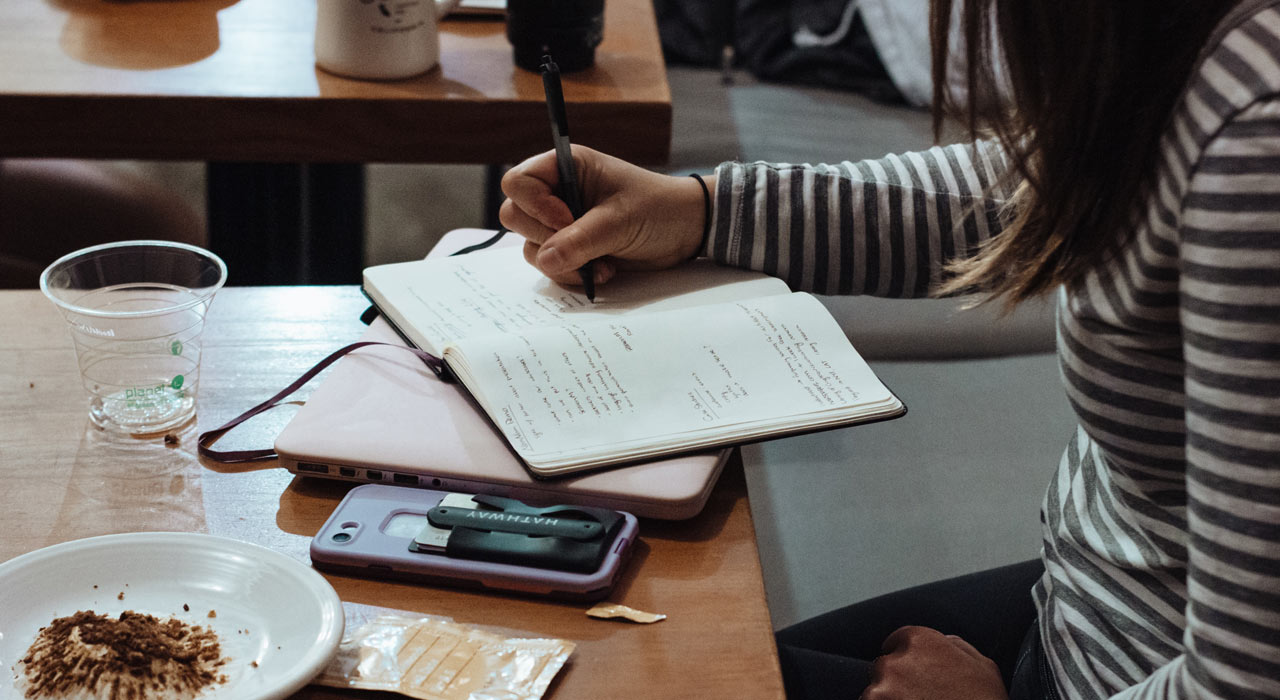
If you’re on bad terms with handwriting or taking notes, this may be a useful time for a truce. Forming thoughts on paper can prepare you to express them aloud. Notes also give you material to retrieve and review later, though they are a tool rather than a guarantee of memory.
During my first months, I found it useful to carry a notebook and record what I wanted to revisit. Copying a tricky word or rule can build familiarity, but recall practice matters too. Five years into learning English, I still liked having paper nearby for sentences and definitions. That was my preference, not a rule for every learner.
If you write, you won’t forget. It’s as simple as that.
Let’s Sum It Up
Learning a language takes time and energy. A clear routine cannot guarantee a particular result, but it makes the next useful action easier to repeat.
If your target language is a real goal, you can adapt this immersion-based strategy to your circumstances.
It basically relies on:
- Considering mistakes your best friends: failing stings, but it will help you to remember.
- Basing your learning on relevant topics, then widening the range as your needs grow.
- Using music as an ally: music prompts you to willfully learn words and sentences, and to work with your target language in a new cadence.
- Engaging in small talk and being curious: this is like digging a gold mine for words, expressions, sentence construction, but most of all accent use and speech melody
- Measuring your comprehension using TV programs: while person-to-person interaction can be adapted to your pace, television broadcasts will force you to speed up your understanding.
- Reading everything and anything: when you read, you have time to analyze the construction of the text, you can study it on loop until you fully understand how word combinations work.
- Stop hating writing: your brain will associate the gesture to the words, which will make the memory more lasting

Social