


16 Basic Phrases to Learn Before You Travel

Full disclosure: This post contains affiliate links. ?
A handful of well-chosen phrases can make a trip easier and give you a natural way to start using the local language. You do not need a long vocabulary list before you leave. You need phrases tied to moments that are likely to happen.
This guide gives you 16 useful intentions, with examples in German, French, Mandarin Chinese, Spanish and Italian. They are starting points rather than word-for-word templates for every country or situation, so check the local variety, formality and pronunciation before your trip.
Learn each phrase with audio and one real scenario: greeting a host, ordering a coffee, asking a price or telling someone you did not understand. That makes the words much easier to retrieve when you need them.
A note from the Fluent in 3 Months team before we get started: You can chat away with a native speaker for at least 15 minutes with the “Fluent in 3 Months” method. All it takes is 90 days. Tap this link to find out more.
Table of contents
- What a Few Phrases Can Change
- Holly’s Burmese Conversation
- Why I Learn Before I Travel
- 1. “Thanks”
- 2. “Sorry” and “Excuse Me”
- 3. “Hello”
- 4. “I’d Like…”
- 5. “How Much Does It Cost?”
- 6. “Yes”
- 7. “No”
- 8. “I Am…”
- 9. “What’s Your Name?”
- 10. “How Are You?”
- 11. “Very Good!”
- 12. “Again, Please”
- 13. “More Slowly, Please”
- 14. “Sorry, I Don’t Understand”
- 15. “Where Is…?”
- 16. “Goodbye”
- Ollie’s Full Email About Learning Vietnamese
- A 10-Minute Practice Loop
What a Few Phrases Can Change
Fluent in 3 Months reader Ollie used an earlier version of this list to prepare for a trip to Vietnam. He was 17, and the short conversations he managed became some of his strongest memories from the trip. This is part of the email he sent afterwards:
It astounded me how much [Vietnamese] people appreciated me just learning a few words in Vietnamese… My best experience was with two men in Phong Nha Ke Bang National Park, we were queuing for a boat ride when I asked two men what their names were, they looked at each other in astonishment! They couldn’t believe what they were seeing, a white person speaking Vietnamese! They were smiling so much and we conversed for a few minutes, they then stuck to me for the entire trip!
His full 2017 email appears later in this article. It is reproduced in his own words, apart from removing two stray HTML fragments left by the old editor.
Holly’s Burmese Conversation
Holly Keenan also learnt 20 Burmese phrases before travelling to Myanmar. She used nearly all of them and found that even a short exchange changed how she experienced the trip:
It’s hard to express what a magical experience it was to have this short conversation with such a friendly group of Burmese women. I kept thinking back to it with a smile over the next several days… I ended up using nearly every one of the few phrases I had learned, and it improved the trip more than I ever would’ve expected.
After that experience, I made a promise to myself to never travel to another country again without learning at least a few sentences in the local language. I want to make the most out of my trips, and that doesn’t just mean seeing the sights. It also (or rather, especially) means interacting and connecting with the people who live there.
You can read Holly’s full account of speaking Burmese in Myanmar. Her experience is personal rather than a guarantee, but it shows what a small, usable phrase set can make possible.
Why I Learn Before I Travel
I have been travelling around the world since 2003. On longer stays I have often focused hard on the local language; on shorter visits I have learnt whatever I could before arriving. Some of those languages faded when I stopped using them, while I maintained others through continued practice.
My preference is to use less English while travelling when it is practical and welcome. I once spent a single hour learning basic Polish, which was enough to attempt greetings and a few simple exchanges.
A destination may have several languages, and the national language may not be the one used in your neighbourhood or by the person in front of you. Check what people actually use, then learn a polite form and an informal form where the distinction matters.
The examples below use standard German, French, Mandarin Chinese, Spanish and Italian. Mandarin entries include simplified Chinese characters and pinyin. Listen to native audio before relying on romanisation, and ask a speaker or teacher to check the exact phrase you plan to use.
If French is one of your targets, this video gives you another set of phrases with pronunciation:
1. “Thanks”
Use this after someone helps you, serves you or answers a question.
- German: Danke
- French: Merci
- Mandarin: 谢谢 (xièxie)
- Spanish: Gracias
- Italian: Grazie
2. “Sorry” and “Excuse Me”
A phrase for getting someone’s attention is not always the same as a fuller apology. These pairs cover both jobs.
- German: Entschuldigung (“excuse me”); Es tut mir leid (“I’m sorry”)
- French: Pardon (“excuse me”); Désolé or Désolée (“sorry”, matching the speaker)
- Mandarin: 不好意思 (bù hǎoyìsi, a mild “excuse me”); 对不起 (duìbuqǐ, an apology)
- Spanish: Perdón or Disculpe (“excuse me”); Lo siento (“I’m sorry”)
- Italian: Mi scusi (formal “excuse me”); Scusa (informal); Mi dispiace (“I’m sorry”)
3. “Hello”
Choose a greeting that fits the time of day and your relationship with the other person.
- German: Hallo
- French: Bonjour
- Mandarin: 你好 (nǐ hǎo)
- Spanish: Hola
- Italian: Buongiorno; Ciao with people you address informally
4. “I’d Like…”
A polite request is more useful than translating “Can I have?” literally.
- German: Ich hätte gern …
- French: Je voudrais …
- Mandarin: 我想要这个。 (wǒ xiǎng yào zhège, “I’d like this”)
- Spanish: Quisiera …, por favor.
- Italian: Vorrei …, per favore.
5. “How Much Does It Cost?”
Pointing can help, but learn the question and the numbers used for prices too.
- German: Wie viel kostet das?
- French: Combien ça coûte ?
- Mandarin: 这个多少钱? (zhège duōshao qián?)
- Spanish: ¿Cuánto cuesta?
- Italian: Quanto costa?
6. “Yes”
Four of these languages have a general standalone “yes”. Mandarin answers often echo the relevant verb or adjective, so 是 is not a universal substitute.
- German: Ja
- French: Oui
- Mandarin: 对 (duì, “right/correct”) can show agreement; repeat the main verb for many yes-or-no questions
- Spanish: Sí
- Italian: Sì
7. “No”
Mandarin negatives also follow the verb and context. Learn the answer with the question instead of memorising one sound as a universal “no”.
- German: Nein
- French: Non
- Mandarin: negate the main verb; for example, 不是 (bú shì, “is not”) or 不要 (bú yào, “do not want”)
- Spanish: No
- Italian: No
8. “I Am…”
This frame lets you add your name, nationality or role, though natural introductions vary by language.
- German: Ich bin …
- French: Je suis …
- Mandarin: 我是…… (wǒ shì …)
- Spanish: Soy …
- Italian: Sono …
9. “What’s Your Name?”
Use the formal version until the other person or local custom gives you a reason to switch.
- German: Wie heißen Sie? (formal); Wie heißt du? (informal)
- French: Comment vous appelez-vous ? (formal); Comment tu t’appelles ? (informal)
- Mandarin: 您贵姓? (nín guìxìng?, formal, asking a surname); 你叫什么名字? (nǐ jiào shénme míngzi?, common)
- Spanish: ¿Cómo se llama usted? (formal); ¿Cómo te llamas? (informal)
- Italian: Come si chiama? (formal); Come ti chiami? (informal)
10. “How Are You?”
This question is not used in exactly the same way in every culture. Treat it as a phrase for a suitable social conversation, not an obligation for every service exchange.
- German: Wie geht es Ihnen? (formal); Wie geht’s dir? (informal)
- French: Comment allez-vous ? (formal); Ça va ? (informal)
- Mandarin: 最近怎么样? (zuìjìn zěnmeyàng?, “How have things been lately?”)
- Spanish: ¿Cómo está? (formal); ¿Cómo estás? (informal)
- Italian: Come sta? (formal); Come stai? (informal)
11. “Very Good!”
This is a simple positive answer when someone asks how you are.
- German: Sehr gut!
- French: Très bien !
- Mandarin: 很好! (hěn hǎo!)
- Spanish: ¡Muy bien!
- Italian: Molto bene!
12. “Again, Please”
When you miss a sentence, ask for the whole thing again.
- German: Noch einmal, bitte.
- French: Encore une fois, s’il vous plaît.
- Mandarin: 请再说一遍。 (qǐng zài shuō yí biàn)
- Spanish: Otra vez, por favor.
- Italian: Può ripetere, per favore? (formal)
13. “More Slowly, Please”
Slowing down helps only if you have enough vocabulary to recognise the answer, so combine this with “I don’t understand” and a request to write or point.
- German: Langsamer, bitte.
- French: Plus lentement, s’il vous plaît.
- Mandarin: 请说慢一点。 (qǐng shuō màn yìdiǎn)
- Spanish: Más despacio, por favor.
- Italian: Più lentamente, per favore.
14. “Sorry, I Don’t Understand”
Be clear when the conversation has moved beyond what you can follow.
- German: Entschuldigung, ich verstehe das nicht.
- French: Pardon, je ne comprends pas.
- Mandarin: 不好意思,我听不懂。 (bù hǎoyìsi, wǒ tīngbudǒng)
- Spanish: Perdón, no entiendo.
- Italian: Mi scusi, non capisco.
15. “Where Is…?”
Add one place you are likely to need, such as the station, hotel or toilet, and practise understanding a pointing answer.
- German: Wo ist …?
- French: Où est … ?
- Mandarin: ……在哪里? (… zài nǎlǐ?)
- Spanish: ¿Dónde está …?
- Italian: Dov’è …?
16. “Goodbye”
Learn the neutral or formal goodbye first, then add the local informal option.
- German: Auf Wiedersehen (formal); Tschüss (informal)
- French: Au revoir
- Mandarin: 再见 (zàijiàn)
- Spanish: Adiós or Hasta luego
- Italian: Arrivederci; Ciao (informal)
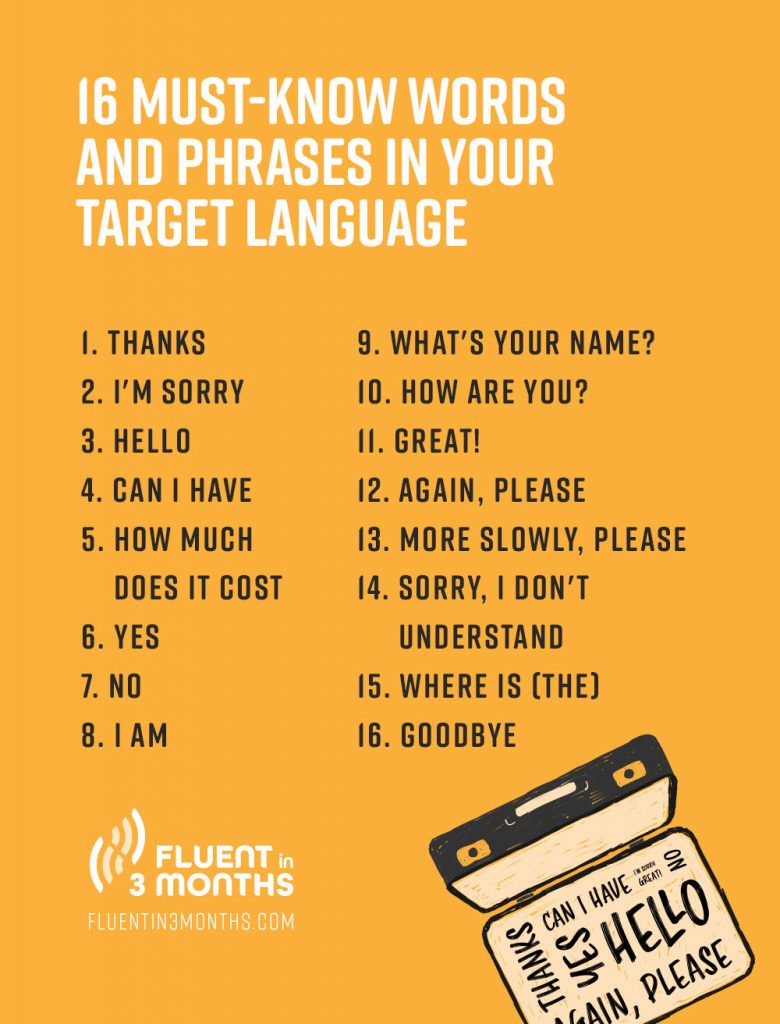
Keep the list on your phone, or use this infographic as a prompt. The image gives the English intentions; your job is to attach the forms used in your destination.
Ollie’s Full Email About Learning Vietnamese
Here is Ollie’s complete email from 6 December 2017. The wording is his; only the old editor’s visible <div> fragments have been removed.
Date: Wed, Dec 6, 2017
Subject: Trip to Vietnam, thank you!Hi Benny,
My names Ollie, I’m 17 years old and I live in London. (Thought I’d give you a bit of context as you must get emails from people all over the world!)
I was looking at your blog a few months ago to find out more about trying to learn Spanish when I came across your blog ‘16 Must-Know Words and Phrases For Any Language’. I thought it was a really handy list and told myself next time I go abroad I would learn those phrases. I then found out I would be going to Vietnam in the summer!! So I learnt the phrases in Vietnamese in the few weeks before my big trip and I was very excited to use all the phrases.
I really enjoyed learning the phrases so I bought a phrasebook for a fiver the day before my trip. On the plane journey there, our TVs weren’t working so I spent many hours of the journey creating new sentences and learning the original ones inside out. We finally arrived and my first words were a meek ‘Cam ern’ to the miserable, scary passport man. Even that gave me a kick and made me want more. When we arrived and put our bags down I ventured into the chaos of Hanoi, I had learnt how to say ‘how much is this?’ and all the numbers in Vietnamese, so I confidently asked a shopkeeper the question and she replied with what sounded like gibberish to me! She then said it in English and I felt like a right idiot, but I was ready to keep trying! I’m glad to say it only got better from there.
We had a trip to Halong Bay where I practiced my Vietnamese on our tour guide, he spoke English very well so helped me out a lot, he was extremely impressed and shocked that I had made the effort to learn some Vietnamese. I then spoke to a woman on the boat who couldn’t speak any English which was a challenge but I managed to converse a little. Again she was very impressed!
My best experience was with two men in Phong Nha Ke Bang National Park, we were queuing for a boat ride when I asked two men what their names were, they looked at each other in astonishment! They couldn’t believe what they were seeing, a white person speaking Vietnamese! They were smiling so much and we conversed for a few minutes, they then stuck to me for the entire trip! We weren’t even talking! Just walking next to me smiling. I got some photos with them as well!
My other memorable experience was with two little kids on a train to Hoi An, they were two really cute little twin boys who were giggling away and smiling at me, I then said something to them in Vietnamese and they started laughing and singing English songs they knew, we counted to ten in English and Vietnamese! I also talked to their mum for a while and it was all a lovely experience! Which I wouldn’t have had if it wasn’t for you.
I also found learning the phrases useful for conversing with other English speaking travellers, they are all very interested with the Vietnamese I’ve learnt and want to learn some themselves.
Sorry, I went on a bit but I hope you enjoy reading about my experience and I hope you know how grateful I am to you for writing your blog! It astounded me how much people appreciated me just learning a few words in Vietnamese.
Thanks again,
Ollie
A 10-Minute Practice Loop
Pick one situation for tomorrow, then choose three phrases you will need in it. Listen to each phrase, repeat it with the same rhythm, cover the text and say it from memory. Next, role-play the exchange and ask a speaker or tutor for one correction.
Write the corrected phrases in a note on your phone. Two days later, use the same three phrases with a different item, place or person. This small transfer step is what turns a memorised line into language you can retrieve.
If you want a structured runway to your first exchange, Conversation Countdown is built around preparing for and having that conversation. For language-specific dictionaries, audio and courses, start with the Fi3M learning resources.

Social