


83 British Slang Words and Phrases (with Regional Notes)

Full disclosure: This post contains affiliate links. ?
British slang can help you follow conversations and TV, but it won’t give you a “British accent” by itself. Accent is pronunciation; dialect also includes vocabulary and grammar.
As an American living in London, I’ve come across a lot of British slang. I knew some of it growing up (thanks, Harry Potter), but living here taught me how much depends on the speaker, the setting, and where you are.

The UK has many regional and social accents and dialects. A word that feels ordinary in one place may sound dated, playful, rude, or unfamiliar somewhere else. This list keeps those limits visible, and it also flags expressions that are widespread beyond the UK. For more on pronunciation and regional variation, see British dialects of the English language.
I’ve put these 83 words and phrases in alphabetical order. Read straight through, or jump to the one you’ve been trying to decode. At the end, I’ll explain how Cockney rhyming slang works.
A quick pronunciation note: the occasional IPA transcription uses a broad contemporary southern British reference accent. It is a guide, not a rule for the whole UK; Scottish, Welsh, Northern Irish, northern English, Midlands, London, and other accents can sound quite different.
Some entries are rude, vulgar, or can be slurs in another variety of English. I’ve marked those with §. Learn them for recognition before you decide whether they suit the company you’re in.
A note from the Fluent in 3 Months team before we get started: You can chat away with a native speaker for at least 15 minutes with the “Fluent in 3 Months” method. All it takes is 90 days. Tap this link to find out more.
A
- Alright: /ɔːlˈraɪt/ An informal greeting, often heard as “Alright?” or “You alright?” It does not automatically ask about your health, although tone and context can turn “Are you alright?” into a genuine question about your wellbeing. “Alright?” “Yeah, you?”
- Arse §: /ɑːs/ A rude word for someone’s bottom, or an insulting word for an unpleasant or foolish person. The closest US equivalent is ass. “Stop being such an arse!”
B
- Blimey: An informal, rather old-fashioned exclamation of surprise. “Blimey, did you see that?”
- Blinking: A mild, somewhat old-fashioned intensifier used instead of a stronger swear word. “Blinking heck, that was close!”
- Bloke: An informal word for a man. “That bloke over there has been staring at his pint for an hour.”
- Bloody §: An intensifier that can add annoyance or emphasis. How rude it sounds depends on the speaker and setting, so avoid assuming it is harmless everywhere. “It’s bloody cold today!”
- Bollocking §: /ˈbɒləkɪŋ/ A severe telling-off. “He got a bollocking from his boss.”
- Bollocks §: /ˈbɒləks/ Literally testicles; also a rude way to say “nonsense” or to express disbelief or frustration. “That’s a load of bollocks!”
- Brilliant: Excellent, or an enthusiastic response to good news. It is standard informal English rather than UK-only slang. The playful shortening brill is also heard. “She passed her driving test? Brilliant!”
- Bruv: An informal form of brother used to address a friend, especially in some London and youth speech. It is not a universal British substitute for mate. “You alright, bruv?”
- Bugger §: A potentially offensive word for a person or thing causing annoyance. “This little bugger won’t leave me alone!” Bugger off means “go away” and is ruder than a neutral request.
- Bugger all §: Absolutely nothing. “I did bugger all today.”
- Buzzing: Informal for very excited or pleased. “I’m buzzing for the concert tonight!” In North American English, buzzed can mean slightly drunk; that is a different use.
C
- Cheeky: Impudent or slightly disrespectful, often in an amusing or likeable way. Before a treat, it can make the plan sound spontaneous or mildly indulgent: “Fancy a cheeky pint after work?”
- Cheers: Said before drinking a toast, and informally used for “thanks” or “bye.” “I’m off. Cheers!”
- Chippy: A fish-and-chip shop. “I’m going to the chippy. Want anything?” In another context, chippy can also mean a carpenter.
- Chuffed: Very pleased or proud. “I’m chuffed with my exam results!”
- Come off it: An informal expression of disbelief or dismissal. “Come off it, you can’t be serious!”
- Crack on: To start or continue doing something, often promptly. “We need to crack on with this project.”
- Cracking: Informal for excellent. “That was a cracking goal!”
- Crikey: /ˈkraɪki/ An informal, old-fashioned exclamation of surprise. “Crikey, that was close!”
- Cuppa: /ˈkʌpə/ An informal “cup of,” usually a cup of tea when no drink is named. “Fancy a cuppa?”
D
- Daft: Informal for silly or foolish, often milder than a direct insult. “Don’t be daft!”
- Dead: An informal intensifier meaning “very” in some regional varieties, particularly in parts of northern England and the Midlands. “That’s dead useful.”
- Dodgy: Informal for suspicious, dishonest, unreliable, or poor quality. “That’s a dodgy-looking kebab van.”
F
- Faff: To spend too much time on unimportant details; also a noun for an unnecessary nuisance. “Stop faffing around and get to work!”
- Fag §: In informal UK usage, a cigarette. In North American English the same word is a homophobic slur, and it can still be heard as a slur in the UK, so context matters. “I’m stepping outside for a cigarette” is the safest international phrasing.
- Fancy: To want something, or to be romantically or sexually attracted to someone. “I fancy a bit of chocolate.”
- Fanny §: In British English, a vulgar word for female genitals; in American English, it can mean someone’s bottom. That difference is why the US term fanny pack is usually bum bag in the UK.
- Fit: Informal for sexually attractive. It can also keep its standard meaning of healthy or in good physical condition. “Did you see that fit bloke in the café?”
- Fiver: /ˈfaɪvə/ A £5 note or an amount of £5. “This whole meal only cost a fiver!”
- Fob off: To dismiss someone with an excuse, or persuade them to accept less than they wanted. The particle off is part of the usual phrase. “He tried to fob me off with a fake excuse.”
G
- Good fun: Enjoyable or entertaining. This ordinary phrase is common in the UK but not exclusive to it. “Going to the fair was good fun.”
- Good job: In it’s a good job…, “a fortunate thing.” “It’s a good job I remembered my keys.” This differs from praising someone with “Good job!”
- Grand: Fine, good, or satisfactory. This sense is especially characteristic of Irish English, and it is also heard in parts of Britain; it is not a pan-British default. “You’re coming home tomorrow? That’s grand.”
- Gutted: Extremely disappointed. “He was gutted when his team lost.”
H
- Heaving: Informal for extremely crowded. “The bar was absolutely heaving last night.” Other contexts can give heave its literal meanings of moving forcefully or retching.
- Hiya: An informal, friendly “hi.” It is common in the UK but not exclusive to it. “Hiya, you alright?”
- Hundred per cent: Completely, certainly, or “I agree.” It is widely used outside the UK too. You can hear the conversational form in “The Traitors,” including answers such as “Do you trust me?” “A hundred per cent.” Some speakers omit the a.
I
Innit: /ˈɪnɪt/ Historically a reduced form of isn’t it. In some contemporary dialects it also works as a general tag question after clauses where standard English would use a different tag. “She went to York last week, innit?” Usage varies by region, age, and social group, so do not treat it as a feature of every British speaker.
K
- Knackered §: /ˈnækəd/ Informal for very tired; it can also describe something broken or worn out. Some speakers consider it mildly rude. “After the marathon, I was completely knackered.”
- Knob §: A rude insult for an annoying or foolish person; it can also mean a penis. “Her boyfriend is such a knob.”
L
- Lads: Boys or men, often a group of male friends. Lad culture is a separate, usually critical expression for behaviour associated with heavy drinking, sport, and sexism; it does not describe every group called “the lads.” “The lads are going out tonight.”
- Loo: An informal word for a toilet or the room containing one. “Where are the loos?”
- Lot: A group of people or things. It can address or describe a mixed group, but it is not simply a grammatical replacement for guys. “This lot are coming to the party tonight.”
- Love: A friendly form of address heard in several regions, especially parts of northern England. Warmth, familiarity, age, gender, and tone all affect how it lands. “Here’s your coffee, love.”
- Lovely: Pleasant, excellent, or a warm response to good news. It is standard English, not uniquely British slang. “You’re free tonight? Lovely!”
- Lovely jubbly: A playful, dated-sounding expression of pleasure or approval. “Found £20 on the road. Lovely jubbly!”
- Lush: In informal UK usage, excellent or, of a person, attractive. The sense is strongly associated with Wales and parts of western England, though it is understood more widely. “We had a lush time.” A lush can separately mean someone who drinks too much.
M
- Mate: A friend, or an informal way to address someone. Depending on tone, “Listen, mate” can be warm, neutral, or confrontational. “Hey mate, can you lend me a quid?” Mates’ rates means a discount offered to friends.
N
- Naff: Informal for unfashionable, in poor taste, or not very good. “That hat is a bit naff, isn’t it?”
- Nick: Informal for steal. It can also mean arrest when the police are the subject. “My brother nicked a fiver straight from my pocket!”
O
- Oh my days: An informal expression of surprise or disbelief, similar to “Oh my gosh.” It is associated with younger and London-influenced speech but is not limited to one group. “Oh my days, did he really just say that?”
P
- Pants: In informal British English, very poor or disappointing: “The weather today is pants.” As a noun it usually means underpants, while American pants are British trousers.
- Pillock: A mild, somewhat dated insult meaning a foolish or annoying person. “You’re such a pillock.”
- Pint: In a pub context, a 568 ml serving of beer or another draught drink; go for a pint usually implies an alcoholic drink. “Fancy going for a pint after work?”
- Pissed §: In informal British English, drunk. In American English it usually means angry. “He got pissed at the party last night.”
- Plonker: A mild, dated or humorous insult meaning a foolish person. “Don’t be such a plonker!”
- Pong: An unpleasant smell; as a verb, to smell unpleasant. “There’s a pong coming from the kitchen.”
- Pop: To go somewhere briefly or quickly, normally with a following word such as in, out, or to. “I’m just going to pop to the loo, and then I’ll be ready.”
- Proper: In some informal and regional speech, an intensifier meaning “really” or “completely.” “He only had one pint, and now he’s proper pissed!” It is not used this way by every British speaker.
Q
Quid: /kwɪd/ An informal word for a pound sterling. The plural stays quid: “It cost me fifty quid.”
R
- Right: As an informal intensifier before a noun, “complete” or “considerable.” “Fixing the car was a right job.” The fixed phrase is not right job; the reusable pattern is a right + noun, as in a right mess.
- Row: /raʊ/ An argument. It rhymes with now, not slow. “They had a row about money.”
- Rubbish: Waste material; informally, something poor quality or a claim you think is nonsense. “Your argument is rubbish.”
- Rugger: /ˈrʌɡə/ An informal word for rugby. It can sound dated or facetious, so rugby is the safer everyday choice. “Are you watching the rugby today?”
S
- Shag §: A vulgar verb or noun for sex. “I heard they broke up but are still shagging.”
- Shattered: Informal for extremely tired: “You must be shattered after that long flight.” In another context it can mean deeply upset, so the surrounding sentence matters.
- Smash: Informal for doing something extremely well. This use is widespread beyond the UK. “You really smashed the presentation.”
- Snog: An informal British verb or noun for a passionate kiss. “I saw them snogging in the corner.”
- Sod off §: A rude way to tell someone to go away. “I’ve told you a million times to sod off!” Other rude expressions include sod it (“forget it”) and sod all (“nothing”).
- Soz: /sɒz/ A playful, very informal shortening of sorry, common in messages and sometimes speech. “Soz for being late.”
T
- Ta: An informal “thank you.” It is heard in several parts of the UK, not only northern England, and also occurs outside the UK. “Ta for the tea.”
- Take the piss §: A rude idiom. Take the piss out of someone means mock them; take the piss can mean behave unreasonably or exploit a situation. “He’s always taking the piss out of his friends.”
- Tenner: A £10 note or an amount of £10. “A pint cost me a tenner in that pub!”
- Tipple: A usually alcoholic drink, often said humorously, or someone’s habitual choice of drink. “Care for a tipple?”
- Tosser §: A rude insult for an annoying or foolish person. It can be aimed at anyone, although it is often directed at men. “Don’t be such a tosser.”
- Tuck in: To begin eating eagerly; tuck into takes the food as its object. “Let’s tuck into this meal.”
U
- Uni: Informal for university. “She’s starting uni next month.” In the UK, college can mean a place for post-16 or vocational study, a specialist institution, or a constituent part of a university, so it is not simply an earlier level of schooling.
W
- Wanker §: A strong insult for a contemptible or foolish person; literally, someone who masturbates. “He’s a complete wanker.” Keep it out of polite or professional settings.
- Wee: Small or a small amount, especially in Scottish and Irish English, including Northern Irish usage. “Could I have a wee bit more sugar in my tea?” As a noun or verb, it can also mean urine or urinating.
- Wicked: Informal for excellent or impressive, a sense also found outside the UK. “He’s wicked at football.” The standard adjective still means morally bad.
X
- X: A written kiss, often added to the end of a message. It can be friendly, familial, or romantic, and people differ widely in how many they use and what they imply. “Hope to catch up soon x”
Cockney rhyming slang
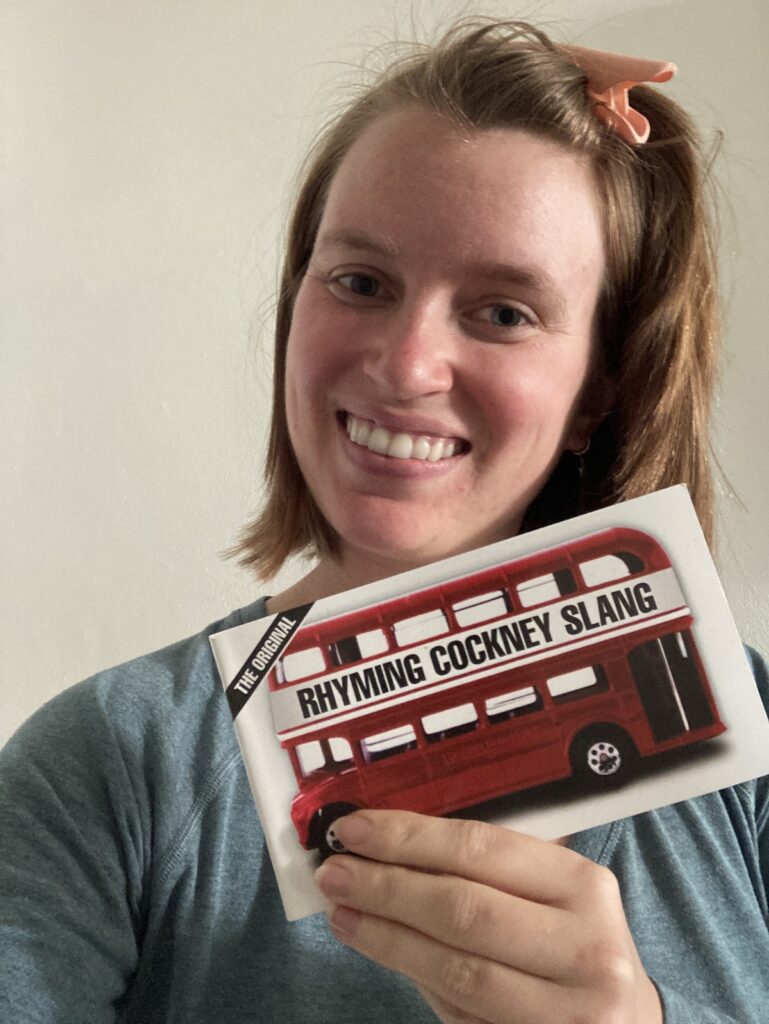
Cockney rhyming slang is much more than a list of funny substitutions, and it is not a British version of Pig Latin. It is a vocabulary tradition associated with Cockney and London speech, although some expressions have travelled far beyond the East End.
The usual pattern replaces a word with a rhyming phrase. Speakers may then drop the part that carries the rhyme, which hides the connection from anyone who does not know it. The tradition is well attested in nineteenth-century London, but claims that it was invented specifically to fool police, customers, or other eavesdroppers are theories rather than settled fact.
For example, loaf of bread rhymes with head, so “Use your loaf” means “Use your head.”
Another familiar example is apples and pears for stairs. A speaker may shorten that to apples: “I’m going up the apples.” The shortened form only works when the listener already knows the rhyme.
My housemate gave me a glossary when she learned I was writing this article. That was useful because rhyming slang is creative, changes over time, and is not a code that every Londoner speaks or understands in the same way.
Crack on with British Slang
Now you can recognise 83 words and phrases used in British English without assuming that every speaker in the UK uses them. Listen for the region, relationship, and setting as well as the dictionary meaning. Save the expressions you want to remember in Vocab Vault, or learn even more British slang. Then crack on!

Social